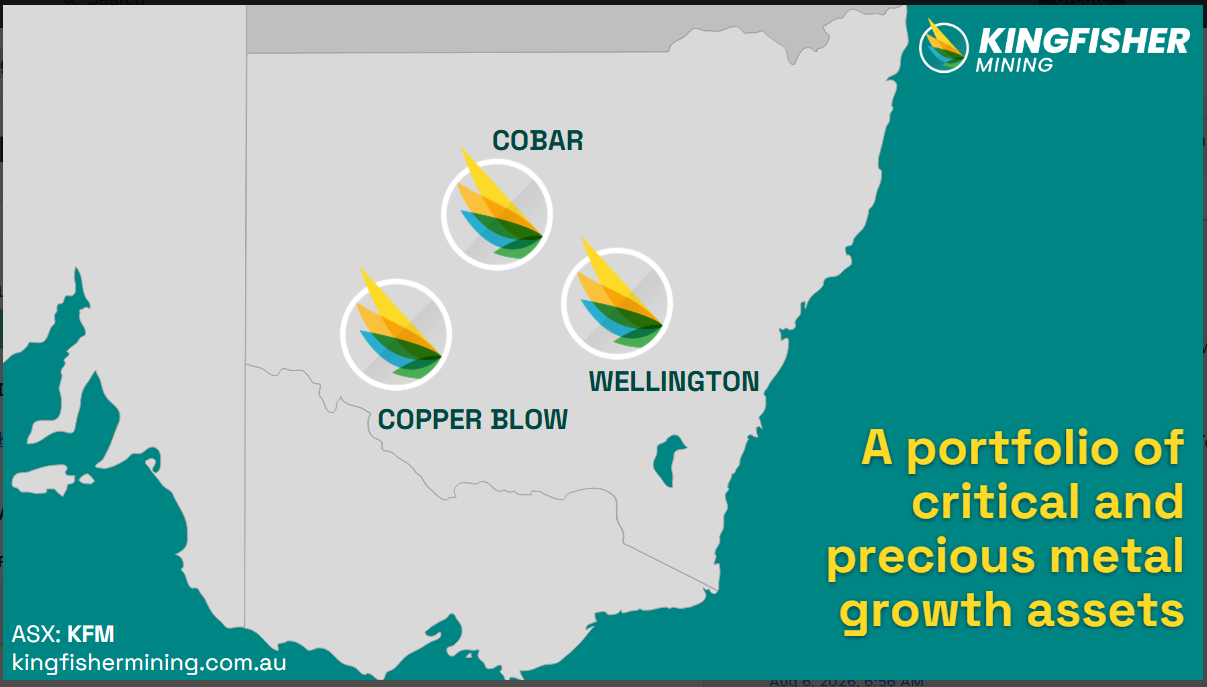
Kingfisher Mining Ltd (ASX:KFM) has reshaped its exploration portfolio around three established New South Wales mining districts, with the Copper Blow Copper-Gold Project near Broken Hill providing the most advanced project in a wider group of copper, gold, silver, lead and zinc assets.
The company has acquired 11 New South Wales licences, including nine in the Broken Hill region and one each in the Wellington and Cobar districts, making 2026 a milestone year for the company.
Kingfisher subsequently divested its Gascoyne rare earth projects in Western Australia, completing the transaction in March 2026 as it concentrated its activities on the New South Wales portfolio.
Managing director Chris Bittar described the change to Proactive as "a pretty transformative period for the company".
Kingfisher has since completed drilling across Copper Blow, Stephens Trig and Allendale, signed a mining and processing cooperation agreement with Broken Hill Mines and set out a program aimed at delivering a maiden mineral resource estimate for Copper Blow by the end of 2026.
A Broken Hill portfolio close to existing infrastructure
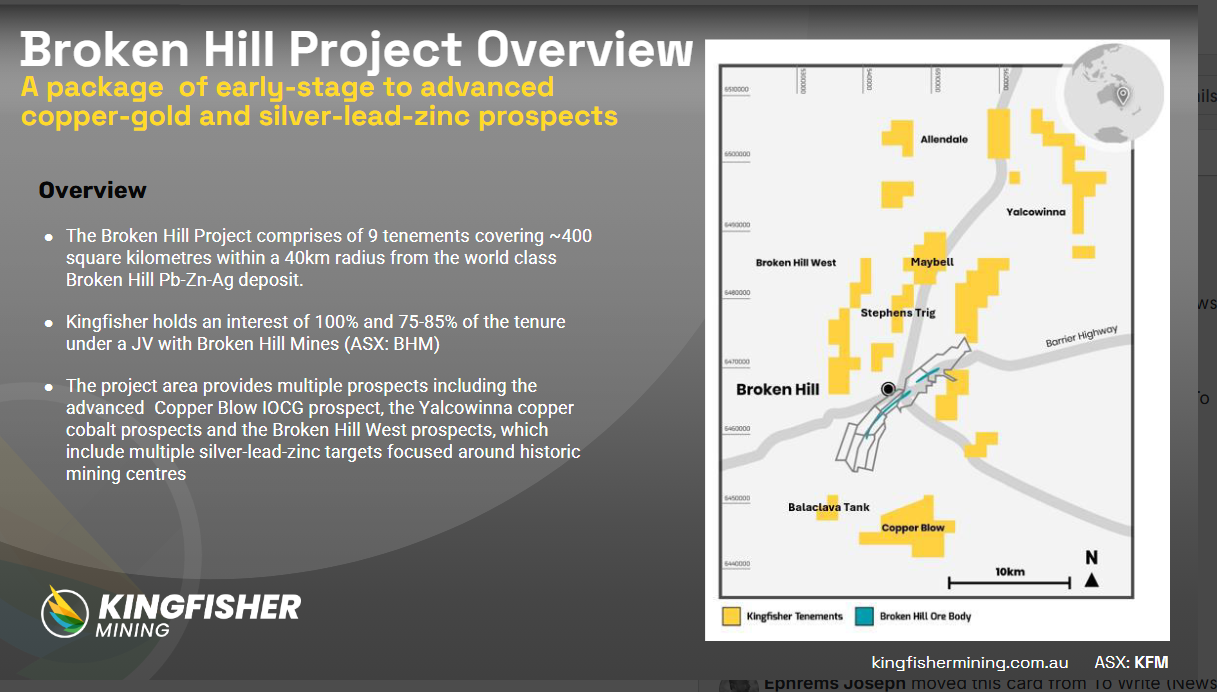
Kingfisher's Broken Hill Project comprises nine tenements covering about 400 square kilometres within a 40-kilometre radius of the city. The package ranges from the advanced Copper Blow iron oxide copper-gold system south of Broken Hill to silver-lead-zinc prospects associated with historic mining centres to the north and copper-cobalt targets at Yalcowinna in the northeast.
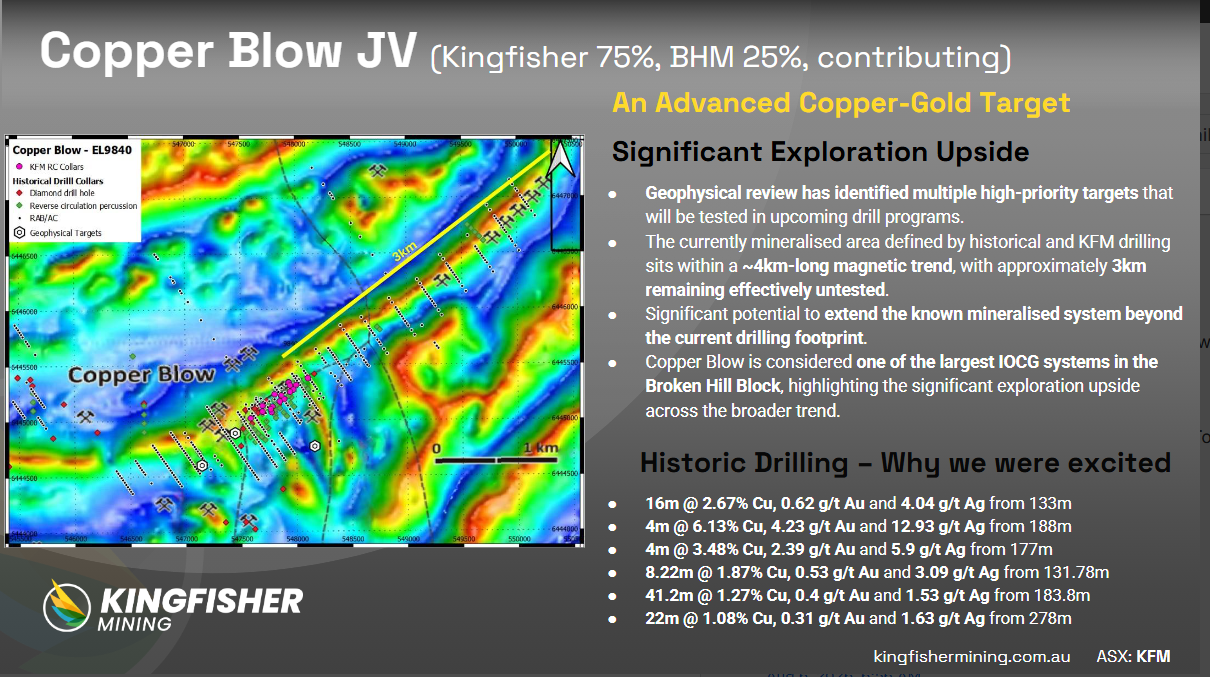
Copper Blow is about 20 kilometres southeast of Broken Hill and is held through a joint venture in which Kingfisher owns 75% and Broken Hill Mines holds a 25% contributing interest. The project has been explored by several groups over more than a decade, providing Kingfisher with a historical drilling database that it is supplementing with new infill and extensional work.
North of the city, the Broken Hill West group includes Allendale, Stephens Trig, Maybell and Parnell. The Yalcowinna area extends across more than 25 kilometres of prospective strike and contains historical copper and copper-cobalt occurrences, old workings and gossans, with much of the previous drilling limited to shallow rotary air blast programs.
Copper Blow becomes the anchor project
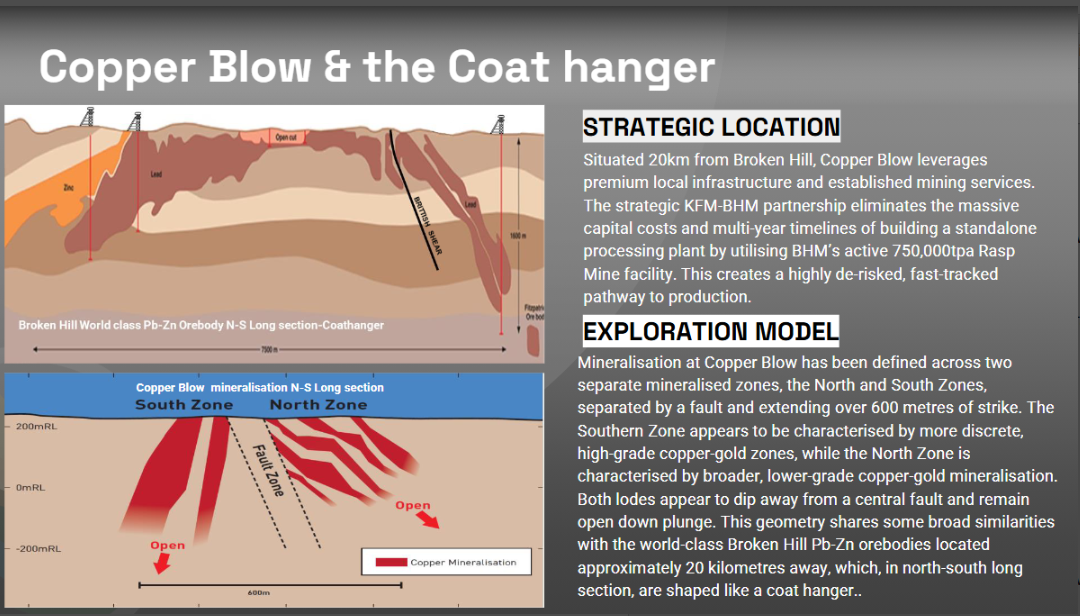
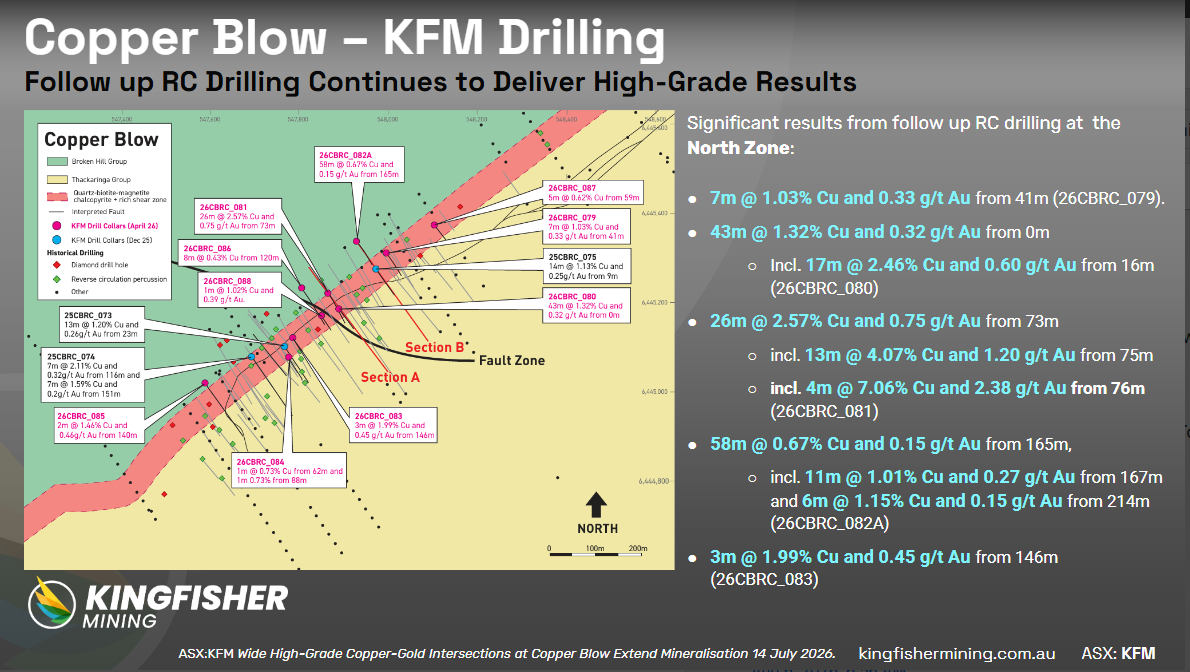
Copper Blow contains North and South mineralised zones separated by a fault and extending across more than 600 metres of strike.
Kingfisher's interpretation describes broader, lower-grade copper-gold mineralisation in the North Zone and more discrete high-grade copper-gold zones in the South Zone.
Both lodes appear to dip away from a central fault and remain open down-plunge.
Importantly, historical drilling established the basis for the company's renewed work.
Results included 16 metres at 2.67% copper, 0.62 g/t gold and 4.04 g/t silver from 133 metres; 4 metres at 6.13% copper, 4.23 g/t gold and 12.93 g/t silver from 188 metres; 8.22 metres at 1.87% copper, 0.53 g/t gold and 3.09 g/t silver from 131.78 metres; and 41.2 metres at 1.27% copper, 0.40 g/t gold and 1.53 g/t silver from 183.8 metres.
Kingfisher completed its first post-acquisition drilling at Copper Blow in early 2026, returning high-grade copper-gold intersections in the first drilling undertaken at the project in seven years.
A follow-up campaign then added 10 reverse-circulation holes for 1,576 metres during the June quarter, taking the company's total at Copper Blow to 16 holes for 2,506 metres.

Broad North Zone intersections add to the geological picture
The follow-up program returned 26 metres at 2.57% copper and 0.75 g/t gold from 73 metres, including 13 metres at 4.07% copper and 1.20 g/t gold from 75 metres and 4 metres at 7.06% copper and 2.38 g/t gold from 76 metres.
Another hole intersected 43 metres at 1.32% copper and 0.32 g/t gold from surface, including 17 metres at 2.46% copper and 0.60 g/t gold from 16 metres.
A deeper result returned 58 metres at 0.67% copper and 0.15 g/t gold from 165 metres, including 11 metres at 1.01% copper and 0.27 g/t gold from 167 metres and 6 metres at 1.15% copper and 0.15 g/t gold from 214 metres. Further results included 7 metres at 1.03% copper and 0.33 g/t gold from 41 metres and 3 metres at 1.99% copper and 0.45 g/t gold from 146 metres.
Bittar added that the company was "very excited and very encouraged" by the results and pointed to the width, shallow position and continuity of the mineralised zones.
The drilled mineralised area sits within an approximately 4-kilometre magnetic trend, leaving about 3 kilometres effectively untested. Geophysical work has also identified targets outside the current mineralised envelope. Kingfisher plans further reverse-circulation and diamond drilling, with diamond core to support geological interpretation and metallurgical testing across oxide, transitional and sulphide material.
Rasp agreement links the portfolio to a regional processing hub
The proximity of Kingfisher's Broken Hill projects to established mining infrastructure became a formal part of the company's strategy in March 2026, when Kingfisher and Broken Hill Mines entered a legally binding mining and processing cooperation agreement.
The agreement establishes a framework under which ore from Kingfisher's Broken Hill tenements could be mined and processed at Broken Hill Mines' 100%-owned Rasp Mine processing plant. The plant has a nameplate capacity of 750,000 tonnes per annum and sits within about 40 kilometres of Kingfisher's Broken Hill project areas.
Furthermore, the parties may negotiate project-specific commercial arrangements if a project advances, including toll treatment, joint ventures or mine-gate ore sales. Bittar described the agreement as "the backbone" of Copper Blow and said access to existing infrastructure provided a potential lower-capital route to production.
Broken Hill Mines is also Kingfisher's contributing joint venture partner at Copper Blow. Its wider operations are organised around the Rasp plant and a multi-source production strategy in the Broken Hill district, including ore from the Pinnacles Mine southwest of the city.
Satellite drilling builds out the Broken Hill pipeline
Kingfisher's June quarter program extended beyond Copper Blow, with the company completing 24 reverse-circulation holes for 2,962 metres across 3 project areas.
At Stephens Trig, 5 holes for 584 metres tested a 1.5-kilometre lead-zinc geochemical anomaly beneath alluvial cover. The program was designed to validate historical drilling and provide further geological information across an underexplored mineralised system.
At Allendale, 9 holes for 802 metres targeted extensions to historical silver-lead-zinc mineralisation across a prospective 2.5-kilometre strike. Historical results included 10 metres at 16.1% combined lead and zinc and 29 g/t silver from 15 metres, 2 metres at 19.9% combined lead and zinc and 39.2 g/t silver from 47 metres, and 2 metres at 13.8% combined lead and zinc and 51.1 g/t silver from 117 metres.
Samples from Stephens Trig and Allendale had been submitted for laboratory analysis at the time of the June quarter report, with results scheduled for August in the company's July presentation.
Wellington and Cobar add further district exposure
Outside Broken Hill, Kingfisher's 100%-owned Wellington Copper-Gold Project lies in the Macquarie Arc. Its principal target is Willunga, where historical work outlined a coherent 1.2-kilometre copper-in-soil anomaly with peak values of up to 2,000 ppm copper.
Willunga is 15 kilometres south of the Boda-Kaiser porphyry copper-gold deposits and has been tested by 2 historical diamond holes completed in 1967. Kingfisher planned an airborne geophysical survey to refine targets, although Proactive reported that technical issues with unmanned aerial vehicle equipment delayed the work during the June quarter.
The Tindery Gold Project is 45 kilometres north of Cobar and includes several faults considered prospective for gold mineralisation. Historical workings are present at Golconda, where samples from old mine dumps returned grades of up to 2.5 g/t gold. The prospect has not been drilled.
Corporate position
Kingfisher ended the June quarter with A$1.157 million in cash. Including listed investments in Black Cat Syndicate and Dreadnought Resources, cash and investments were valued at about A$2.486 million at 30 June 2026. Exploration and evaluation expenditure for the quarter was A$409,000.
The company has 104.07 million shares on issue, along with 34.5 million options and performance rights, and no debt.
At a share price of A$0.073 on 11 August 2026, the company has a market capitalisation of approximately A$7.6 million and, based on A$2.49 million in cash and investments at 30 June 2026, an enterprise value of about A$5.1 million.
2026 work program
Kingfisher Mining plans to advance Copper Blow through:
- reverse-circulation and diamond drilling,
- geological modelling; and
- metallurgical test work.
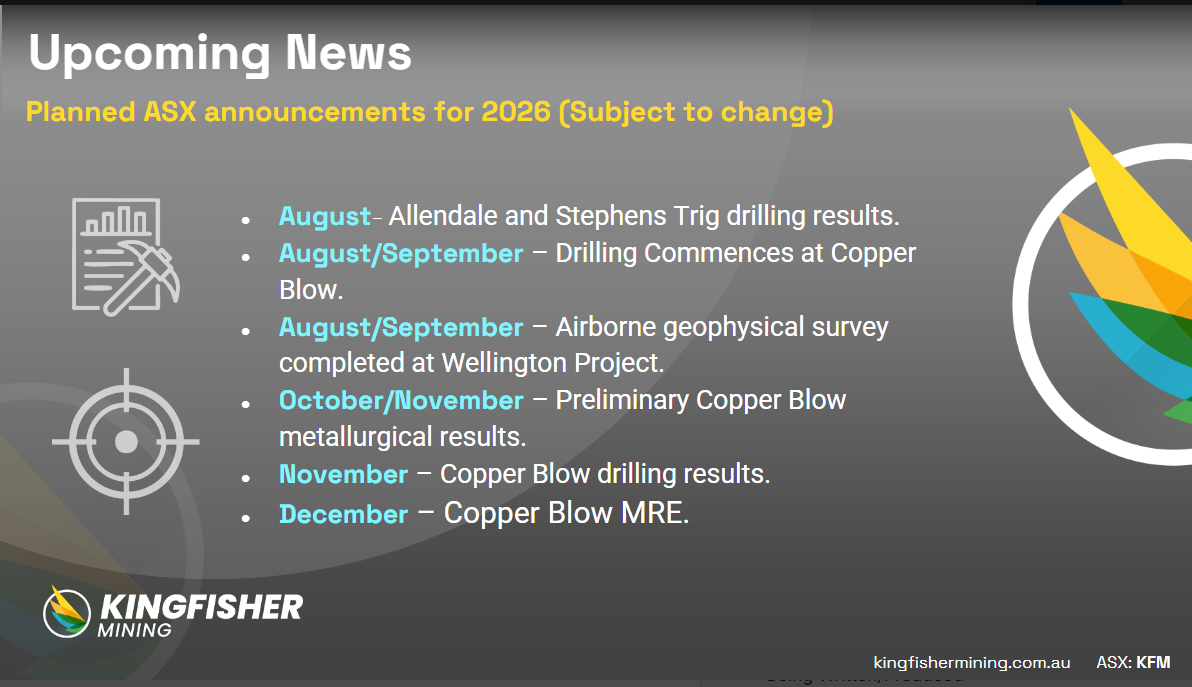
This will set the stage for Copper Blow's maiden mineral resource estimate targeted for December 2026.
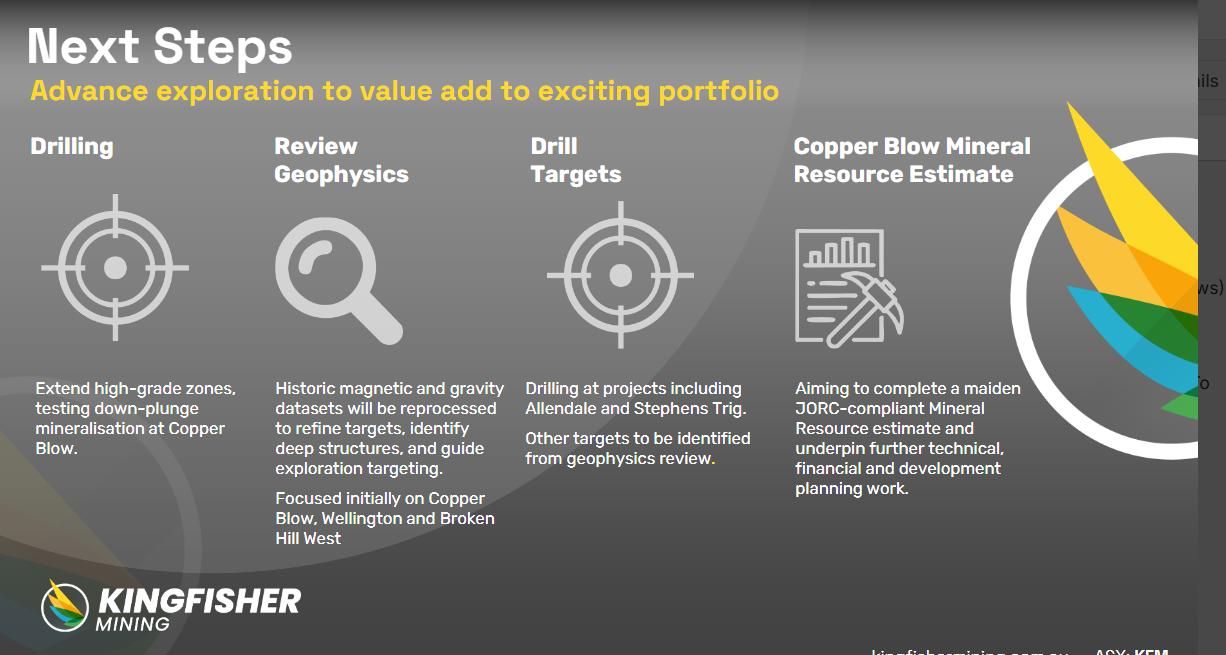
Meanwhile, Allendale and Stephens Trig assay results are scheduled for August 2026.
In addition, the delayed Wellington airborne survey is expected in August or September.
Preliminary Copper Blow metallurgical results are planned for October or November, followed by further drilling results in November.