
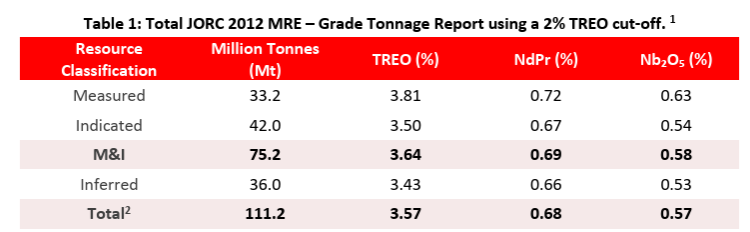
St George Mining Ltd (ASX:SGQ, FRA:S0G, OTC:SGQMF) has increased the Mineral Resource Estimate at its 100%-owned Araxá Project in Brazil by 57% to 111.2 million tonnes at 3.57% TREO and 0.57% Nb₂O₅, further expanding what the company says is the largest and highest-grade hard-rock rare earths resource in South America.
The upgrade also establishes Araxá as hosting the world’s largest undeveloped Measured niobium resource, while Measured and Indicated resources have increased 155% to 75.2 million tonnes at 3.64% TREO, 0.69% NdPr and 0.58% Nb₂O₅.
The updated MRE contains 3.98 million tonnes of TREO, including 760,000 tonnes of NdPr oxides, alongside 630,000 tonnes of Nb₂O₅
The new resource contains an estimated 3.98 million tonnes of TREO, including 760,000 tonnes of NdPr oxides, together with 630,000 tonnes of Nb₂O₅.
Higher-confidence resource supports development studies
The higher proportion of Measured and Indicated material is expected to support metallurgical test work, pilot plant programs, mine planning and economic studies as St George progresses development options for Araxá.
Measured and Indicated resources contain around 520,000 tonnes of NdPr oxides and 440,000 tonnes of Nb₂O₅.
The MRE also includes a higher-grade subset containing 830,000 tonnes of TREO at grades above 6.29% and 120,000 tonnes of Nb₂O₅ at grades above 0.90%, potentially providing flexibility to target higher-grade mineralisation during the early years of a future mining operation.
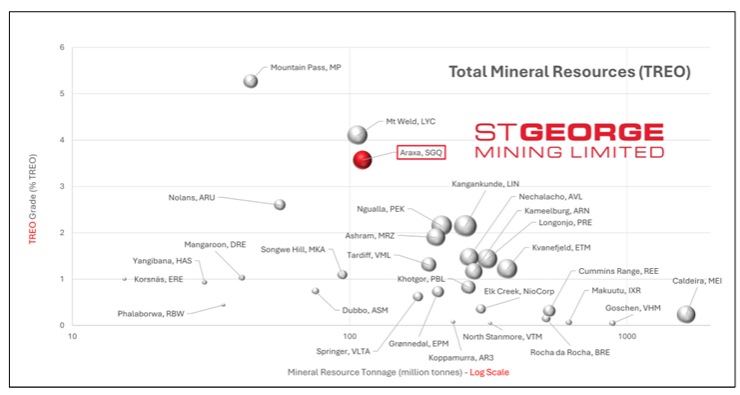
Comparison of rare earth deposits based on mineral tonnage. Source: Terra Studio .
Executive chair John Prineas said the upgrade strengthened the scale and quality of the Araxá resource and its position among major hard-rock rare earths deposits.
"Our Araxá MRE now compares even more favourably in scale and grade to the two largest producing rare earths mines outside of China – the Mountain Pass mine of MP Materials (NYSE: MP) and the Mt Weld mine of Lynas Rare Earths (ASX: LYC) – both of which have the same carbonatite-hosted style of mineralisation as our Araxá deposit," he stated.
A key feature of the deposit is its near-surface mineralisation. The company reported that all of the resource within the upper 120 metres is hosted within the weathered profile, which it considers potentially amenable to open-pit mining. Mineralisation remains open in all directions and at depth.
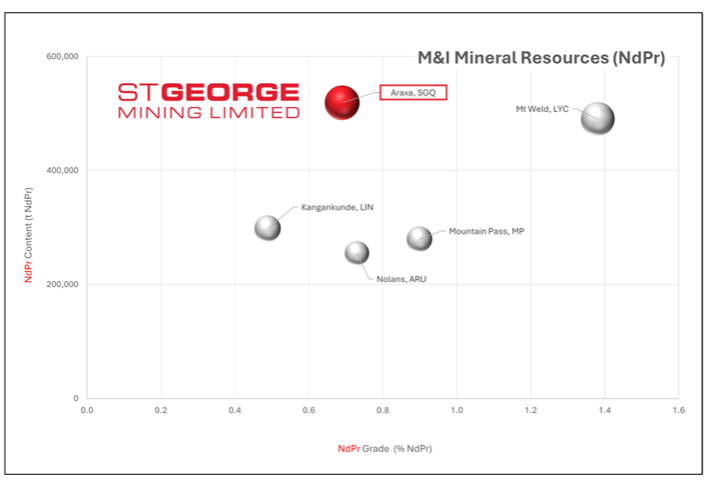
Comparison of contained NdPr oxides and grade within Measured & Indicated resources data of major hard-rock deposits in production or development. Source: Terra Studio.
About the Araxá Project
The Araxá Project is a 100%-owned rare earths and niobium project in Minas Gerais, Brazil, about 5 kilometres from the city of Araxá and within one of the world’s most established niobium-producing districts.
The project is supported by existing infrastructure, an experienced mining workforce and a long history of commercial mining in the region.
Araxá is hosted within the Barreiro Carbonatite Intrusive Complex, the same broad style of carbonatite-hosted mineralisation associated with major rare earths deposits such as Mountain Pass and Mt Weld. Mineralisation at Araxá includes niobium-bearing pyrochlore and rare earth-bearing monazite, with weathering and residual enrichment concentrating mineralisation through the near-surface saprolite profile.
Next steps
St George is continuing drilling at East Araxá with the aim of completing a maiden MRE in Q4 2026, subject to drilling, assay turnaround and geological modelling.
In parallel, the company is advancing metallurgical test work, pilot plant programs, mine planning and economic studies on the main Araxá deposit, supported by the increased proportion of Measured and Indicated resources.