
St George Mining Ltd (ASX:SGQ, OTC:SGQMF) has recorded its strongest drilling results to date from the Araxá Rare Earths and Niobium Project in Brazil, including a record 207-metre mineralised intercept from surface and individual grades of up to 30.3% total rare earth oxides (TREO).
Assays from 37 diamond drill holes confirmed extensive, thick, and high-grade rare-earth and niobium mineralisation within the weathered profile, strengthening the potential for a large-scale, low-strip open-pit development.
The results will be incorporated into an updated mineral resource estimate scheduled for completion during the current quarter, before feeding into economic and development studies.
Furthermore, the company has secured A$60 million to fast-track the project via a two-tranche placement.
Record rare earths results from surface
The standout rare earths result came from hole AXDD142, which intersected 207 metres at 2.60% TREO from surface, including 45 metres at 4.68% TREO.
Other significant intercepts included:
- 135.1 metres at 4.86% TREO from surface in AXDD166, including 69 metres at 7.33% TREO and 20 metres at 12.65% TREO;
- 150.5 metres at 3.66% TREO from surface in AXDD165, including 67 metres at 5.46% TREO;
- 150.2 metres at 3.49% TREO from surface in AXDD167, including 104 metres at 4.25% TREO and 13.25 metres at 8.08% TREO; and
- 100.6 metres at 4.39% TREO from surface in AXDD155, including 25.2 metres at 6.21% TREO.
A peak interval in AXDD166 returned 1.25 metres at 30.3% TREO from 11 metres, demonstrating the presence of very high-grade mineralisation close to surface.
St George said the continuity, thickness and grade of the intersections supported the potential for high-grade material to be accessed during the initial years of a possible mining operation.
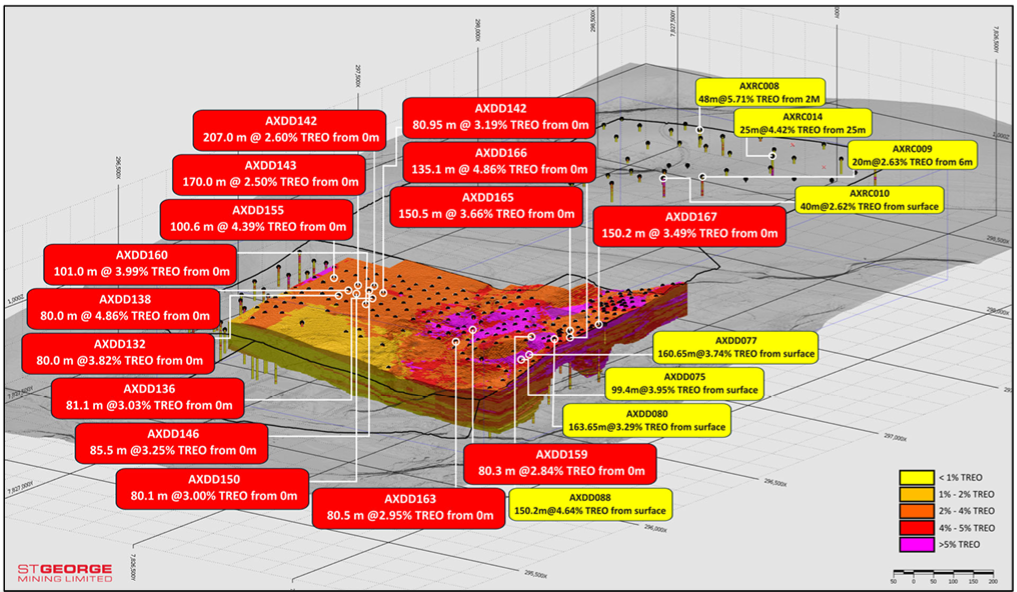
Oblique section showing some of the latest diamond drill holes as well as other significant drilling completed in the current campaign, set against the current 3D model of the MRE. The latest drill holes are shown with red labels.
Broad niobium mineralisation strengthens dual-commodity case
The drilling also confirmed extensive niobium mineralisation, reinforcing Araxá’s potential as a dual rare earths and niobium development.
Key niobium results included:
- 150.2 metres at 0.72% niobium pentoxide (Nb₂O₅) from surface, including 19 metres at 1.32% Nb₂O₅.
- 150.5 metres at 0.70% Nb₂O₅ from surface, including 53 metres at 1.21% Nb₂O₅ and 5.6 metres at 2.09% Nb₂O₅.
The Araxá Project lies within the Barreiro Carbonatite, adjacent to the operations of CBMM, the world’s leading niobium producer.
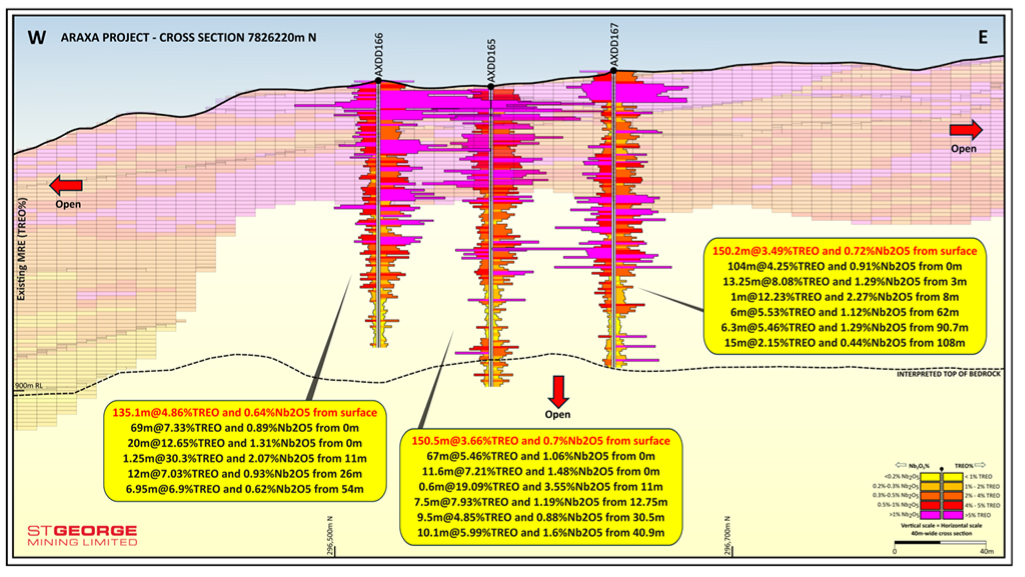
section A – A’ showing high-grade TREO intercepts (cut-off 1% TREO) and high-grade Nb2O5 intercepts (cut-off 0.2% Nb2O5) along with the existing MRE outline, showing both in-fill drilling and the expansion of the existing MRE at depth.
Mineralisation extends beyond current resource
Six of the 37 reported holes were drilled outside the existing mineral resource footprint, extending known mineralisation by as much as 140 metres to the north.
A further 13 holes intersected high-grade mineralisation below the current modelled resource depth, indicating potential for further expansion at depth.
Much of the resource definition drilling was completed on 40-metre spacing, which the company expects will support conversion into higher-confidence resource categories and assist future mine scheduling.
St George executive chair John Prineas said the results highlighted the volume of mineralisation and the potential development advantages associated with mineralisation beginning directly at surface.
“We can get into high-grade material directly from surface, which speaks to the very significant commercial advantage we have – both in cost and speed to development,” he said.
Next steps
St George will incorporate the latest assays into an updated mineral resource estimate, expected in the coming weeks.
The upgraded resource will support ongoing economic studies assessing a potential open-pit development, with further study outcomes expected during the remainder of 2026.
About St George Mining
St George Mining is an Australian critical minerals explorer and developer focused on the 100%-owned Araxá Rare Earths and Niobium Project in Minas Gerais, Brazil.
The company describes Araxá as the largest and highest-grade carbonatite-hosted rare earths resource in South America, with additional development exposure to niobium, a critical metal used in high-strength steels and advanced technologies.