
St George Mining Ltd (ASX:SGQ, FRA:S0G, OTC:SGQMF) has reported strong initial metallurgical testwork results from its Araxá Niobium and Rare Earth Project in Brazil, with flotation beneficiation producing separate high-grade niobium and rare earth concentrate streams from near-surface mineralisation.
The results are an important step for St George in demonstrating the project's potential to support a dual-commodity operation capable of producing both niobium and rare earth products from the same ore source.
High-grade niobium concentrate achieved
Initial open-circuit flotation testwork on approximately 5 tonnes of near-surface saprolite material produced niobium concentrates grading up to 40.2% Nb₂O₅.
The best results returned a 39.6% Nb₂O₅ concentrate at 54.3% flotation recovery and a 40.2% Nb₂O₅ concentrate at 46.0% recovery. Including a preceding magnetic separation stage, overall niobium recovery reached about 50.9%.
These grades and recoveries are comparable with existing operations processing Araxá-style pyrochlore-hosted niobium deposits, where flotation recoveries typically range between 40% and 60%.
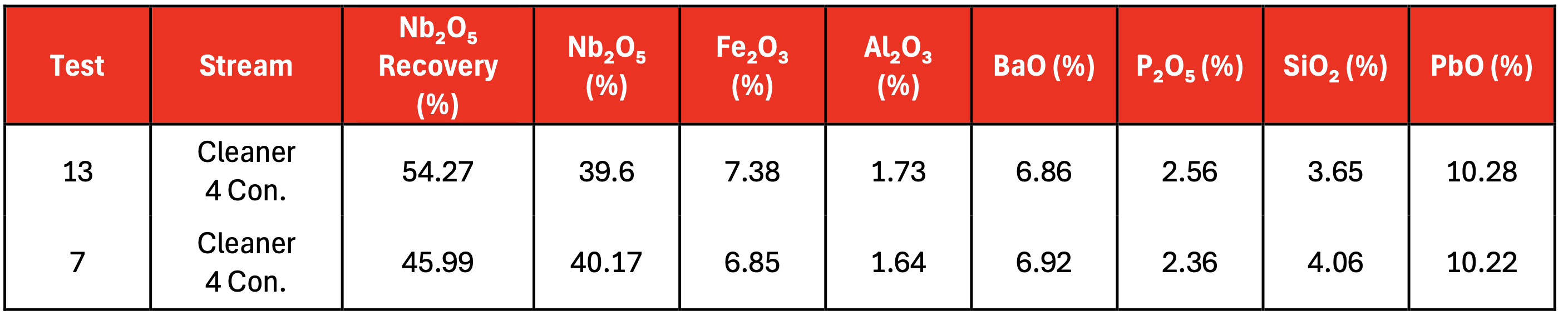
CIT-SENAI Flotation Results for Niobium.
Executive chairman John Prineas said the results supported the potential for commercial production of both niobium and rare earth products from Araxá.
“Our Araxá Project hosts world-class resources for each of niobium and rare earths – something which is unique amongst our critical metals peers. Our aim is to capture the full value of this mineralisation by producing commercial products of both niobium and rare earths in a potential mine development at Araxá.
“The initial flotation results are very encouraging for our dual commodity approach as they support the potential to produce commercial niobium and rare earths products from the Araxá mineralisation. This represents an important milestone for the project.
“High-grade niobium concentrate was produced in this early-stage flotation testwork with recoveries and grades that are consistent with niobium mining operations with Araxá-style pyrochlore mineralisation.
“In addition, the open circuit beneficiation testwork demonstrated the potential to upgrade rare earth concentrate in the niobium flotation tailings.
“The testwork was completed on five tonnes of near-surface material likely to be the kind of ore mined in the initial years of a mining operation at Araxá, thereby providing a robust result for development study work.
“We are particularly pleased to have assembled a Brazilian and Australian technical team with extensive practical experience in both niobium and rare earths process development and\ operation, including previous experience at Araxá niobium operations along with Brazilian and international rare earths projects.
“Further work is now underway to optimise flotation performance, evaluate locked-cycle operation and assess downstream refining pathways.”
Rare earth upgrade supports dual-processing strategy
The company also reported encouraging rare earth beneficiation outcomes from material remaining after niobium flotation.
Rare earth flotation testwork produced a concentrate grading 15.7% total rare earth oxides (TREO), representing a 1.6-times upgrade from the original feed grade of 9.8% TREO. The concentrate was recovered from niobium flotation tailings, supporting the flowsheet being developed to extract value from both commodities.
The testwork indicated that around 82% of rare earths were recovered through the combined process, with further locked-cycle testing expected to improve recoveries and better define final product specifications.
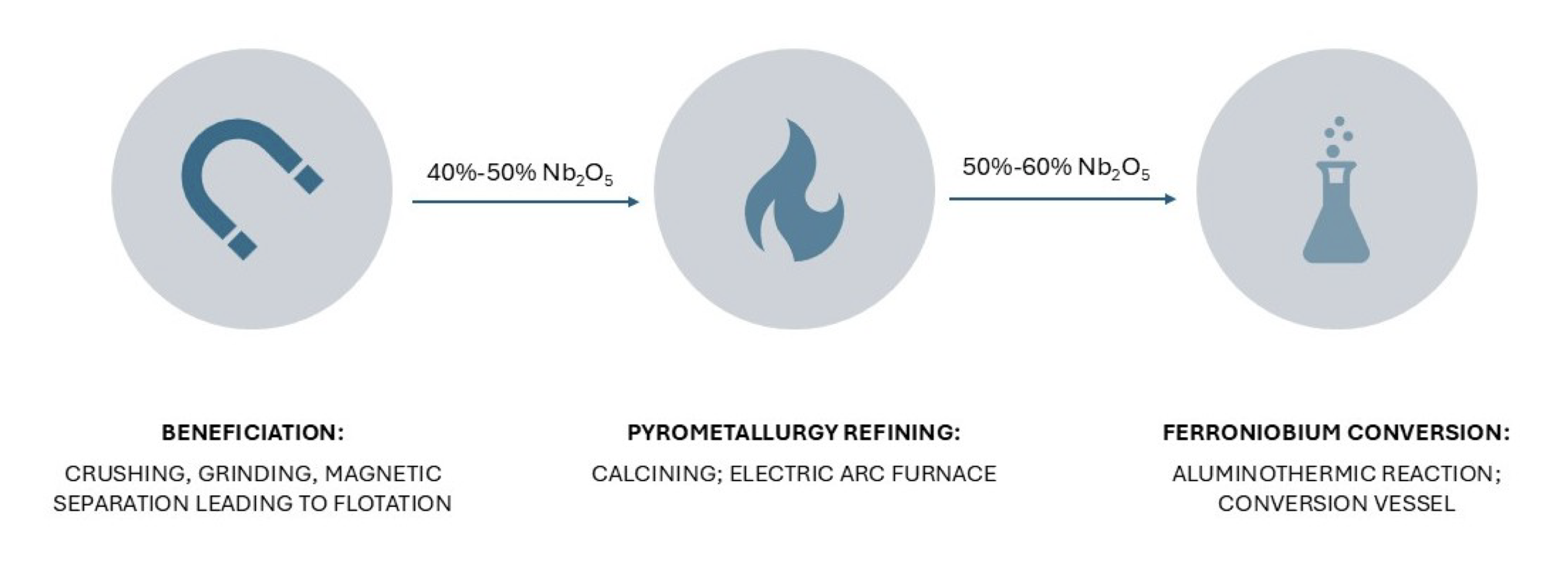
Simplified process flowsheet for niobium production from Araxá-style pyrochlore with typical grades achieved.
Testwork based on representative mine feed
The metallurgical program utilised approximately 5 tonnes of saprolite collected from a shallow trench within the Central Araxá area. The sample, taken from between 1 and 3 metres depth, averaged 0.69% Nb₂O₅ and 9.29% TREO.
The material is considered representative of the near-surface ore likely to be mined during the early years of a future operation, providing a realistic assessment of processing performance and development potential.
The Araxá project hosts a globally significant resource comprising 70.91 million tonnes grading 4.06% TREO and 0.62% Nb₂O₅, with an additional 24.56 million tonnes grading 0.52% Nb₂O₅ outside the rare earth resource envelope.
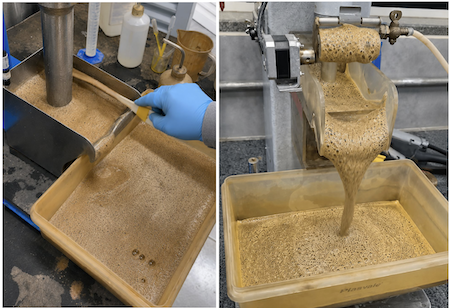
Niobium flotation by CIT-SENAI. On left: niobium flotation (second cleaner stage). On right: niobium flotation (third and last cleaner stage – the more yellow colour reflects cleaner material).
Next phase focused on optimisation and pilot-scale studies
With the initial beneficiation stage completed, St George has moved into the next phase of metallurgical development aimed at improving recoveries and refining the processing flowsheet.
Locked-cycle and recycle flotation testwork is underway at laboratories in Brazil and Canada, while additional studies will examine comminution, flotation variability, concentrate refining and ferroniobium production pathways.
CIT-SENAI is scheduled to undertake a one-month pilot-scale niobium flotation program in July 2026. Meanwhile, St George's larger pilot plant under construction at CEFET-MG in Araxá is expected to commence operations in late Q4 2026. The facility will be capable of producing niobium concentrate, ferroniobium, mixed rare earth carbonate and rare earth oxides.
The upcoming pilot-scale work is expected to provide key data for process optimisation and future development studies as the company advances Araxá towards potential commercial production.