
Astral Resources NL (ASX:AAR) has delivered broad, high-grade gold intersections from deep drilling at the Theia deposit, strengthening the case for a material resource expansion at its 100%-owned Mandilla Gold Project near Kalgoorlie in Western Australia.
Results from drill holes AMRCD260 and AMRCD261 intersected mineralisation both within and beyond the April 2026 resource shell, including zones extending as much as 250 metres below the current model.
The results form part of an expanded 12-hole, 7,500-metre diamond drilling program targeting the broader scale and depth potential of the cornerstone 1.4-million-ounce Theia deposit. Nine holes have now been completed.
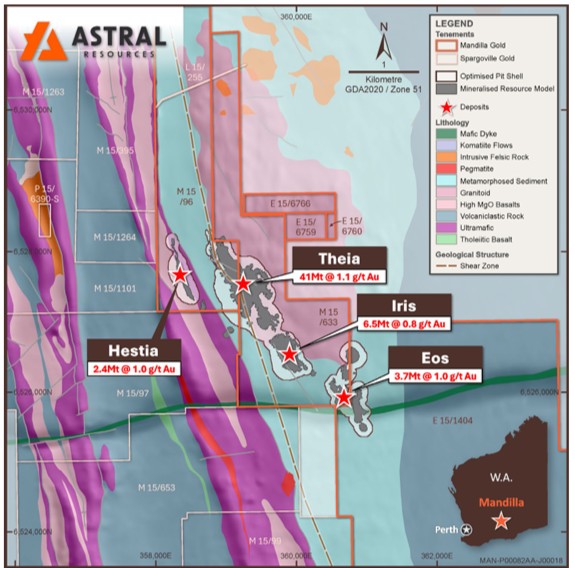
Map of Mandilla Gold Project on local area geology.
Broad zones extend mineralisation at depth
AMRCD260 returned a standout intersection of 52.60 metres at 1.48 g/t gold from 389.4 metres, including several narrow high-grade zones grading up to 18.3 g/t.
Deeper in the same hole, drilling intersected 7 metres at 5.22 g/t gold from 583 metres, including 0.3 metres at 114.7 g/t, followed by 43.86 metres at 0.87 g/t from 605 metres.
Additional results included 16.52 metres at 1.54 g/t gold from 272.48 metres and 17 metres at 0.65 g/t from 295 metres.
The shallower 52.60-metre interval correlated well with the existing inferred resource, while the deeper intersections demonstrated the potential for mineralisation to continue substantially below the current resource boundary.
High-grade zone identified outside resource shell
AMRCD261 delivered 54 metres at 2.38 g/t gold from 316 metres, including 1 metre at 10.8 g/t, 0.3 metres at 48.6 g/t and 0.88 metres at 73.2 g/t.
The intersection sits beneath the April 2026 resource pit shell in an area where no mineralisation is currently modelled.
The hole also ended in mineralisation, returning 5 metres at 2.72 g/t gold from 582 metres and 14.77 metres at 0.78 g/t from 601.13 metres. Visible gold was observed at about 603 metres down-hole.
Managing director Marc Ducler said the results demonstrated significant growth potential beyond the existing resource while also confirming mineralisation within the proposed pit shell.
“The Theia Deeps drill program continues to demonstrate that Theia has significant growth potential beyond the current resource, while also confirming mineralisation within the current pit shell,” he said.
Further assays pending
Two additional holes, AMRCD376 and AMRCD262, have logged broad alteration zones containing quartz, sulphides and visible gold, although laboratory assays remain pending.
AMRCD262 intersected alteration extending from within the current resource shell to about 230 metres below it, indicating the potential for a wide zone of Theia-style mineralisation beyond existing limits.
Astral cautioned that visual observations are not a substitute for laboratory assays.
Mandilla development platform
Mandilla hosts a mineral resource of 53.5 million tonnes at 1.0 g/t gold for 1.74 million ounces, with Astral’s broader project portfolio containing 2.07 million ounces.
A 2025 pre-feasibility study outlined seven open pits feeding a 2.75-million-tonne-per-year processing plant and producing about 95,000 ounces annually for the first 12 years. The study generated a post-tax net present value of $1.4 billion at a gold price of A$4,250 per ounce.
What’s ahead
Astral will complete the remaining holes in the expanded Theia Deeps program before assessing the potential for a resource upgrade and further drilling.
Two rigs are operating at Mandilla, while infill drilling within the proposed Stage 1 open pit continues.
Astral has completed 140 holes for 13,750 metres of a planned 431-hole, 44,400-metre program, which is expected to run through the remainder of 2026.
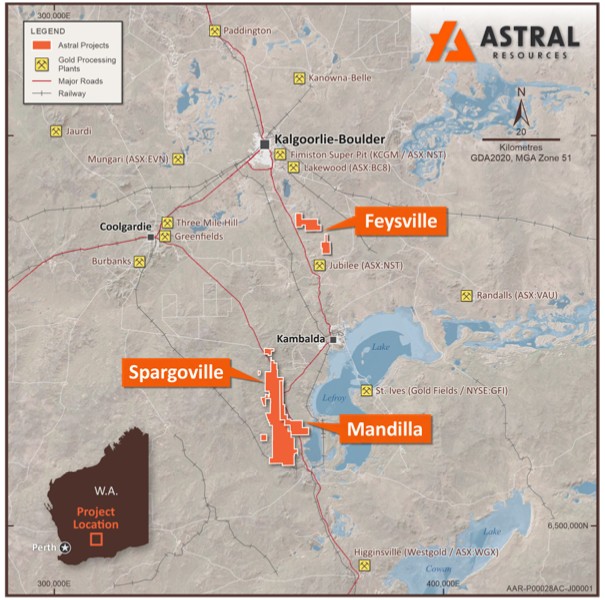
Map illustrating the location of the Mandilla, Spargoville and Feysville Gold Projects.