
Dalaroo Metals Ltd (ASX:DAL) has transformed its Blue Lagoon project in southern Greenland from an early-stage exploration concept into a defined regional rare earth element system after completing its largest field program to date.
The 2026 campaign combined geological and structural mapping, surface geochemistry, Ground Penetrating Radar (GPR), bathymetric surveys and lagoon and offshore sediment sampling across the 100%-owned project.
The work identified four new REE targets and established the foundation for a comprehensive three-dimensional geological model to guide future drilling.
More than 200 geological, rock chip, stream sediment and surface sediment samples were collected and are being sent to ALS Laboratories in Perth for multi-element analysis, mineralogical assessment and preliminary metallurgical test work.
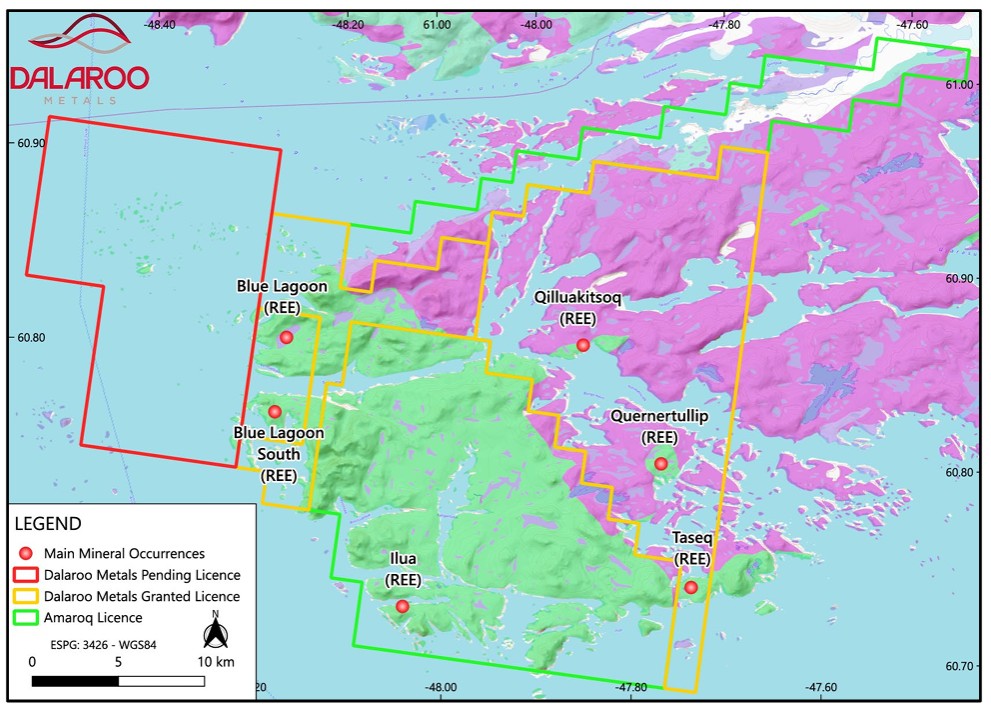
Location of four additional REE targets relative to Amaroq's Ilua REE discovery and Dalaroo's Blue Lagoon Project.
Four new exploration targets
Regional mapping identified the Qilluakitsoq, Quernertullip, Taseq and Blue Lagoon South prospects, materially expanding Dalaroo’s exploration pipeline.
Blue Lagoon South is around one kilometre south of the flagship prospect and adds approximately 34 square kilometres of prospective ground. It is adjacent to Amaroq Minerals’ Ilua REE discovery, where drilling is testing a mineralised system across about five kilometres of strike.
Mapping at Blue Lagoon South confirmed geological units comparable with those at the main project, including fenite alteration, quartz syenites, alkaline granites, pegmatites and aplite intrusions. Dalaroo said the continuation of favourable geology onto its tenure strengthened the case for follow-up exploration.
Qilluakitsoq hosts a layered alkaline intrusive complex, Rapakivi granite and magnetic heavy mineral sands, which may represent a second mineral sand system within Dalaroo’s Greenland portfolio.
Quernertullip comprises a ring-shaped alkaline intrusive complex containing syenites, alkali granites and altered contact zones, while Taseq contains alkaline granite, metasomatic alteration and a major shear zone considered prospective for structurally controlled REE mineralisation.
Source-to-sink model strengthened
The program also advanced Dalaroo’s source-to-sink exploration model, under which REE-bearing minerals are weathered from surrounding alkaline granites and pegmatites, transported through drainage systems and deposited within the Blue Lagoon basin.
Mapping identified several catchments measuring between approximately 1.3 and 2.4 kilometres long, substantially increasing the potential volume of source rocks feeding material into the lagoon.
The company believes the combination of multiple source areas, extensive drainage pathways and the lagoon’s sedimentary environment could create favourable zones for heavy mineral accumulation.
GPR surveys were completed across five priority beach systems, while bathymetric coverage was acquired across the entire lagoon. The surveys aim to map sediment thickness, basin geometry, paleochannels and potential depositional centres ahead of drill targeting.
Large, fertile system emerging
Dalaroo CEO John Morgan described the field season as transformational, saying the company had gained a clearer understanding of the geological system responsible for producing mineralised sediments discovered in 2025.
He said the identification of multiple alkaline granite and pegmatite phases, extensive drainage systems and interpreted eudialyte-like mineral occurrences had increased confidence that Blue Lagoon represented a large and fertile rare earth system.
However, the visual identification of potential eudialyte-like minerals remains preliminary and requires confirmation through laboratory analysis.
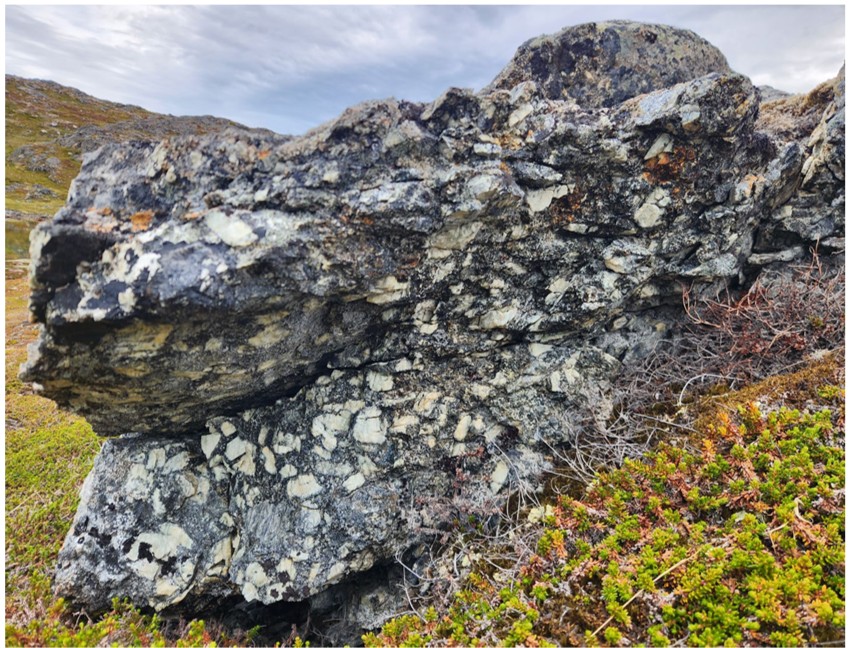
Rapakivi Granite outcrop at the Qilluakitsoq REE prospect.
What’s ahead
Dalaroo will now interpret the GPR and bathymetric datasets and integrate geological, structural, geochemical, mineralogical and sediment information into a three-dimensional project model.
Assay results from the 200 surface samples, along with lagoon and offshore sediment analyses and mineralogical confirmation work, are expected within two to three months. Preliminary metallurgical testing and follow-up exploration planning will also support the generation of priority drill targets.