
- FTSE 100 up 12 points at 10,497
- Miners climb on higher copper prices
- Sainsbury's Q1 update impresses
4.55pm: Stocks little changed
It was a quiet finish for London stocks, with the FTSE 100 adding 12 points at 10,497.
As the month comes to an end, gold hovers just above $4,000 per ounce, down this year amid elevated Fed rate hike expectations and a strengthening US dollar.
“Gold is on track for its eighth straight week and fourth consecutive month of falling prices amid a hawkish Fed and appreciating greenback, dropping by close to 30% from its January peak,” IG chief technical analyst Axel Rudolph said.
“Meanwhile the Yen sinks to a 40-year low - increasing the risk of Bank of Japan currency intervention - while the S&P 500 looks to be on track for its best quarter in six years amid the ongoing AI and chip boom while crude suffers its worst quarterly decline since 2020.”
4.01pm: Blue-chip gains dwindling
Gains for UK blue-chips, which were at a 10-week high at around 128 points at lunchtime, are dwindling.
Losses for the likes of heavyweights Diageo (-2.6%), AstraZeneca (-1.3%), BP (-1.3%), Unilever (-1%), GSK, BAT, National Grid, Coca-Cola Europacific, Reckitt and Haleon are doing a lot of the damage.
The biggest fallers are Smith & Nephew, Entain, Vodafone, Burberry, BT and Airtel Africa. In the background, government bond yields are rising on both sides of the Atlantic.
Housebuilders are down too, including Persimmon and Barratt Redrow, following reports that seven of the biggest housebuilders are facing a £4.5 billion lawsuit over claims they overcharged buyers.
Across the pond, US stocks are increasing their gains, while on commodities markets, oil has picked up again, with earlier losses wiped out and back up slightly above $73.
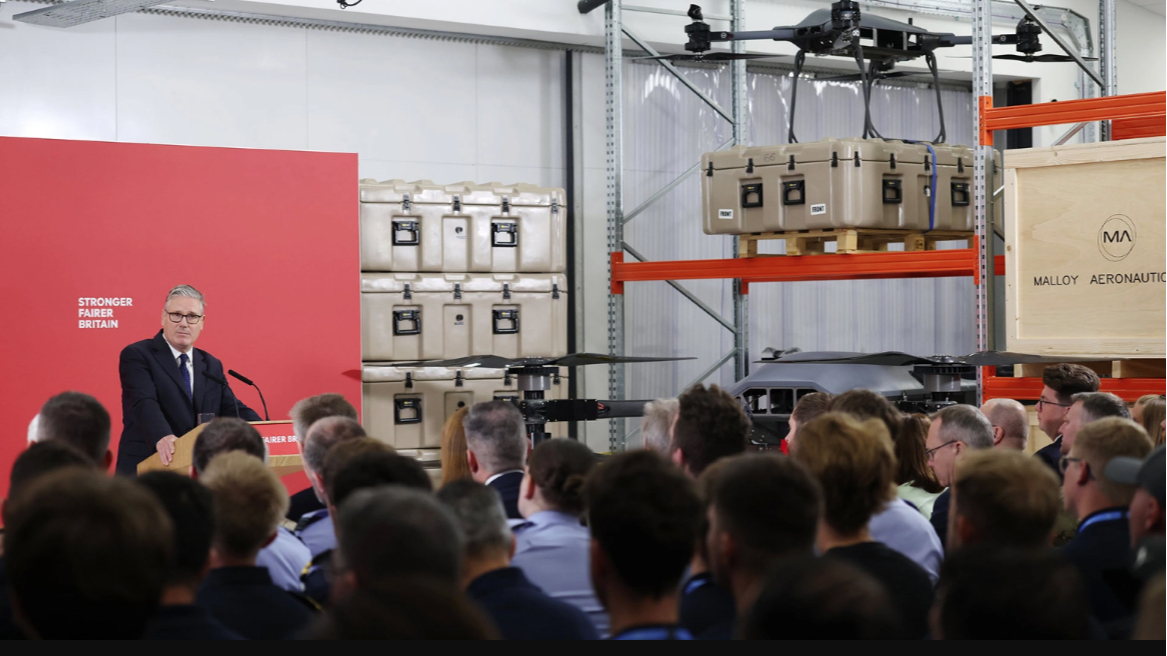
3.41pm: Starmer unveils Defence Investment Plan
Defence shares are up after outgoing PM Keir Starmer confirmed a £15 billion increase in military spending, with drones, ammunition stockpiles and the nuclear deterrent among the priorities.
In a speech at BAE Systems' Malloy Aeronautics drone factory in Berkshire today, Starmer said the government’s Defence Investment Plan would "transform our armed forces" and give them "the funding and equipment they need to fight and defend our nation".
More than £5 billion will go into drones over four years, while £63 billion has been earmarked for the nuclear deterrent and submarine programmes.
Defence minister Dan Jarvis said: "Britain is stepping up on security."
Chemring shares jumped the most, up 5.8%, Melrose rose 3.4%, Rolls-Royce added 2.7%, Babcock gained 2.3%, QinetiQ climbed 2.1% and BAE Systems rose 1.5%. Avon Tech is down 0.9%.
3.22pm: UK could intervene in US media merger
The UK could intervene in Paramount-Skydance's proposed $110 billion acquisition of Warner Bros Discovery.
Culture secretary Lisa Nandy said today that she is "minded to intervene" in the transaction, citing concerns over media plurality and the concentration of ownership in the news sector.
"Following engagement with the parties and independent research, my department has today written to the current and proposed owners of Warner Bros Discovery on my behalf to inform them that I am minded to intervene," Nandy said in a statement.
She added that any potential intervention would be based on public interest considerations, including ensuring "a sufficient plurality of views in news media" and "a sufficient plurality of persons with control of the media enterprises."
If the government proceeds, Ofcom would conduct a public interest assessment alongside an ongoing review by the Competition and Markets Authority.
Channel 5 is owned by Paramount, while TNT Sports is part of Warner Bros Discovery. The pair also own streamers Paramount+ and HBO Max, plus Nickelodeon and Cartoon Network UK.
2.50pm: Nasdaq rebounds further
Wall Street stocks have opened higher, with the Nasdaq out in front as chip stocks return to the front.
The Dow is up 0.1% to 52,229, while the S&P 500 has added 0.3% and the Nasdaq 0.6%.
The early leaderboard is heavily semiconductor-weighted, with SanDisk up 5.8%, then a line looking like Monolithic Power, AMD, Lam Research and KLA all up 3% or more, while ASML, Intel and NVIDIA are also up 2-1% as part of the broader tech bid.
Back in London, the FTSE's gains have been chipped away, with its gain halved from earlier.
Fashion, utilities, healthcare and gold miners are weighing.
1.37pm: Segro says 'nothing new' in Prologis presentation
Segro has put out a response after US suitor Prologis published an investor presentation this morning.
The FTSE 100 warehouse and logistics investor has again rejected Prologis’s possible offer, saying the proposal “falls a long way short" of the board's own view of its value.
Segro said the current proposal was worth 881p a share, down 5% since the start of the offer period, and described it as "inadequate, opportunistic and one-sided".
Chairman Andy Harrison says: "There is nothing in Prologis's announcement and presentation issued this morning that changes the board's clear position.
"Prologis is trying to acquire SEGRO on the cheap when our share price has been dislocated by the Middle East conflict and at a price that reflects none of the quality, scarcity and growth embedded in the business."
He says the board has unanimously rejected the Proposal "because we continue to believe our compelling standalone investment case can deliver superior shareholder value. Capital is not a constraint on our ability to unlock all of this value for our shareholders.
"We look forward to providing more detail on our growth strategy and value case next week."
1.23pm: US futures in green
US stocks are predicted to extend their recovery today, after yesterday saw a five-day losing run come to an end.
Futures are pointing to S&P 500 and Dow Jones opening up around 0.2%, with Nasdaq futures up 0.4%.
Kenny Polcari at SlateStone Wealth said recent weakness was “not a funeral for AI”, but rather quarter-end rebalancing as institutions harvested gains and rotated capital.
"Today is the final trading day of the quarter, which means the quarter-end window dressing is essentially over," he said.
"The rebalancing by pension funds, institutional asset managers and sovereign wealth funds ... is just about complete."
Tuesday’s data calendar includes the Conference Board consumer confidence index and JOLTS job openings, ahead of Thursday’s non-farm payrolls report, with US markets closed on Friday.
12.23pm: New UK regulation for crypto firms
Crypto firms in the UK will face tougher supervision under new FCA rules published today, requiring them to hold capital against risky assets and carry out annual stress tests.
The rules are due to come into force in October next year. They are intended to create the UK’s first comprehensive regulatory framework for crypto trading, custody, consumer service and risk management.
David Geale, the FCA’s executive director for payments and digital finance, said: "For the first time, we’ve got a comprehensive regulatory framework for crypto in the UK, one that covers how firms trade, how they hold assets, serve consumers and manage risk."
The regulations apply the same core principles used across financial services, he says.
Responses have been coming in all day.
Renuka Rawlins, director at the Payments Association, says the regulator has listened to feedback, making adjustments that "replace rigid complexity with commercial workability".
She says: "Most significant is the decision to halve the coefficient of the stablecoin issuance capital requirement from 2% to 1%... This calibrated K-factor represents a major victory for proportionality, ensuring robust risk management without placing an unworkable capital burden on larger issuers."
Other refinements are "tailored to how real-world crypto markets function", she says, including adjusting redemption timelines to ensure operational effectiveness, removing the need to estimate complex redemption forecasts and permitting up to a 5% excess to be held within the backing asset pool.
"Prohibiting unallocated backing fund accounts while confirming statutory trust arrangements also injects vital legal clarity for safeguarding."
Jill Lorimer, partner at law firm Kingsley Napley, says the framework "will – broadly – be welcomed by the industry".
It will bring "a vast volume of new rules and guidance" and a "perhaps surprising" amount of brand new sections in the FCA’s handbook created rather than adapting current sections.
"The commercial opportunities for UK firms within this space are however immense. The finalisation of the regime will allow UK crypto firms to move forward with confidence and it will be of interest to overseas firms weighing up the option of a UK presence."
12.05pm: FTSE at 10-week high
The FTSE 100 has broken above 10,600 for the first time in over two months, having last traded above this level on 21 April.
Joining miners and tech funds in powering the move are defence companies, financials and banks.
Babcock is up 3.3% and BAE Systems 1.9% higher, while St James’s Place rose 3%, Lloyds gained 2.4% and Lion Finance added 2.3%.
Market analyst Kathleen Brooks is another looking back at the past month and quarter, which she says is "ending on a high note".
"Stocks are higher across Europe, the oil price is falling, and expectations for Fed rate hikes are moderate as we lead up to Kevin Warsh’s speech on Wednesday, and the US payrolls report on Thursday.
"The second quarter has been dominated by stunning gains for chip stocks, and tech-heavy indices, a strengthening dollar that has sent the yen down to a 40-year low and shifting geopolitical risks that are playing out in commodity markets."
The key numbers for Q2 include a 59% gain for South Korea’s Kospi, an 88% gain for the Philadelphia semiconductor index. a 23% gain for the US small cap Russell 2000 index, a 22.5% gain for the Nasdaq, a 9% gain for the Eurostoxx 600, just a 3% gain for the FTSE 100, a 10% decline in the gold price, a 15% decrease in the silver price and a 30% fall in Brent crude from the initial Iran war peaks.
"These numbers tell a story," Brooks says. "The AI trade is still robust, even if it has splintered in recent months, with the chip makers surging and the hyperscalers struggling."
She says it is a story that "physical commodities are out, in favour of tech indices", with US and Asia are leading the pack, while Europe lags.
"A strong economic outlook in the US is boosting the smaller cap Russell 2000 index, which was also a top performer this quarter. The Dow Jones is ending the quarter at a record high above 52,000, which is another sign of US economic dominance."
The rally in Asian stocks is almost exclusively driven by chipmakers and chip-linked stocks, while the rally has broadened in the US, helped by firm growth prospects.
US GDP is predicted to grow 2.5% for the US this quarter, which has seen a shift in US interest rate expectations to a slightly more hawkish stance rather than inflation concerns.
"With growth lagging elsewhere, it supports a divergence in monetary policy in Q3 and beyond, which could play out in the forex market later this year.
"Overall, trades made today will settle tomorrow, the first day of Q3, so today’s price action could give us a clue about what to expect over the summer months.
"The focus will also shift to central Bank speakers at the ECB’s conference in Portugal. So far, ECB members have sounded hawkish about inflation risks, but the main event will be Kevin Warsh’s speech on Wednesday. We may drift into the event risks coming up in the next few days."
11.14am: Barclays buys Canary Wharf HQ building
Barclays has bought its Canary Wharf headquarters for £750 million, taking control of One Churchill Place, the building it has occupied since 2005, after making some refusbishments in recent years.
The bank said the purchase of a new 999-year lease from Canary Wharf Group would provide greater certainty over long-term occupancy costs. Its original lease had been due to expire in 2039.
The 32-storey building, which has more than one million square feet of office space, has apparently been refurbished in recent years, including work on its trading floors. Barclays has also been renovating its North American headquarters in New York.
“This acquisition gives us long-term certainty, greater flexibility over our London footprint and reinforces our continued confidence in London as one of the world’s leading global financial centres,” boss CS Venkatakrishnan said in a statement.
10.26am: Entain and Rank slip on tax report
Shares in Ladbrokes and Coral owner Entain and Grosvenor casino owner Rank Group are both down around 2% after a report that slot machine shops and casinos could face a £460 million tax rise under a future Labour government led by Andy Burnham.
The Guardian has reported on a proposal from the Social Market Foundation to double machine games duty from 20% to 40% on higher-stakes Category B machines, which allow £2 spins every 2.5 seconds.
The thinktank estimated the move could raise between £275 million and £458 million, on top of around £600 million currently paid by the sector.
Industry groups Bacta called the report “fantasy economics and grossly irresponsible”, warning that it would cost jobs and drive customers towards the illegal market.
9.33am: FTSE up, dollar strength in focus
The FTSE 100 is up 42 points at 10,526 after an hour and a half of trading, with miners and tech funds remaining in the driving seat.
A bit of a handbrake is coming from small falls from oil giants Shell and BP, both slightly in the red, though most of the index heavyweights are in positive territory.
A stronger dollar is something to bear in mind, says market analyst Neil Wilson at Saxo, which he puts down to the "Warsh effect", in reference to the new Federal Reserve and his views.
ECB chief Christine Lagarde opened the central bank’s Sintra conference with an echo of her US counterpart's views that "we no longer need to act with the same force... and we no longer need complex forms of forward guidance".
Wilson explains that "the immediate impact is the stronger dollar, which has risen about 1.3% for the quarter" and 3% from its May lows. The GBPUSD is down 0.2% this morning.
Dollar strength sees the pound and euro down 0.2% and 0.3% this morning, and more significantly has put further pressure on the Japanese yen, with the USDJPY breaching fresh 40-year highs above 162.40 this morning.
Japanese authorities have said they will intervene to support the currency.
9.11am: Sainsbury's impresses but Argos beat given context
Some thoughts on Saino's Q1 update from the City, as the shares trolley 2% higher.
Analyst Freddie Wild at Jefferies said the update was a "slight beat" against expectations, with "grocery and (more surprisingly) Argos strength offsetting a weaker-than-expected General Merchandise + Clothing number".
"Strength in Argos ahead of peak summer season in Q2 would ordinarily be a very positive signal, but we note commentary in the release that this strength in Q1 was volume led (vols +2.2% vs total growth -0.5%) and that they have seen 'lower sales in core seasonal categories' and 'strong sales of fans... and large screen TV sales', which may imply a mix shift from higher-margin categories to lower, offsetting some of the strength today."
The balance of these means it is "unlikely" that the cons forecast changes much today, Wild says.
Clive Black at house broker Shore Capital is more optimistic, saying: "With a Q2 tailwind, the bottom end of the current guided [underlying earnings] range may yet be raised."
Victoria Scholar at Interactive Investor says: "After a challenging two months for the stock from mid-April onwards following disappointing full-year earnings and a major broker downgrade from ‘buy’ to ‘sell’ from Goldman Sachs, slashing its price target, there appear to be some green shoots of recovery coming back into play in recent weeks as the recent rebound looks to be gathering momentum.
"While shares are little changed so far this year, the stock remains higher by a respectable 15% over the past 12 months, a similar percentage increase to its long-standing rival Tesco.”
8.26am: Market analysis: a strange month
Today is the last day of the month, the quarter and the first half of the year, as several analysts are pointing out.
It has been the best quarter for global equities in the past six years, "despite the Iran war, disrupted oil and fertilizer flows, and a spike in energy prices that led to a rise in global inflation expectations, which in some parts of the world resulted in interest rate hikes and, in others, more hawkish monetary policy", says market analyst Ipek Ozkardeskaya at Swissquote.
Deutsche Bank strategist Jim Reid also notes that last night saw the S&P 500 finally end a run of five consecutive declines and, with just one day of Q2 left, the S&P is on the verge of its best quarterly performance since the index was bouncing back sharply from the pandemic slump.
The Philly semiconductor index rebounded 3.8% after posting its worst week since the post-Liberation Day sell-off last April.
"But not all tech stocks are performing well," says Ozkardeskaya. "The AI enablers – the beneficiaries of massive AI spending – are outperforming, while Big Tech – the companies spending heavily on AI infrastructure – are sputtering."
The Magnificent Seven group of tech megacaps is down 10% in June and nearly 15% since the May peak, with Microsoft losing more than a third of its valuation since October last year, Google parent Alphabet down 17% since the May peak, Amazon down nearly 19% since the May peak and Meta down nearly 30% since last August.
Oil prices have fallen overnight, with Brent crude down 1.2% to $72.25 a barrel, a rise in oil yesterday following the weekend tensions in the Middle East saw bond prices climb on both sides of the Atlantic.
UK gilts were a relative outperformer, with yields falling as Andy Burnham, the favourite to be next PM, delivered a speech outlining some of his plans, which Reid notes included a commitment to stick to the current fiscal rules. "So that reassured investors who were concerned about looser fiscal policy".
Donald Trump says the peace talks will resume in Doha today, while Iranian officials say they will not.
8.15am: Tech funds and miners lead FTSE higher at open
The FTSE 100 has got off to a solid start, up 29 points to 10,513 in early trades as miners and tech investors beat the path higher.
Polar Capital Tech Trust is top riser, up 2.4%, with Scottish Mortgage up 1.6%.
They are joined by miners Anglo American and Antofagasta, both up over 2% as they get a boost from higher copper prices and Chinese economic data coming in better than expected. Glencore and Rio Tinto, seen as having less copper exposure, are both up around 1.5%,
Sainsbury's is up 1.35% as it's first-quarter update seems to have been well received.
Fallers are led by housebuilders Barratt Redrow and Persimmon, along with Ladbrokes owner Entain, following speculation about new taxes on gambling machines.
7.57am: Saga reiterates guidance
Saga has backed its guidance for the full year after getting off to a "strong" start to its new financial year, as higher spending by ocean cruise passengers offsets an expected drop in holiday customer numbers due to the conflict in the Middle East.
In an update ahead of its annual meeting, the over-50s products and services specialist said ocean cruise revenue for the first half is expected to be ahead of last year, helped by a 13% increase in booked per diems and a booked load factor of 93%.
Saga said it had a "high level of confidence" in ocean cruises for the rest of the year and beyond, with customers said to be typically booking well in advance and commodity and foreign exchange risk fully hedged to the end of 2027.
First-half holidays revenue and passenger numbers are expected to be ahead, though with full-year passenger numbers "potentially slightly behind".
7.41am: Sainsbury's backs outlook
Sainsbury's sales have slowed in the first quarter of its new financial year but it has held its profit outlook steady.
The UK's second-largest supermarket revealed total retail sales excluding fuel were up 2.7% in the 16 weeks to 20 June, with like-for-like sales up 2.1%.
Grocery sales for the first period of the new financial year were up 3.6%, driven by volume growth, while online grocery sales increased 12.5%.
Argos sales slipped 0.5% and general merchandise and clothing sales fell 3.7%.
7.27am: GDP unrevised
UK GDP for the first quarter of 2026 is estimated to have grown by 0.6% compared to the preceding three-month period, unrevised from the last estimate.
But year-on-year, GDP grew 0.9%, down from the previous estimate of 1.1%.
Exports and business investment were both revised up, though. Business investment rose 0.9% on the quarter, while imports jumped 1.4%.
Household consumption grew 0.6% and government spending increased 1.3%, helping to offset a wider current account deficit of £22.1 billion, which was slightly worse than expected.
Commenting on today’s Q1 GDP figures, the ONS's director of economic statistics Liz McKeown says: “Our latest set of figures show no revision to economic growth in the first quarter of this year. However, growth for 2025 was revised down a little.
"Services were the main driver of growth in the latest quarter, with strength in computer programming, wholesale and advertising only partially offset by falls in rental companies and recruitment agencies. Production and construction also both grew overall, although construction only partly reversed its recent weakness.
"The household saving ratio continued to ease at the start of 2026 but remains above its pre-pandemic levels."
FTSE 100 Live pre-open
London's blue-chip stocks should come out of the blocks on Tuesday in a cautiously optimistic fashion, as various reports emerge about potential new government policies amid the looming handover of power on Downing Street.
The FTSE 100 has been called 10 points higher on the futures market, after falling almost 24 points to 10,484.22 yesterday.
Headlines in the financial press include that Keir Starmer and his new defence minister will unveil a defence plan with a reduced funding gap and £5 billion for drones, while elsewhere it is reported that incoming Prime Minister Andy Burnham could crack down on the gambling industry with new taxes.
Overnight, a rebound by US tech stocks improved the mood on Wall Street, with sentiment seemingly boosted by easing geopolitical tensions and a Supreme Court ruling that backed the Federal Reserve’s independence.
The Dow Jones added 0.6% to close about 52,000 for the first time, while the Nasdaq leapt 2.1% and the S&P 500 closed up 1.2%.
Asian markets are mixed this morning, with good tech-powered gains for Japan's Nikkei and Korea's Kospi, while the Hong Kong and Indian benchmarks drop back.


