
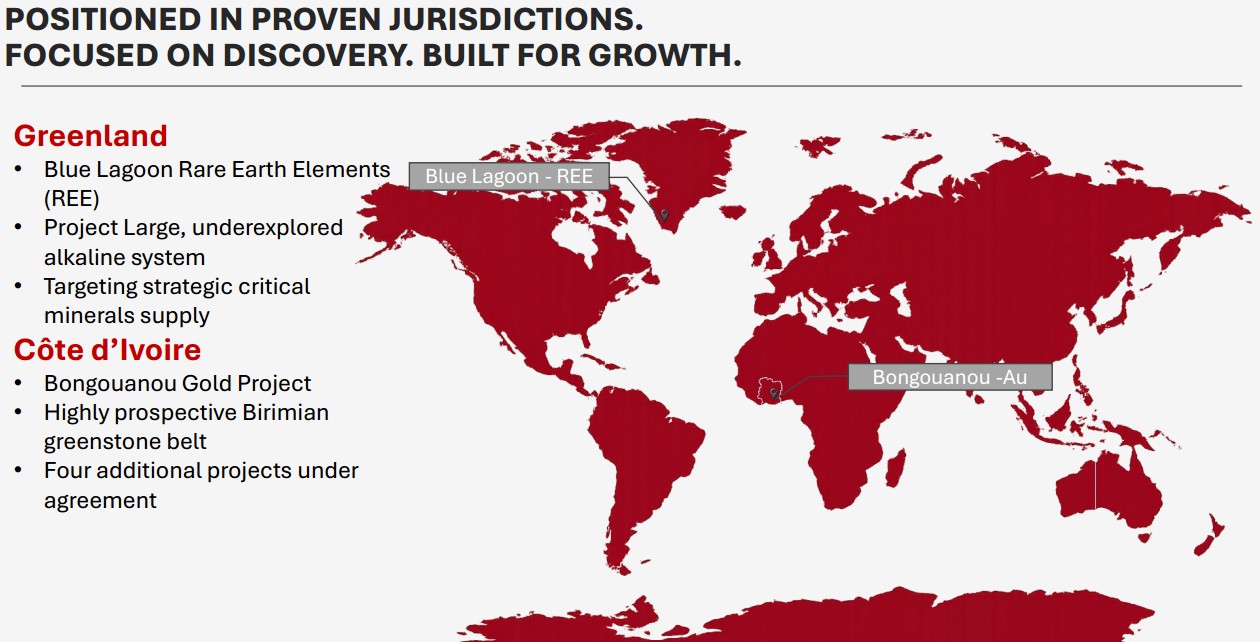
Dalaroo Metals Ltd (ASX:DAL) is positioning itself as a diversified exploration company with exposure to two investment themes: critical minerals supply security in Greenland and gold discovery potential in Côte d’Ivoire.
The company’s portfolio is anchored by the Blue Lagoon rare earth and critical minerals project in southwest Greenland and a Five-project gold package in Côte d’Ivoire, with both workstreams aimed at generating exploration catalysts through 2026.
Dalaroo is still at an early exploration stage, but the scale of its land positions, the strength of initial surface results at Blue Lagoon and the historical gold intersections at Bongouanou give the company multiple routes to discovery.
Blue Lagoon puts Dalaroo in the critical minerals conversation
The immediate investor focus is likely to be Blue Lagoon, a 100%-owned project in Greenland, prospective for zirconium, niobium, hafnium and rare earth elements.
That commodity mix is important. Rare earths and associated strategic metals are now tied directly to supply chain security, advanced manufacturing, defence, electric vehicles, robotics and next-generation electronics. Dalaroo’s investor presentation frames hafnium in particular as a semiconductor-related metal, with potential application in next-generation microchips.
Blue Lagoon sits within the Gardar Alkaline Province, a geological belt already known for critical minerals prospectivity. Dalaroo also highlights the project’s ice-free coastal position and weathered, beach-like granitic material as potential logistical advantages for bulk-tonnage separation.
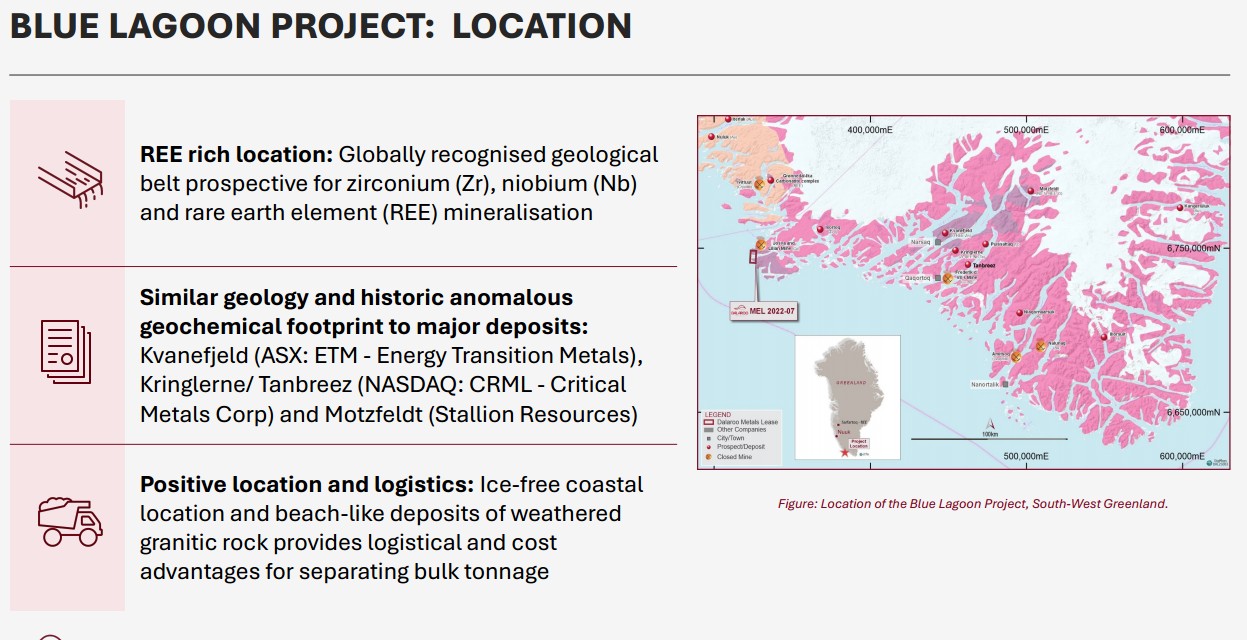
The first-pass exploration results give the project its early technical foundation. Dalaroo says its maiden program confirmed a broad mineralised system over more than 2.7 kilometres, with 100% of samples returning anomalous values.
Among the standouts were zirconium oxide results of 4.42% and 4.09%, hafnium oxide results up to 99 ppm, and peak calculated total rare earth oxide values of 8,079 ppm, or 0.81% TREO. The company also reported heavy rare earth enrichment, including dysprosium and terbium, with peak surface values carrying 29% magnetic rare earth oxides.
These are surface sampling results, not a mineral resource, and they require systematic follow-up. However, the combination of scale, coherent anomalism and multiple critical minerals provides Dalaroo with a broader exploration thesis than a single-commodity rare earth target.
Hafnium, zirconium and niobium add strategic depth
A notable feature of the Blue Lagoon story is that Dalaroo is not presenting the project only as a rare earth opportunity.
The hafnium results were distributed across the 2.7-kilometre strike, with the strongest sediment samples grading 99 ppm and 98 ppm hafnium oxide. Zirconium values were also material, with numerous samples exceeding 10,000 ppm zirconium and a peak result of about 32,700 ppm zirconium.
Dalaroo says the zirconium enrichment points to abundant zircon-rich heavy mineral assemblages, a strong alkaline intrusive source and potential for both secondary placer-style accumulations and primary hard-rock sources.
Niobium adds another layer. Typical results were reported in the 400 ppm to 1,000 ppm range, with a peak of around 1,465 ppm, compared with background crustal abundance of about 20 ppm.
The key question now is whether Dalaroo can convert these early geochemical results into defined, coherent zones with enough continuity and grade to justify drilling and, eventually, more advanced technical studies.
Follow-up work provides near-term news flow
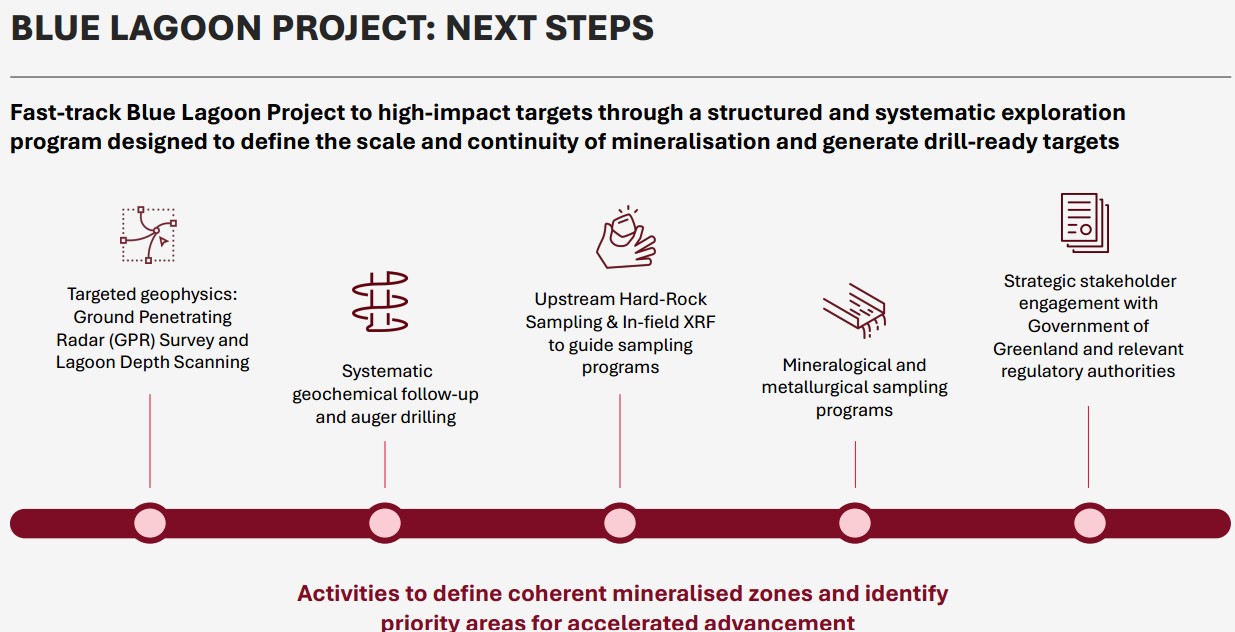
Dalaroo’s planned next steps at Blue Lagoon are structured around defining scale, continuity and drill-ready targets.
The proposed work includes ground penetrating radar, lagoon depth scanning, systematic geochemical follow-up, auger drilling, upstream hard-rock sampling, in-field XRF work, mineralogical and metallurgical sampling and engagement with Greenland authorities.
For investors, this creates a relatively clear sequence of catalysts. The first stage is likely to be confirmation of whether the surface anomalism is laterally continuous and whether mineralisation can be linked to source rocks or concentrated weathered material. The second stage would be target ranking. The third would be drilling.
That makes Blue Lagoon a project where news flow could be important. Early exploration companies can re-rate quickly on evidence of scale, but they can also lose momentum if follow-up work fails to improve geological confidence.
Côte d’Ivoire adds gold exposure
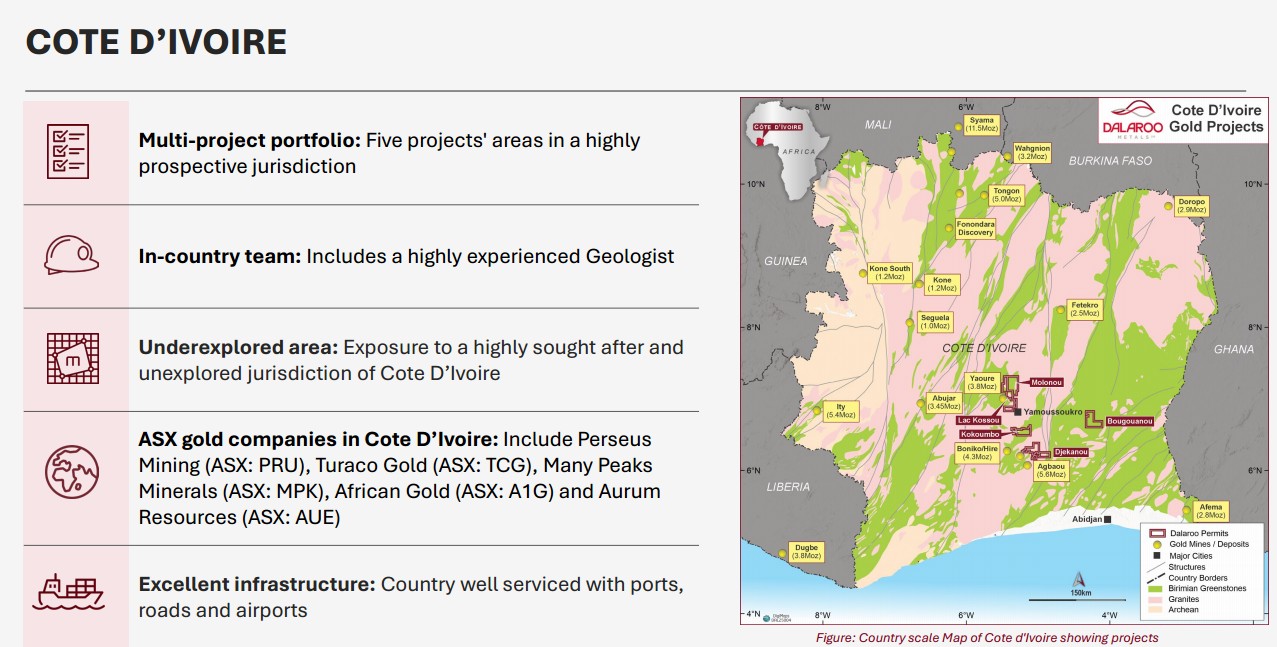
Alongside Greenland, Dalaroo is building a gold platform in Côte d’Ivoire, a country that has attracted a growing cohort of ASX-listed gold explorers and producers.
The portfolio includes Bongouanou as the core advanced project, along with 4 additional projects acquired or under agreement from Red Rock Resources. The total land package from the Red Rock transaction is 1,368 square kilometres, with Djekanou and Yamoussoukro granted and Kokoumbo and Molonou under application.
Bongouanou is located in the Birimian Greenstone Belt of West Africa and along the Sefwi-Come Shear, with Dalaroo noting numerous artisanal workings along related second-order structures.
The project already has meaningful historical data. Dalaroo reports more than 15 active artisanal sites, rock chip results above 70 g/t gold, soil anomalies above 50 ppb gold across a 16-kilometre by 10-kilometre area, a 94-hole aircore program that defined 5 anomalous areas, and a 28-hole diamond drilling program completed in 2022.
Historical drilling included 4 metres at 9.24 g/t gold in aircore, and diamond drilling results including 17 metres at 6.79 g/t gold and 2 metres at 60.47 g/t gold.
Kokoumbo, meanwhile, appears to be the most advanced of the Red Rock projects, with previous drill results including 7.5 metres at 16 g/t gold from surface and 1.5 metres at 14.9 g/t gold from 87 metres.
The investment case: optionality, but still early stage
Dalaroo’s investment proposition is built around optionality.
Blue Lagoon gives the company exposure to critical minerals at a time when governments and industry are trying to diversify supply chains. Côte d’Ivoire gives the company gold exposure in a prolific West African geological setting, with historical high-grade results and multiple project areas.
That dual-track structure could be useful. Gold offers a more familiar exploration pathway for many ASX investors, while critical minerals can attract attention during periods of geopolitical tension or supply chain concern. Together, they give Dalaroo more than 1 potential discovery pathway.
The risks are equally clear. Blue Lagoon is based on maiden surface sampling and still needs geophysics, drilling, mineralogical work and metallurgical validation. Bongouanou and the other Côte d’Ivoire assets require systematic modern exploration and confirmation of historical data. Dalaroo also has a modest cash position relative to the breadth of its project portfolio, meaning capital discipline will be important.
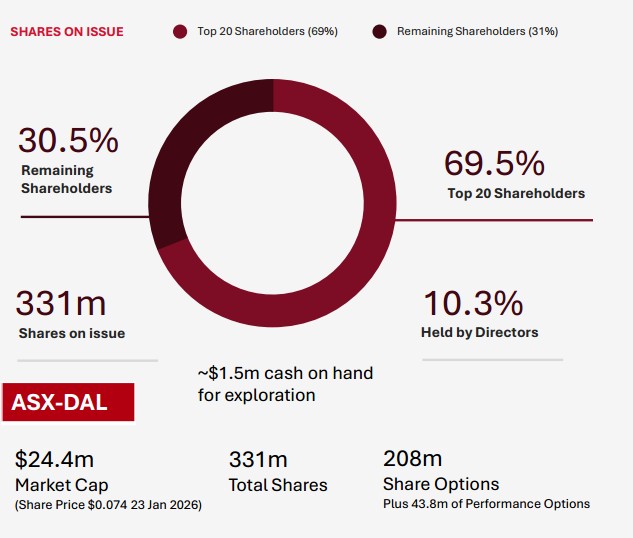
The company reported a market capitalisation of A$24.4 million at a 7.4-cent share price on January 23, 2026, with 331 million shares on issue and around A$1.5 million cash on hand for exploration. The market cap has risen slightly since June, now sitting at $25 million.
That capital structure means investors are essentially backing exploration execution. Dalaroo has several targets, but the market will likely want to see the company prioritise the highest-impact work programs and deliver results that progressively de-risk the portfolio.
What to watch
The main watchpoints are straightforward: further Blue Lagoon geochemistry and geophysics; any evidence of coherent mineralised zones; auger or shallow drilling plans; mineralogical and metallurgical results; and updates from Greenland regulatory engagement.
In Côte d’Ivoire, investors will be watching for confirmation of work programs at Bongouanou, target generation across the broader gold portfolio and any drilling designed to test extensions of historical high-grade mineralisation.
Dalaroo is attempting to build a diversified gold and critical minerals company from a relatively small market base. The next phase is about proof: proving that Blue Lagoon has scale beyond surface anomalism, and proving that the Côte d’Ivoire portfolio can turn historical gold results into modern discovery targets.
If the company can do that while managing its capital carefully, Dalaroo could move from an early-stage explorer with thematic exposure to a more defined discovery story.