
Heavy transport remains one of the hardest sectors of the economy to decarbonise — and one of the most valuable opportunities for companies able to solve it.
For fleet operators, the transition to electric transport is not simply a matter of buying new vehicles. A new Class 8 electric truck can cost between A$500,000 and A$900,000, creating a major capital barrier for operators managing large fleets on tight margins. Wholesale replacement is beyond the reach of many transport businesses, particularly those with existing diesel assets that still have years of working life ahead of them.
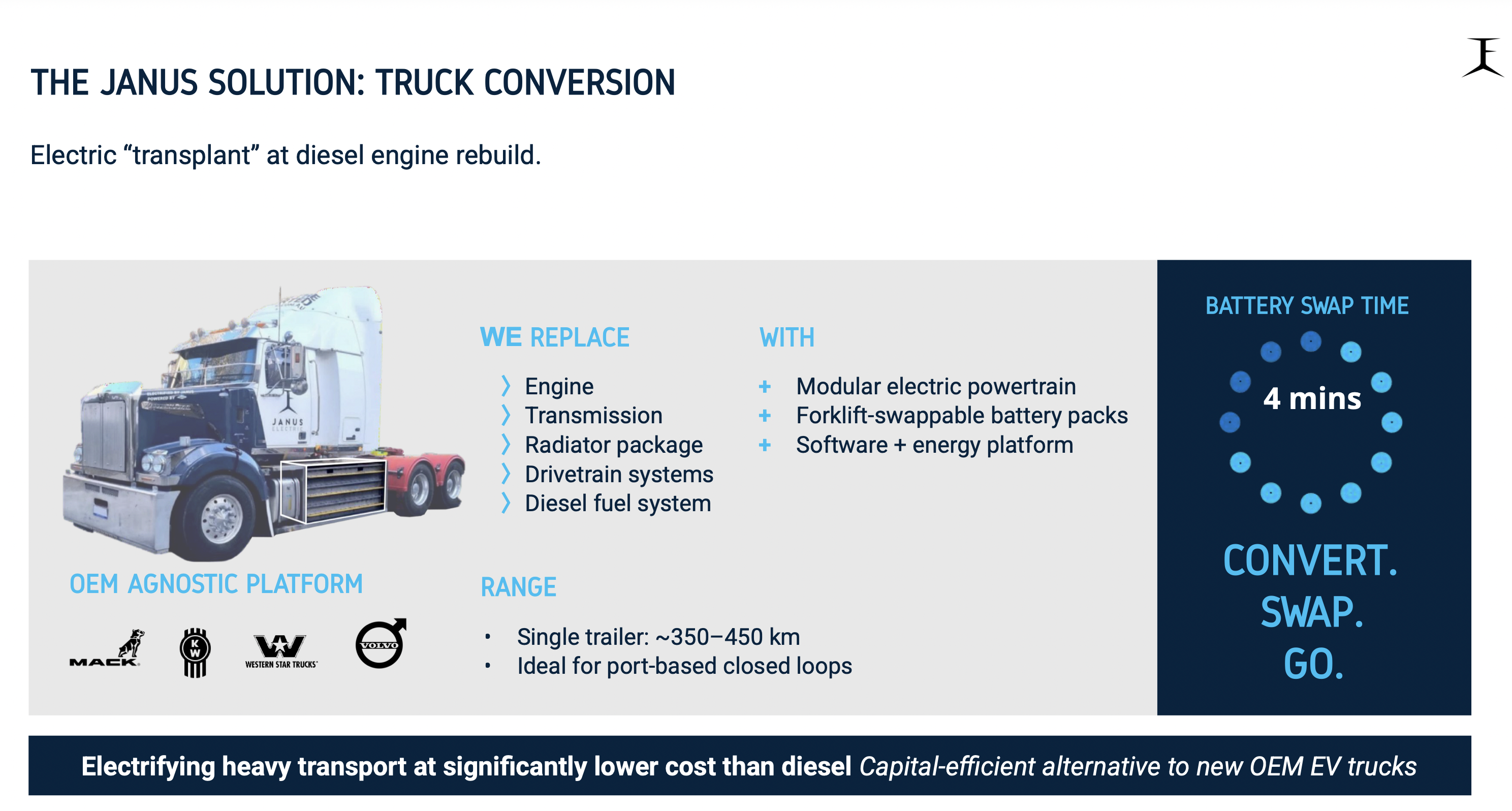
Janus Electric Holdings Ltd (ASX:JNS) is positioning itself around that gap. Rather than requiring fleet operators to restart their fleets from scratch, Janus offers an electrification pathway through conversion kits costing about A$150,000 to A$175,000. This approach allows operators to convert existing vehicles to electric drivetrains while avoiding the upfront capital burden of full vehicle replacement.
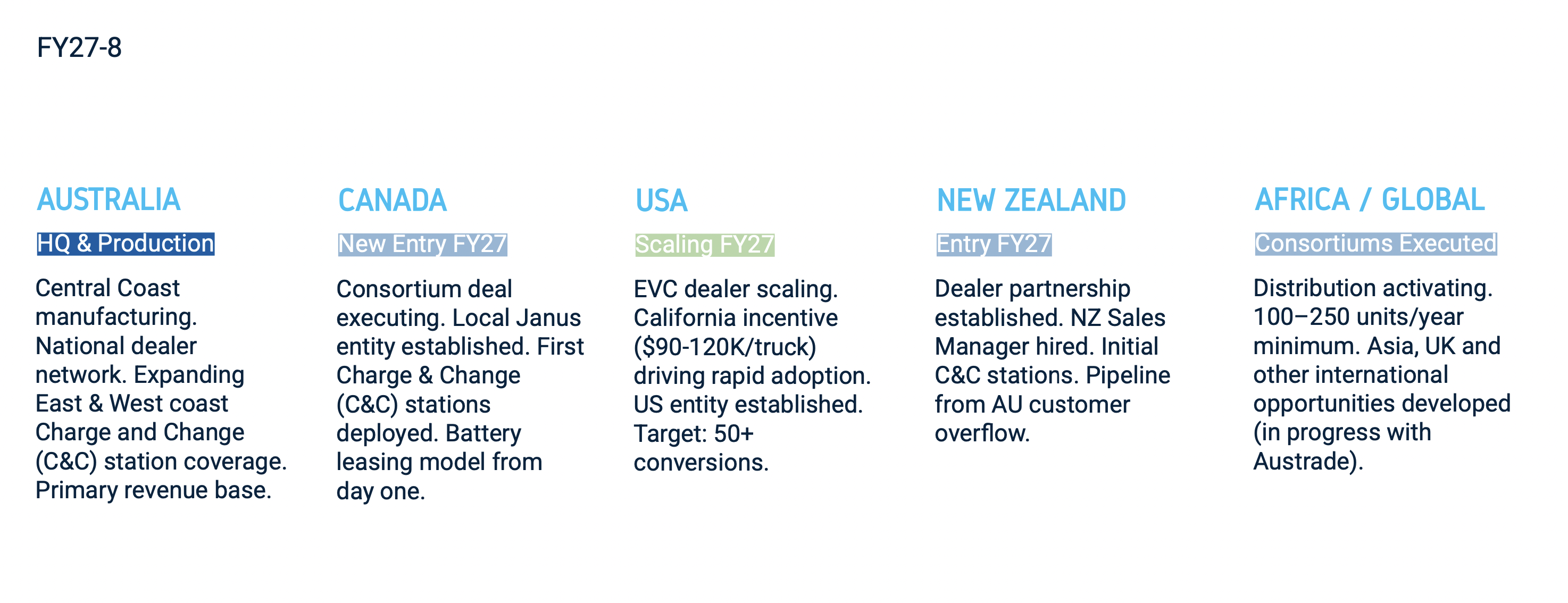
The company is positioning itself in a market of more than eight million heavy diesel trucks across target regions, including Australia, the US, Canada, New Zealand, the UK, Japan, South Africa, Malaysia and Sri Lanka, where electric penetration remains below 1%. The company recently made three senior appointments to support the commercial rollout of its heavy vehicle electrification platform across Australia, New Zealand, the US and Canada. Janus appointed Zorana Bull as senior adviser to the board, Mark Ramirez to lead North American market development, and Brooke Ditzler as chief operating officer.
The appointments come as Janus shifts from technology validation to large-scale commercial deployment of its battery-swapping electric truck platform, with North America emerging as a key target market due to supportive fleet electrification policies.
The overall total addressable market represents an estimated A$1.2 trillion replacement cost.
The timing is being shaped by regulation as much as economics. In California, zero-emission vehicle mandates require 40% of Class 7 and 8 trucks to be zero-emission by 2030. The UK is moving toward a requirement that all new heavy goods vehicles be electric by 2035, while Canada’s Clean Fuel Standard is increasing the cost pressure on diesel. In Australia, road user charges are rising 6% per year to 2027, and in New Zealand diesel trucks face a 55 cents per kilometre charge compared with 0 cents for electric vehicles.

These policy settings are strengthening the case for electrification, but the economics are also shifting. Electric heavy transport can deliver fuel-cost savings of more than 30% per kilometre compared with diesel, depending on fuel and electricity prices, vehicle task, route profile and utilisation. As oil prices rise, the relative advantage of electric transport improves further.
Janus’ model is also designed to reduce battery ownership risk for operators through its battery-as-a-service offering. By separating the battery from the vehicle conversion, the company aims to lower the financial and operational burden on fleets while creating recurring revenue from software, energy and battery services.
That recurring revenue model is central to the investment case. Heavy transport assets can operate over long lifecycles, and Janus is seeking to capture value across that period rather than through a single upfront sale. If fleet electrification accelerates under the combined pressure of regulation, diesel costs and capital constraints, Janus’ conversion-led model could offer operators a more practical route into zero-emission transport.
Janus has outlined a three-horizon growth strategy aimed at scaling its diesel-to-electric truck conversion and battery-swap platform across global heavy transport markets.
So let's break down the model and look at the horizons.
The Janus model
The company’s platform is built around three elements: the Janus Conversion Module, swappable battery systems and Charge & Change stations.
The Janus Conversion Module is designed to retrofit existing Class 6–8 diesel trucks to electric. The company's JCM540 system provides 540kWh capacity and is designed to work across most in-use original equipment manufacturer platforms.
Battery swapping is central to the model, with Janus targeting full swaps in four minutes and 99% uptime through its Charge & Change station network.
The company also plans to build recurring revenue through Battery-as-a-Service, fleet management software, energy optimisation, predictive maintenance and carbon reporting.
Horizon 1: build demand and deploy
The first phase of the strategy covers FY26–FY27 and is focused on building demand, converting trucks and deploying infrastructure.
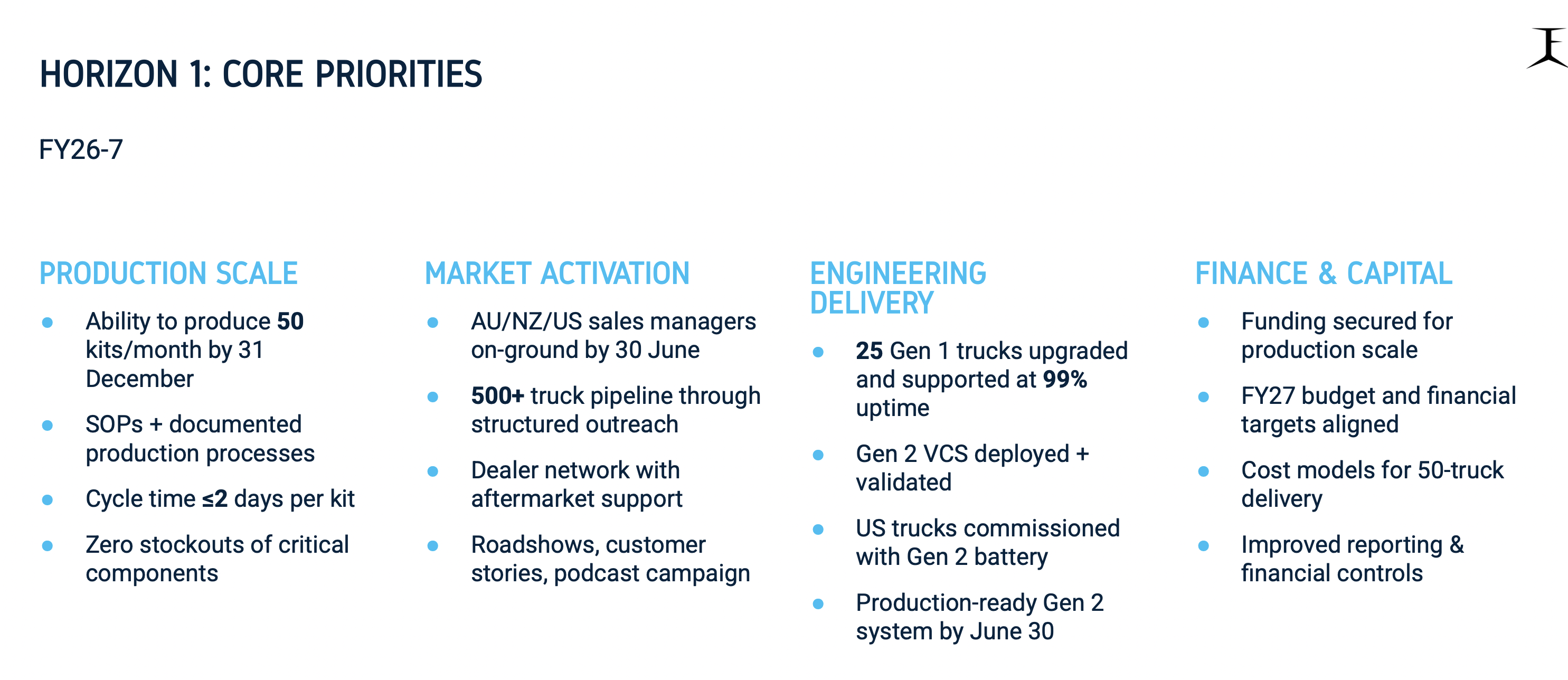
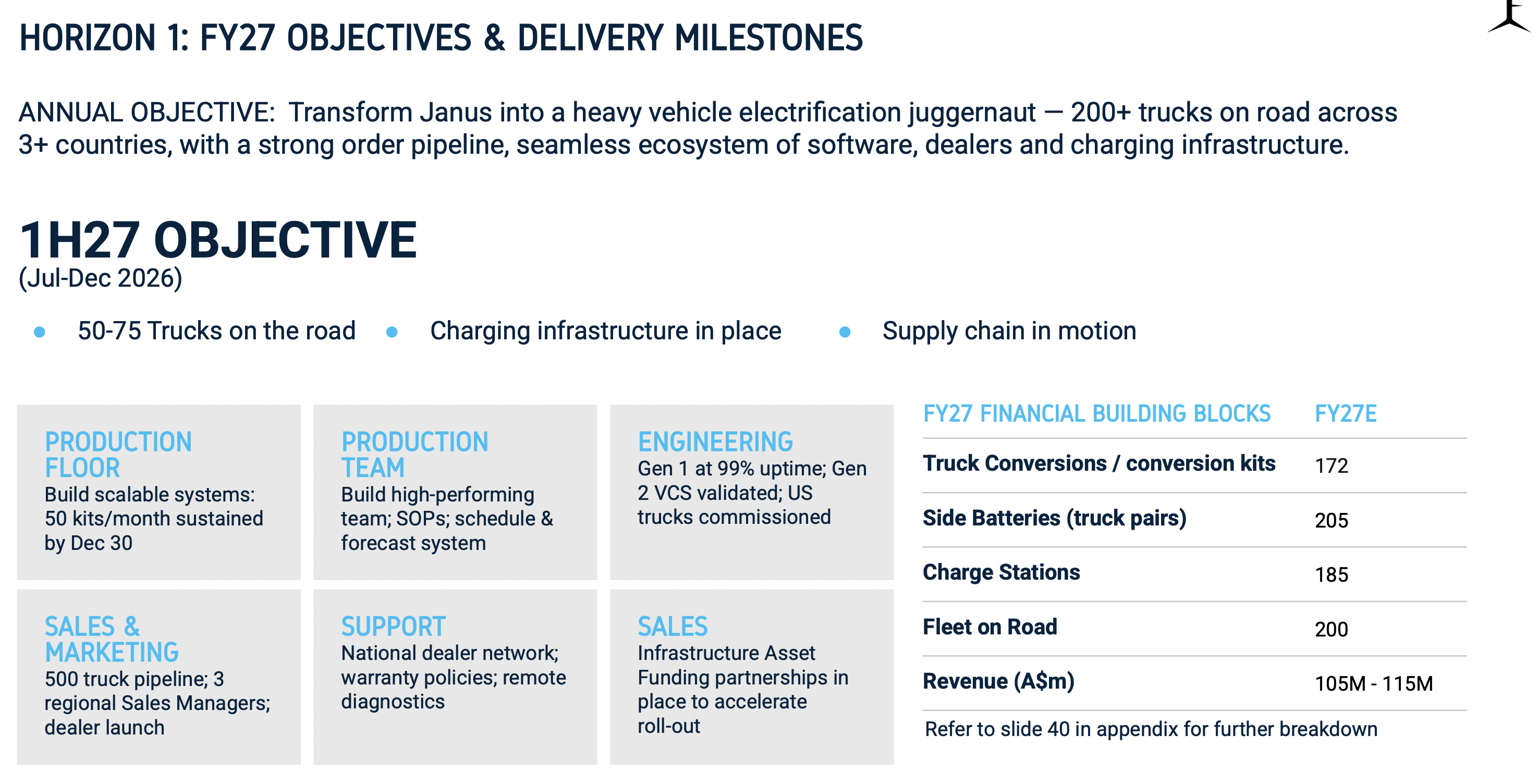
Janus is targeting 50 to 75 trucks on road by December 2026, a 500-plus kit pipeline, operations across at least three markets and 99% fleet uptime.
The company is also targeting production capacity of 50 kits per month by December 31, a kit cycle time of no more than two days and a production-ready Gen 2 system by June 30.
For FY27, Janus has outlined financial building blocks including 172 truck conversions or conversion kits, 205 side battery pairs, 185 charge stations, 200 fleet vehicles on road and revenue of A$105 million to A$115 million.
Horizon 2: plant the flag
Horizon 2, covering FY27–FY28, is centred on physical operations in at least three countries, the development of a capital-light AssetCo/OpCo structure and a target of more than 650 trucks on road.
Under the proposed structure, infrastructure partners would own trucks, battery packs and Charge & Change hardware, while Janus would provide hardware, software, operations and energy management.
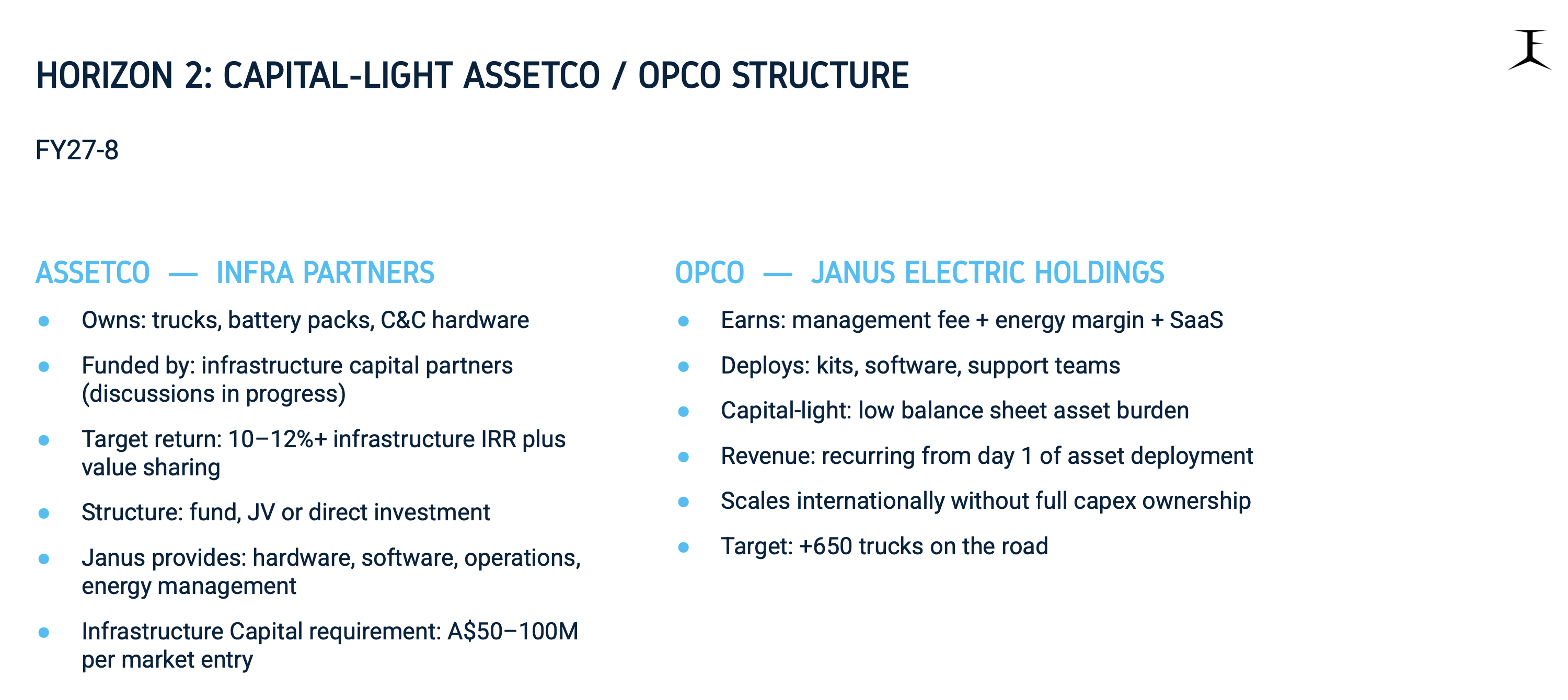
The OpCo model was intended to generate management fees, energy margins and SaaS revenue while reducing the balance sheet burden of international expansion.
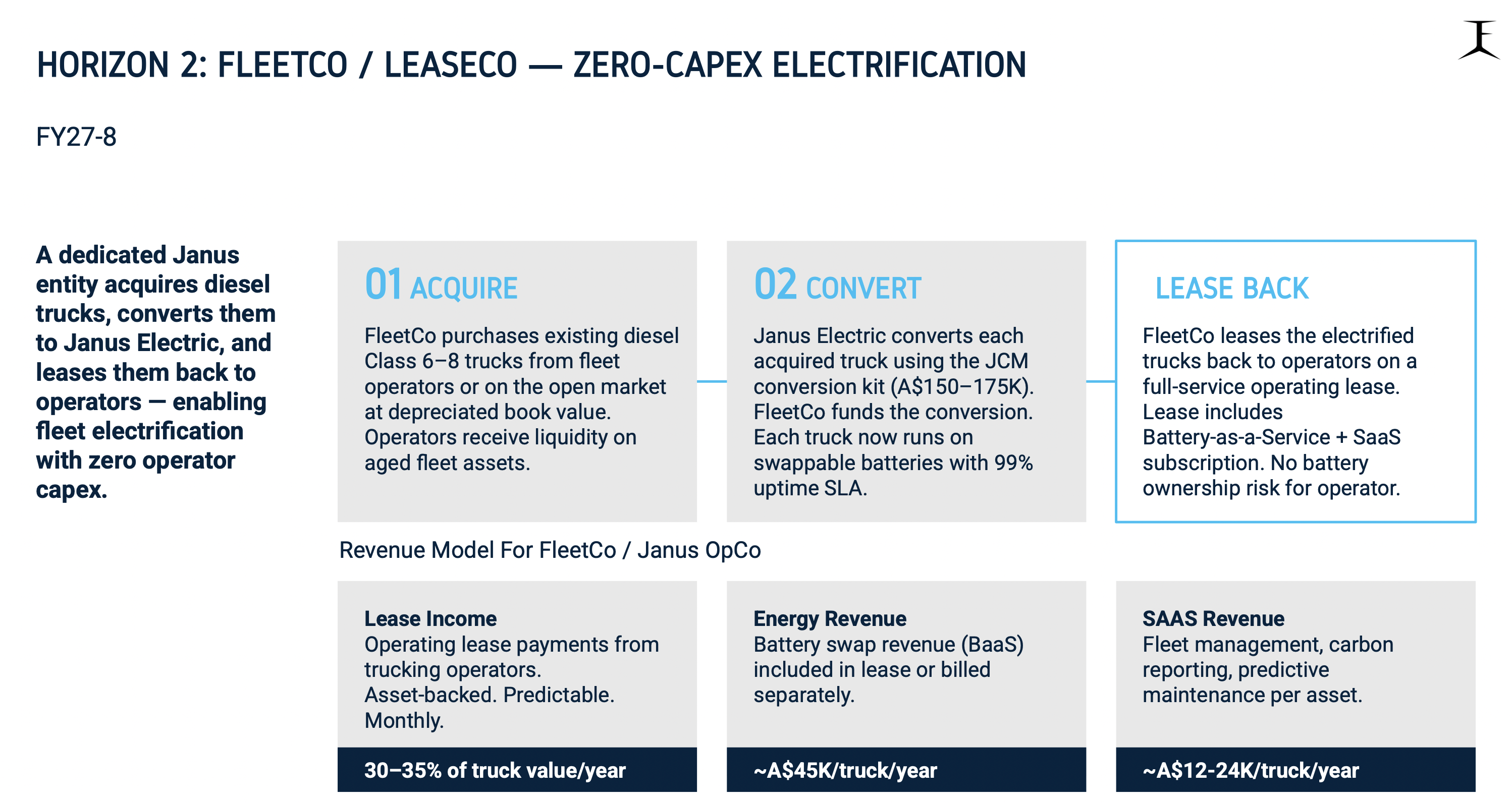
The company also plans a FleetCo or LeaseCo model, where a dedicated Janus entity would acquire existing diesel trucks, convert them to electric and lease them back to operators. The model is designed to allow fleet electrification with no upfront operator capital expenditure.
Horizon 3: global fleet platform
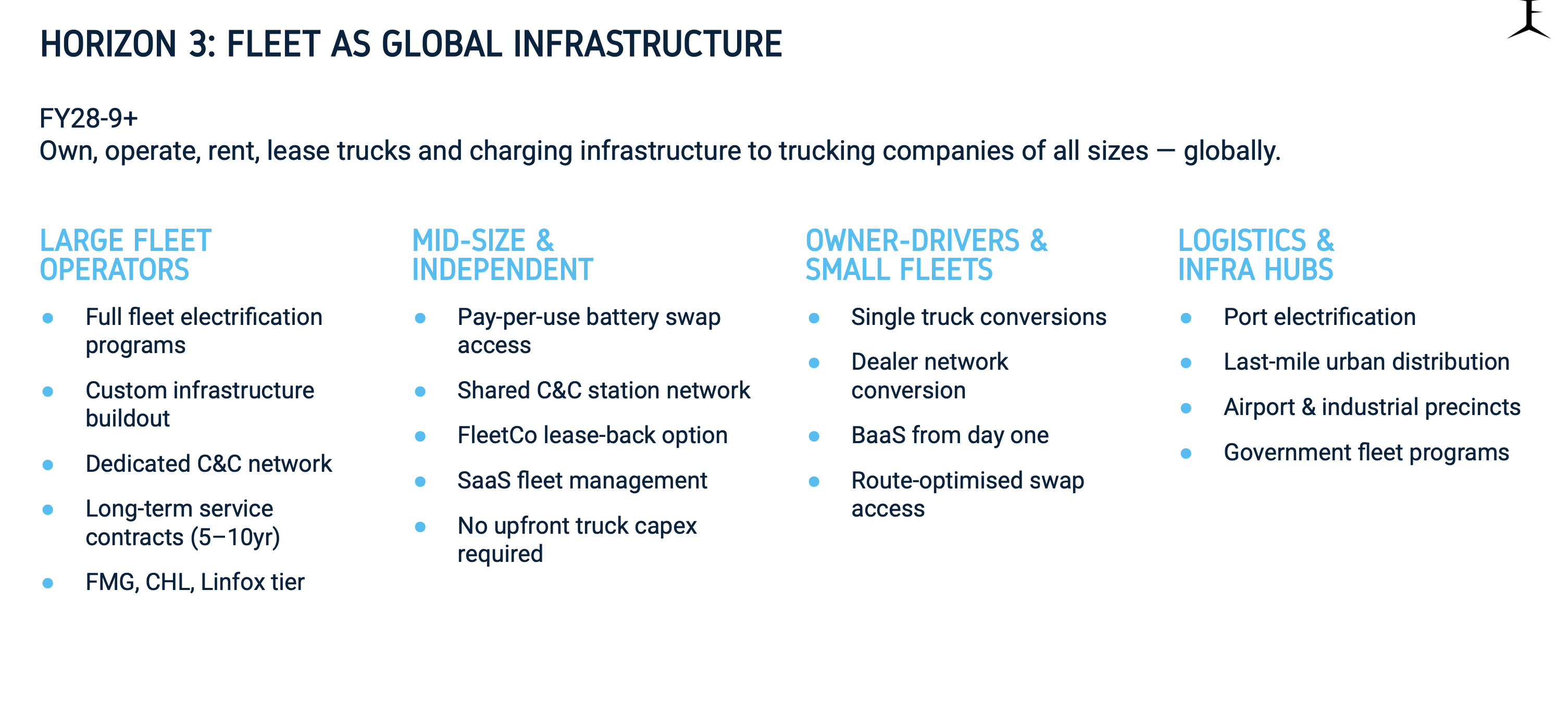
The third phase, from FY29 onward, is aimed at scaling Janus into a global fleet and infrastructure platform.
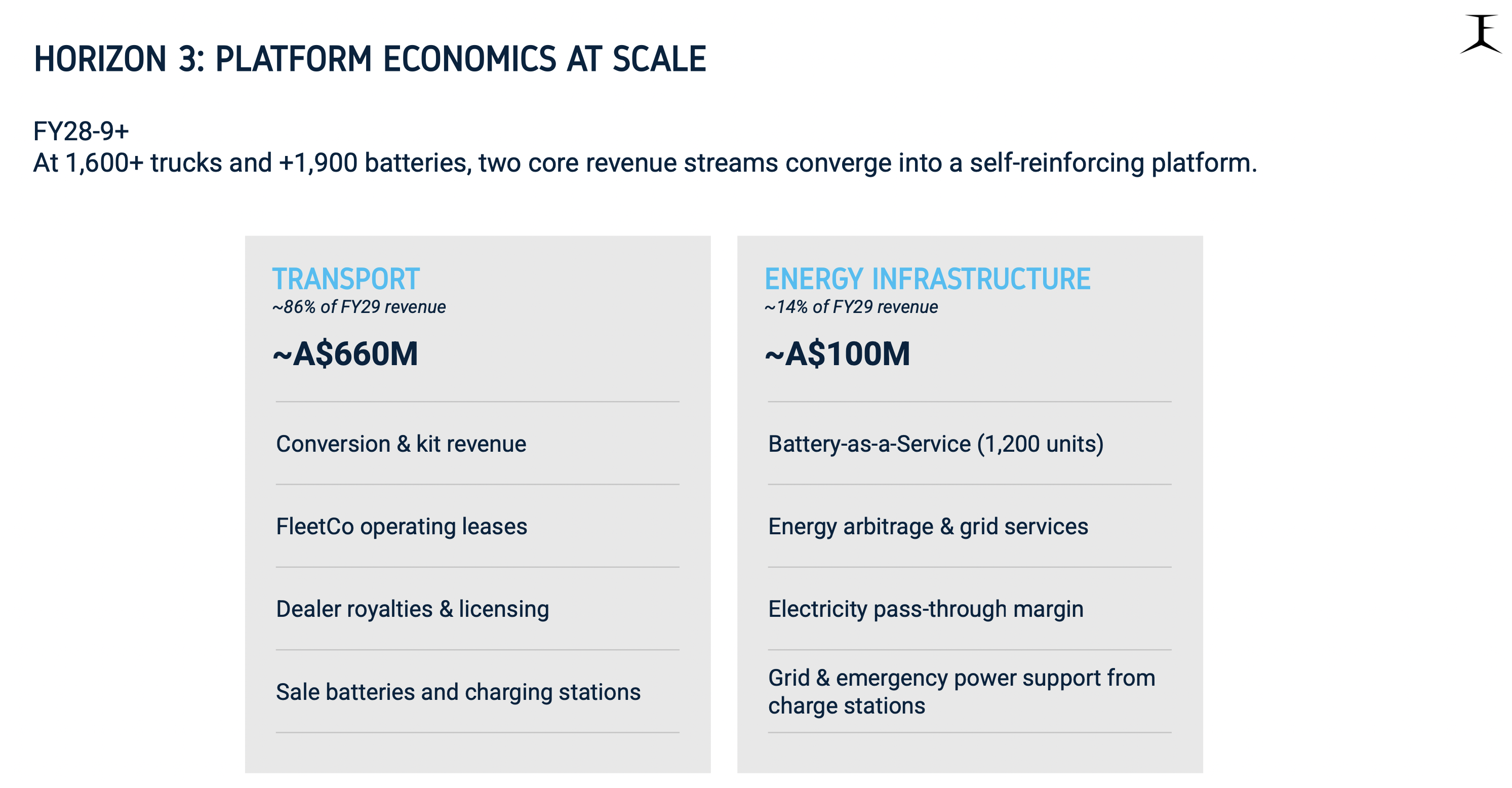
Janus is targeting more than 1,600 trucks on road and revenue of about A$660 million from transport activities, including conversions, operating leases, dealer royalties, licensing, batteries and charging stations.
The company also sees energy infrastructure becoming a second major revenue stream, targeting about A$100 million from Battery-as-a-Service, energy arbitrage, grid services, electricity pass-through margins and emergency power support from charge stations.
Commercial traction
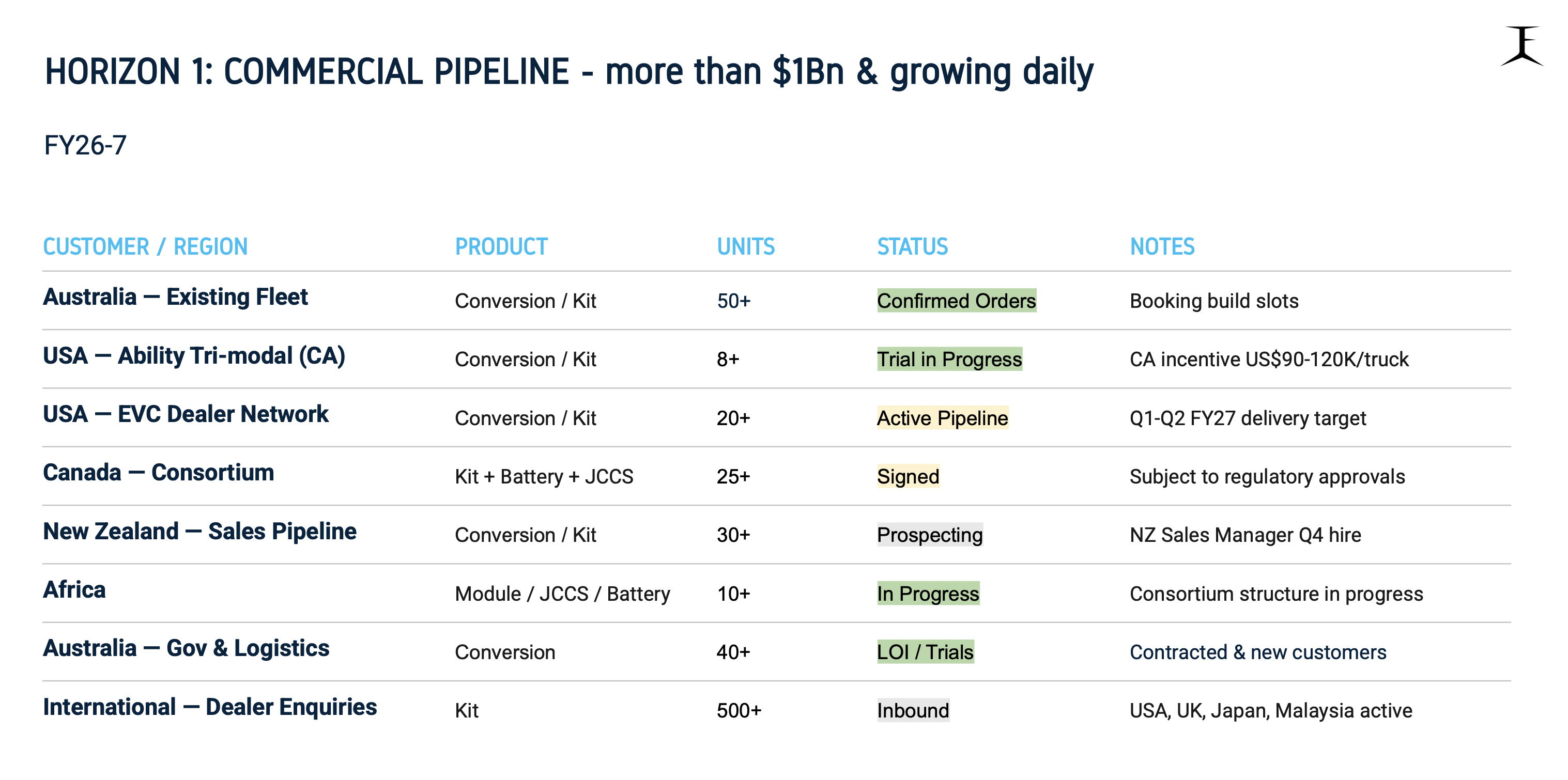
Janus has so far converted 28 trucks across Australia and the US, completed more than 3,600 battery swaps and electrified more than 650,000 kilometres.
The company has 11 Charge & Change stations and is progressing what it described as more than A$1 billion of opportunity across the US, Canada, Australia and five other countries.
In Australia, Janus is extending its Central Coast production facility to support scale manufacturing and is developing a dealer network.
In the US, conversion kits have been exported, an EVC dealer has been activated and the first US trucks are in progress with Ability Tri-modal. The company also boasts California incentives of US$90,000 to US$120,000 per truck.
In Canada, the company has signed a consortium deal for CY2026–2027, subject to regulatory approvals and funding, covering kits, batteries and station deployment.
Capital requirements
Janus estimated total capital requirements across the three horizons at A$138 million to A$187 million.
This includes A$8 million to A$12 million for Horizon 1, A$30 million to A$50 million for Horizon 2 and A$100 million to A$125 million for Horizon 3.
The intended structure is a capital-light operating model, with infrastructure assets funded by partners through asset finance, debt, joint ventures or project finance.
Meanwhile, the company recently raised A$4.5 million before costs through a private placement, with funds to accelerate its growth strategy and scale operations across key markets.
Janus builds structural advantage
Janus is building its competitive position around four structural advantages: ecosystem integration, first-mover status, patented technology and compelling unit economics.
Its battery-swap model creates a platform effect. As more operators convert trucks, the Janus network becomes denser and more useful. That, in turn, encourages more fleets to convert, creating a flywheel that can strengthen over time.
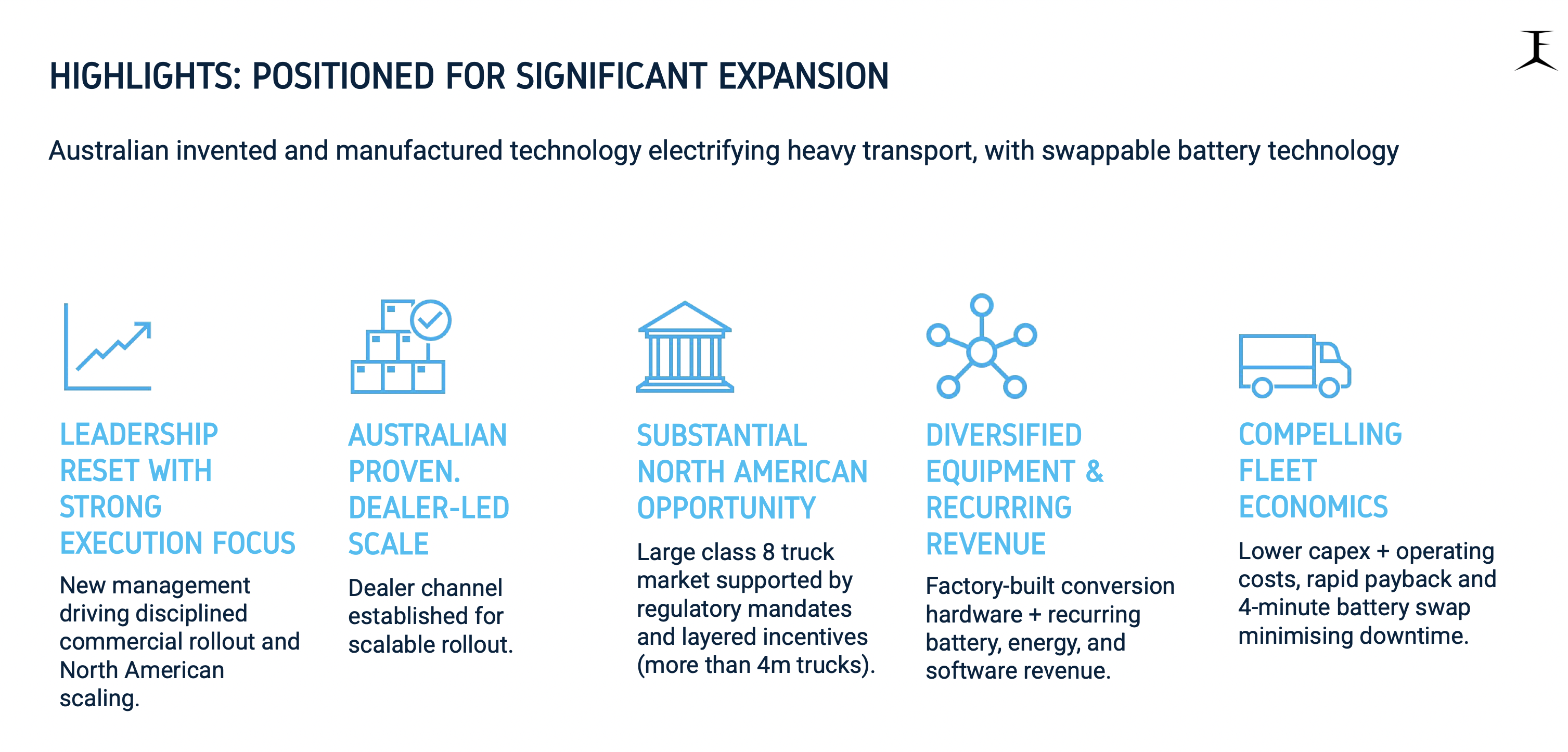
Janus also claims a first-mover position outside China, with no direct global competitor currently offering an integrated retrofit, battery-swap, charging and SaaS model for Class 6–8 trucks. Each month of scaling adds fleet relationships, infrastructure and operational experience.
The company’s patented conversion and battery-swap platform is designed to work across OEM truck brands, creating flexibility for operators and making replication more difficult for competitors. Its Gen 2 system is expected to further extend this technology lead.
With conversion and infrastructure able to be funded on balance sheet and targeted uptime of 99%, Janus offers fleets a lower-cost and lower-disruption path to electrification.