
Atomic Eagle Ltd (ASX:AEU) has secured key environmental and resettlement approvals for its Muntanga Uranium Project in Zambia.
The company has received approval of the Environmental and Social Impact Assessment (ESIA) from the Zambia Environmental Management Agency (ZEMA) and “No Objection” approval for the Resettlement Action Plan (RAP) from the Office of the Vice President’s Resettlement Division.
Together, the approvals represent the main environmental and social permits required before any eventual construction of the project, as envisaged in the previous feasibility study.
The approvals provide a clearer regulatory pathway for Muntanga, while allowing Atomic Eagle to maintain its current focus on growing the resource base and optimising the project before any development decision.
Major de-risking milestone
CEO Phil Hoskins said securing both approvals marked a major step forward for Muntanga and significantly de-risked the pathway toward eventual development.
“It is also a strong endorsement by key Government agencies reflecting strong regulatory alignment and stakeholder engagement, further reinforcing Zambia’s support for responsible uranium development and its attractiveness as a mining jurisdiction,” Hoskins said.
“With key permits in place, Muntanga is now positioned as a development-ready asset – an increasingly rare and strategically valuable profile in a uranium market where few projects can deliver new supply into the expected structural deficit.
“Whilst we are pleased to have cleared these permitting milestones, our focus remains on growing the resource base to support a larger, more valuable operation at Muntanga.”
Resource growth remains priority
Despite securing the approvals, Atomic Eagle said there would be no change to project sequencing.
The company remains focused on expanding Muntanga’s mineral resource base through an ongoing 30,000-metre drilling program, incorporating additional existing resources not currently included in the feasibility study and re-optimising the project’s scale and configuration.
Atomic Eagle said this strategy reflected its view that Muntanga’s economics had the potential to improve substantially at scale, making resource growth and project optimisation the main drivers of long-term value.
ESIA approval scope
The ESIA was submitted to ZEMA on 22 September 2025 and formally approved on 4 June 2026 after technical review, stakeholder consultation and site verification inspections.
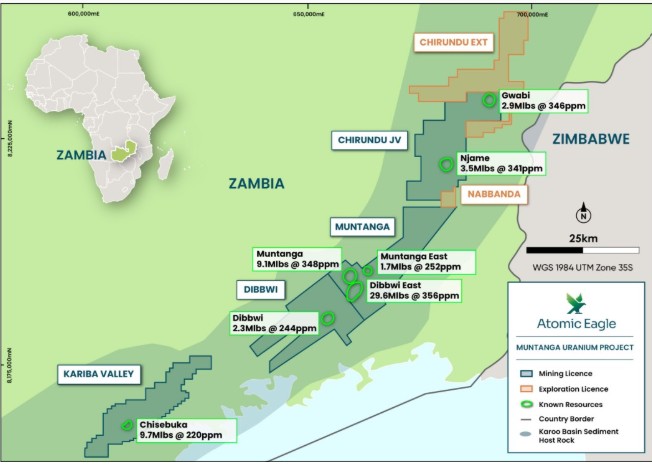
The approval covers development, operation and rehabilitation of the project under the feasibility study, including open-pit mining and heap leach processing of the Muntanga and Dibbwi East deposits at a centralised processing location.
Other deposits in the broader project area, including Dibbwi, Njame, Gwabi and newly defined deposits such as Chisebuka, were considered at a conceptual level and remain subject to further studies and approvals.
The ESIA approval is valid for three years from the date of approval and is subject to conditions including environmental monitoring, radiation safety, water management, pollution controls, biodiversity protection, land rehabilitation, tailings management and ongoing stakeholder engagement.
Resettlement plan approved
The RAP covers relocation and compensation commitments for the Muntanga and Dibbwi East areas under the feasibility study.
It addresses 175 project-affected households comprising 771 individuals and includes a replacement cost compensation framework, household census and asset register, resettlement planning, livelihood restoration measures and a formal grievance mechanism.
The RAP was assessed as technically sound and human-rights compliant, with benchmarking aligned to IFC Performance Standard 5.
It is valid for 18 months from the date of approval. If RAP implementation has not started within that period, a new approval would be required.
Muntanga resource base
Muntanga is Atomic Eagle’s core asset in Zambia and spans four mining licences and two exploration licences over a 146-kilometre strike length covering 1,136 square kilometres near Lake Kariba.
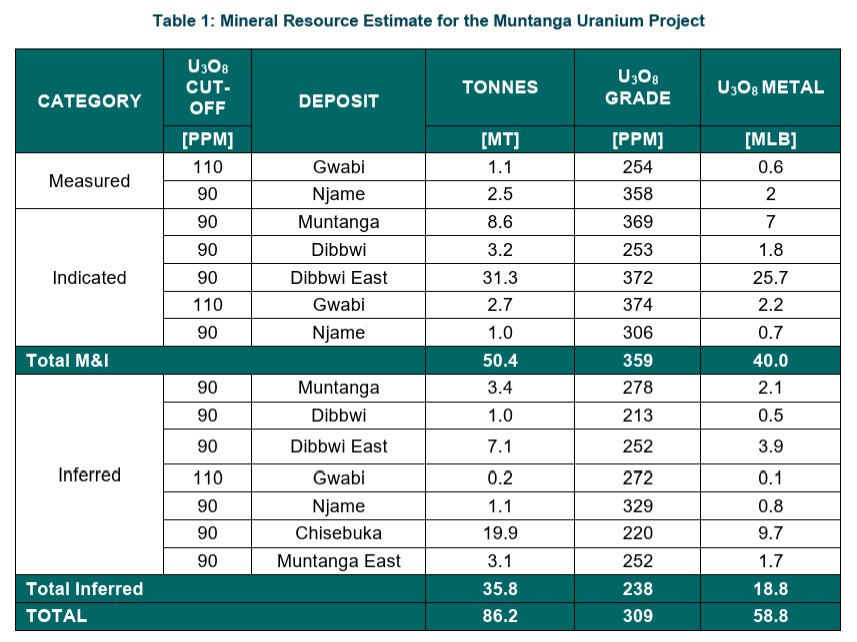
The project contains a combined mineral resource of 86.2 million tonnes at 309 ppm U₃O₈ for 58.8 million pounds of U₃O₈, comprising 40.0 million pounds in the measured and indicated categories and 18.8 million pounds inferred.
What’s ahead
Atomic Eagle will now notify ZEMA before starting project activities, progress detailed engineering and environmental management plans, undertake baseline monitoring and establish compliance systems.
The company will also seek additional approvals relating to radiation, water, forestry and local government, while integrating ESIA conditions with RAP implementation planning.
Subject to procedural requirements, including allocation of RAP funding, Atomic Eagle expects to receive an Implementation Clearance Letter for the resettlement plan.
The company said development timing would depend on project scale, optimisation outcomes, market conditions and completion of future technical work.