
Critical Resources Ltd (ASX:CRR, FRA:9S70) has confirmed the presence of a gold-antimony system at its Croesus Project in New Zealand's Reefton Goldfield after first-pass reconnaissance sampling returned assays of up to 13.3g/t gold and 6,990ppm antimony.
The results come from a program of rock-chip, float and historic ore-spillage sampling completed along the Croesus-Minerva trend, supporting the company's exploration model for a structurally controlled gold-antimony system hosted within Greenland Group metasedimentary rocks.
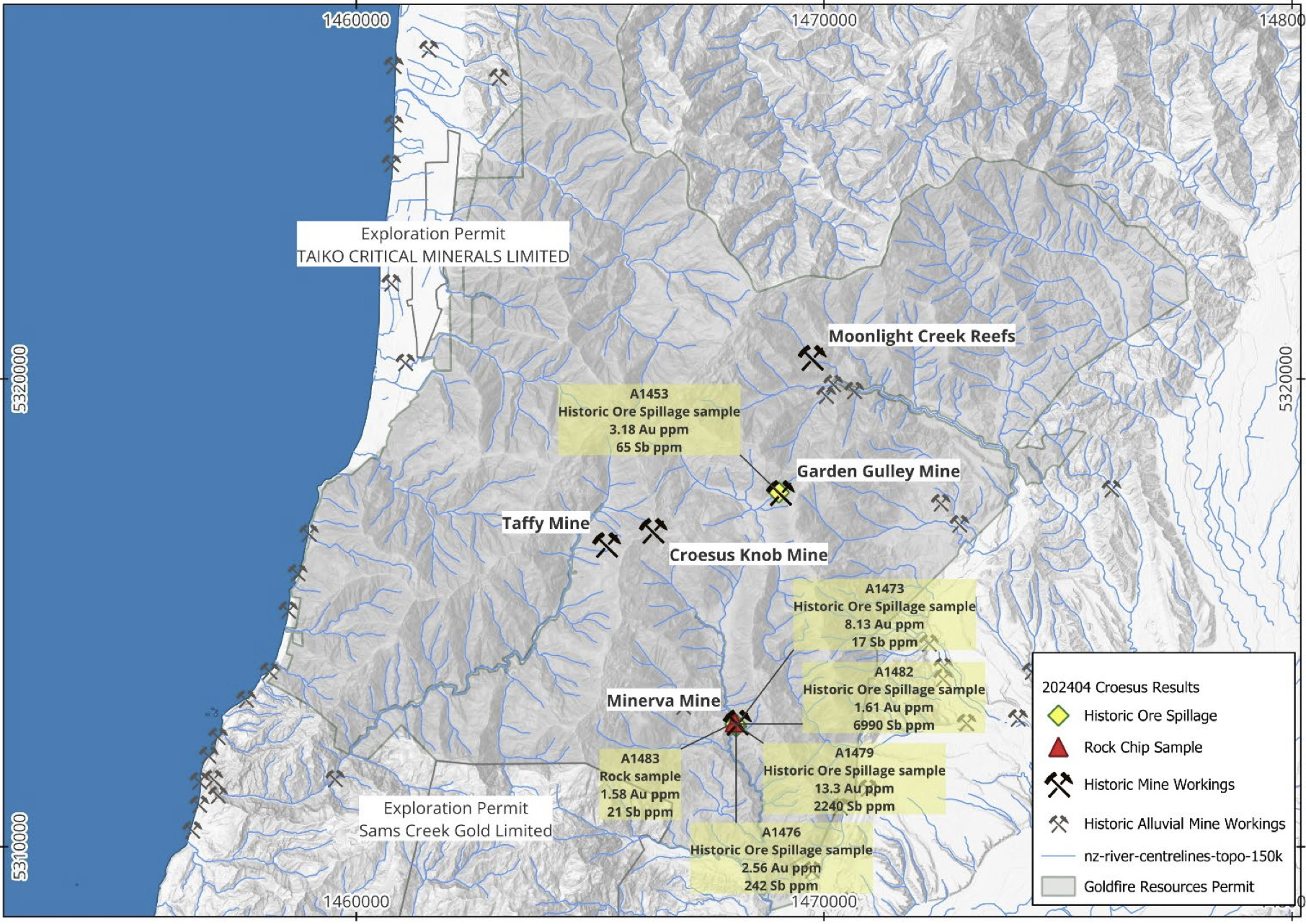
Croesus Project with rock-chip sample locations.
High-grade assays from historic workings
The strongest gold result came from a historic ore-spillage sample containing sulphides and stibnite, which returned 13.3g/t gold and 2,240ppm antimony.
Other notable assays included:
- 8.13g/t gold from a quartz sample containing pyrite;
- 2.56g/t gold and 242ppm antimony from quartz hosting sulphides, pyrite and possible galena; and
- 1.61g/t gold and 6,990ppm antimony from quartz containing chalcopyrite, stibnite and pyrite.
While the highest grades were recorded from ex-situ material associated with historical mining and ore handling activities, the company said these samples provide valuable vectors towards potential bedrock sources of mineralisation rather than representing in-situ grade or continuity.
Bedrock mineralisation supports exploration model
Importantly, Critical Resources also identified gold mineralisation in bedrock, with in-situ sample A1483 returning 1.58g/t gold from quartz-carbonate stockwork hosted in heavily altered Greenland Group rocks.
The result demonstrates gold mineralisation remains preserved within the bedrock system rather than being confined to transported material associated with historic mining activities.
Management said the combination of high-grade gold-antimony assays around historical workings and anomalous gold in bedrock validates its interpretation of a structurally controlled mineralised corridor extending along the Croesus-Minerva trend.
Antimony adds strategic value
Alongside gold, the presence of antimony is attracting increasing attention due to tightening global supply and growing strategic importance.
Antimony has been designated a critical mineral by Australia, the United States and the European Union and is included as a priority resource under Australia's Critical Minerals Strategy 2025-2030. The market has experienced significant supply constraints following Chinese export controls introduced in 2024.
New Zealand has also identified gold-antimony mineralisation within the Reefton Goldfield as a priority area for critical minerals development, enhancing the project's relevance beyond its gold potential.
Follow-up work planned
The company is now advancing the project toward a more systematic exploration phase aimed at identifying the source structures responsible for the mineralisation.
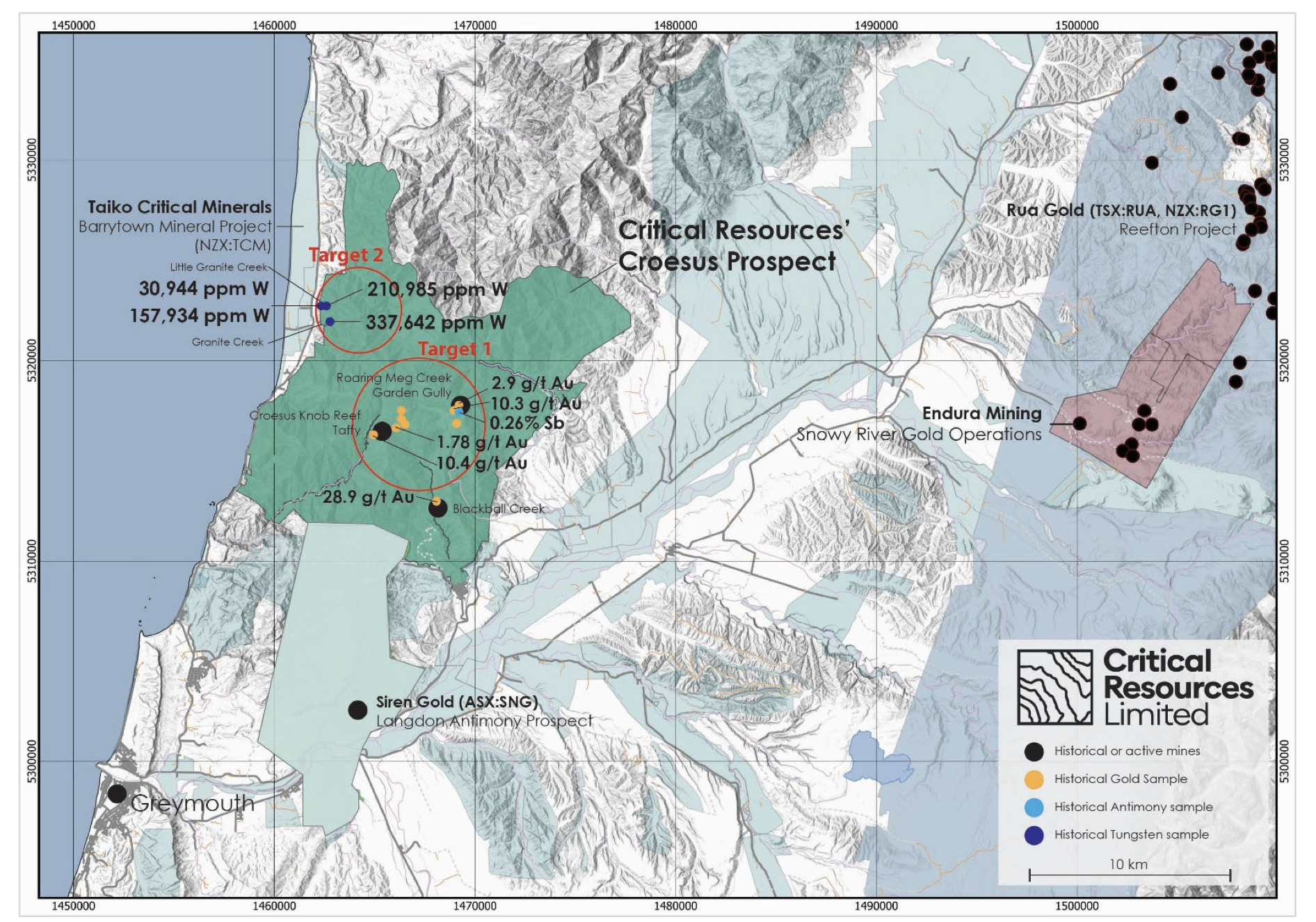
Location Map of Croesus Prospecting Permit in the Reefton Goldfield region, with legacy sampling.
Planned work includes detailed geological and structural mapping of quartz-sulphide vein systems, systematic in-situ rock-chip and channel sampling, further investigation around historical workings and haulage routes, integration of gold-antimony geochemical data and ranking targets for future trenching and drilling.
Critical Resources is also awaiting assay results from its separate Granite Creek tungsten target, another critical minerals prospect within the broader Croesus project area.
Expansion in Ontario
Critical Resources is active across its project portfolio, having recently expanded the footprint of pegmatite mineralisation at its wholly owned Mavis Lake Lithium Project in Ontario after identifying 14 pegmatite bodies, including six previously unmapped occurrences, during a field exploration program at the Corona target.
The discoveries extend known pegmatite mineralisation across the northern Mavis Lake corridor and have generated a growing pipeline of drill targets ahead of the company's planned 2026 Northern Prospects drilling campaign.
The 10-day field program focused on the Corona Pegmatite Field and nearby northern target areas, about 4 kilometres north of Mavis Lake's existing mineral resource of 8.0 million tonnes at 1.07% lithium oxide (Li₂O). Exploration activities included systematic prospecting, geological mapping and structural analysis, resulting in the collection of 106 rock samples, 161 outcrop maps and 74 structural measurements.
Managing director Tim Wither said the work continued to highlight the scale of the opportunity within the northern portion of the project, which remains relatively underexplored compared with the broader Mavis Lake lithium-caesium-tantalum (LCT) pegmatite system.