
Critical Resources Ltd (ASX:CRR, FRA:9S70) has identified and sampled 14 pegmatite bodies, including six previously unmapped occurrences, during a field exploration program at the Corona target within its 100%-owned Mavis Lake Lithium Project in Ontario, Canada.
The results expand the known extent of pegmatite mineralisation across the northern Mavis Lake corridor and provide a growing pipeline of targets ahead of the company's planned 2026 Northern Prospects drilling campaign.
The 10-day program covered the Corona Pegmatite Field and adjacent northern target areas, located about 4 kilometres north of the project's existing 8.0-million-tonne resource grading 1.07% lithium oxide (Li₂O). Field teams completed systematic prospecting, geological mapping and structural data collection, generating 106 rock samples, 161 outcrop maps and 74 structural measurements.
Critical Resources managing director Tim Wither said the northern corridor remained significantly underexplored relative to the broader scale of the Mavis Lake lithium-caesium-tantalum (LCT) pegmatite system.
"This program has confirmed that — 14 pegmatite bodies identified, six of them new, across ground that had not been systematically prospected," he said.
"That's exactly the kind of result that sharpens our targeting and builds confidence ahead of drilling."
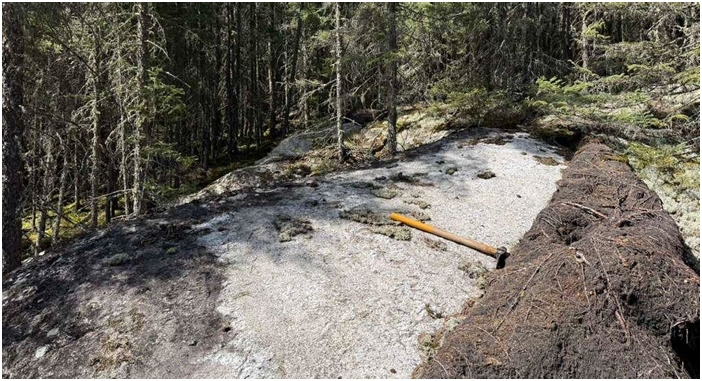
Newly identified concealed pegmatite at the Corona target area.
Assays to guide next drill targets
The company has submitted all 106 rock samples for geochemical analysis, with results expected within three to four weeks.
The assays will help determine the fertility and prospectivity of the identified pegmatites, with particular focus on lithium pathfinder elements including rubidium, caesium and tantalum, which can indicate more evolved and potentially lithium-bearing portions of a system.
Critical Resources said the assay results would be integrated with existing geological, geochemical and geophysical datasets to rank exploration targets and prioritise future drilling across the northern corridor.
The company also identified a potential new follow-up target south of the Northern Prospect area, where coarse-grained, well-developed pegmatites coincide with previously recorded anomalous lithium responses.
Building a multi-deposit lithium district
The Corona target lies within the same broader pegmatite corridor that hosts the Mavis Lake Main Zone deposit and is considered one of the least systematically explored parts of the district.
Critical Resources believes the area may form part of a broader pegmatite trend extending about 5 kilometres north of the existing resource. Recent fieldwork confirmed multiple pegmatite occurrences across the target area and surrounding northern prospects, supporting the company's interpretation of a larger mineralised corridor.
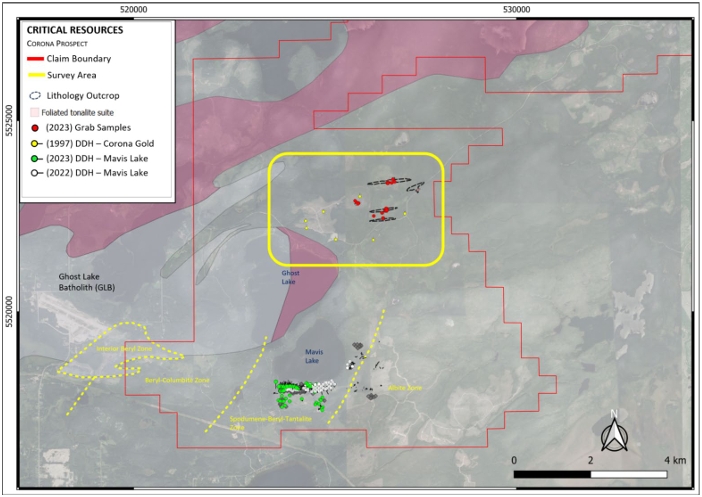
Corona Pegmatite Field with traced out pegmatites and historical drill collar locations shown in yellow. The target area lies within the interpreted Spodumene-Beryl-Tantalite Zone trend.
The work forms part of a broader strategy aimed at expanding Mavis Lake beyond a single deposit.
Among the most advanced northern targets is the Gullwing pegmatite, which hosts an exploration target of 7 million-10 million tonnes grading 0.3-1.2% Li₂O. Gullwing has a surface expression up to 80 metres wide and around 500 metres long, with spodumene mineralisation already confirmed through historical exploration.
The Northern Prospects portfolio also includes Tot, Little Wing, Coates, Drope and Corona, which together underpin the company's vision of developing a multi-deposit lithium district in northwestern Ontario.
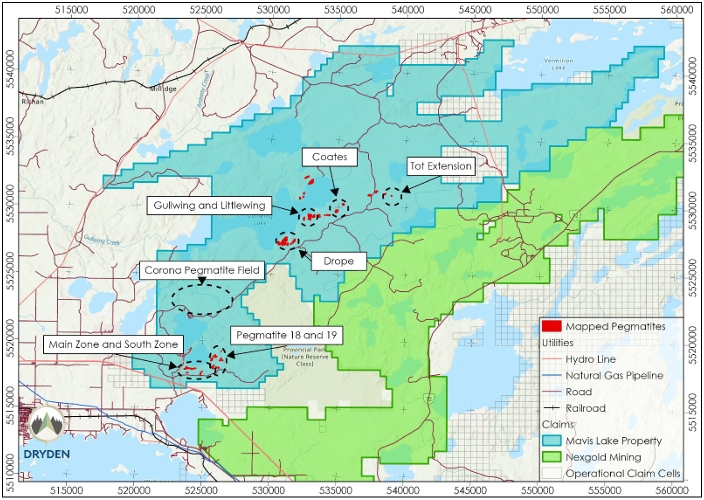
Mavis Lake Property Map with regional targets that require further exploration work.
Lithium strategy extends beyond mining
The latest exploration update follows a series of initiatives designed to strengthen Critical Resources' position across the broader lithium value chain.
Last month, the company reported encouraging results from its solid-state battery technology program in the United States, including a sulphur-free electrolyte that delivered room-temperature performance comparable with leading sulphide-based solid-state battery systems.
Critical Resources is pursuing what it describes as a mine-to-market strategy, combining upstream lithium development at Mavis Lake with downstream battery technology research through partnerships including the South Dakota School of Mines & Technology.
With assay results expected later this month, the company is preparing to refine drill targets across the northern corridor as it continues evaluating opportunities to grow the Mavis Lake project beyond its current 8.0Mt resource base.