
AuKing Mining Ltd (ASX:AKN) says a recently completed airborne survey has revealed that its Tundulu Rare Earths Project in Malawi hosts a much larger carbonatite system than previously recognised, identifying multiple new drill targets ahead of a major exploration campaign.
The high-resolution drone-based magnetic and LiDAR survey has confirmed that historical drilling at Tundulu focused on only a small portion of a broader intrusive complex centred on Nathace Hill, with significant areas of the system remaining unexplored beneath shallow sedimentary cover.
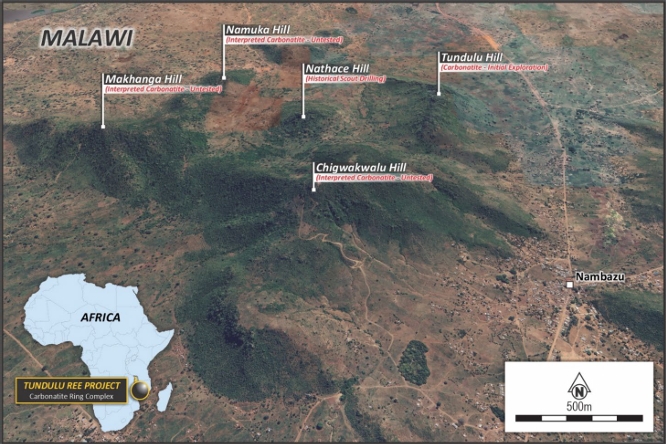
Tundulu Project, highlighting the location of the main target area for drilling at Nathace Hill and nearby Tundulu Hill.
Results from the survey come as AuKing begins mobilising drilling equipment for a planned 10,000-metre reverse circulation (RC) and diamond drilling program and finalises alternative arrangements to maintain access to the project while regulatory approvals continue in Malawi.
“The airborne survey has significantly enhanced our understanding of the scale and architecture of the Tundulu carbonatite system,” AuKing managing director Paul Williams said.
“Importantly, it confirms that historical exploration has tested only a relatively small portion of what now appears to be a much larger intrusive complex,” he added. “The survey has identified multiple new geophysically defined drill targets beneath shallow cover while also highlighting significant expansion potential around known mineralisation at Nathace Hill.”
New targets emerge beneath cover
AuKing said interpretation of the magnetic data outlined a structurally coherent alkaline-carbonatite intrusion spanning about 3 kilometres, with ring-style intrusive features and structural corridors that may control rare earth mineralisation.
The survey identified multiple untested intrusive margins, structural corridors and possible demagnetised zones that have now been prioritised for drilling. According to the company, these targets sit beneath shallow post-mineral sedimentary cover that has seen little or no historical exploration.
An independent review of the survey data was completed by a former chief geophysicist from Rio Tinto's global exploration group, who validated the company's interpretation of the airborne dataset and contributed to recommendations for future work.
AuKing believes the results strengthen the case that known mineralisation at Nathace Hill may represent only part of a substantially larger rare earth system. The company said the survey has shifted its understanding of Tundulu from a historically surface-focused rare earth occurrence to a large-scale alkaline-carbonatite system containing multiple exploration targets.
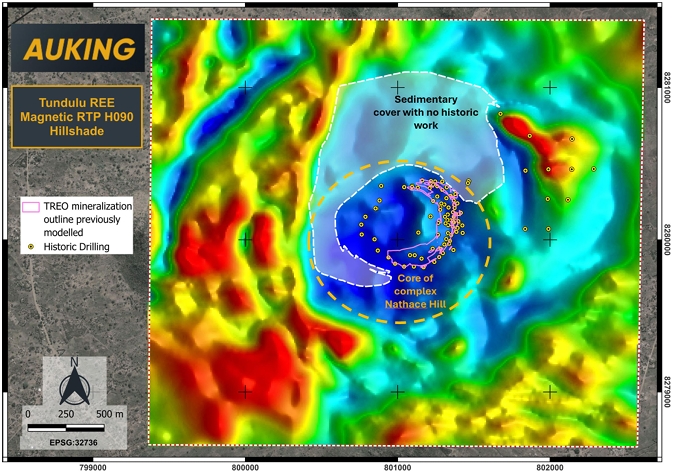
Interpreted significant extensions of known mineralisation corridors surrounding Nathace Hill.
Drilling program ramps up
The new geophysical data has already been incorporated into the design of AuKing's upcoming drilling campaign, which will target extensions to known mineralisation as well as newly identified geophysical anomalies.
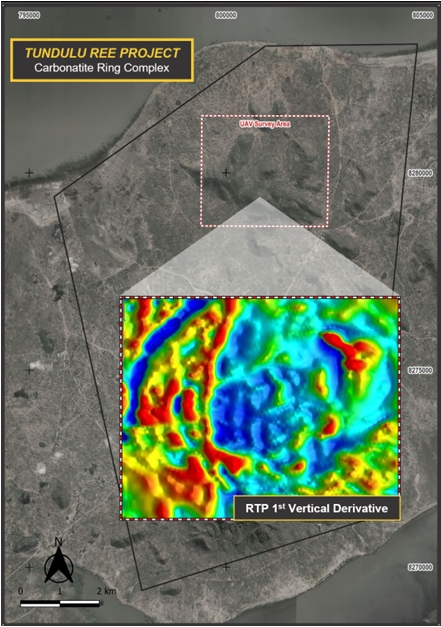
Location of the survey and first vertical derivative RTP1 magnetic results.
Southern African contractor Thompson Resources has been appointed to undertake the drilling program, with an RC rig now being mobilised to site and a diamond rig expected to follow later this month.
The initial program is planned to test about 50 targets through a combination of RC and diamond drilling, although provisions have been included to expand the campaign if warranted by results.
Priority holes at Nathace Hill will test southwest and southern extensions to known mineralisation corridors, while also validating historical drilling and assessing depth continuity.
Alternative pathway secured as licence transfer reviewed
Separately, AuKing provided an update on the transfer of the Tundulu exploration licence to its subsidiary, Tundulu Rare Earths Limited (TREL). The company said all documentation required by Malawi's Mining and Minerals Regulatory Authority (MMRA) has been lodged and remains under review.
To ensure exploration activities can continue while the approval process is completed, AuKing has entered into an earn-in agreement with Tusker Minerals Ltd (ASX) and its Malawi subsidiary Green Exploration Limited. The arrangement provides AuKing with a contractual pathway to acquire 100% of the Tundulu licence and authorisation to carry out exploration activities pending final transfer approvals.
The earn-in terms broadly mirror the acquisition structure previously announced by the company, including staged cash payments and share consideration tied to project milestones. A key performance hurdle involves defining a JORC-compliant resource of at least 25 million tonnes grading 1.25% total rare earth oxide (TREO).
Williams said the earn-in agreement would allow the company to maintain momentum as drilling preparations advance.
“With drilling preparations now under way and an earn-in agreement in place providing operational access to the project, we look forward to rapidly advancing Tundulu and evaluating the broader rare earth potential of this highly prospective carbonatite system,” he said.