
Large, shallow copper sulphide discoveries in established mining jurisdictions are becoming increasingly difficult to find — particularly ones with existing drilling, nearby infrastructure and clear room for expansion.
That scarcity is helping drive renewed attention towards overlooked copper systems across Canada, where explorers are revisiting historical projects amid rising long-term demand expectations tied to electrification, energy infrastructure and industrial supply constraints.
For Aruma Resources Ltd (ASX:AAJ), the opportunity has accelerated a stronger focus on copper growth in 2026.
After spending recent years building a broader Australian exploration portfolio, the junior explorer is now centring its attention on the Tillex Copper Project in Ontario — a shallow high-grade copper-silver system in the prolific Timmins mining district with more than 10,000 metres of historical drilling already completed. Since acquiring the project in February 2026, Aruma’s early work has identified electromagnetic (EM) conductors that could materially expand the scale of the known copper system.
What appears to have particularly attracted Aruma is the combination of grade, shallow mineralisation and untapped strike potential — qualities becoming harder to secure in mature mining regions.
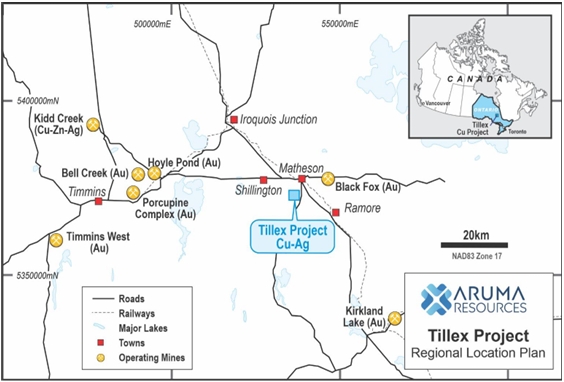
Project Location & Infrastructure
A shallow copper system with scale already emerging
Tillex is not an early-stage conceptual target.
The project was originally discovered in 1973 and later advanced through multiple drilling campaigns by TSX-V-listed Metals Creek Resources, which completed more than 10,283 metres of diamond drilling across the system after acquiring the project in 2008.
That work consistently intersected broad zones of copper sulphide mineralisation from relatively shallow depths.
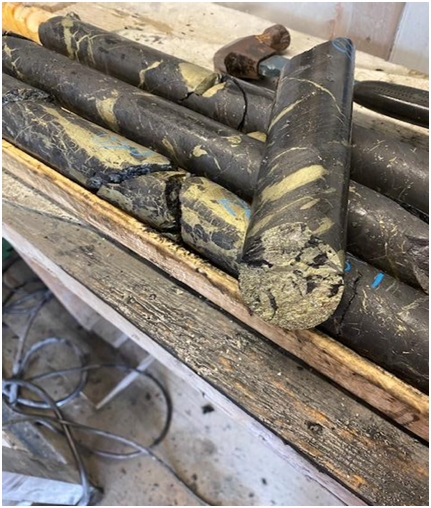
Historical Drilling Significant Intersection TX24-020 76.50 to 82.25m
Among the standout historical results were:
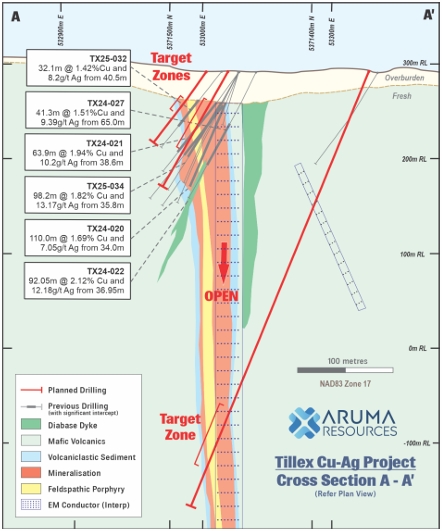
- 110 metres at 1.69% copper and 7.05 g/t silver from 34 metres, including 29 metres at 2.64% copper and 12.31 g/t silver;
- 98.2 metres at 1.82% copper and 13.17 g/t silver from 35.8 metres;
- 92.05 metres at 2.12% copper and 12.18 g/t silver from 36.95 metres, including 29 metres at 3.26% copper and 20.92 g/t silver;
- 42.46 metres at 2.12% copper and 53.45 g/t silver from 53.77 metres, including 5 metres grading 5.55% copper and 355.3 g/t silver.
Several of the intercepts also include high-grade silver credits, adding another layer of potential value to the mineralised system.
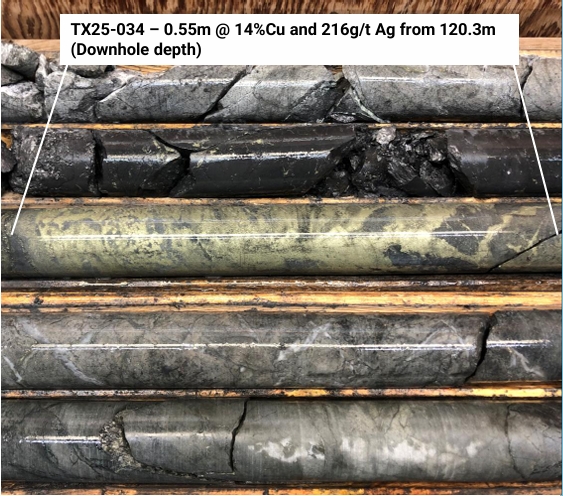
Importantly, the mineralisation begins from roughly 30 metres below surface and has only been drill-tested to around 150 metres depth so far.
Despite that relatively limited drilling depth, Aruma says high-grade copper has already been defined over about 450 metres of strike and remains open in multiple directions, including at depth.
The combination of shallow mineralisation, broad intercepts and open-ended geometry is one reason the company believes the project still has considerable room for expansion.
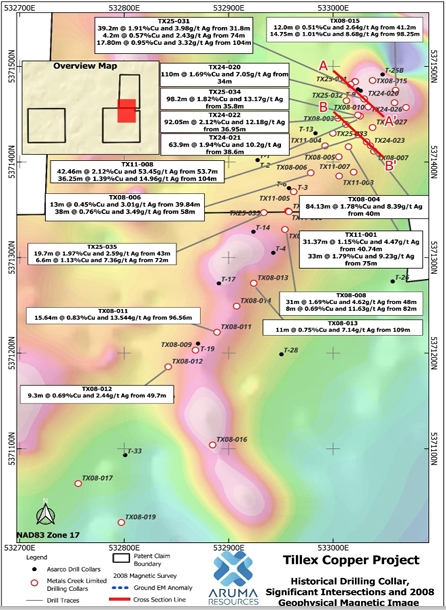
Plan view; high-grade copper & silver drilling intersections
Timmins location offers strategic advantages
The project’s location may prove just as important as the drill results themselves.
Tillex sits around 57 kilometres east of the city of Timmins in Ontario and roughly 60 kilometres from Glencore’s Kidd Creek copper operation, one of Canada’s best-known base metals mines.
The broader Timmins district has historically been associated more closely with gold mining, but it also hosts volcanogenic massive sulphide (VMS) and strata-bound copper systems.
For a junior explorer, operating within an established mining region carries several advantages:
- existing roads and power infrastructure;
- access to skilled mining labour and contractors;
- clearer permitting pathways; and
- proximity to processing and transport networks.
Aruma says the project already has year-round highway access and direct access to power at the claim boundary.
The company also notes that Tillex sits on patented claims, meaning it holds both land ownership and underlying mineral rights across the project area, with First Nations agreements already in place over acquired property. That can simplify exploration activity compared with projects requiring more complex land access negotiations.
EM survey expands the exploration picture
While the historical drilling established the presence of a significant copper-silver system, Aruma’s recent EM survey appears to have strengthened the case for broader scale potential.
The company says the survey identified two major conductive zones across the project area. The first — referred to as the Main Conductor — aligns with the existing Tillex deposit and extends over roughly 600 metres of strike while continuing to depths exceeding 400 metres.
That is significant because previous drilling only tested mineralisation to around 150 metres’ depth.
The second target, known as the East Conductor, sits immediately east of the existing deposit and has emerged as a potentially important parallel structure. Aruma says it displays strong conductivity over more than 200 metres of strike and remains open at depth.
In practical terms, the survey suggests the known copper system may represent only part of a larger mineralised corridor.
Managing director Grant Ferguson has pointed to the possibility of discovering additional strata-bound or VMS-style copper mineralisation both along strike and deeper within the system.
That potential for repeat structures is a major part of the company’s exploration thesis moving forward.
Drilling campaign now under way
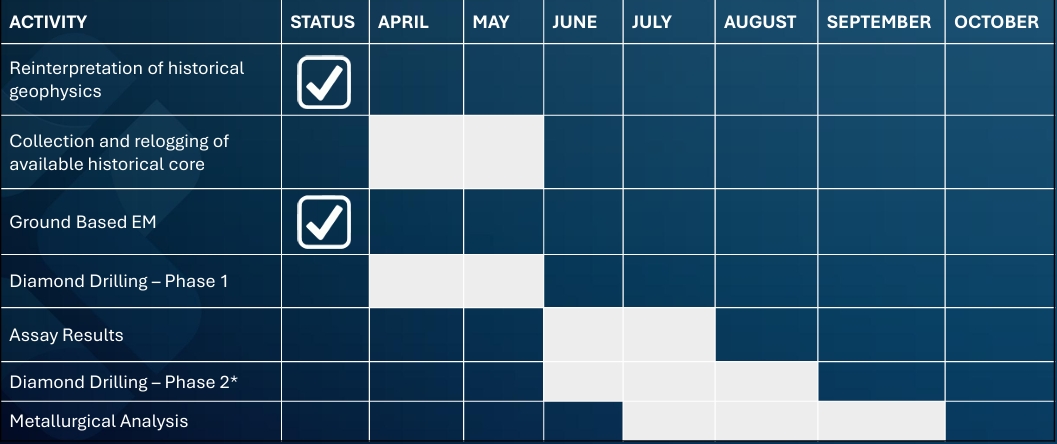
Aruma moved quickly after completing the Tillex acquisition in February, launching a maiden drilling campaign in April.
The initial program comprises about 1,500 metres of diamond drilling designed to test both strike extensions and deeper targets highlighted by the EM work.
The company is targeting extensions of the known copper footprint along strike while also testing mineralisation down to roughly 400 metres’ depth — around 250 metres below the deepest existing copper intersections.
Aruma expects initial assay results from the first phase of drilling during May, with a second phase planned later in 2026 depending on results and field observations.
The company describes its approach as a dual exploration and resource development strategy, focused on:
- expand the known mineralised footprint;
- test for parallel copper-bearing structures; and
- work towards defining a maiden Mineral Resource Estimate.
The combination of near-surface mineralisation, existing drilling density and expanding EM targets gives the company multiple avenues to grow the project beyond its current footprint.
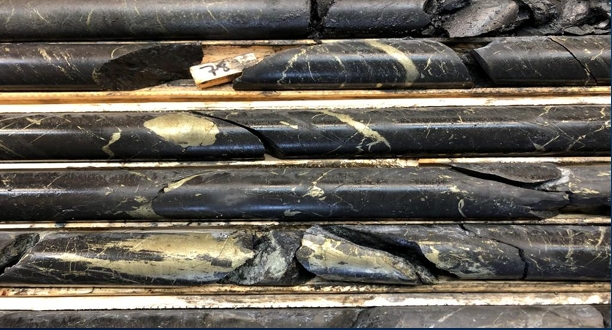
Diamond drill core from TX24-020. 77m to 83m Downhole Depth
Copper market dynamics may strengthen the backdrop
Aruma’s timing also coincides with surging copper prices and renewed attention on global supply constraints.
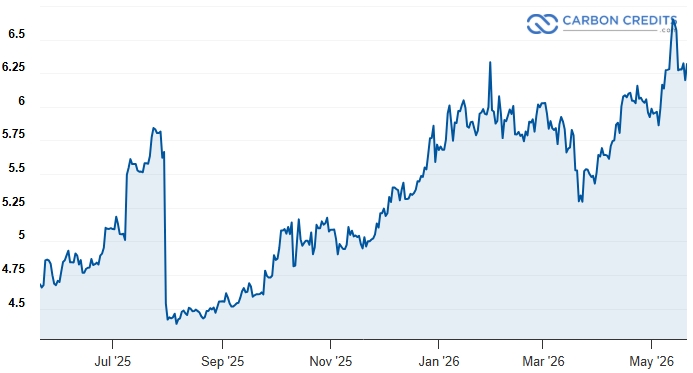
Copper Price (Source: CarbonCredits.com)
Major miners, governments and commodity analysts have increasingly warned that the industry faces a shortage of new large-scale copper projects capable of meeting long-term electrification demand.
At the same time, many existing copper mines globally are ageing, grades are declining and new discoveries are becoming more difficult and expensive to develop.
That has helped drive stronger investor interest in projects located in stable jurisdictions with existing infrastructure and demonstrable sulphide mineralisation.
Tillex still remains firmly in the exploration stage, and substantial drilling and technical work will be required before the project can move towards formal resource definition or economic studies.
But the ingredients attracting market attention to Aruma and its Canadian project are increasingly visible:
- shallow high-grade copper intersections;
- strong silver credits;
- large open-ended conductors;
- established infrastructure; and
- a location within one of Canada’s best-known mining districts.
For a company with a market capitalisation still sitting below $10 million, the next phase of drilling could play an outsized role in determining whether Tillex evolves from a promising copper acquisition into a materially larger development story.
Works Program