
Elixir Energy Ltd (ASX:EXR, OTC:ELXPF) has confirmed Diona-1 as an official gas discovery in Queensland’s emerging Taroom Trough play, with the well meeting its key exploration objectives and paving the way for a new independently certified Contingent Resource estimate.
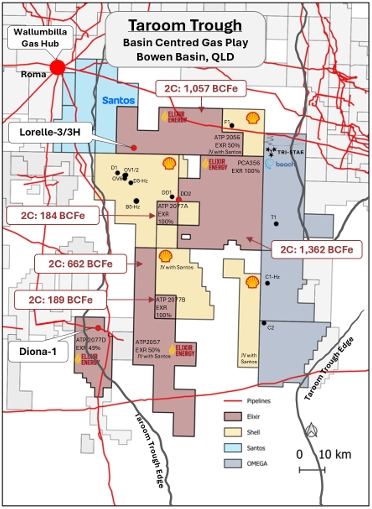
The ASX-listed company said the Diona-1 vertical exploration well had confirmed the presence of a recoverable overpressured Permian gas and condensate resource with low hydrocarbon impurities, extending the recognised western boundary of the Taroom Trough basin-centred gas play.
Diona-1 continues to flow gas during the current clean-up and flow-back phase, with produced gas being flared at surface while the joint venture works to recover remaining stimulation fluids from the well.
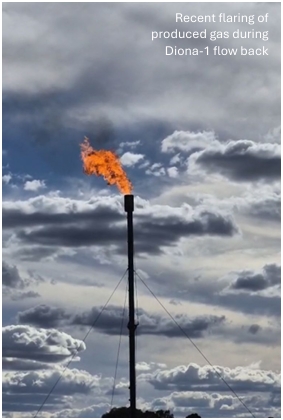
The update follows recent stimulation and flow-back operations at the well, which Elixir previously described as an important step in evaluating the commercial potential of the project.
Discovery expands Taroom Trough position
Elixir said the Diona sub-block would now be incorporated into its broader Taroom Trough portfolio, increasing its net acreage position by about 184 square kilometres, or 45,000 acres. That lifts the company’s total net acreage in the play to roughly 548,000 acres, which it says is the largest position in the basin.
The company said measurements and observations from the well were consistent with the broader basin-centred gas setting being targeted across the Taroom Trough. Elixir now plans to model potential horizontal drilling scenarios and associated production rates and recoverable resources while progressing an independently certified contingent resource assessment.
Field testing has also confirmed negligible impurity levels in the produced gas, with Elixir reporting 0% carbon dioxide and no detectable hydrogen sulphide.
Flow-back operations still underway
While gas production has continued throughout testing, the well has so far recovered about 45% of the total injected stimulation fluid. Elixir said Diona-1 was intermittently recovering additional fluid as reservoir pressure continued pushing fluids back towards the well bore.
The company said operational teams had been varying choke and flow settings to encourage further fluid recovery and were now evaluating artificial lift options to accelerate the process. Elixir believes once about 50–60% of injected fluid is recovered, reservoir back pressure should reduce sufficiently for the well to naturally lift remaining fluids and potentially increase gas production rates.
Managing director and chief executive officer Stuart Nicholls said the well had already delivered a significant exploration outcome despite still being in the clean-up phase.
“Diona-1, now officially a discovery, has successfully extended the Taroom Trough westerly boundary, and we now include this area in our primary portfolio,” Nicholls said.
“This unoptimised vertical exploration well continues to show encouraging results and flows which may improve significantly once back pressure is reduced sufficiently from the remaining stimulation fluids,” he added.
Existing infrastructure nearby
Diona-1 sits between the Silver Springs Gas Plant and the Waggamba gas field in Queensland’s Surat-Bowen Basin, immediately adjacent to existing gas infrastructure. Elixir noted the Waggamba pipeline lies less than 100 metres from the well pad, with a tie-in point about 1 kilometre away, potentially offering a relatively rapid commercialisation pathway if sufficient flow rates are achieved.
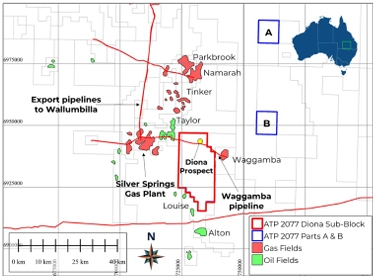
The pipeline connects through the Silver Springs Gas Plant into the Wallumbilla Gas Hub, one of eastern Australia’s key gas trading and pricing centres.
“Given the proximity to the pipeline, it is worth persisting in pursuit of this objective whilst working on the booking of a new Contingent Resource which reflects the success of the campaign to date,” Nicholls said.