
Surefire Resources NL (ASX:SRN, FRA:GBL) has reported a new round of high-grade gold results from surface sampling at its Yidby Gold Project in Western Australia, extending the footprint of mineralisation at the emerging Loot prospect.
The latest assays, drawn from follow-up float rock sampling along strike, returned gold grades of up to 13.19 g/t, reinforcing the prospectivity of what the company has described as a newly recognised style of mineralisation hosted in albitite rocks.
The results build on earlier March sampling at Loot and form part of a broader effort to better define the scale and orientation of gold mineralisation across the Yidby project, located in the Mid West region of WA.
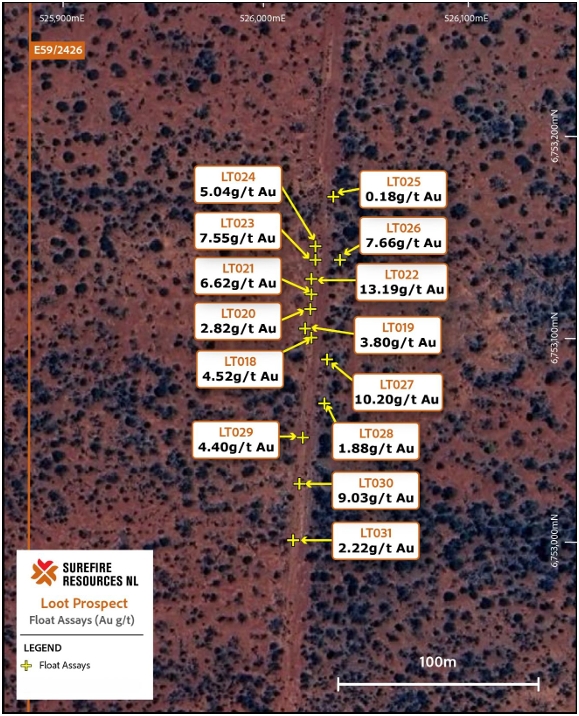
Float rock sampling exploration at the Yidby Loot Prospect was initially implemented in February 2026 (ASX release 26.3.2026), the results of which provided exceptional gold grades in an unexceptional looking Albitite rock.
High-grade surface results extend mineralised zone
Sampling along a 165-metre strike length returned a consistent spread of gold values, with multiple assays exceeding 5 g/t and several above 10 g/t. Key results included:
- 13.19 g/t gold from sample LT022
- 10.20 g/t gold from sample LT027
- 9.03 g/t gold from sample LT030
- 7.66 g/t gold from sample LT026
- 7.55 g/t gold from sample LT023
Most samples within the newly identified albitite lithology returned anomalous gold values, suggesting a potentially coherent mineralised system rather than isolated occurrences.
The company noted that this style of mineralisation — gold hosted in albitite — has historically been associated with major gold systems across Western Australia, including deposits in the Kalgoorlie region.
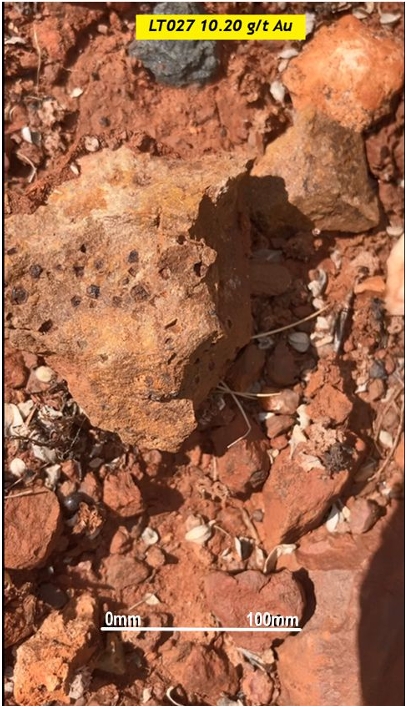
Rock sample LT027 displaying Euhedral sulphide casts providing a gold grade of 10.20 g/t Au.
New geological model emerging
Surefire said the identification of albitite-hosted gold represents a shift in understanding at Yidby, with the rock type forming through hydrothermal alteration processes linked to fluid pathways such as faults and shear zones.
According to the company, gold mineralisation at Loot and the nearby Cashens Find prospect occurs within a highly altered, fine-grained albitite unit containing sulphide textures, indicating potential for both strike and depth extensions.
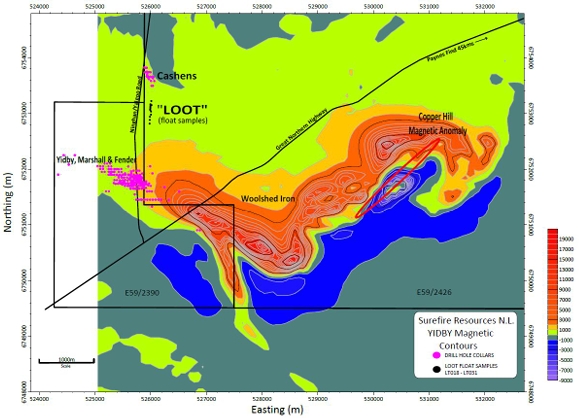
Surefire’s Yidby Gold Project displaying Magnetics and additional mineralisation (Woolshed Iron & Copper Hill).
Importantly, historical workings at Cashens — including a shallow open pit mined in the 1970s — are now believed to also contain previously unrecognised albitite mineralisation, pointing to a broader mineralised corridor.
The company also highlighted that traditional soil geochemistry may not adequately detect this style of mineralisation due to transported overburden, suggesting geophysical methods could play a larger role in targeting.
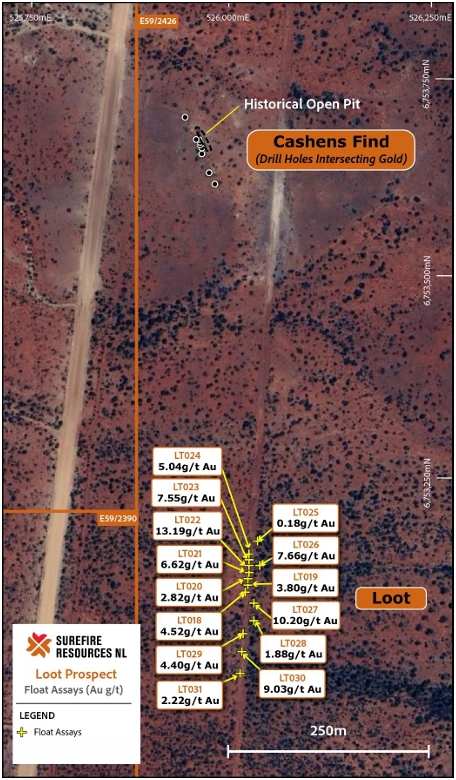
Plan showing the proximity of the Loot Prospect to the Cashens (1975) open pit.
Expanding exploration footprint
The Loot prospect sits within Surefire’s broader Yidby project, which hosts multiple gold targets including Cashens, Fender, Marshall and Copper Hill.
Loot is positioned along a structural corridor linking several anomalous zones, reinforcing the potential for a larger mineralised system across the project area.
Surefire indicated that further work will focus on defining the geometry and continuity of mineralisation, with follow-up drilling planned once all assay results are compiled.
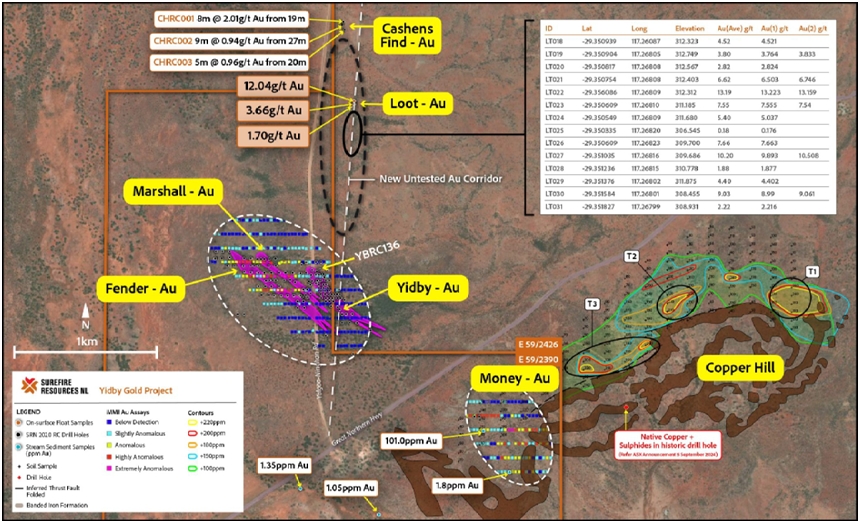
The Yidby Gold Project – Gold projects anomalies and Copper Hill in plan view.
The latest results add momentum to exploration at Yidby, where the company has been steadily building a geological model around both conventional orogenic gold systems and this emerging albitite-hosted mineralisation style.
With high-grade surface results now confirmed over a growing strike extent, upcoming drilling will be critical in determining whether Loot can transition from an early-stage discovery into a more defined gold resource.