
Sovereign Metals Ltd (ASX:SVM, OTCQX:SVMLF, AIM:SVML, FRA:SVM) has laid out the full scale of its Kasiya rutile-graphite project in Malawi, with a definitive feasibility study (DFS) pointing to a long-life, low-cost operation that could reshape supply across two critical minerals markets.
The DFS delivers a pre-tax net present value (NPV₈) of US$2.2 billion and steady-state annual EBITDA of US$476 million, alongside a 25-year mine life and robust projected cash flows.
It also sharpens the project’s strategic edge — positioning Kasiya as a potential world-leading producer of both natural rutile and flake graphite at a time when Western supply chains are actively looking for alternatives.
Scale and economics come into focus
The DFS brings together several years of work into a single, bankable development plan, with metrics that place Kasiya firmly in the top tier of undeveloped projects globally.
- Pre-tax NPV₈ of US$2.2 billion and internal rate of return (IRR) of 23%
- Annual revenue of about US$728 million and free cash flow of US$452 million (pre-tax, unlevered)
- Initial capex of US$727 million to first production
- Life-of-mine revenue of US$16.2 billion over 25 years
- Operating costs of around US$450 per tonne (FOB Nacala)
Development is staged, starting with a 12-million-tonnes-per-annum (Mtpa) operation before doubling capacity from year five — a structure that helps manage up-front capital while preserving long-term scale.
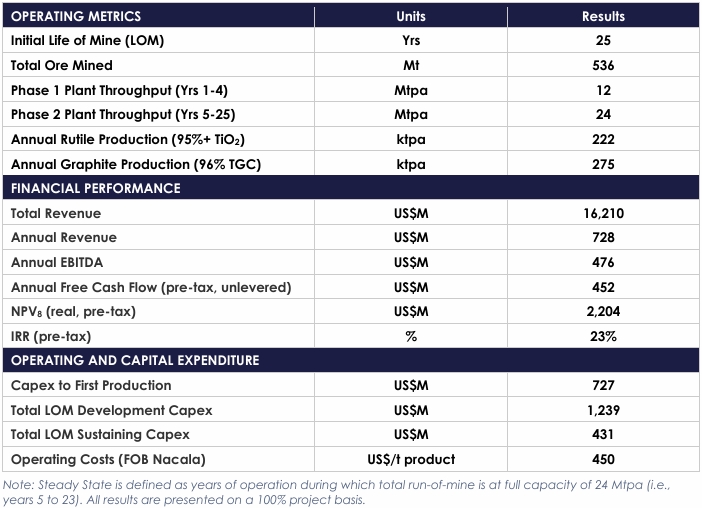
Key DFS Metrics (Steady State).
A rare combination: Scale, cost and product mix
Kasiya’s edge lies in the combination rather than any single metric.
At steady state, the project is expected to produce about 222,000 tonnes per annum of rutile and 275,000 tonnes per annum of graphite — volumes that would place Sovereign among the largest global producers of both materials.
Rutile, the highest-grade titanium feedstock, is facing a tightening supply outlook as existing operations wind down and few new projects emerge. At the same time, demand remains tied to high-spec applications across aerospace, defence and industrial markets.
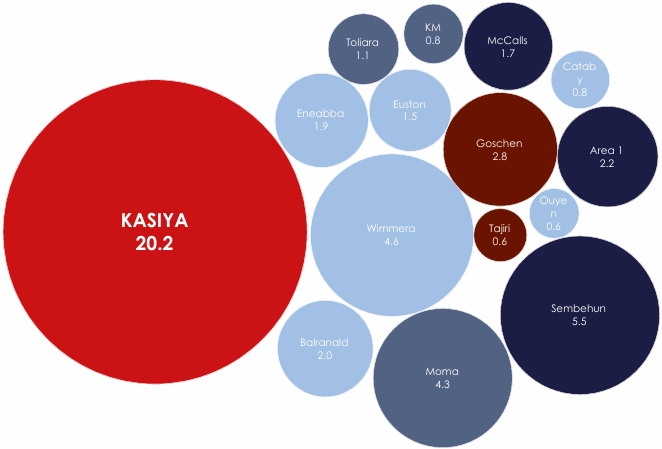
Kasiya contained rutile resource vs. other rutile-bearing titanium deposits (Mt).
Graphite tells a different story, but with similar strategic implications. The market remains heavily dominated by China, particularly in battery anode supply, leaving Western economies scrambling to diversify.
Here, Kasiya stands out on cost. The DFS estimates graphite production at around US$216 per tonne — positioning it at the low end of the global cost curve, even against Chinese supply.
That advantage is driven by the project’s co-product nature, with graphite effectively produced alongside rutile from a soft, free-dig orebody and a relatively simple flowsheet.
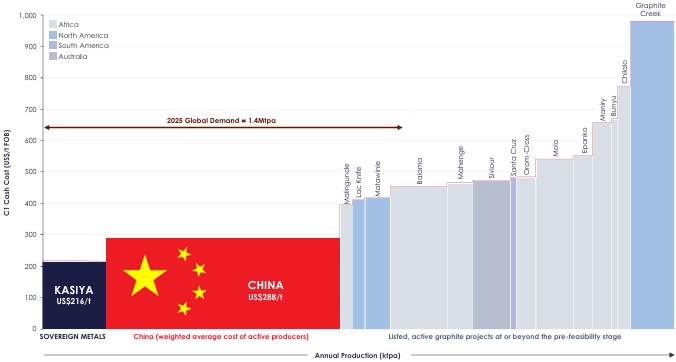
Natural flake graphite C1 cash costs.
De-risked pathway backed by partners and trials
The study leans heavily on real-world data, incorporating results from large-scale pilot mining and rehabilitation programs completed with technical input from Rio Tinto.
These trials confirmed a dry mining approach using draglines and trucks — avoiding the need for drilling, blasting, or crushing and simplifying operations.
Infrastructure is another key pillar. Kasiya benefits from access to hydropower, established rail networks and the Port of Nacala, reducing both development complexity and operating risk.
On the commercial side, Sovereign has already secured non-binding offtake agreements covering more than half of stage one rutile output and over a third of graphite production, providing early validation from end users.
The project has also been aligned with International Finance Corporation standards, with the World Bank and IFC involved as potential financing partners — a step that adds weight to its development credentials.
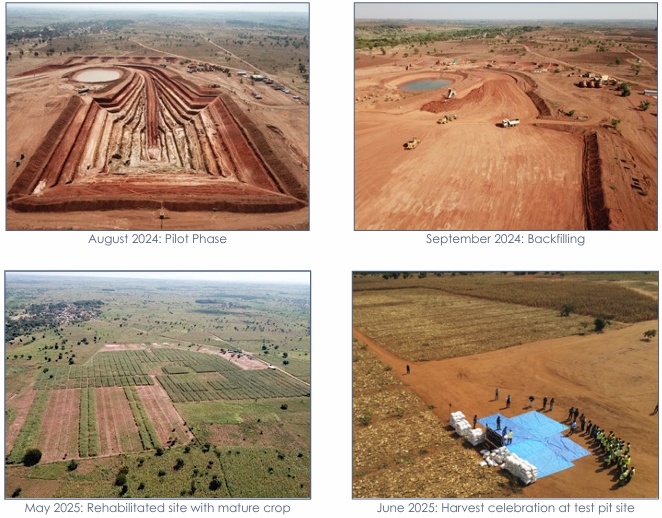
Pilot Mining Life Cycle.
Rehabilitation and design reduce long-term footprint
Environmental and social workstreams are embedded throughout the DFS, with pilot programs showing that mined land can be returned to productive use relatively quickly.
Rehabilitation trials delivered maize yields more than five times the local average within six months, supporting the case for progressive land restoration.
The project design also removes the need for a conventional tailings storage facility, instead using backfilling of mined-out pits — a shift that reduces both footprint and long-term risk.
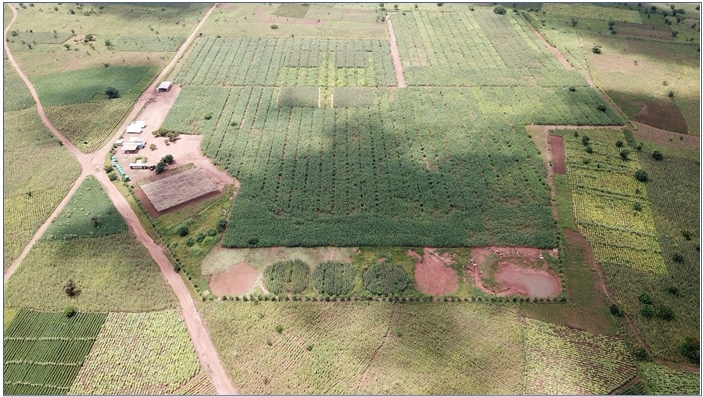
Rehabilitation Trial Site with Crops (Image Taken on 9 February 2026).
Additional upside still to be tested
Beyond rutile and graphite, Sovereign is assessing the potential for a third revenue stream from monazite concentrate, which contains valuable heavy rare earth elements.
These include dysprosium, terbium and yttrium — all of which face supply constraints and export controls — and could be recovered at minimal incremental cost.
A dedicated evaluation program is now under way to determine how material that opportunity could become.
A defining step towards development
The DFS marks a major step forward for Kasiya, pulling together scale, cost position and strategic relevance into a clearer development pathway.
For Sovereign, the focus now shifts from defining the project to executing it — with financing, approvals and final partnerships set to determine how quickly Kasiya moves from study to production.