
Sovereign Metals Ltd (ASX:SVM, OTCQX:SVMLF, AIM:SVML, FRA:SVM) says rehabilitation trials at its flagship Kasiya rutile-graphite project in Malawi are delivering strong agricultural and community outcomes, as the company advances critical workstreams underpinning its definitive feasibility study (DFS).
The company reported that its second year of pilot mining, backfilling and rehabilitation trials is nearing completion ahead of the upcoming harvest season, with results continuing to support the integration of mine closure and rehabilitation planning into the broader project development strategy.
The trials form a key component of the DFS, which is being progressed under the oversight of the Sovereign–Rio Tinto technical committee, and are designed to demonstrate that land can be returned to productive use following mining.
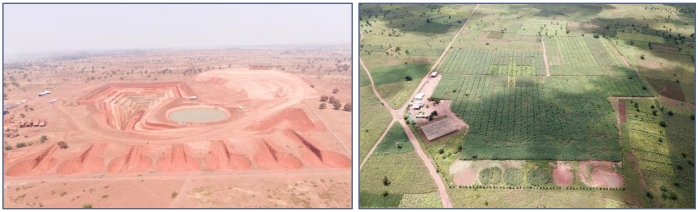
Pilot mining site post-mining and following rehabilitation.
Rehabilitation trials feed into DFS and project planning
Sovereign said empirical data gathered from the program has already been incorporated into its mine closure and rehabilitation plans, helping to de-risk the DFS and strengthen alignment with international environmental and social standards required for project financing.
Managing director and CEO Frank Eagar said the results highlight both the technical and social potential of the project.
“Sovereign’s primary objective is to deliver sustainable returns for all stakeholders, including shareholders and local communities,” he said.
“Not only will the overwhelming success and empirical data collected through this pilot mining and rehabilitation trial underpin the DFS accuracy, but it also demonstrates that land post-mining can be successfully rehabilitated and our ability to improve agricultural productivity.”
Strong uplift in crop yields
The rehabilitation trials have delivered a significant uplift in agricultural output, with first-year maize yields reaching 5.2 tonnes per hectare — around five times the regional average of 1 tonne per hectare.
Sovereign said this demonstrates that rehabilitated land can achieve superior productivity compared with pre-mining conditions, where soil fertility typically declines over time.
The program uses relatively simple and low-impact techniques, including lime, fertiliser and biochar application, alongside a no-tillage approach designed to preserve soil structure. Activities are carried out largely by hand, with no heavy machinery permitted on rehabilitated land, making the model accessible for local communities to adopt long term.
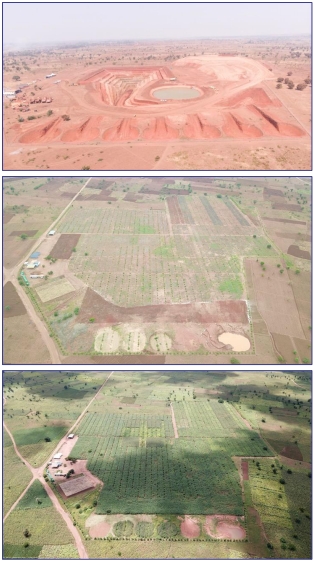
Images showing the progression of mining, backfilling and rehabilitation at Sovereign's Rehabilitation Trail Site.
Second-year crop yields are expected to match the first-year benchmark when harvested in mid-2026, reinforcing confidence in the repeatability of the results.
The trials have also evolved into a diversified multi-cropping system, combining maize with bamboo, winter beans, groundnuts and fodder crops. Sovereign said the intercropping approach supports year-round productivity while improving soil health and providing a broader mix of food and income sources for local farmers.
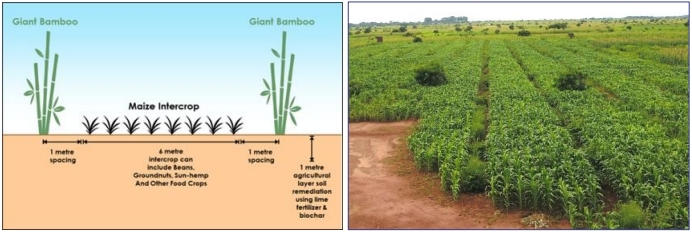
Bamboo and maize intercropping system & Sovereign's rehabilitation showing maize intercropped with bamboo (February 2026).
Community partnerships deepen
Beyond technical outcomes, the program has also driven stronger engagement with local communities, with 28 participating farmers now seeking to formalise a farming co-operative supported by Sovereign.
The proposed co-operative is expected to play a central role in the project’s post-closure social transition strategy, enabling communities to continue agricultural activities on rehabilitated land after mining operations cease.
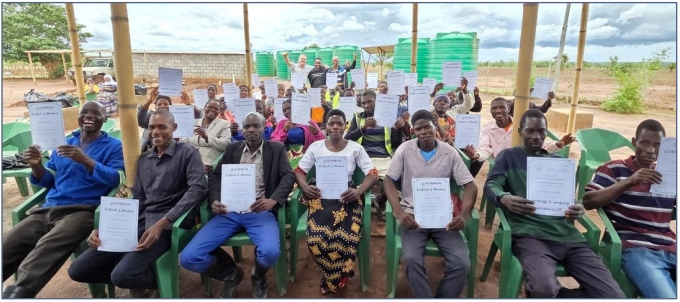
Rehabilitation site farmers with agreements on setting up a farming co-operative.
Sovereign said the development represents a strong endorsement of the program’s value and demonstrates the potential for long-term economic benefits beyond the mine life.
The company plans to continue working with local farmers through 2026 to refine and scale the model across the broader Kasiya project area as development progresses.
Supporting financing and ESG alignment
The rehabilitation outcomes also support Sovereign’s recently announced collaboration with the International Finance Corporation (IFC), part of the World Bank Group, which is assisting with the integration of IFC Performance Standards into the DFS and environmental and social impact assessment (ESIA).
Sovereign said the multi-year dataset provides “irrefutable empirical evidence” of alignment with international standards, a key requirement for securing development finance.
The latest update builds on a series of recent milestones at Kasiya, including a major resource upgrade and offtake and marketing agreements for both rutile and graphite products, as the company works towards positioning the project as a globally significant, low-cost source of critical minerals.
With DFS work advancing and rehabilitation outcomes now validated in the field, Sovereign is increasingly focused on demonstrating both the economic and sustainability credentials of Kasiya as it moves towards development.