
- FTSE 100 climbs 162 to 10,412
- Oil prices drop after US government comments on Iran
- Persimmon and Costain results impress
5.15pm: Stocks rally
The FTSE 100 finished the session on the front foot, adding 162 points at 10,412 after US president Donald Trump suggested the war in Iran could end soon.
“Renewed optimism on the back of falling oil prices helped global stock indices recover, most strongly in Asia and Europe where gains of between 2% and 6% were seen,” IG chief technical analyst Axel Rudolph said.
“WTI crude dropped below $85 a barrel on Tuesday after spiking close to $120 the previous day, as President Donald Trump signalled the war with Iran could end sooner than expected, pledged naval escorts for tankers in the Strait of Hormuz and the G7 said it stood ready to release strategic oil reserves, easing supply fears.”
4.09pm: Miners provide main support for FTSE gains
Heading into the final stretch in London, miners are the main fuel for the FTSE 100's gains, which have not been diminished too much by the aggressive comments from US defence minister Pete Hegseth (pictured above) about Iran.
Fresnillo, up 7.6%, followed by Anglo American and Antofagasta, both up just over 6%, are the top three on the leaderboard, as gold and copper prices rebounded.
Persimmon is next, following its results this morning, up 5.2%.
Analyst Charlie Campbell at Stifel says it is his favoured housebuilder due to several factors: overweight exposure to the north, where house price inflation has been and should remain stronger; relatively small fire safety remediation provisions, which will be less a drag on cash flows than for its peers; and the sector’s leading site opening momentum.
The shares rise reflects "the strength of trading in the past nine weeks, and the confident outlook statement," he says.
IAG is next (see previouis update), followed by Pershing Square (see New York IPO update below).
Banks, including Barclays and Lloyds, and financials, such as St James's Place, L&G and Prudential, are also among the top risers.
Looking at the biggest companies on the index, Shell and BP are notable in the red, down 0.8% and 1.6%,. while Unilever, BAE Systems, RELX, LSEG and Compass are the only other top 20 names in the red.
3.28pm: IAG a potential indirect winner from Iran?
The war in the Middle East presents British Airways owner IAG and other major European airlines with a paradox: a short-term revenue opportunity that could quickly turn into a longer-term drag if the fighting proves difficult to resolve.
That is the argument behind a note from JPMorgan today, where analysts looked back at previous geopolitical shocks such as the Gulf wars, Russia's invasion of Ukraine and the Israel-Gaza conflict to assess how the current situation might play out for carriers such as IAG, Ryanair and Lufthansa.
European airlines' direct exposure to Middle Eastern routes is relatively small, the bank's analysts said, meaning the near-term demand hit from that region is limited.
More interesting is the indirect effect. With transatlantic travel potentially facing some softness as American consumers grow cautious, European carriers – many of which hedge their fuel costs more aggressively than US peers – could actually benefit from stronger pricing power on those routes, with IAG identified as the biggest potential winner. Ryanair likewise could benefit from European re-routing.
3.10pm: Oil analysis
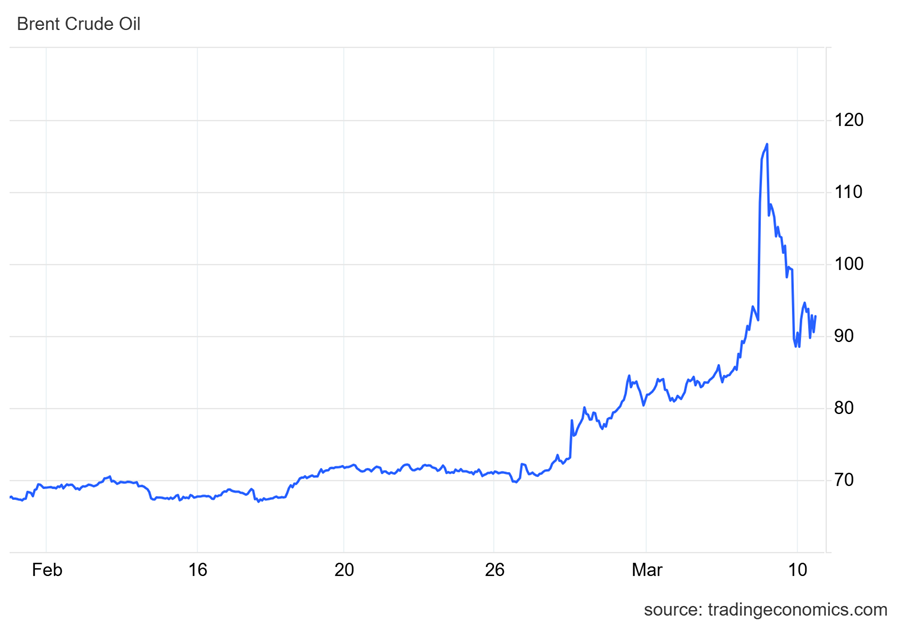
If the Iran situation persists, oil prices could reach $150 a barrel within weeks, according to energy consultancy Wood Mackenzie, as the shutdown of 15 million barrels per day of Gulf exports forces the global economy to destroy demand rather than find alternative supply.
The scale of the disruption is without precedent, the report said, with Gulf countries that normally produce 20 million barrels per day in total seeing 15 million barrels per day of exports removed from global markets in a single shock.
This dwarfs any previous supply crisis, including the Russia-Ukraine war of 2022.
Prices broke above $100 a barrel on Monday, as buyers competed for remaining cargoes, but Wood Mackenzie's chief analyst argued this would only the beginning of the price escalation required to bring supply and demand back into balance.
"Global oil demand of 105 million barrels per day will still have to fall to balance the market and in our view, that will require Brent to push up at least to $150 a barrel in the coming weeks," said Flowers.
However, this presumably was written before the comments from President Trump yesterday and other factors that have seen the Brent price sink back below $89 now.
2.38pm: Meta buys social network for AI agents
Instagram and Facebook owner Meta has reportedly acquired Moltbook, a social network built for AI agents rather than humans, in a deal that will bring its founders into the company's secretive artificial intelligence division.
The purchase, reported by Axios, will see founders Matt Schlicht and Ben Parr join Meta Superintelligence Labs as soon as next week.
Moltbook, which launched in late January and went viral in AI circles, was designed as what Schlicht called a "third space" for AI agents to verify their identities, connect with one another and coordinate complex tasks on behalf of their human owners.
1.56pm: Mixed start for US stocks
Wall Street stocks have started in mixed fashion, with the Dow and S&P 500 slipping 0.4% and 0.25%, while the Nasdaq is fractionally in the green.
Salesforce leads the Dow fallers with a drop of 3.3%, followed by IBM down 1.5% and Chevron off 1.2%, with the energy giant's decline reflecting the continued pullback in oil prices from Monday's extraordinary highs.
Disney, Microsoft, Visa and Nike were all down around 0.7-0.9%.
12.11pm: Gains soften as Washington says strikes on Iran will be more intense today
Gains for the FTSE and other European stock benchmarks have dipped a little in the last hour of the morning, while US futures have dived into the red.
At the same time, and probably connected, oil price losses have been pared slightly. Brent crude is now down 5.9% at $93.10 a barrel, with WTI at just over $90, having both been down over 8% earlier.
Perhaps this follows more comments coming from the direction of Washington.
Going somewhat against President Trump's “very complete, pretty much" statement yesterday, today defence minister Pete Hegseth has said that "today will be our most intense day of strikes inside Iran.”
At a press conference at the Pentagon he said this would see "the most fighters, the most bombers, the most strikes, intelligence more refined and better than ever.
"So that’s on one hand. On the other hand, the last 24 hours have seen Iran fire the lowest number of missiles they’ve been capable of firing yet.”
Hegset said the current administration is "not even close" to the nation-building under former presidents, noting that Trump "very clearly ran against those kinds of never-ending, nebulously-scoped missions – those days are dead".
Maybe more concerning to oil industry followers, Iran's IRIB state TV has reported the explosion of an oil tanker near Abu Dhabi.
Earlier, Ali Larijani, the secretary of Iran’s Supreme National Security Council, tweeted in response to Trump's previous comments, saying: “Iran is not afraid of your empty threats. Even those greater than you could not eliminate the Iranian nation. Take care of yourself not to be eliminated.”
11.49am: Ackman's Pershing Square fund to float in NY
Bill Ackman, the investor and fan of very long tweets, is planning to float his Pershing Square fund on the NYSE, it has been announced.
Plans for an initial public offering were filed today, with a dual listing structure so that Pershing's common shares and those of its PSUS investment vehicle will both trade.
The firm noted that there has previously been no public market for Pershing Square’s common stock prior to the combined offering, though there is a London-listed Pershing Square Holdings (LSE:PSH) closed-end fund that tracks the performance of Ackman’s New York hedge fund, which was listed in London in 2017 and joined the FTSE 100 in 2020.
The hedge fund firm said it has secured $2.8 billion in commitments ahead of the offering.
11.05am: G7 ready to release oil reserves, market volatility 'likely to persist'
G7 energy ministers are due for talks over video today, to discuss a potential release of emergency oil reserves, according to reports.
After discussions took place yesterday, the group’s finance ministers vowed to take “necessary measures” to stabilie markets.
* ASKED WHETHER ANY NAVAL ESCORT WILL RESOLVE ISSUE OF TRANSIT IN HORMUZ, QATAR FOREIGN MINISTRY SPOKESPERSON SAYS A VIABLE SOLUTION WOULD BE TO STOP ATTACKS ON OUR ENERGY FACILITIES @reuters.com
— Carl Quintanilla (@carlquintanilla.bsky.social) March 10, 2026 at 11:25 AM
On the wider market situation, Neil Wilson at Saxo says: "TACO had to happen and I guess Trump just revealed his pain threshold. European stock markets opened sharply higher as oil prices plunged in an historic move from top-to-bottom as Donald Trump signalled the war with Iran could be over soon."
Trump said in an interview late yesterday that he thinks the Iran war is "very complete, pretty much,” and added that the US was ahead of his initial four to five week estimated time frame, that the war would end "very soon" and that the administration was keen to keep oil prices down.
As well as the FTSE 100 rallying, Spain’s IBEX 35 and Italy’s FTSE MIB are leading gains in Europe, up 2.8% and 2.6% respectively, while the German DAX has climbed 2.4% and France's CAC 1.9%.
The Stoxx 600 is up 2.0%, with some of the worst hit stocks from the last week’s selling on the up, led by Prosus, the Dutch technology investor, Persimmon, Sonova, Infineon and Lufthansa.
Bond yields are also "sharply lower as markets repriced inflation outcomes," says Wilson.
"A Bank of England rate cut this month may be back on the table (although I would argue it was never off the table).
"It completes a pretty madcap couple of days for the markets. It shows it pays to keep calm, keep invested, and always have some dry powder.
"Volatility will persist and we now should note risks from escalatory shocks which would hit bonds & stocks and force up oil and gas prices once more, but there is at last a sense of credible de-escalation even if Iran might view things otherwise."
10.17am: Water bills going up, but less than companies wanted
Five water companies have been handed a partial victory in their battle against regulator Ofwat, with customers of Anglian Water, Northumbrian Water, South East Water, Southern Water and Wessex Water able to raise bills rise by an average of 2.2% more than already announced.
However, the Competition and Markets Authority rejected 83% of the additional revenue the companies had sought.
The five water firms had each challenged Ofwat's December 2024 price control decision, which already set out average bill increases of 36% over the five years to 2030, arguing the settlement left them unable to meet their regulatory obligations.
The CMA's independent panel allowed an additional £463 million in revenue across the five companies, down from the £556 million it had provisionally proposed in October and well short of the £2.7 billion the companies had requested.
None of the five are part of London-listed water groups.
9.32am: Miners and airlines fly higher
Miners and airline stocks are staging a partial recovery as metals prices rebound and investors reassessed whether the previous session's sell-off had been overdone.
Anglo American, Antofagasta and Fresnillo were among the leaders as gold and copper prices recovered around 1%, clawing back ground lost yesterday.
Gold was hit yesterday by a stronger dollar and geopolitical risk weighing on non-yielding assets, while copper prices touched three-week lows.
The partial dollar retreat gave commodity prices room to recover, unwinding some of the pressure that had sent both metals and mining equities sharply lower when the currency hit its highest level in more than three months on Monday.
IAG has attracted buyers after falling more than 5% in the previous session and 15% since the start of the Iran conflict, as flight cancellations and surging oil prices have stoked fears about sales and fuel costs.
Analysts noted that IAG's valuation looked stretched on the downside given the company's recent full-year results.
8.49am: Rotork shares hit by 'subdued' outlook
Rotork PLC (LSE:ROR) shares are down 10% despite the engineer reporting full-year results broadly in line with expectations.
The sell-off appeared to reflect a subdued outlook and perhaps some disappointment with the net cash position, which came in at £65.3 million, which was below some analyst estimates.
Panmure Liberum say there were expecting around £89 million, as a larger-than-expected working capital outflow to support growing revenues offset strong cash conversion of 101% and £38.4 million of share buybacks completed in the second half.
Peel Hunt's Harry Philips says 2025 EBITA was better than consensus and net cash was better than his £46 million estimate.
"The outlook is a little subdued, particularly around Oil & Gas, where it highlights project delays in midstream through the end of the year, with two projects in particular, totalling £6m.
"As a consequence, 2026 guidance for the division is stable, underpinned by Target Segments and Rotork Services. Rotork expects CPI and Water & Power to see good momentum.
"Current consensus for 2026 is EBITA of £203m; we forecast £205m, but, reflecting on the outlook statement, we may revise this down to mid-£190 million," says Philips.
"We see this as a moment in time, and if the weakness anticipated today comes through, we would be buyers of the stock.".
8.29am: Costain and Genuit results impress
On the FTSE 250, the top risers are construction sector names Genuit and Costain, up 9.4% and 9.1% respectively, which is mostly from their results out this morning, with a bit of added 'rising tide' with the rest of the market.
Costain has hiked its dividend a whopping 75% and launched a £20 million share buyback today, following the positive pension agreement announced in January.
Analyst Andrew Nussey at Peel Hunt said this was as expected. "There were no major surprises in the mix (company-specific volume challenges in Transportation were mitigated by positive AMP7 water settlements).
"The outlook remains confident, supported by a 30% increase in forward work (to a record £7bn)."
As for Genuit, the water management and ventilation group's full-year results were a bit better than expected, says Nussey's Peel colleague Sam Cullen.
"The subdued market conditions of 4Q have continued into the first part of 2026, albeit the group has seen some positive signs on order intake. Wet weather has not helped activity. The group continues to target further share gains and productivity improvement, but the impact of the current Iranian conflict is hard to gauge currently."
Genuit's shares have slipped 7% in the year to date, he notes, worse than the sector's -2% and with an 18% drop in the last week being "the key factor".
8.15am: FTSE flies higher at the open
The FTSE 100 has been catapulted higher in early Tuesday trading, up 145 points to 10,394, around where it was last Thursday.
Housebuilder Persimmon is leading the way, up 10.8% as its full-year results seem to have gone down well and following a sharp fall since the Iran conflict broke out.
British Airways owner IAG is next, up 5.6%, followed by a group of engineers, miners, banks and builders.
There are eight names in red, led by BP and Shell, down 2.6% and 2.4%, followed by defence contractors BAE Systems and Babcock, and what we might term AI-fear victims RELX and LSEG.
7.58am: Domino's profits sliced but chicken dippers bring hope
Domino's Pizza has reported a 15% dip in profits for last year, which was as expected, but new initiatives, including 'CHICK 'N' DIP' make management more optimistic about 2026.
Lower supply chain volumes and investment in skills and capabilities weighed on margins last year, with like-for-like orders falling 2.3% as the challenging consumer backdrop persisted through the second half of the year.
Underlying EBITDA dropped 6.6% to £133.9 million, while statutory profit before tax fell 35% to £81.1 million, hit by impairments and costs related to transactions that did not proceed.
The new financial year brought a brighter note, with the FTSE 250 group saying the positive momentum seen over the Christmas trading period had continued into the first nine weeks of 2026.
7.48am: Oil update
Oil prices have been shifting lower again in this past hour, with Brent crude now at $90.28 a barrel, and WTI at $86.63 a barrel, both down 8.4%.
Gulf nations have cut oil output by as much as 6.7 million barrels per day, someone at Bloomberg has calculated, in recent days.
Iraq has cut output by roughly 2.9 million barrels a day, Kuwait by about 0.5 million barrels, Saudi by 2-2.5 million a day and UAE about 0.5-0.8 million.
7.32am: Persimmon results
Persimmon has reported a 13% increase in profit for last year and an accelerated sales rate at the start of the new year despite uncertainty over the impact of the Iran conflict on customer sentiment.
The dividend was held at 60p per share and there was no share buyback.
Chief executive Dean Finch said: "Sales in the opening weeks of the year have been strong and the build-to-rent market is recovering from the slowdown around November's Budget."
The board guided for underlying operating profit towards the upper end of current City analyst consensus, but flagged that higher finance costs from ongoing investment would leave underlying profit before tax in line with consensus rather than ahead of it.
7.16am: FTSE 100 rebound expected after oil price drop
A strong FTSE 100 bounce is expected on Tuesday, with Asian stocks setting the course as energy prices slide back to where they were a week ago.
London's blue-chip share index has been called 73 points higher on the futures market, a day after paring an early 200-point loss to a decline of just over 35 points and finishing at 10,249.52.
US stocks went a stage further and turned around sharp early losses to close higher, with the Dow Jones reversing a near 900-point plunge in the opening hour to finish almost 240 points or 0.5% higher, with the S&P 500 rising 0.8% and the tech-powered Nasdaq doing best with a 1.4% gain.
Asian markets have improved broadly, with Japan’s Nikkei 225 jumping 2.9% and Hong Kong’s Hang Seng up nearly 2%, with the Korean Kospi leaping over %, while China’s Shanghai Composite and and India’s Sensex climbed 0.5-0.6% higher.
"The past 24 hours has seen a dramatic roundtrip in oil markets," says Jim Reid, macro analyst at Deutsche Bank, noting "seismic moves" seen at the start of the week gave way to increased optimism as President Trump suggested in the US afternoon that the war with Iran could be over "very soon".
"That eased concerns over a longer-term conflict that could trigger a major stagflationary shock and helped drive a turn lower in oil markets."
Brent crude oil prices pulled back from an intraday peak of $119.5 a barrel to as low as $84 in the US close, though have edged back up to $92.4 this morning.
Says Reid: "While market stress had gradually eased through the course of yesterday’s session after peaking in Asia hours, the biggest turning point came after the European close as CBS reported Trump saying that 'I think the war is very complete, pretty much', with the US 'very far ahead of schedule'.
"The President then delivered a similar message in a press conference after the US close, suggesting the war will 'be finished pretty quickly'."
Trump also repeated his suggestion that the US Navy could escort tankers and the possibility of lifting “certain oil-related sanctions to reduce prices”.