
Cobalt Blue Holdings Ltd (ASX:COB, OTC:CBBHF, FRA:COH) says its Kwinana Cobalt Refinery project in Western Australia has cleared an important technical milestone after confirming that cobalt sulphate samples produced using its proprietary process meet stringent battery precursor material specifications.
The company reported that material produced at its Broken Hill Technology Centre (BHTC) meets the trace-metal purity and physical specifications required by precursor cathode active material (pCAM) customers — a key step towards commercial offtake agreements and a final investment decision (FID) on the refinery project.
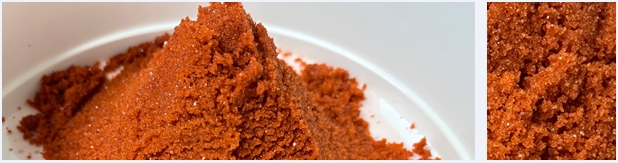
Cobalt sulphate produced at BHTC.
Cobalt-containing pCAM is used in lithium-ion battery chemistries including nickel-manganese-cobalt (NMC) and nickel-cobalt-aluminium (NCA), which are widely deployed in electric vehicles as well as energy storage and specialised electronics applications.
Only a limited number of proposed refineries outside China have successfully produced cobalt sulphate to this specification, placing the Kwinana project among a small group capable of supplying high-purity battery materials.
“We are delivering measurable progress for the Kwinana Cobalt Refinery,” Cobalt Blue CEO Dr Andrew Tong said.
“Achieving prospective pCAM customer cobalt sulphate specifications and advancing offtake discussions are critical steps towards FID,” he added. “In parallel, our continued optimisation work at the Broken Hill Technology Centre and expansion into black mass evaluation enhance feedstock optionality, strengthen project economics and further de-risk development.
“These milestones reinforce our broader growth strategy and position the company to capitalise on improving cobalt market conditions.”
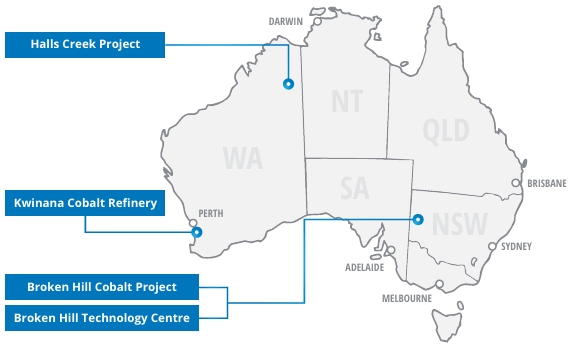
Refinery moving toward development decision
The Kwinana Cobalt Refinery is designed to become Australia’s first dedicated cobalt refinery, producing high-purity cobalt sulphate for the lithium-ion battery industry as well as cobalt metal for defence and industrial markets.
Cobalt Blue has been progressing the project alongside partner Iwatani Australia under a binding pre-FID consortium deed signed in April 2025, which outlines the framework for jointly advancing the refinery towards development approval.
Several key conditions required before the partners can move to a final investment decision have already been completed, including:
- Securing a binding feedstock supply contract with Glencore in May 2025
- Receiving a works approval permit from the Western Australian Government in September 2025
- Producing cobalt sulphate samples meeting trace-metal specifications using project design parameters
Other steps remain in progress, including converting letters of interest into binding offtake agreements and completing technical studies and due-diligence reviews. Financing arrangements and joint venture documentation are expected to follow once offtake agreements advance further.
Since mid-2023, the company has invested more than $7 million advancing development of the refinery.
Expanding battery materials ecosystem role
As part of efforts to support Australia’s emerging battery materials supply chain, Cobalt Blue has also supplied high-purity cobalt sulphate to CSIRO for use at its Cathode Precursor Production Pilot Plant in Western Australia.
The facility, operated in partnership with Curtin University and the Minerals Research Institute of Western Australia, is designed to test production of battery cathode precursor materials from Australian raw materials.
The company has already delivered 4 kilograms of cobalt sulphate monohydrate for testing, contributing to domestic development of pCAM and cathode active materials.
At the same time, Cobalt Blue has strengthened intellectual property protection around its refinery flowsheet through a newly lodged Australian patent application covering an integrated process for producing high-purity cobalt sulphate.
Recycling opportunity through battery black mass
Beyond conventional feedstocks, the company is also exploring battery recycling opportunities through evaluation of battery “black mass” — a mixture of metals recovered from end-of-life lithium-ion batteries.
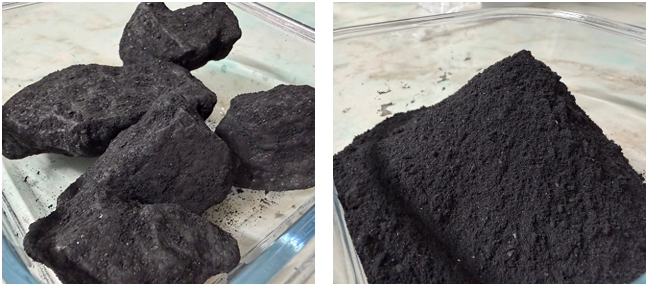
Battery black mass.
Under a new collaboration with CSIRO, Cobalt Blue has begun designing a process to recover and purify graphite from black mass to battery-grade specifications.
Battery black mass typically contains 20–40% graphite alongside cobalt, nickel and other metals, offering the potential for multiple revenue streams and improved project economics if successfully processed.
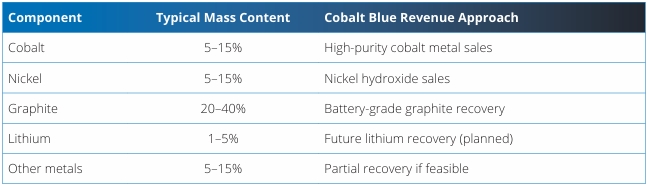
Battery black mass - typical content and potential value streams.
The research program will be supported by a combination of CSIRO grants and company funding as Cobalt Blue continues to broaden feedstock options for the Kwinana refinery.
Together, the technical qualification of its cobalt sulphate product, expanding market engagement and ongoing process development mark continued progress towards a final investment decision on what could become a key link in Australia’s critical minerals supply chain.