
- FTSE 100 closes up 17 points at 10,171.76
- Index earlier hit a new intraday high of 10,277.72
- Copper, gold and silver surge suddenly reverses
- 3i Group, Antofagasta, Lloyds, easyJet report
5.05pm: Oil surges
A 17-point gain saw the FTSE 100 finish the session at 10,171.76, as increased oil prices amid expectations that the US will move against Iran boosted Shell and BP.
4.08pm: Gold and silver crater, but oil hits 6-month high on Iran worries
While gold has dropped off its own self-created cliff, oil prices are still sustaining the UK index.
Brent crude has hit its highest point since last July, up 3.5% to $70.75 a barrel.
Shell is now second on the leaderboard, up 2.3%, with BP also in the top 10, up 1.2%.
This comes on the back of rising expectations of a US strike on Iran.
"Evidence suggests the US will go for a major and extended campaign, which inevitably raises fears that Tehran will retaliate by closing the Hormuz straits and causing major dislocation in oil markets," says analyst Chris Beauchamp at IG.
"Combined with this and yet more strength in metals, the news has meant that the FTSE 100 is an island of gains in an otherwise risk off session."
Gold is down 5.2% and silver down 6.7% now.
US markets are deep in the red. The Nasdaq has cratered 2.5%, the S&P has dived 1.4% and the Dow is down 0.7%
3.52pm: Gold and silver crumple after massive gains
Some comments on the gold and silver prices cratering suddenly.
This is "seemingly under the weight of their own excess after ballooning to record highs," says Neil Wilson at Saxo, saying "things are looking pretty messy out there" for metals markets.
Copper also took a nosedive, cutting its gains to below 3%.
"We are seeing extreme volatility in metals and FX markets which is leading to serious dislocations and may well gnaw away at equity market sentiment," Wilson says.
Looking across the Atlantic, he says Microsoft's 11% decline is "causing huge damage", though Meta has "steadied things a bit" after both reported earnings last night.
3.40pm: Gold U-turn
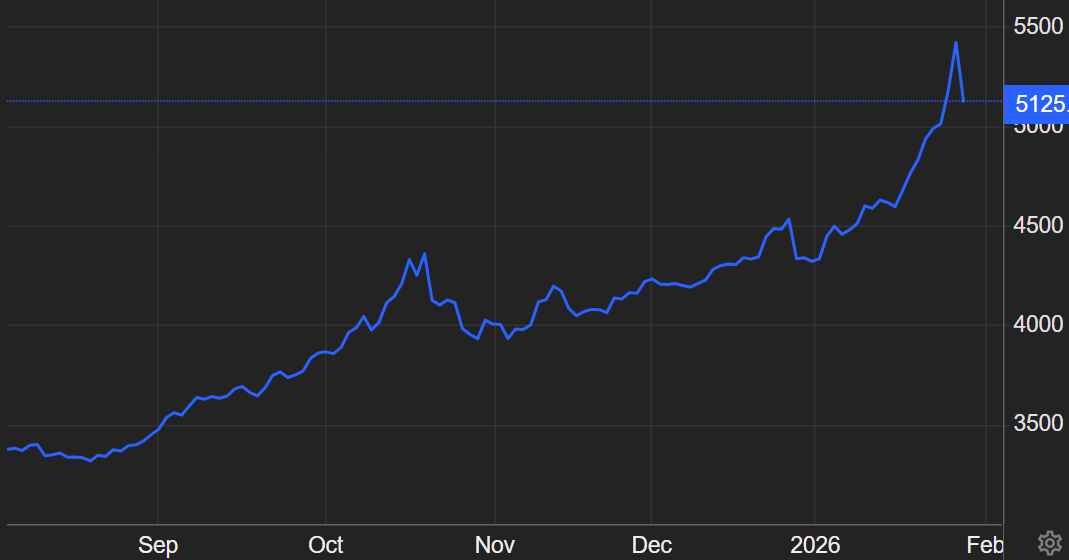
The gains in London have been slashed as gold's melt-up has turned on its head with a screeching U-turn.
Gold is now down 4% to $5184.80.
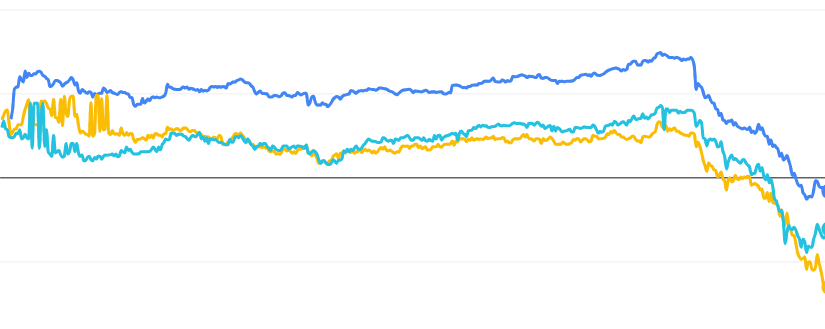
Fresnillo and Endeavour Mining shares are down 6% and 0.8%, with Hochschild down 3.2% on the FTSE 250.
Here's a six-month gold price chart:
And here's FRES, ENV, and HOC today:
2.50pm: Microsoft tanks 10% at open
US stocks have opened with some big tech falls dragging down benchmarks.
While the Dow Jones is up 20 points, or 0.04%, the S&P 500 is down 0.3% and the Nasdaq has dropped 0.8%.
On the Nasdaq 100 the fallers are led by Atlassian, down 12%.
More importantly, Microsoft has tumbled 10% - losing a massive £350 billion in just a few moments.
Tesla has dropped 1%, reversing its strong after-hours gains.
At the other end, Meta is up 8%, adding around $150 billion to its market cap.
Dragged into the negativity, Palantir is down 3% and Netflix 1.8%.
2.22pm: FTSE romps to new high
The record high of earlier this month is broken and the Footsie is continuing to romp higher, up over 100 points to over 10,263.
This is being helped by copper prices flying ever higher, lifting the index's cabal of heavyweight miners.
Copper futures on the London Metal Exchange surged over 10% intraday, ripping above $14,400 per metric ton, another record high.
Prices are now up 25% since the start of the month.
Analyst Naeem Aslam at Zaye Capital Markets says this is being "fueled by heavy speculative buying and relentless industrial demand from China"
He says what’s "really happening" is that mine disruptions (such as Freeport-McMoRan's Glasberg) are tightening supply just as demand rises across electrification.
"A weaker dollar and geopolitical stress are pouring fuel on the move. Why this matters beyond metals: Higher copper feeds straight into electric vehicles, renewable grids, and AI data centers. That means rising build costs, and inflation pressure that doesn’t fade quickly.
"This isn’t a spike. It’s a cost shock forming upstream."
1.44pm: FTSE nears new high
Getting nearer to that record high.
Antofagasta now up 11.9% and Endeavour up 6.5%, Glencore 5.2%, Anglo 4.2%, Rio Tinto 3.5% and Fresnillo 2.5%.
Some interesting factoids about gold going about - here have some tweets to break up the text.
Gold futures see largest one day dollar gain in history. pic.twitter.com/2y8PFxZASF
— CME Group (@CMEGroup) January 29, 2026
Wow. Gold has now outperformed Bitcoin on a 5-year basis pic.twitter.com/MBqeVqwnit
— Joe Weisenthal (@TheStalwart) January 29, 2026
Gold now has a total market cap of more than $38 Trillion
Over just the last 2 days that has increased by ~$4 Trillion
That is roughly equivalent to the market cap of Google or DOUBLE the total market cap of Bitcoin https://t.co/z8TckfnSyt
— Evan (@StockMKTNewz) January 29, 2026
1.26pm: FOMO and other factors driving commodities highs
Some words of caution on the metals melt-up, driving gold, silver, copper and platinum to record highs.
"This has all the hallmarks of a speculative squeeze that is increasing disorderly, volatile and dangerous," says Saxo market analyst Neil Wilson.
"We know the backdrop and solid fundamentals to this trade – debasement and rush to hard assets etc - but the moves are highly unusual.
"The volatility can be self-sustaining as market makers become reluctant to take and hold positions, leading to thinner liquidity and greater volatility."
Spot gold approached $5,600 before backing off a bit to around $5,550 and silver hit a new high above $120, before it too trimmed gains to $118. Copper has surged over 8% to fresh record highs.
Wilson's commodity colleague Ole S Hansen, head of commodity strategy at Saxo Bank, said the surge across metals, especially gold and silver, is "entering a dangerous phase", in his opinion.
He says he has seen this dynamic "play out several times across commodities – and occasionally in other asset classes", which is partially driven by FOMO.
"Fear of missing out can drive prices far beyond levels justified by prevailing fundamentals, and timing that turning point is notoriously difficult," he says.
The metals market is "feeding on itself", he says, with higher prices leading to lower trade volumes, which can increase volatility.
The Bloomberg Commodity Total Return Index is set for its strongest monthly gain in decades, points out Wilson, up 15% this month.
Oil prices have also risen sharply on geopolitical tensions, kicking up to four-month highs, towards $70 for Brent and $64.50 for WTI.
He says this comes as markets eye potential military attacks by the US on Iran.
"Sources suggest Trump is weighing all kinds of options – there are multiple plausible scenarios and markets are on edge for disruption to supplies."
12.46pm: FTSE building up steam
The FTSE 100 has picked up momentum since mid-morning and is now within sight again of its all-time high (10,257 from two weeks ago).
Commodities stocks, banks and financials are providing the fuel.
Top of the risers is 3i Group PLC (LSE:III), up 11.4% after an encouraging update.
Likewise, Antofagasta PLC (LSE:ANTO) is up more than 8% after the Chilean miner posted a solid fourth-quarter production update and benefited from a sharp rally in copper prices, where futures have risen another 7% to $6.34/lb, taking the year-on-year gain to nearly 48% as supply constraints and electrification-driven demand continue to support sentiment.
Similarly, gold miner Endeavour Mining PLC (LSE:EDV) has jumped 6.1% after hitting 2025 guidance and declaring its biggest ever second-half dividend of US$200 million.
Glencore PLC is also up on a production update, while the general support for metals and other commodities sees Anglo American, engineer Weir Group, Rio Tinto, Fresnillo, Shell and BP all rising between 1.5% and 4%.
St James's Place and Lloyds Banking are also up either side of 2% after their updates.
However, the index is also being held back by a number of sizeable fallers, with Ashtead down 6%, Sage Group falling 3%, RELX, AB Foods, Compass and Experian.
Looking ahead to the start of Wall Street trading, US stock futures are close to flat.
S&P 500 futures are up 0.15% but those for both the Dow Jones and Nasdaq are up less than 0.1%.
11.44am: James III
Jameses were out in force this morning.
St James's Place PLC (LSE:STJ) shares are up 2.1% after the FTSE 100 wealth manager showed off a more beneficial effect from markets than expected, offsetting the impact on Q4 flows from the Budget (as seen across the industry) and the introduction of its new pricing structure the previous quarter.
Analyst Rae Maile at PanLibs says this meant the outcome for funds under management, which drives profits, was ahead of expectations at year-end.
Business trends were said to have "normalised" since the Budget and into the new year.
James Fisher & Sons PLC (LSE:FSJ) is doing even better, up 10% after reporting a positive year end, with management expecting operating profit to be around £28 million, ahead of the current consensus of around £25.5 million.
Energy delivered a solid profit performance, defence improved thanks to new contract awards including a recent Polish Navy deal, and maritime transport saw good utilisation in tankships and increased ship-to-ship transfer operations.
James Halstead PLC (AIM:JHD) is the odd one out, down 0.4% after the flooring manufacturer said sales in its first half were hit by "challenging" markets in Central Europe and Asia Pacific.
UK sales remain "robust and marginally up on last year" despite market conditions that were described as uncertain.
10.57am: Overseas investment in LSE companies rises
The proportion of UK shares held by overseas investors increased to another record high, according to data released from the Office for National Statistics today.
Of the total £2.5 billion of shares listed on the London Stock Exchange at the end of 2024, foreign investment rose to a high of 58.8%, up from 57.7% in 2022.
The largest overseas proportion was held by US institutional and individual investors at £693.9 billion.
An estimated £1 trillion is owned domestically, with banks holding 3.6%, the government just 0.2%, and UK-based individuals holding 11.6% of the total, up from 10.8% in 2022. In other words, UK private investors' holdings were valued at £295 billion (a few billion over the market caps of Morgan Stanley or Goldman Sachs, IBM or Intel).
Jonathan Parry, partner at law firm White & Case, said it was "extraordinary" that overseas investors continue to recognise the value of the UK market, while domestic investors "remain more hesitant".
“While many investors clamour for exposure to the ‘Magnificent Seven’ in the US, UK institutional investors seem to be overlooking compelling opportunities closer to home while overseas investors are benefitting from them," he said, noting the strong run that the FTSE 100 has enjoyed.
"This disconnect has fuelled sustained takeover interest in UK-listed companies, with private equity and overseas buyers stepping in where public markets have failed to fully price underlying value."
He said greater individual ownership of UK equities was "encouraging" and said "the narrative around London is beginning to shift", as the LSE, FCA and Treasury's regulatory reform drive aims to level the playing field with other leading listing venues.
If we see IPOs of well-priced companies "that momentum should continue to build," he said.
That would be good. Who will be the first big UK IPO of the year though?
10.13am: Gains trimmed
Both the FTSE 100 and 250 have slid a little lower in the past half-hour, with the blue-chip index up 0.4% and the mid-caps now flat so far for the day.
Looking around, it could be a currency thing, with the US dollar strengthening this morning, and the pound and euro both receding a little.
Eurozone consumer confidence figures just came out, showing no overall change, with economic confidence improving.
Mainland Europeran indices have also dipped.
Germany's DAX is down 1.2%, due to a big fall for software SAP, while gains have been trimmed for France's CAC 40 to 0.4%.
Victoria Scholar, head of investment at Interactive Investor, says US futures are pointing to a slightly higher open "as investors assess a mixed bag of tech earnings" and with focus turning to Apple’s results after the bell tonight.
Oil prices are trading back up at September highs, after a strong uptrend this week, with Brent and WTI both gaining around 1.5% today, pricing in the US-Iran uncertainty and fears of military escalation.”
9.42am: Another Ocado customer 'bites the dust'
Ocado shares are down Ocado 10% as another overseas client, Sobeys, the leading supermarket in Canada, has announced it will close one of its robot-run warehouses, and keep its Vancouver site on pause.
This follows US customer Kroger's announcement to close three customer fulfilment centres, as Ocado calls them, at the end of last year.
Sobeys has decided to close its CFC in Calgary due to the e-commerce market being smaller and expanding at a slower rate, than originally expected.
Ocado is to receive a one-off payment of £18 million in compensation this year, though it said the closure will reduce its fee revenue by £7 million.
It also reaffirmed its commitment to reaching cash breakeven in 2026.
The £18 million is a significantly lower termination payment than the $85 million per CFC received from Kroger, pointed out analyst James Lockyer at Peel Hunt.
"While Sobeys' continuing two CFCs are expanding the number of services taken from Ocado, the closure is another blow for the company.
"The issue is that once secure, lifetime revenues from established sites are turning out to be more fragile. Investors will be wondering who will be next to close."
9.05am: Lloyds thoughts from UBS
Lloyds shares are back in positive territory, having edged lower.
Results and guidance largely matched expectations rather than beating them.
UBS noted that while pre-tax profit was 7% ahead of forecasts due to lower impairments, underlying numbers were in line.
Guidance for 2026 was also mostly unchanged, with net interest income seen around 1% below consensus.
A £1.75 billion share buyback and a final dividend of 2.43p were both as expected.
Some investors may have taken profits after the recent rally, maybe seeing little in the update to push the shares higher.
8.55am: Dividends up, buybacks up
UK dividends rose 1.3% in the final quarter of last year, according to the latest dividend monitor report from Computershare.
Excluding one-off special divis, underlying growth of regular dividends was up 2.1% on a constant currency basis to £13.9 billion as payouts in the energy, consumer and property sectors all beat expectations.
For the full year, payouts fell 0.9% on a headline basis to £87.5 billion owing to lower one-offs, exchange-rate headwinds and cuts from telecoms and mining companies. Underlying 2025 growth was 3.6%.
Mid-caps from the FTSE 250 saw better growth than the FTSE 100, with underlying growth of 5.4% versus 3.4%.
Share buybacks were also higher, with a provisional £63.6 billion paid out over 2025, which compares to the £30.8 billion in pre-pandemic 2019, but this growth in buybacks has seen dividends drop 13% in that period.
Shell is given as an example, having bought back 6% of its shares in 2025, meaning its declared dividend per share "has to rise at least this fast just to keep its total dividend expenditure flat year-on-year. Even more significantly than this mechanical effect, buybacks represent cash that could otherwise have been distributed as a dividend."
For 2026, Computershare is projecting growth of 1.5% in total dividends to £88.8 billion, or up 2% on an underlying basis.
8.29am: easyjet guidance reassures after larger winter loss
Shares in easyJet PLC are up 2.3% as the budget airline reported larger winter losses than last year's, but after its strongest-ever bookings in January has stuck to its full-year outlook, saying demand for both flights and package holidays remains strong.
A headline loss before tax of £93 million for the three months to the end of December was deeper than the £61 million loss in the same period last year and the City analyst consensus of £83.6 million.
Analyst Gerald Khoo at Panmure Liberum said the results were "as expected, with a wider pre-tax loss on the start-up costs of the new Italian bases and the full year effect of last summer’s investment in resilience".
He said summer bookings were "building well" and were reassured that the outlook was unchanged, resulting in "minimal changes" to his forecasts.
8.15am: FTSE races higher at open
The FTSE 100 has raced 67 points higher to 10,221.5 in initial trading.
Top of the leaderboard by some way is 3i Group, up 14.3% as the private equity investor reported a 20%, driven by strong growth at its key asset, Action.
Next in line are miners Antofagasta, Endeavour Mining and Fresnillo, helped by the gains for gold, silver and copper in the past few days. Rio Tinto, Shell and BP are also providing some oomph to the index too.
Lloyds is down 0.5% as its results did not seem to land that well.
7.41am: Lloyds results
Lloyds Banking Group PLC (LSE:LLOY) has announced a new £1.75 billion share buyback and upgraded guidance for 2026 as it generally met or beat expectations in results for the final quarter of 2025.
A statutory profit before tax of £1.98 billion for the quarter beat the average City analyst's forecast of £1.72 billion.
Net interest margin for the final quarter of the year was 3.1%, up 11 basis points year-on-year and 4bps on the third quarter, and only slightly below market estimates.
Chief executive Charlie Nunn said the five-year strategic transformation "accelerates" into its final year in 2026, with a "sustained strength in performance [that] means we are well positioned for 2026 and beyond".
He promised to share details on the next stage of the strategy in July.
7.27am: Market analysis
"Yesterday was a rare occasion when both the latest Fed decision and a slew of Mag-7 results failed to materially move markets," says Jim Reid, macro strategist at Deutsche Bank.
The Federal Reserve's pause (only two of the FOMC voted for a cut and Jerome Powell said there was “broad support” for keeping rates steady after three cuts last year) left bonds and equities little changed, he notes, with precious metals continuing to deliver the most eye-catching moves, with gold's 4.9% gain its best day since the early weeks of the Covid pandemic.
Gold has moving up another 2.4% overnight to above $5,500 per ounce.
Reid also flags that Polymarket's probability of a US government shutdown has sunk to 44% in the last couple of hours from a peak of 80% yesterday, after a deal was reported to have been sketched out.
Microsoft’s shares slumped by around 6% after-hours, despite a modest earnings beat, as the software giant only just met elevated cloud revenue growth expectations, while Meta went the opposite way, surging over 6% as it projected stronger ad-driven sales for the current quarter.
Tesla’s shares have gained around 2% after delivering an earnings beat and laying out plans to invest $20 billion this year to streamline its vehicle lineup and expand work on robotics and AI
Today in Big Tech sees Apple reporting after the close, with the bigger deal of Nvidia earnings not coming until late February.
The dollar also began to stabilise yesterday, says Reid, after Treasury Secretary Scott Bessent reiterated the “strong dollar policy” a day after Trump had seemed more relaxed about its direction.
7.17am: FTSE 100 called higher after lacklustre US session
FTSE 100 futures were pointing to a positive open on Thursday, after a lacklustre Wall Street session and mixed reporting from three of the 'Mag 7' tech giants overnight.
London's blue-chip index has been called 25 points higher, reversing some of the previous day's losses, when it closed 53 points lower at 10,154.43.
US benchmarks fared a little better, though the Dow Jones ended only 12 points or 0.025% above flat, while the S&P 500 retreated from its previous high, but only down less than one point.
The standout was the tech-powered Nasdaq, which gained almost 0.2% thanks to gains from the chipmakers like Intel and Texas Instruments.
After the close, earnings from Microsoft sent its shares down 6% in afterhours trading, while those from Tesla and Meta impressed more.
Results in London this morning include Lloyds Banking, easyJet, Glencore, Crest Nicholson and ITM Power.