
Gold producers are operating in one of the strongest price environments in years, but the real challenge is staying competitive as the sector shifts underground. While high prices have supported margins, many mid-tier miners are still grappling with short mine lives, maturing deposits and limited growth pipelines.
In a market where investors are rewarding scale and longevity, the question facing Western Australia’s gold sector is no longer about survival — it’s about who can deliver sustainable, organic growth.
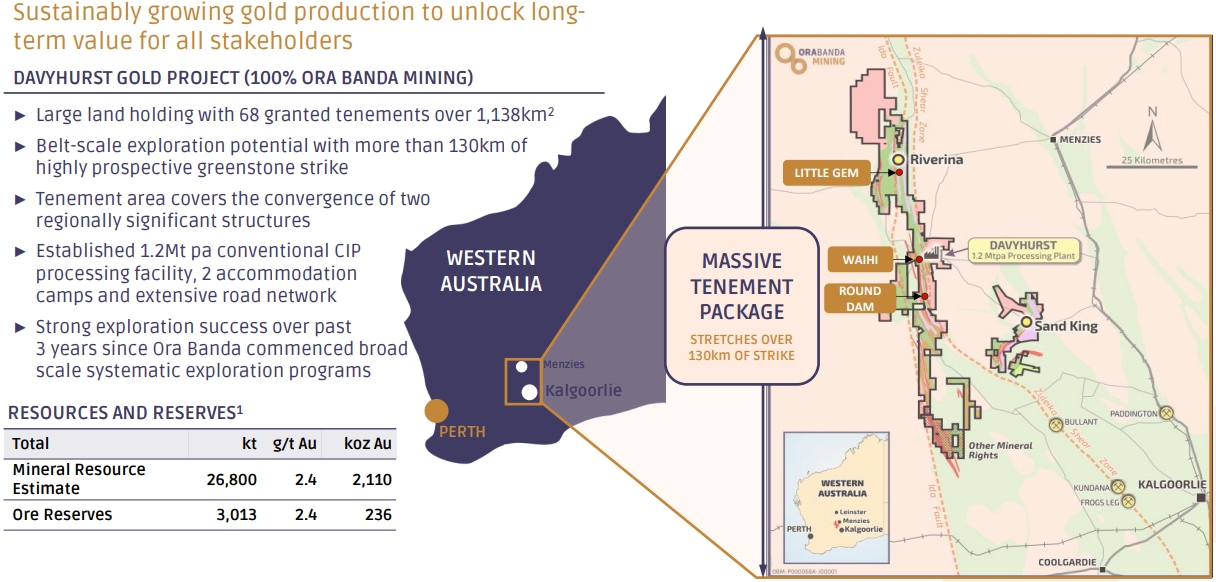
Ora Banda Mining Ltd (ASX:OBM, OTC:ESGFF), owner of the Davyhurst Gold Project in WA’s Eastern Goldfields, is positioning itself as one of the few companies with the underground engine, district-scale footprint and financial runway to do exactly that.
After a full strategic overhaul in 2022 and a 3,800% share price turnaround since then, the mid-tier producer is now leaning heavily into underground growth, mill optimisation and the largest exploration program the Davyhurst district has seen in more than a century. The result is a business shifting from a single-asset operator into a fast-expanding multi-mine producer with district-scale ambitions — and a balance sheet capable of funding it.
A business rebuilt for long-term scale
The most visible sign of Ora Banda’s shift has been its share price performance, but the larger transformation is operational. Overhauled management, a restructured portfolio and a growth strategy centred on predictable underground production have replaced a legacy model dependent on shorter-life open pits.
Davyhurst’s 1.2-million-tonne-per-annum carbon-in-pulp (CIP) plant is now fed by two underground mines: Riverina and Sand King. Together they’ve pushed total mined tonnes above current mill capacity — a high-class constraint now being addressed through a feasibility study to expand throughput to ~3 million tonnes per year.
Unlocking that capacity is central to Ora Banda’s next phase of growth, particularly as underground tonnes continue to build.
Read more: Ora Banda delivers record profit and revenue on strong underground performance
The financial platform to fund growth
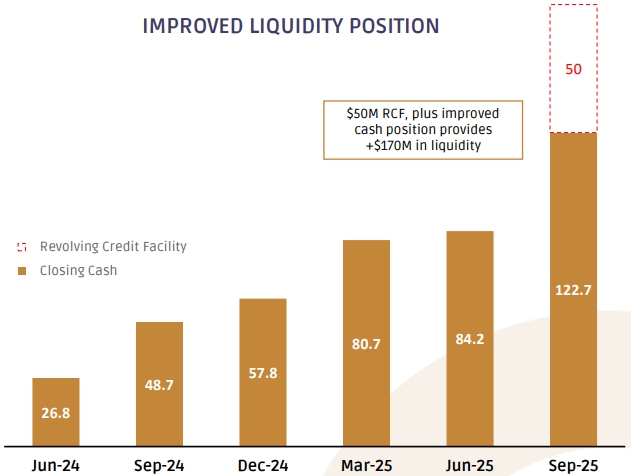
Ora Banda enters FY26 with a notably strong balance sheet for an emerging WA gold producer. The company closed the September quarter with $122.7 million in cash — a $38.5 million increase despite heavy ongoing investment in capital development, exploration and resource growth, plus additional spend on gold put options for downside price protection.
A fully undrawn $50 million revolving credit facility takes total liquidity to more than $170 million. The company can progress development, expand drilling and advance mill upgrade plans without turning back to the market — a significant advantage at a time when capital availability remains tight for many explorers and producers.
Underground engines: Riverina and Sand King
Ora Banda’s multi-mine strategy is built around the performance of its underground assets, and FY26 opened strongly on that front.
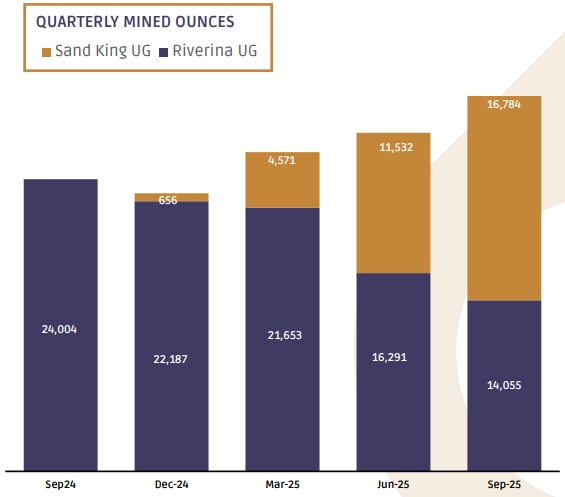
- Riverina Underground continued to demonstrate consistency, with operating development up 24% in the quarter to support higher stope production ahead. Drilling has confirmed the mineralised system extends more than 1,000 vertical metres, with strong intercepts appearing well below the current decline.
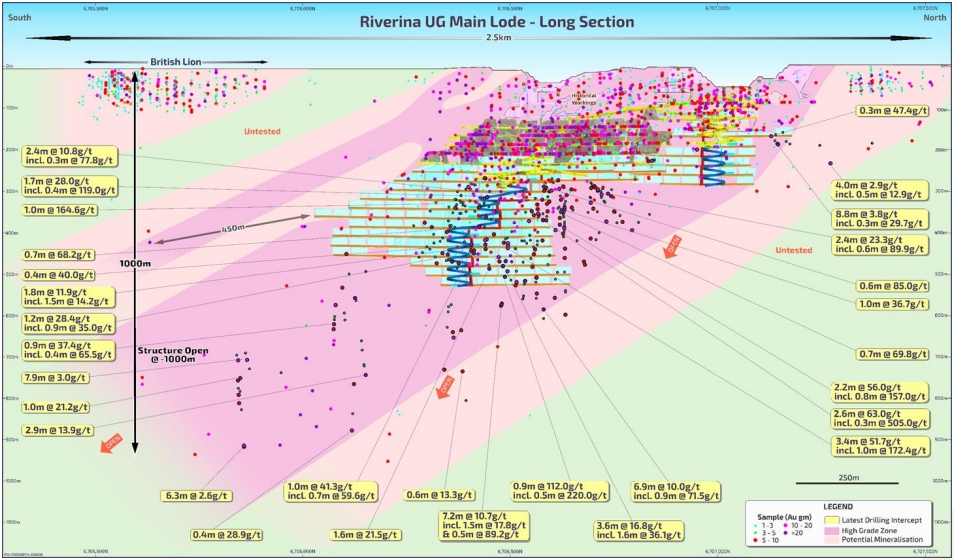
Long section view of Riverina Underground Mine.
- Sand King Underground, the company’s newest operation, achieved full capital payback within 12 months — an unusually fast return for a modern underground mine. It delivered a 52% quarter-on-quarter increase in ounces mined, while grades came in 22% above reserve.
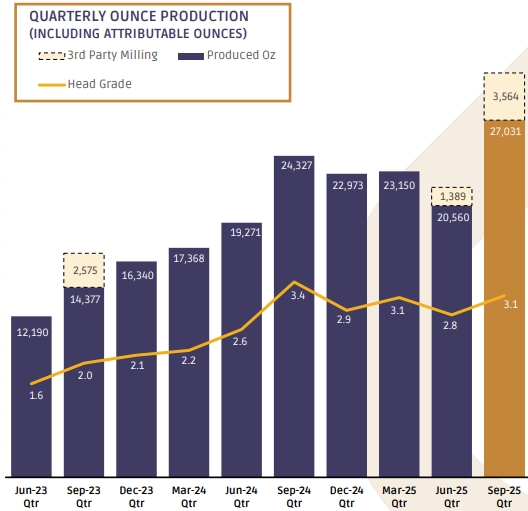
Sand King quarterly production.
These two mines underpin FY26 production guidance of 140,000–155,000 ounces — including contributions from third-party ore sales — marking a step-change of around 60% on the prior year and reducing the single-asset exposure that often constrains mid-tier gold producers.
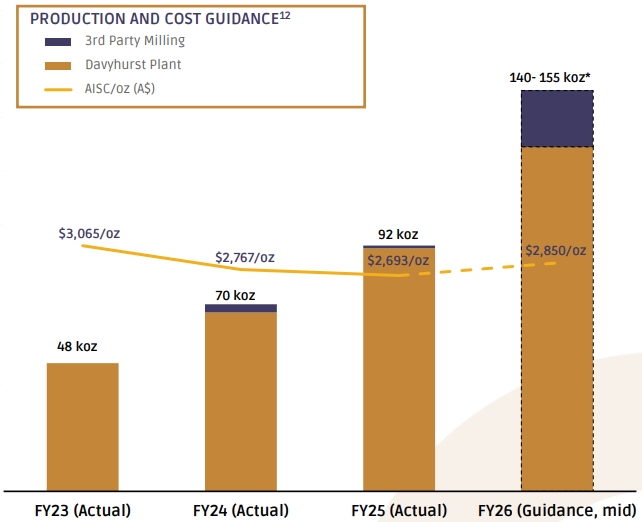
A mill nearing its limits
Davyhurst’s mill is now the central constraint on next-stage growth. Throughput improved 15% in the September quarter, and recoveries increased to 91% following optimisation work completed late in FY25. But with two underground mines and significant stockpiles, the circuit is operating at capacity.
The current feasibility study examining an expansion to 3 million tonnes per year is therefore a central part of Ora Banda’s next phase of growth. With underground output increasing and mine performance improving, the company is preparing its processing capacity to meet a steadily rising volume of higher-grade feed and support the next phase of production growth.
Exploration at district scale: The biggest drill campaign in 130 years
If the underground mines define today’s growth profile, the exploration portfolio is designed to shape tomorrow’s. Ora Banda has committed $73 million to exploration and resource development in FY26, funding 329 kilometres of drilling across multiple trends — the largest program ever undertaken in the Davyhurst goldfield.
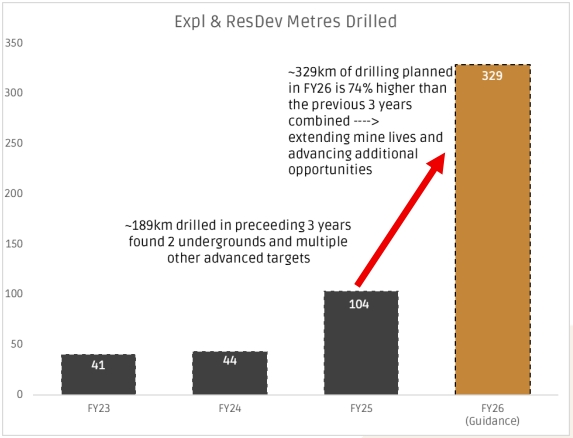
Several fronts are rapidly emerging as potential future mines.
Little Gem: A greenfields discovery gaining scale
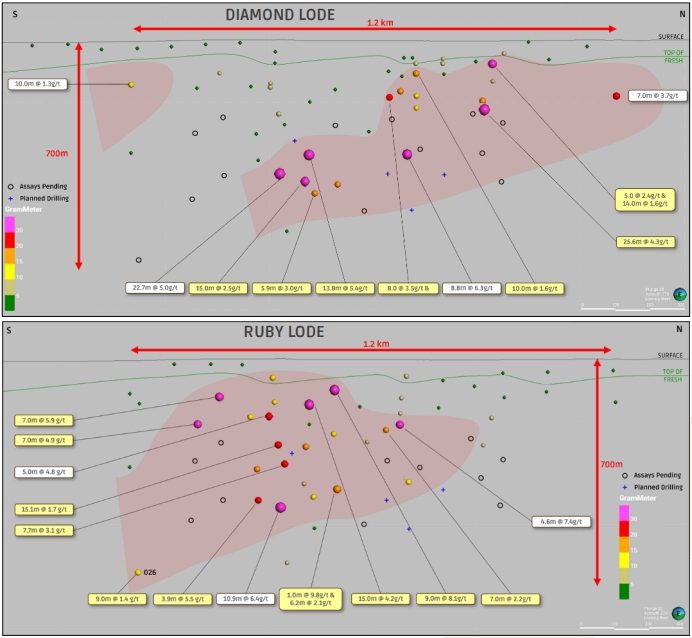
What began as a discovery in late 2024 has quickly become one of the district’s most compelling growth centres. Drilling now defines mineralisation across 1.2 kilometres of strike and 700 metres of vertical extent, open in all directions.
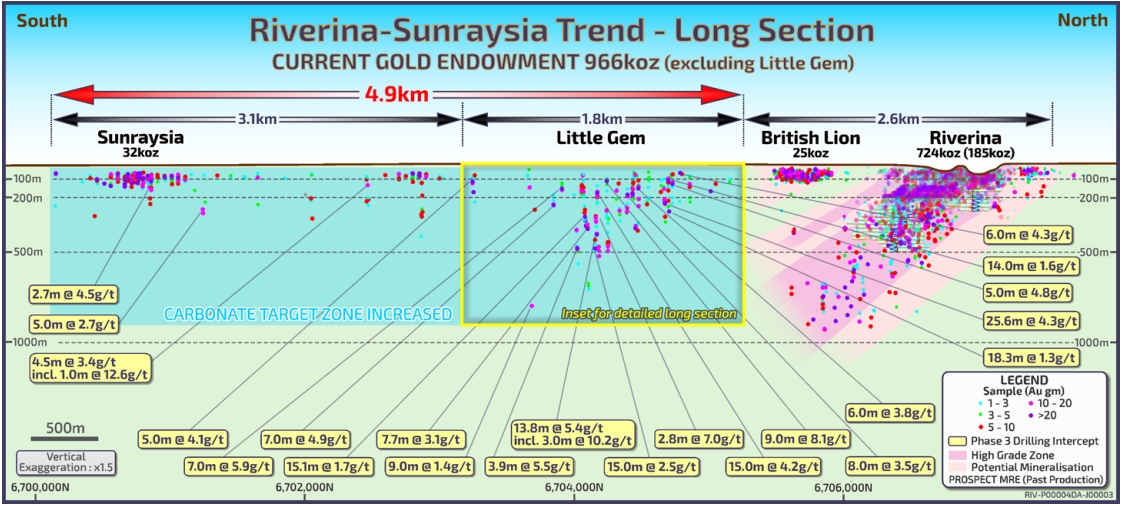
Outstanding drill results continue to expand Little Gem mineralisation.
Shallow intercepts such as 9 metres at 8.1 g/t and 15 metres at 4.2 g/t complement deeper hits like 25.6 metres at 4.3 g/t, located 600 metres north of earlier high-grade holes.
Four lodes have been modelled, with a maiden mineral resource expected late in 2026.
Waihi: A credible third underground mine emerging
Waihi is shaping up as the strongest candidate for Ora Banda’s next underground development. Recent drilling intersected a new high-grade lode — 13.5 metres at 6.1 g/t and 8 metres at 8.7 g/t — while deeper holes confirmed continuity more than 350 metres below surface, including a standout 3.9 metres at 29.5 g/t.
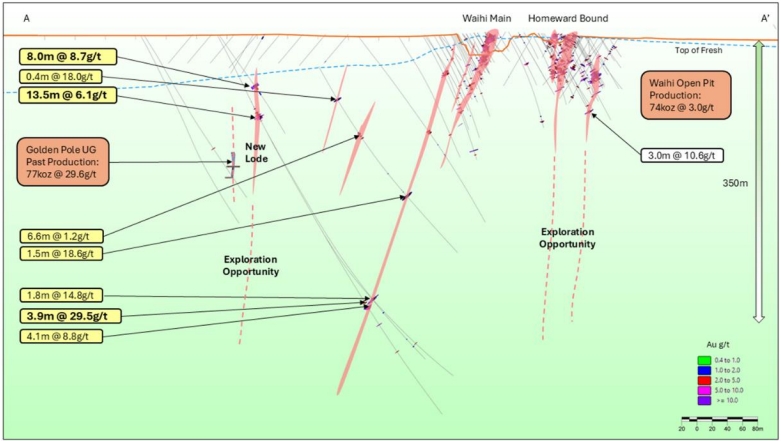
Waihi cross-section looking north showing new lode location and high grade at depth.
Work will continue to map extensions and define the geometry of this emerging system.
Read more: Outstanding drill results at Ora Banda's Waihi deposit build momentum for third underground mine
Sand King: Step-outs highlight larger-scale potential
A 300-metre step-out hole at Sand King returned strong high-grade mineralisation beyond the current mine design, expanding the footprint and supporting the case for a second decline. Drilling indicates potential for both high-grade shoots and wider bulk-tonnage zones.
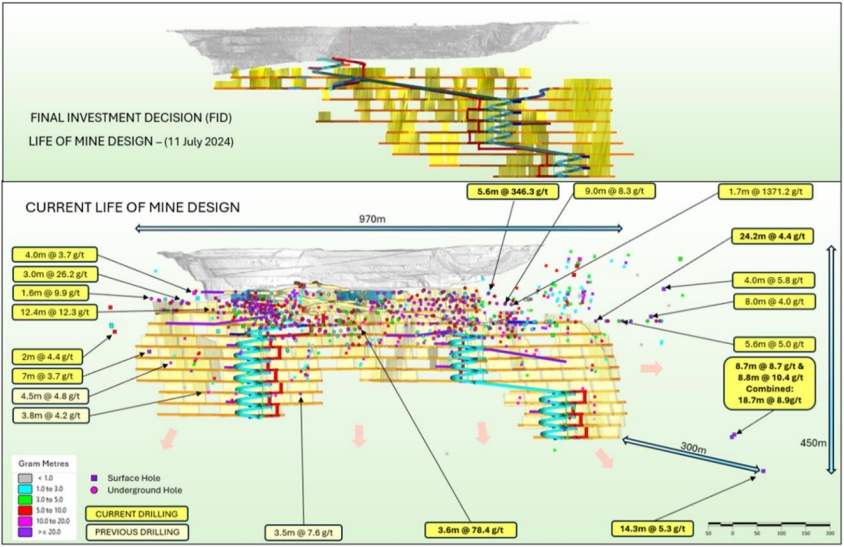
Long section view of Sand King comparing FID case to current mine plan (looking west).
Read more: Ora Banda expands Sand King inventory with high-grade step-out hits
Round Dam: A 7-kilometre multi-lode system
Round Dam is emerging as one of the district’s most extensive near-surface systems. Structural mapping and early drilling have identified up to six subparallel lodes across 7.5 kilometres of strike.
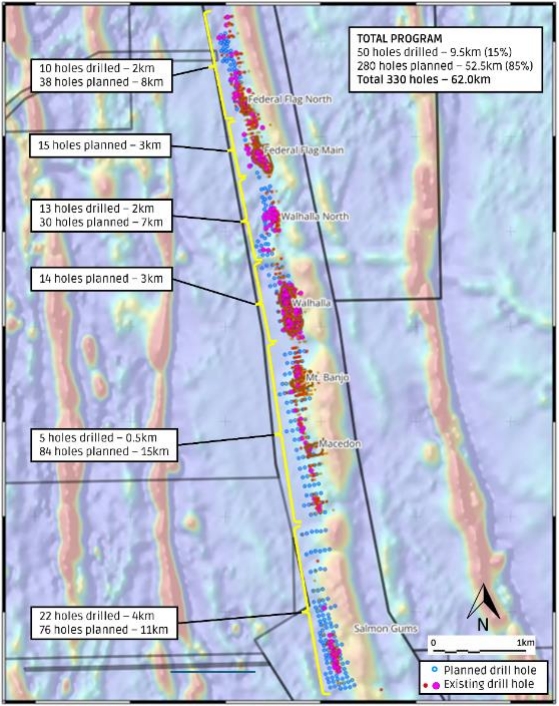
Round Dam Trend: 7-kilometre strike mineralisation with significant drill program continuing.
Early results include 8 metres at 20.6 g/t and 8 metres at 3.0 g/t, combining to 25 metres at 7.7 g/t. Only a small portion — 50 holes totalling 9,500 metres — of the planned 330-hole, 62,000-metre program has been completed.
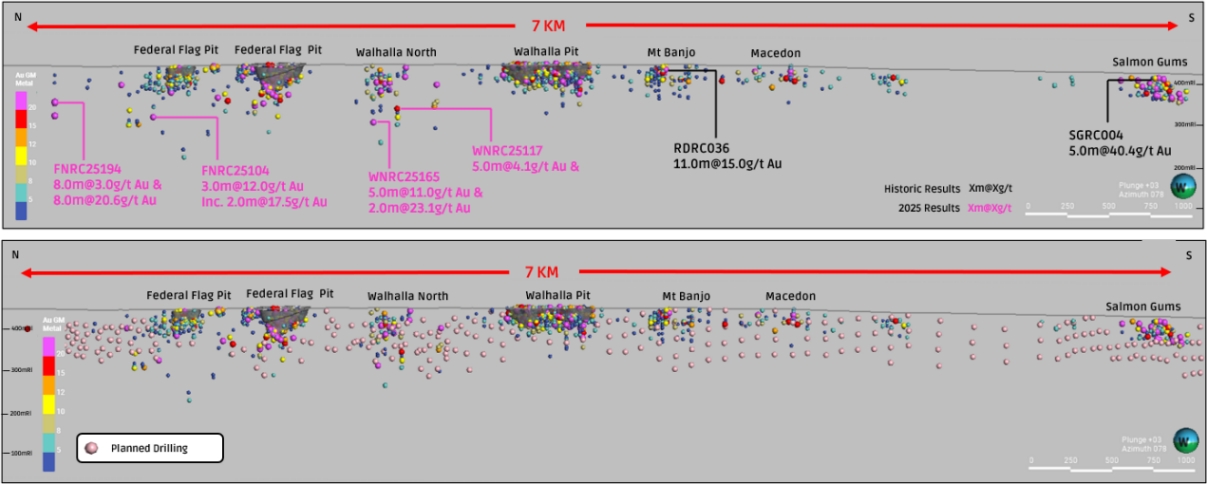
Round Dam long section showing scale of system and current drill program (looking east).
Mulline: A long, underexplored corridor
Just west of the Riverina trend, the 10-kilometre Mulline corridor remains largely untested at depth, with most historical drilling shallower than 100 metres. Early indications and historic workings point to strong underground potential, making it a key target for FY26.
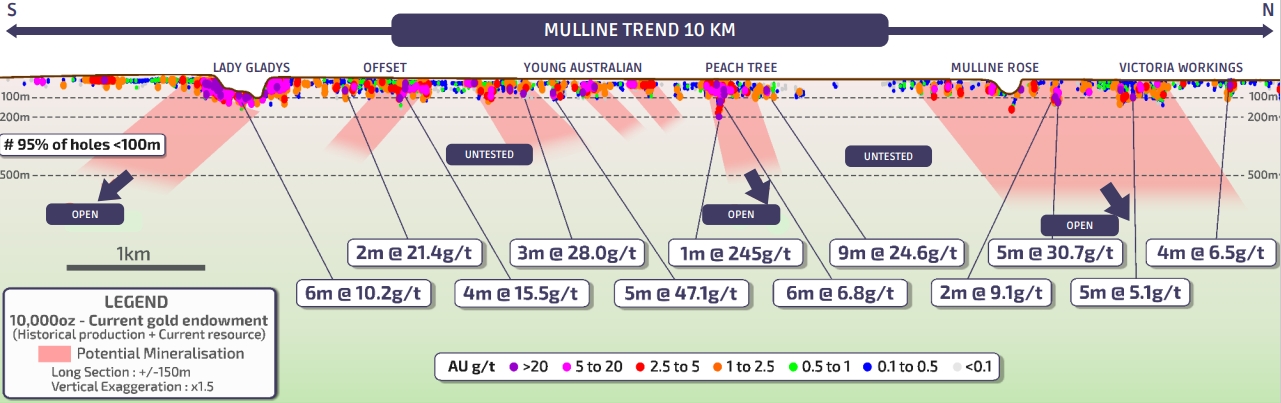
Mulline long section looking west: historic shallow gold mining.
Towards a multi-mine gold business
Taken together, Ora Banda’s strategy is clear: build consistent production through high-grade underground mines, expand the mill to unlock throughput, and invest aggressively in exploration to secure a pipeline of future assets. The scale of the FY26 program — and the quality of results across multiple trends — suggests the company is moving beyond incremental growth towards district-level consolidation.
For investors, FY26 is shaping up as a catalyst-heavy year. Production is forecast to rise significantly, the mill expansion study is due in the March quarter, and drilling across Sand King, Riverina, Little Gem, Waihi, Round Dam and Mulline will continue to generate meaningful newsflow. A maiden resource at Little Gem in 2026 could further strengthen the development pipeline.
Ora Banda’s challenge now is execution. But the alignment of underground performance, exploration momentum and processing growth signals a business preparing to operate at a scale that the Davyhurst field has long hinted at — and may finally be able to deliver.
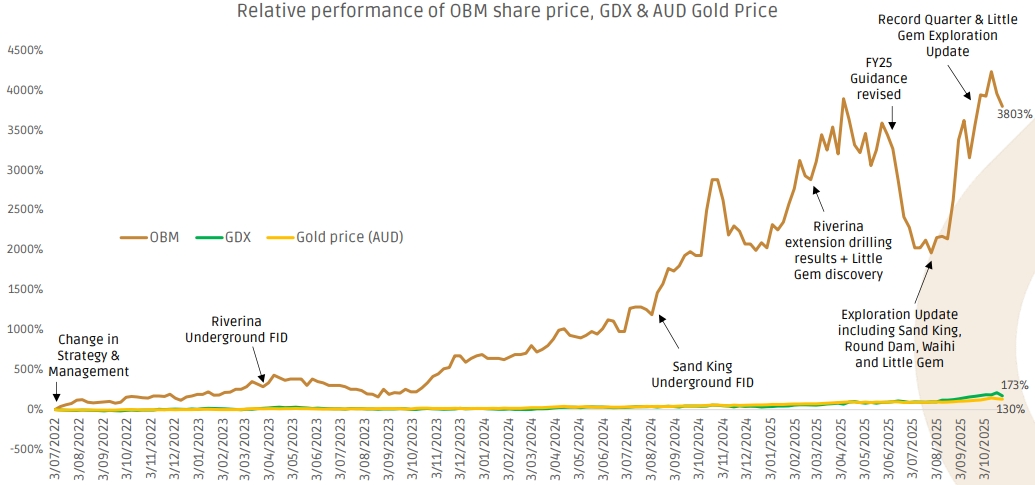
OBM share price performance: over 3,800% return since the change in strategy and management team in July 2022.