
Drilling from the first nine holes of a 45-hole, 15,300-metre program at Ora Banda Mining Ltd (ASX:OBM, OTC:ESGFF)'s Waihi deposit has delivered outstanding results. The program intersected a new gold lode near the historical Golden Pole Mine, with results including 13.5 metres at 6.1 grams per tonne (g/t) and 8.0 metres at 8.7 g/t, as well as extensions on the Waihi West Lode down to more than 350 metres below surface, highlighted by 3.9 metres at 29.5 g/t.
The Waihi deposit, located 3 kilometres from Ora Banda’s Davyhurst processing plant, is being advanced as a potential third underground mine alongside Riverina and Sand King. Significant results to date reinforce this strategy, with further drilling to test both new targets and extensions of known mineralisation.
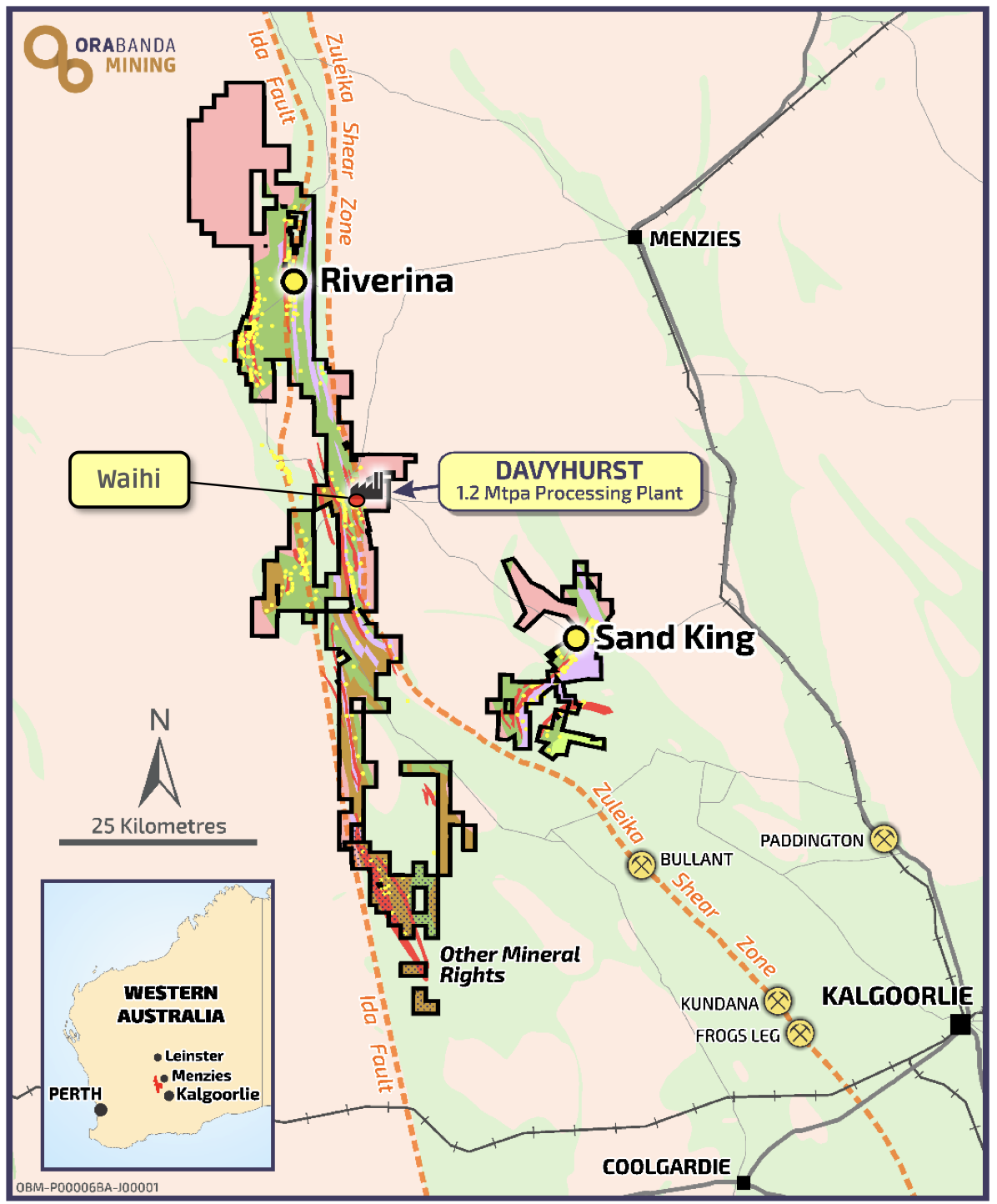
Overview showing location Waihi compared to Davyhurst processing hub.
Significant results include:
- 6.0m @ 21.1 g/t Inc. 0.7m @ 159.0 g/t Waihi East
- 3.9m @29.5 g/t Inc. 1.8m @ 60.8 g/t Waihi West
- 7.0m @ 14.5 g/t Inc. 5.0m @ 19.2 g/t Waihi West
- 4.1m @ 8.8 g/t Inc. 1.5m @ 15.7 g/t Waihi West
- 9.0m @ 3.5 g/t Waihi East
- 13.5m @ 6.1 g/t Inc. 0.9m @ 33.7 g /t New Lode
- 8.0m @ 8.7 g/t Inc. 4.0m @ 14.9 g /t New Lode (4m Comps)
- 12.0m @ 2.3 g/t Homeward Bound (4m Comps)
- 1.8m @ 14.8 g/t Inc. 0.6m @ 33.1 g/t Waihi West
- 8.0m @ 3.0 g/t Waihi East
“These results are nothing short of outstanding as we continue to expand the high-grade potential of the Waihi deposit, which is located only 3km from the Davyhurst processing plant," Ora Banda’s managing director, Luke Creagh, said. "The high-grade and good widths combined with meaningful depth extensions continue to build the case for Waihi as a third underground mine on the Davyhurst Project.”
Expanding high-grade potential at Waihi
The current drill program builds on results announced in June 2025 and is designed to test depth extensions and identify new lodes. Early results have already expanded the mineralised envelope, with intercepts such as 6.0 metres at 21.1 g/t gold 200 metres below surface, underlining the continuity of high-grade zones.
Notably, the Waihi West Lode has now been traced more than 350 metres below surface. Hole WHDD25006W2 returned 3.9 metres at 29.5 g/t, including 1.8 metres at 60.8 g/t — the deepest hole targeting this lode to date. In a shallower position, hole WHRC25005 intersected 7.0 metres at 14.5 g/t, demonstrating potential for multiple high-grade shoots. Drilling to follow up on these positions is ongoing, with results expected to further strengthen the case for underground development.
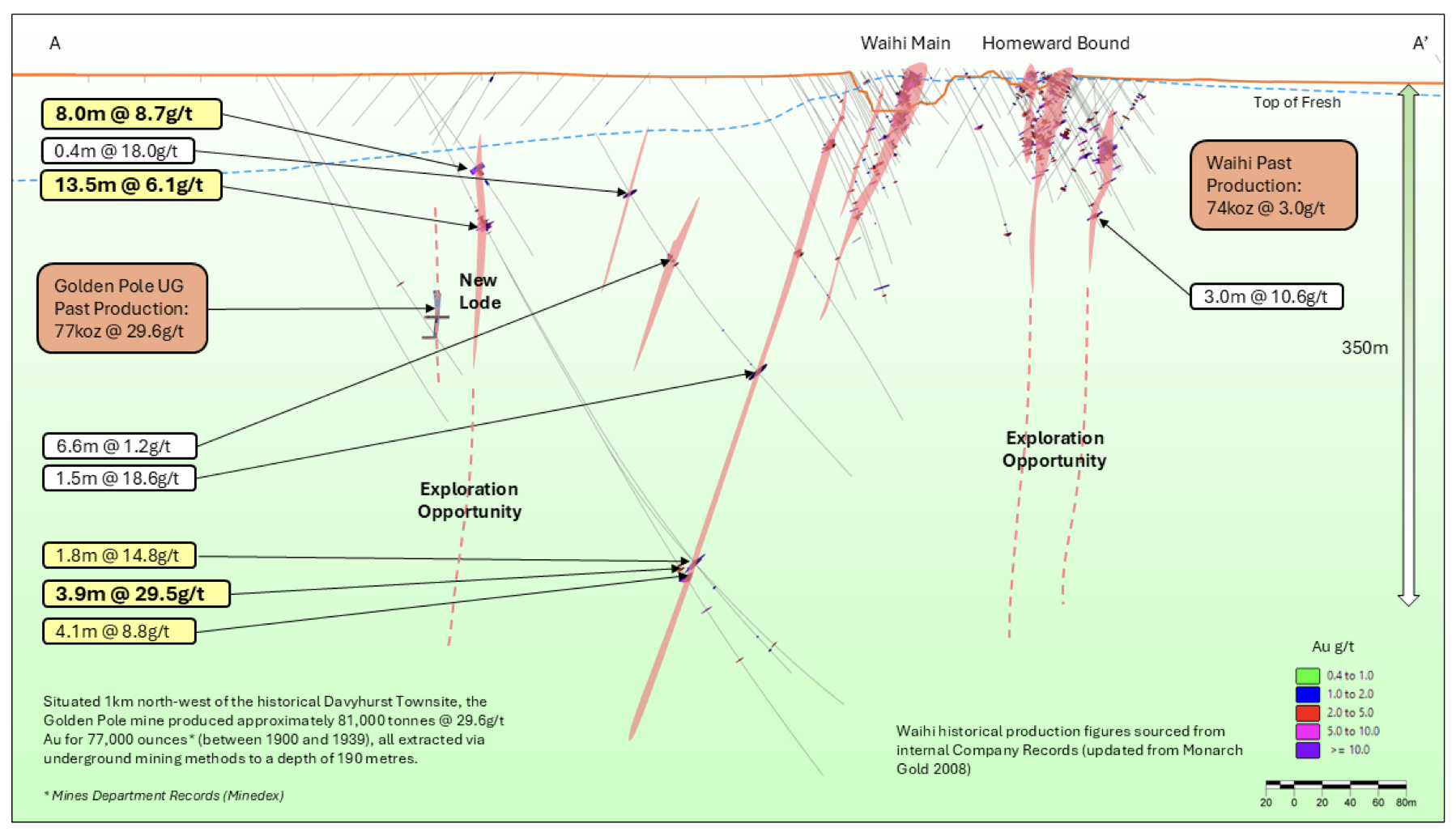
Cross Section looking north showing New Lode location and exploration opportunities. *Historical production figures sourced from internal company records and Minedex database at https://minedex.dmirs.wa.gov.au/Web/home
Discovery of new lode system at Golden Pole
A key outcome of the program has been the identification of a new lode system in the hanging wall of the historical Golden Pole Mine. Intersections include 13.5 metres at 6.1 g/t and 8.0 metres at 8.7 g/t, including 4.0 metres at 14.9 g/t. These results remain open along strike to the north and down plunge, with follow-up drilling planned to define the system further.
The Golden Pole Mine historically produced 81,000 tonnes at 29.0 g/t for approximately 77,000 ounces between 1900 and 1939. Mining reached 190 metres below surface, yet the deepest drill intercept to date is only 150 metres below surface, leaving deeper extensions untested. The discovery of additional mineralisation within the same structures suggests scope to replicate historical high-grade production and support development at Waihi.
Historical context and forward outlook
Historical drilling at Waihi also points to further potential. Intercepts such as 8.7 metres at 9.3 g/t, including 0.4 metres at 90.6 g/t, have been re-interpreted as the down-plunge continuation of the Lady Georgina Lode, which historically hosted some of the highest-grade mineralisation mined in the district.
With 36 holes still to be drilled in the current program, Ora Banda expects to advance its understanding of both the Waihi and Golden Pole systems, while systematically testing additional exploration targets across the broader project area