
With its latest set of assays from diamond drill hole KSD024, Far East Gold Ltd (ASX:FEG) has extended visible gold and bonanza grades as it looks to discover how far the zone extends.
This is the second hole completed in the current program at the Sua Prospect within the Idenburg Gold Project in Papua Province, Indonesia.
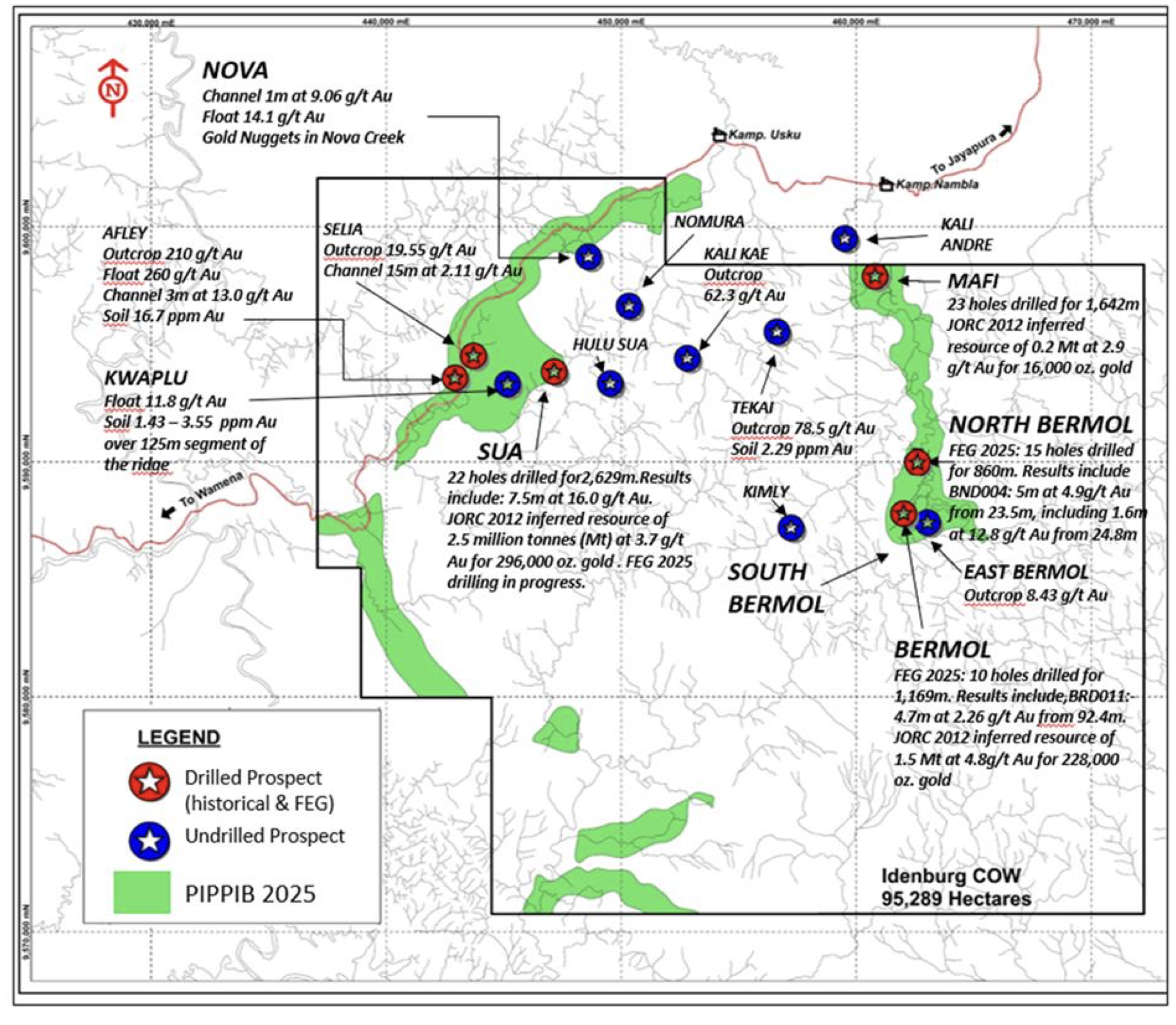
Map showing prospect and resource areas within the Idenburg COW tenement. FEG drilling is currently in progress within the Sua and North Bermol prospect areas. The areas of recently announced PIPPIB forest reclassification are also indicated.
KSD024 was drilled about 25 metres east of hole KSD023. Previous results from KSD023 (ASX release 10 November 2025) included a coarse visible gold intersection of 82 g/t Au over 0.4 metres within a broader near-surface interval of 13.77 g/t Au over 9.8 metres, which also contained 131 g/t Au over 0.8 metres.
The latest hole, KSD024, intersected additional coarse visible gold within a high-grade interval of 280 g/t Au over 0.4 metres from 24.5 metres. This occurs within a wider compiled interval of 35.5 metres at 8.59 g/t Au from 23.5 metres downhole. The results extend the zone of high-grade mineralisation with coarse visible gold intersected in KSD023 by at least 25 metres. KSD024 is an infill hole between historical drill holes spaced 100 metres apart.
Highlights from KSD024
Significant compiled intersections: 8.59 g/t Au over 35.5 metres (23.5m–59m), including:
- 252.5 g/t Au over 0.8 metres (24.5m–25.3m)
- 18 g/t Au over 3 metres (46m–49m)
- 10.8 g/t Au over 2 metres (56m–58m)
- Coarse visible gold observed within a quartz-sulphide breccia, a rock type not widely documented previously at the Sua Prospect.
- The high-grade zone with coarse gold intersected in KSD024 remains open along strike for a further 75 metres towards historical hole KSD001.
- Mineralisation at Sua is hosted within stacked milky quartz ± sulphide veins, with more than 30 individual gold-bearing quartz veins identified.
- The Sua vein system lies within the 5-kilometre-long Sua–Afley shear zone, indicating significant potential for additional high-grade discoveries.
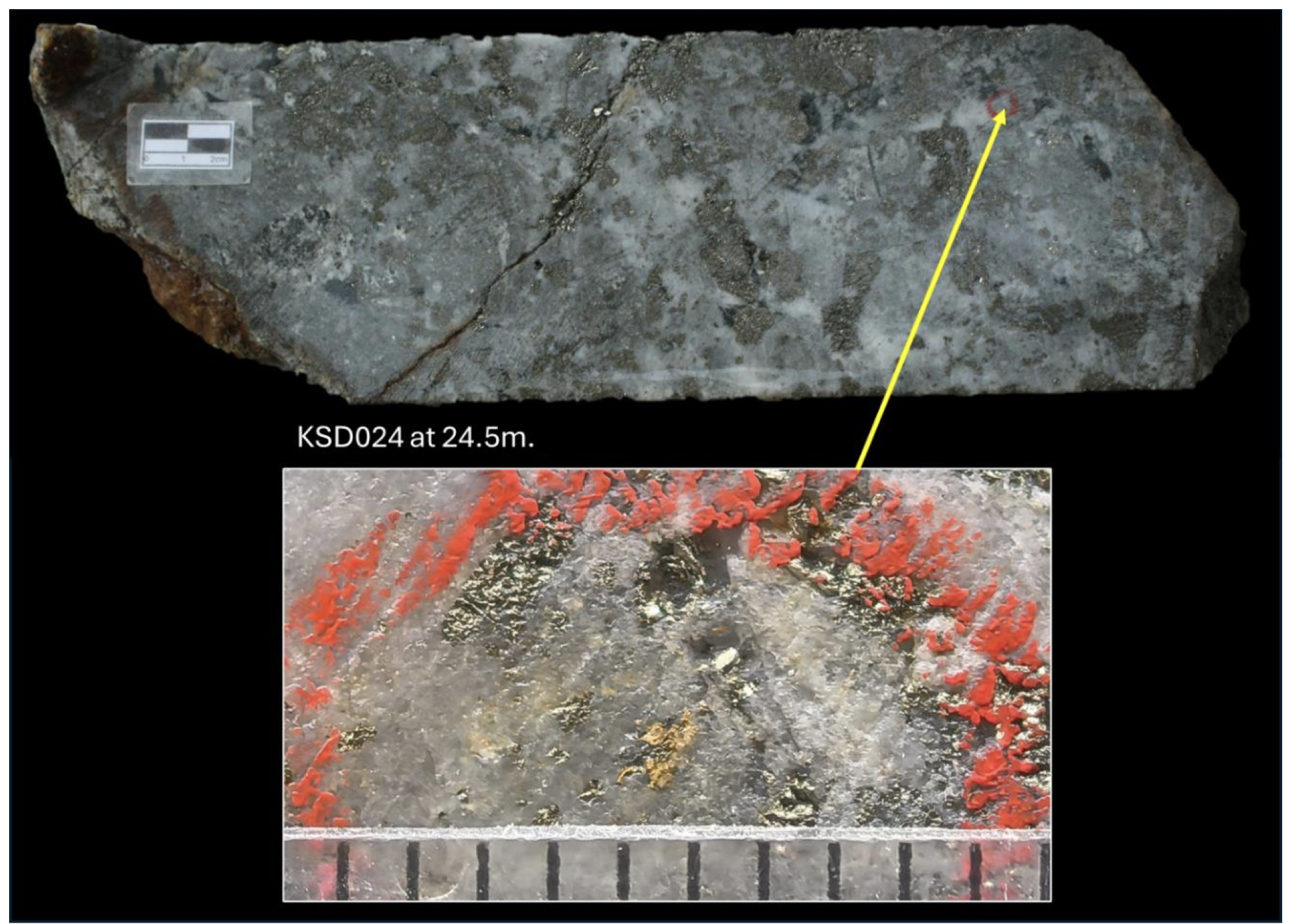
Photos of drill core from hole KSD024.
“The intercept in KSD024 reinforces the geological interpretation for Sua and demonstrates continuity of high-grade mineralisation along strike,” FEG’s non-executive chairman, Justin Werner, said.
“Importantly, these high-grade results are occurring near surface in stacked veins and remain open in several directions. Our focus now is on continuing the disciplined drilling needed to determine the extent of this zone.”
Strategic significance of the Idenburg Project and Sua Prospect
FEG’s Idenburg Project currently hosts an inferred JORC (2012) mineral resource of about 540,000 ounces of gold at an average grade of 4.1 g/t. Within this, the Sua Prospect accounts for an inferred 296,000 ounces of gold at 3.7 g/t, based on SMGC’s assessment of 2.5 million tonnes of mineralisation.
Recent drilling at Sua has confirmed high-grade gold, including coarse visible gold, which is considered a key milestone in unlocking the broader potential of the Idenburg Project. The presence of coarse gold is seen as highly encouraging for future resource development, with scope to both upgrade the existing resource classification and increase the overall resource inventory through targeted drilling.
The current diamond drill program at Sua is designed to confirm the geological interpretation developed from historical work, validate previously intersected high-grade zones and extend the mineralised footprint.
Ten diamond holes for a total of 1,820 metres are planned, of which six holes (1,130 metres) have been completed and assays received for holes KSD023 and KSD024. These new holes, drilled on closer 25–50 metre centres compared with the historical 100 metre spacing, are testing the lateral continuity of mineralised structures as well as stepping out from the known resource area.
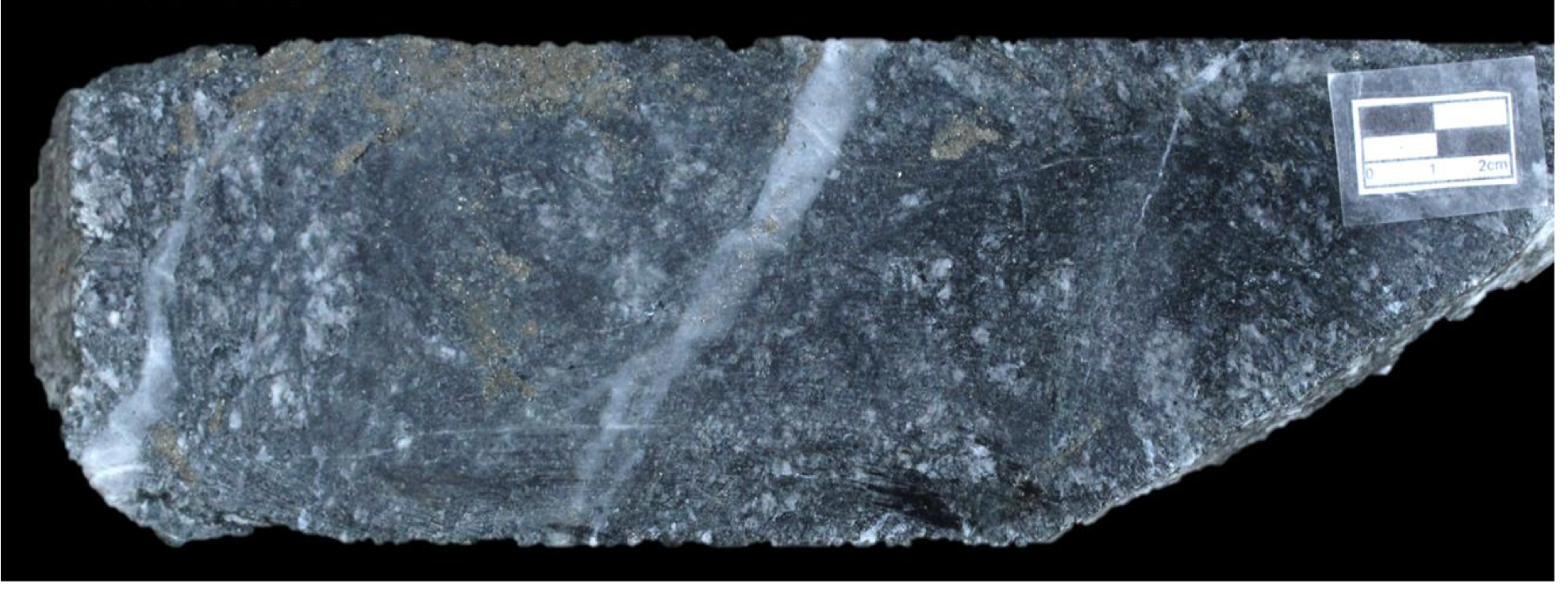
Intensely altered and deformed metadiorite containing narrow quartz-sulphide veins and coarse sulphide blebs in the groundmass. The sample occurs within an assay interval of 29.2 g/t Au over 1m from 48m-49m (sample BDO16732).
Hole KSD024, positioned 25 metres east of KSD023 and twinning historical hole KSD002, has expanded the high-grade zone associated with coarse visible gold and remains open for a further 75 metres along strike towards historical hole KSD001, which previously returned 1.75 g/t gold over 25 metres, including a 1-metre interval at 18 g/t gold.
Read more: Far East Gold delivers visible gold, bonanza grades at Idenburg
At the deposit scale, gold mineralisation at Sua is hosted within a series of stacked quartz–sulphide veins that trend east–west and plunge at roughly 35 degrees to the north. SMGC has identified 30 individual gold-bearing quartz veins within this system, underpinning the current inferred resource estimate for the Sua Prospect.
Together, the geometry of the vein system, the confirmation of visible coarse gold and the ongoing infill and step-out drilling suggest strong potential to refine and grow the existing resource base at Idenburg.