
Far East Gold Ltd (ASX:FEG)’s first hole at Sua (KSD023) has delivered coarse visible gold and multiple bonanza-grade hits, materially strengthening the geological model and the upside case for the Idenburg Gold Project (Papua Province, Indonesia).
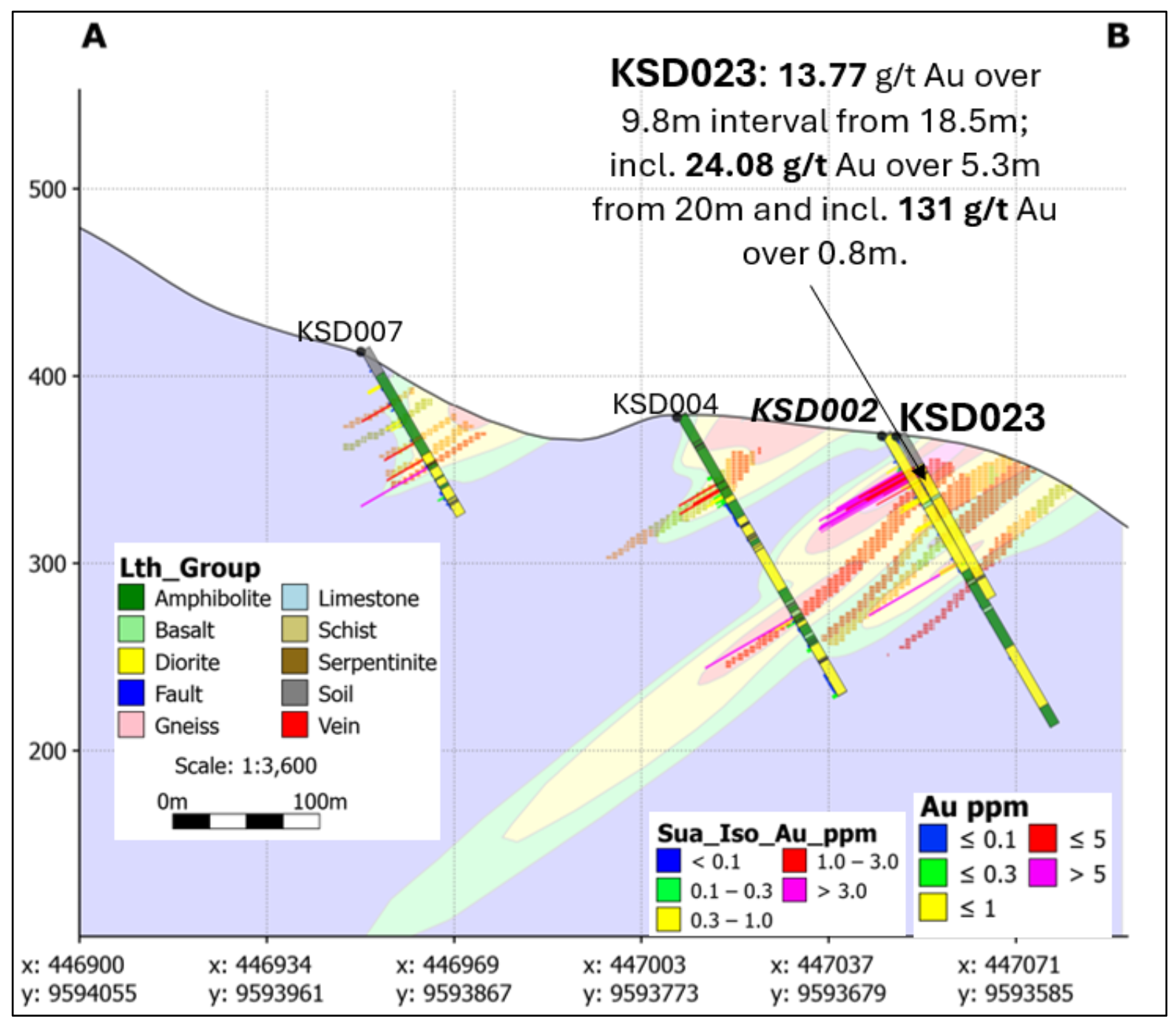
Cross section (looking Northeast) showing the trace of KSD023 and the twinned hole KSD002. Refer to Tables below. Other historical holes along the same section are also shown. Refer to company ASX announcement of October 12, 2025, for complete list of significant intersections for the Sua historical drillholes.
Read more: Far East Gold starts diamond drilling at high-grade Sua prospect
Why it matters
- High-grade near surface: 9.8m at 13.77 g/t Au from 18.5m, including bonanza intervals up to 180 g/t — supportive of strong early-stage economics.
- Data confidence lifted: As a twin to KSD002, KSD023 replicates high grades, de-risking the model and underpinning future resource upgrades.
- Visible gold = high-grade shoots: Coarse gold not seen in KSD002 suggests untested veins may host additional ultra-high-grade zones.
- Scale on a 5km corridor: >30 veins along the Sua–Afley shear give room for step-outs and resource growth.
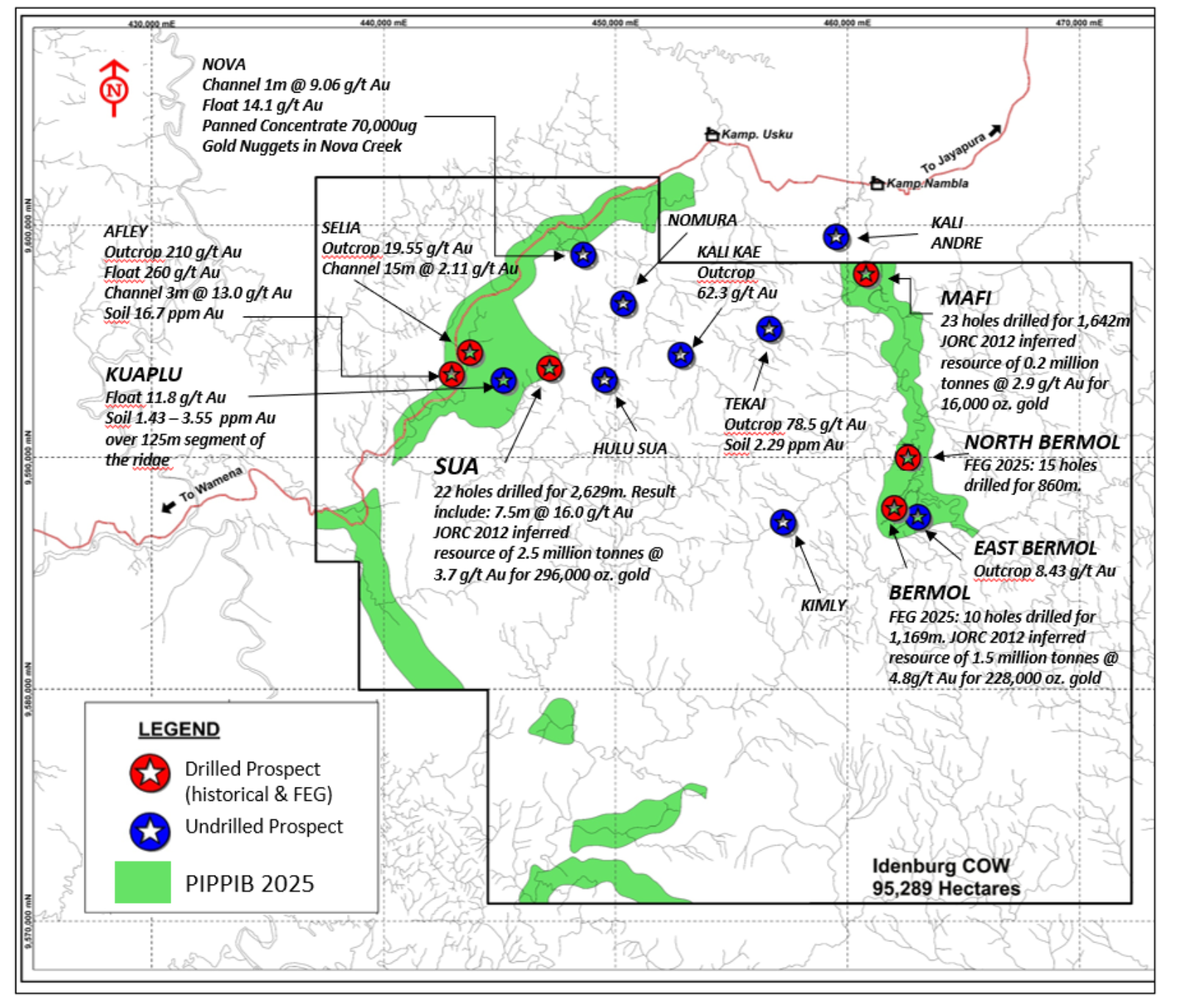
Map showing prospect and resource areas within the Idenburg COW tenement. FEG drilling has been completed in the Bermol prospect area and is in progress the North Bermol prospect. The areas of recently announced PIPPIB forest reclassification is also indicated. Refer to Figures 2 and 3. Coordinates are referenced to datum WGS84, zone 54 south.
Key intercepts from KSD023
- 13.77 g/t Au over 9.8 m (from 18.5 m to 28.3 m)
- 24.08 g/t Au over 5.3 m (from 20.0 m to 25.3 m)
- 131 g/t Au over 0.8 m (24.5–25.3 m)
- 180 g/t Au over 0.4 m (24.9–25.3 m)
- Visible gold-bearing vein: 82 g/t Au over 0.4 m (near surface)
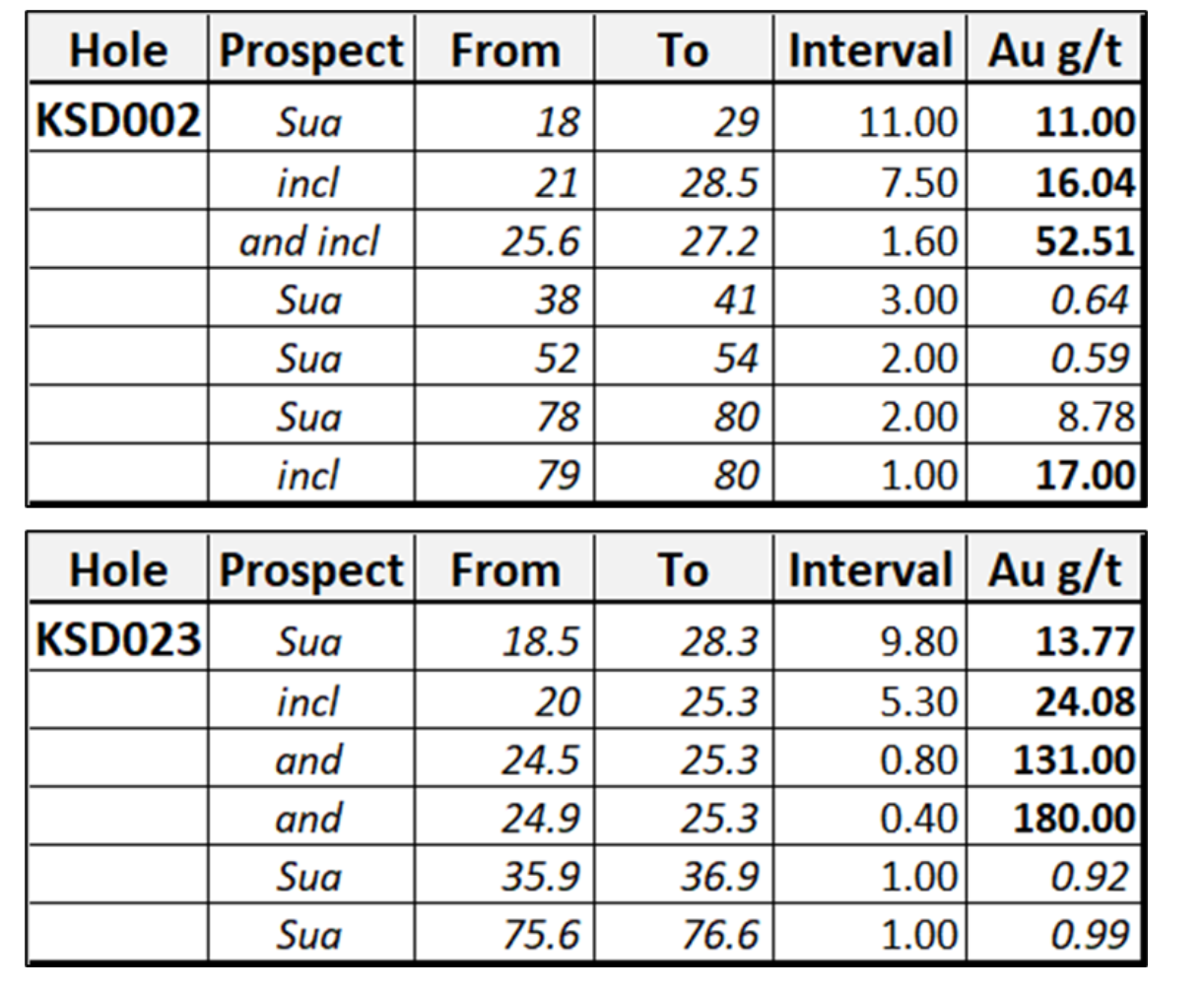
Compiled significant intersections from FEG drillhole KSD023 and historical hole KSD002. Intersections were compiled using weighted averages and using a 0.2 g/t Au cut-off with no grade top cut. A maximum of 3 meters of internal dilution was included. Refer to Table 1 for hole collar details. Table 3 provides individual assay results for the interval 18.5m to 28.3m.
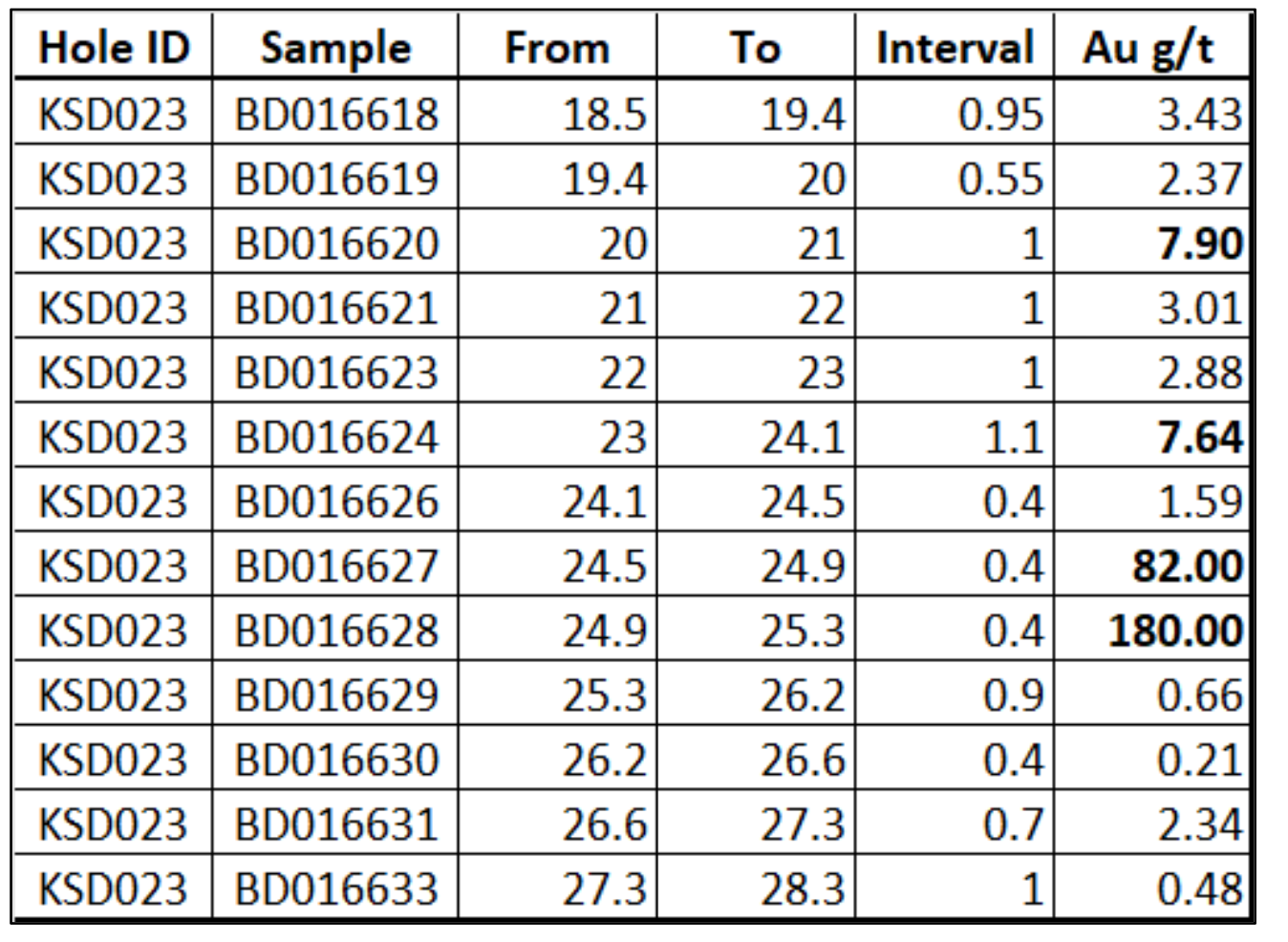
Individual gold assay results for the interval 18.5m to 28.3m in KSD023. The exceptionally high-grade gold assays are associated with massive, milky quartz veins and coarse gold (sample BD016627).
Strategic significance
Idenburg currently hosts a JORC (2012) Inferred Mineral Resource of ~540 koz at 4.1 g/t Au, including ~296 koz at 3.7 g/t Au at Sua. KSD023 achieves two strategic goals:
- it confirms historic grades and geometry, de-risking the model and supporting future resource conversions; and
- it demonstrates the presence of coarse, locally very high-grade gold, which can materially impact ounce-per-vertical-metre profiles where continuity is established.
The result suggests a vein system with intermittent but very rich shoots, characteristic of orogenic gold deposits. With over 30 identified veins across a 5-kilometre shear corridor, the immediate task for the ongoing Sua drill program is to trace the extent and continuity of these high-grade zones — particularly in previously undrilled segments — to inform step-out targeting and future resource growth.
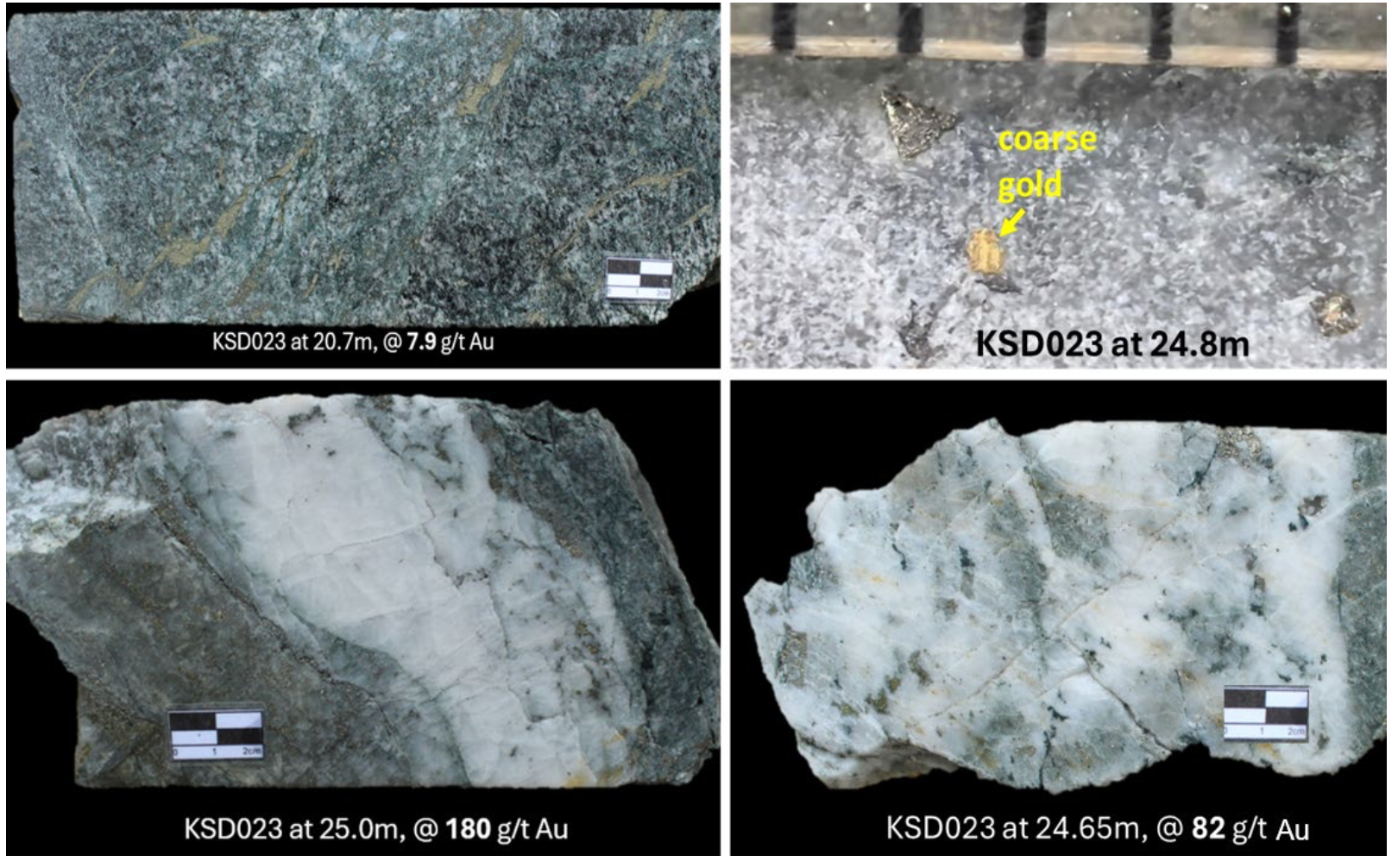
Photos of drill core from hole KSD023. Refer to Table 2. Top left: moderately sheared, altered (chloritic) metadiorite showing coarse pyrite along foliation planes (sample BDO16620). Top right: coarse (0.5mm) visible gold grain and pyrite within metadiorite (sample BDO16627), Bottom left: massive, milky quartz vein within metadiorite. Vein contains disseminated sulphides and contains chlorite along the vein margins (sample BDO16628), Bottom right: massive, milky quartz vein within metadiorite containing disseminated sulphides and specks of visible gold (sample BDO16627).
Sua drill program overview
The current diamond drilling program at Sua aims to validate and extend historical results that identified high-grade gold zones. The campaign includes 10 holes totalling 1,820 metres, with infill drilling on 50-metre spacing to test mineralised continuity.
Twin hole KSD023 successfully confirmed earlier results from KSD002, verifying visible coarse gold in quartz-sulphide veins that trend east-west and plunge ~35° north. In total, 30 gold-bearing quartz veins were identified.
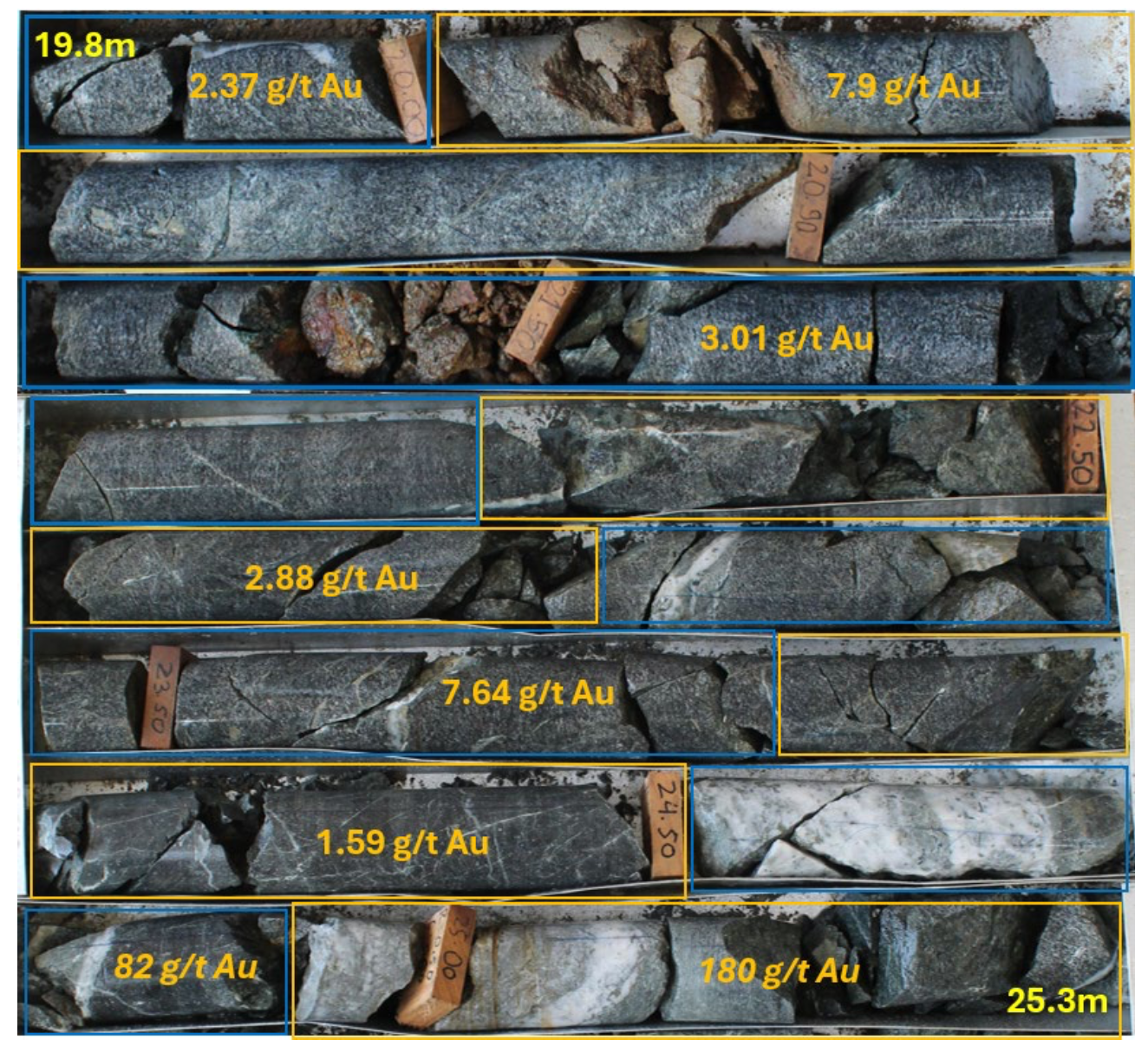
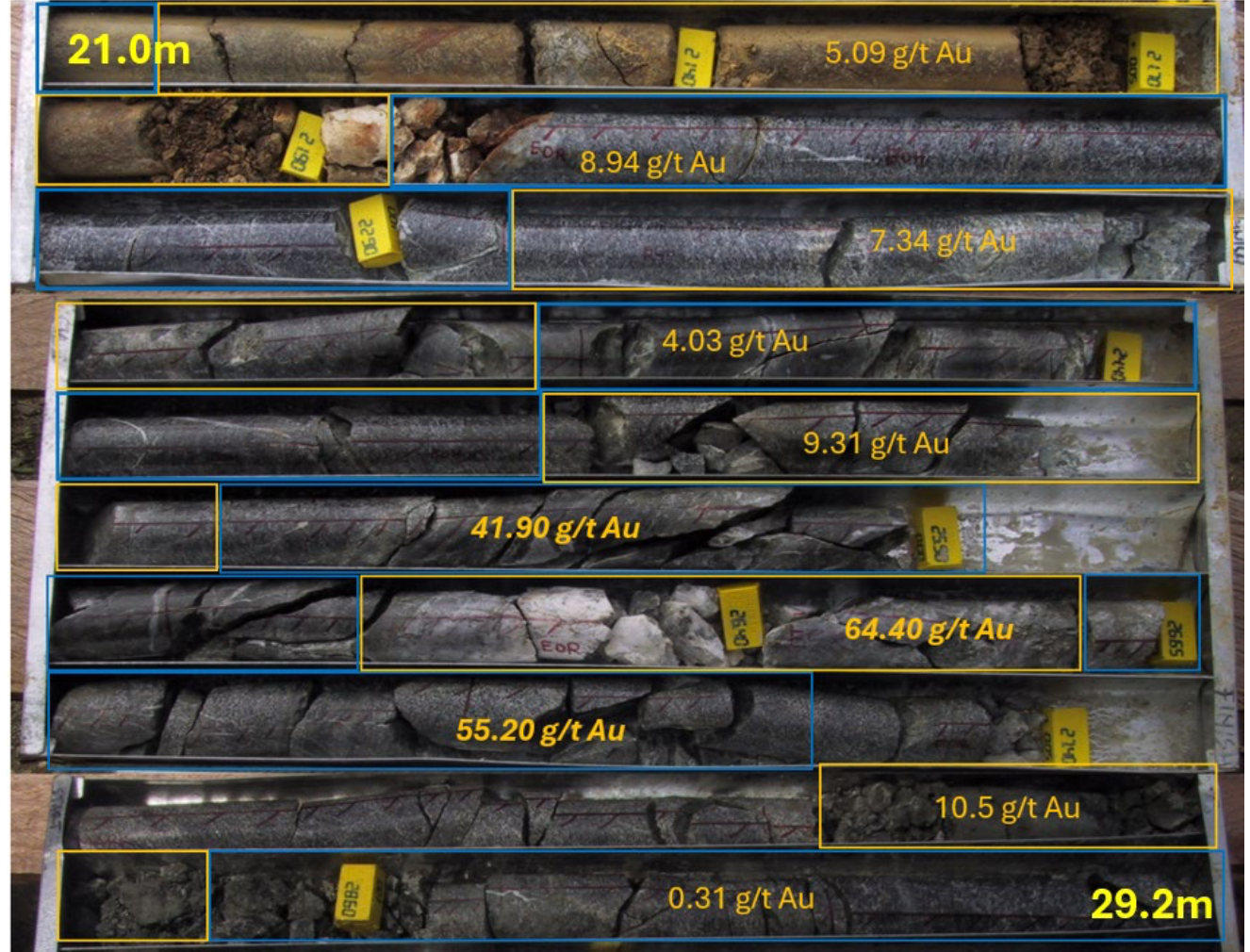
Photos of drill core from holes KSD023. (top) and historical hole KSD002 (bottom). Shows reported assays grades through a comparable twinned core interval. The presence of massive, milky quartz is evident in both core intervals. Assays are comparable between the 2 intervals.
Preliminary metallurgical testing by IMI demonstrated 50–60% gravity gold recovery and overall CIL/RIL recoveries exceeding 90%, confirming amenability to conventional extraction.
The Sua inferred JORC 2012 resource, estimated by SMGC, stands at 2.5 million tonnes @ 3.7 g/t Au for 296,000 ounces (based on November 2024 data).
Kwaplu extension
The ongoing drilling at Sua also targets resource expansion and upgrading of the inferred category. Concurrently, detailed mapping and sampling is underway at the Kwaplu prospect, about 1 km west of Sua.
Historical exploration at Kwaplu revealed high-grade assays exceeding 100 g/t Au from quartz-sulphide outcrops and ridge-and-spur soil anomalies up to 3.88 g/t Au. No prior trenching or drilling has been undertaken. The company believes the Sua shear zone and its quartz vein system may extend into Kwaplu, where upcoming fieldwork will define future drill targets.