
Cobalt Blue Holdings Ltd (ASX:COB, OTC:CBBHF) earlier this week said it will reposition its Broken Hill Technology Centre (BHTC) to begin processing black mass from recycled batteries.
The company said the move follows the completion of its demonstration plant phase, where over $15.00 million was invested since 2021 to build and validate a cobalt refining flow sheet. With that program now complete, BHTC’s capacity will be redirected toward black mass processing.
Black mass is a powder produced during battery recycling and contains a range of critical minerals, including cobalt, nickel, lithium, manganese, graphite, copper, and zinc. The company said these minerals are key inputs for battery manufacturing and resource recovery, aligning the initiative with Australia’s circular economy goals.
Joel Crane, Commercial Manager at Cobalt Blue, said the company is currently the only refiner in Australia able to process black mass. It expects this step will support the growth of domestic recycling capabilities.
The company said black mass would serve as a supplementary feedstock for its proposed cobalt refinery. It highlighted that while Australia currently lacks domestic cobalt production, black mass will help bridge the gap until local mining projects commence or the nickel sector restarts.
“This is a two-pronged strategy,” Crane said. “It helps develop Australia’s circularity and provides us with diversification in sources of feedstock.”
Cobalt Blue also said it hoped other refiners would follow its lead, contributing to the establishment of a more robust local battery recycling infrastructure.
The Broken Hill Technology Centre is expected to be a focal point for investors as the company advances toward a financial investment decision on the refinery.
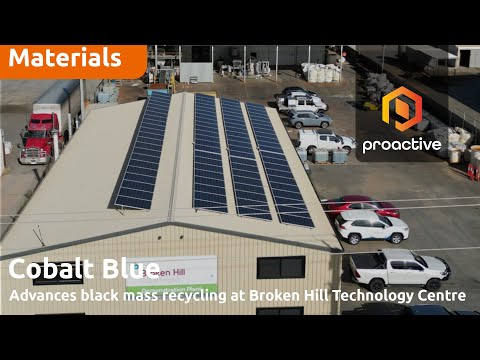
Proactive: Cobalt Blue is repositioning its Broken Hill Technology Centre to start processing black mass from recycled batteries. All the details on this are with Cobalt Blue's Commercial Manager Joel Crane, live out of Melbourne. Joel, it's good to have you back on here. How are you?
Joel Crane: I'm great. Thanks for having us back.
Proactive: Joel, this is quite a stepping stone for Cobalt Blue. But perhaps give us a quick overview of what today's announcement is all about.
Joel Crane: Sure. So basically, since 2021, we've been running what we used to refer to as a demonstration plant. We spent over $15.00 million over that period putting together, first a pilot stage and a full demonstration plant of our flow sheet—basically from mining cobalt all the way through refining.
So the past five years, we've been optimizing, testing, going through that whole process to basically prove up our flow sheet. Now that process is essentially done, and we're ready to move on to the financial investment decision for the refinery, leaving a lot of spare capacity for that technology centre. So what we've announced in this ASX announcement is that we're going to start processing black mass.
Proactive: What is black mass and why is it important, Joel? I think a lot of investors don’t have any prior knowledge on this.
Joel Crane: Sure. What black mass is, is essentially the output from recycling batteries. Battery recyclers, either they collect or they're given batteries. We’re talking your typical button batteries or the batteries in cell phones or laptops, that type of thing. They then shred them and do a little processing on their end, and it becomes basically a black powder.
And this black powder, called black mass, is full of lots of critical minerals. The things that we all know about batteries—namely nickel, cobalt, manganese, lithium and graphite—are the main ones. But there's also often copper and zinc in there as well. So there's lots of opportunity to recover these critical minerals that Australia and the rest of the world need.
Proactive: Joel, this will also tag along with Australia’s circular economy framework set by the government. It will help deliver that essentially and it will advance the country’s battery recycling capability. What is your strategy in that regard, and how do you foresee that to take shape in the short term and on the long run?
Joel Crane: Well, processing black mass has really two important factors. First, what you just mentioned—helping advance the circularity within Australia. Now there is a nascent sector producing this black mass, gathering batteries, recycling them and then creating this material that can be reprocessed. We're at this point the only refiners within Australia that can do it. And we'd like to advance that now, and we hope that others follow us.
But what it also does, importantly, is it provides us with a feedstock for our refinery. At the moment, the refinery strategy is to import feedstock from overseas, because there are no cobalt units within Australia—at least not until our mine gets up or the nickel sector restarts.
So while that is occurring, we'll be able to take this black mass and use it as a feedstock to help diversify sources of supply. So again, it's a two-pronged strategy: to help develop Australia’s circularity and to provide us with the diversification in sources of feedstock.
Proactive: I think the Broken Hill Technology Centre will be a key focal point for investors in the next few weeks. We'll look forward to having you on to discuss more updates as they start rolling through. This was Cobalt Blue's Commercial Manager Joel Crane. Thank you so much.
Joel Crane: Thank you.