
Cobalt Blue Holdings Ltd (ASX:COB, OTC:CBBHF) is repositioning its Broken Hill Technology Centre (BHTC) to support a growing national push toward battery recycling, shifting the facility’s primary role from project testwork to processing lithium-ion battery black mass. The move follows a broad testwork program in 2025 that assessed multiple samples of recycled material for cobalt, nickel and manganese recovery.
The company expects the shift to provide modest near-term revenue potential while also helping de-risk feedstock supply for its planned Kwinana Cobalt Refinery (KCR) in Western Australia. The transition has drawn support from key stakeholders, including Broken Hill Mayor Tom Kennedy, who said the development aligns with the city’s long-standing mining innovation base and is likely to deliver new jobs and local economic benefits.
The strategic realignment also reflects broader national efforts to establish domestic capability for battery material recovery, reduce waste and integrate Australia further into allied critical minerals supply chains.
“It's extremely encouraging to see that Cobalt Blue is in a position to fast-track its transition to black mass recycling in Broken Hill, and Council is proud to have supported this project from the outset," Broken Hill Mayor Tom Kennedy said.
"Broken Hill has long been at the forefront of innovation in the mining and minerals industry, and this project represents a continuation of that legacy. The transition to black mass recycling will provide a welcome boost for the city's economy and bolster local employment, and we wish Cobalt Blue every success in this exciting venture.”
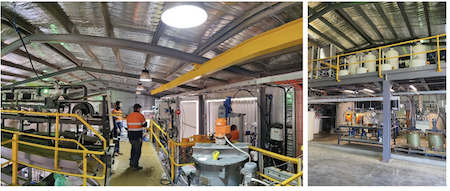
Pressure oxidation and iron precipitation circuits at the Broken Hill Technology Centre.
Investment in BHTC underpins Kwinana refinery plans
Since 2021, Cobalt Blue has invested more than A$15 million in BHTC to validate processing flowsheets for both the Broken Hill Cobalt Project and, more recently, the KCR development.
Recent testwork using commercially available cobalt hydroxide and cobalt–nickel sulphide feedstocks resulted in cobalt sulphate meeting battery-grade specifications and London Metal Exchange-grade cobalt metal, completing the technical foundations required for the refinery’s next stage.
The company is now progressing KCR toward final investment decision, including offtake negotiations, finance and pre-construction work. BHTC’s new mandate is to evaluate whether recycled black mass can be incorporated as part of the refinery’s initial target of around 3,000 tonnes per year of contained cobalt in sulphate and metal products.
Flowsheet optimisation targets multiple battery materials
Current testwork has shown consistent extraction performance from black mass samples containing typical grades of 6–14% cobalt, 5–17% nickel and 6–15% manganese.
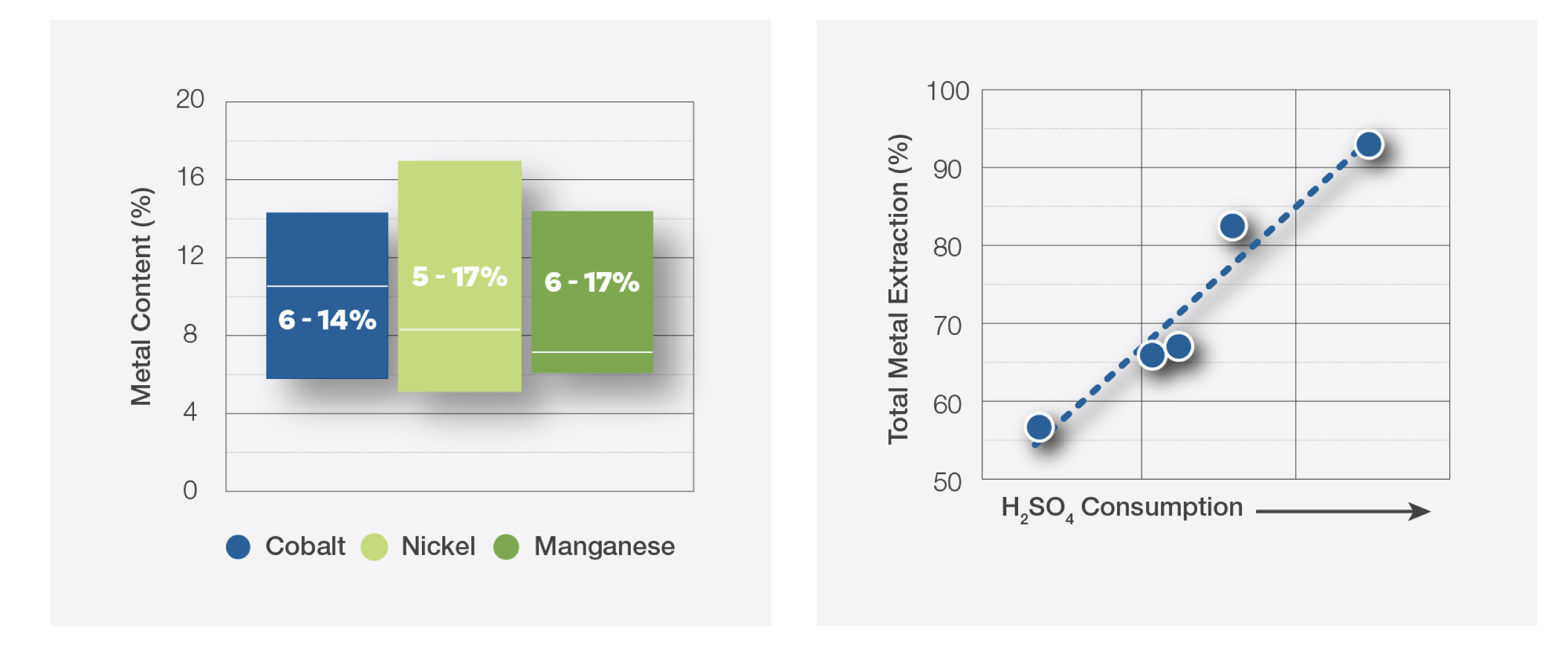
Typical composition of battery black mass and COB’s recent black mass recovery statistics.
The flowsheet under assessment would produce cobalt metal, nickel hydroxide and manganese sulphate, with parallel studies exploring lithium and graphite recovery. Success at this stage would allow BHTC to generate saleable products from recycled feed while demonstrating a pathway for integrating black mass into future KCR operations.
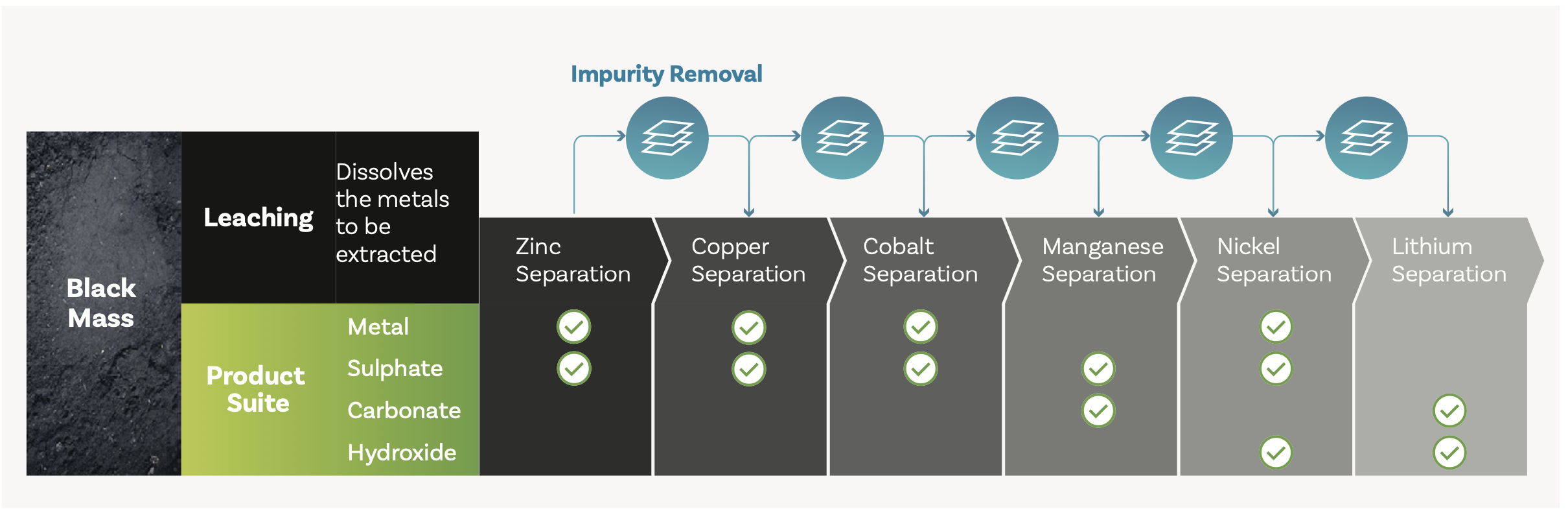
COB’s black mass flowsheet.
The work is also intended to improve supply-chain resilience by diversifying away from a sole reliance on imported cobalt intermediates.
EcoBatt and Hartree support recycling strategy
Cobalt Blue’s recycling strategy is being advanced alongside commercial partnerships aimed at securing both feedstock and potential early-stage product offtake.
A memorandum of understanding with EcoBatt, a subsidiary of Ecocycle, is examining the processing of black mass produced at EcoBatt’s Victorian facility, which operates one of Australia’s largest battery collection and sorting networks.
Positive technical outcomes could lead to a commercial supply agreement.
On the downstream side, global commodities group Hartree Partners has issued a non-binding letter of intent covering possible purchases of cobalt metal produced from recycled material. Together, these partnerships strengthen the commercial case for BHTC’s recycling pivot and position Cobalt Blue within an emerging national ecosystem for battery material recovery.
Why is Black Mass important?
Black mass is the high-value concentrate produced during the recycling of lithium-ion batteries from electric vehicles, mobile phones and other electronics. After battery packs are dismantled and cells crushed, contaminants are removed to yield a dense powder containing key cathode and anode metals, including cobalt, nickel, manganese, lithium and graphite.
Now traded as a commodity, black mass is priced according to its metal content, with payability guided by assessments from agencies such as Fastmarkets and Platts. Metallurgically, it is an appealing feedstock thanks to its high-grade composition and its ability to be leached under atmospheric conditions. Environmentally, black mass processing plays a critical role in developing Australia’s circular economy.
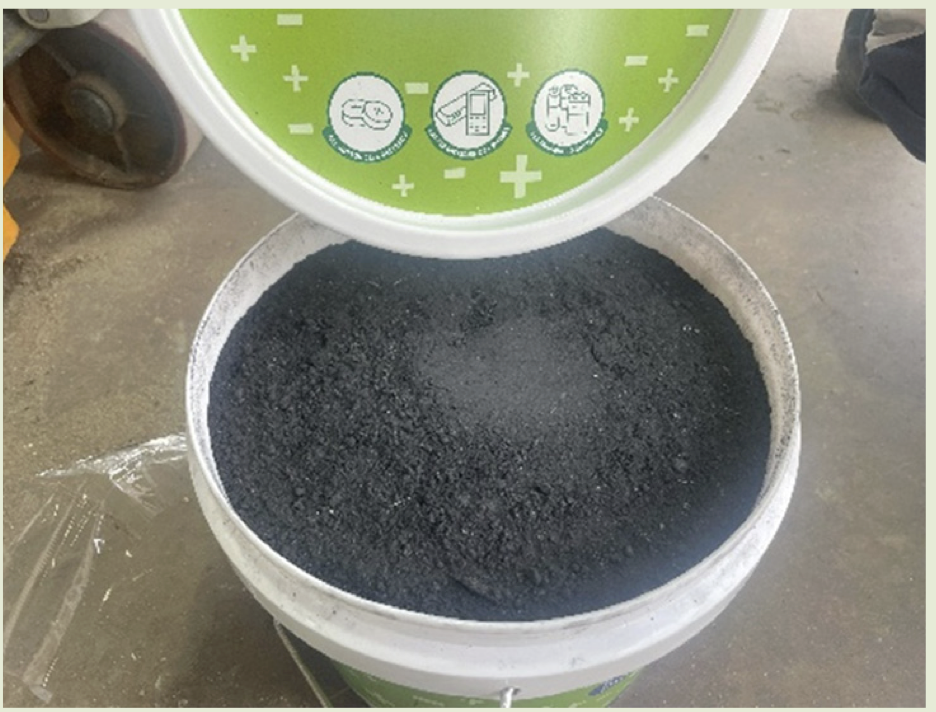
Black mass sample from EcoBatt.
Only a small proportion of lithium-ion battery waste is currently recycled in Australia.
COB’s partner, EcoBatt, estimates the household battery recycling rate at just 12% — among the lowest in the OECD4 — leaving most batteries to accumulate in hazardous stockpiles or end up in landfill.
By progressing downstream battery reprocessing, COB aims to help establish a self-sustaining domestic recycling industry. Recovering minerals from end-of-life batteries not only improves supply chain resilience but also reduces dependence on traditional mining.