
Australia’s diplomatic push to deepen critical minerals cooperation with the United States is gaining momentum, with several ASX-listed explorers called on to brief the Australian embassy in Washington ahead of next week’s meeting between Prime Minister Anthony Albanese and President Donald Trump.
Among the companies asked to participate are Resolution Minerals Ltd (ASX:RML, OTC:RLMLF) and Nova Minerals Ltd (ASX:NVA, NASDAQ:NVA, OTC:NVAAF) — both advancing North American projects focused on antimony, a critical mineral essential to US defence and industrial supply chains.
Their invitations, issued by Ambassador to the US Kevin Rudd, highlight how the Albanese Government is positioning Australian expertise as central to US efforts to secure alternative supply chains and reduce reliance on China.
Resolution brings Idaho’s Horse Heaven into the spotlight
For Resolution Minerals, the engagement represents a milestone for its Horse Heaven gold-antimony-tungsten project in Idaho. The company has submitted a detailed dossier outlining project scale, expansion potential and resource value ahead of the leaders’ summit.
Read more: Resolution Minerals tapped to brief ambassador ahead of PM’s meeting with President Trump
Craig Lindsay, the company’s CEO of US operations, said Resolution was “very supportive of the Australian government’s efforts to engage with and assist the US government in its efforts to address their significant critical metals supply deficit”.
“Several Australian companies, including Resolution, are investing heavily in US domestic critical element projects,” he said.
“In the case of Resolution, our Horse Heaven project is a past-producer of both tungsten and antimony, enjoys high grades that potentially support a nearer-term production profile utilising smaller-scale, modular processing units, and, just as importantly, is immediately adjacent to Perpetua Resources’ Stibnite Gold and Antimony Project. With respect to Stibnite, the significant planned investments in infrastructure to support this mine will benefit Horse Heaven directly.”
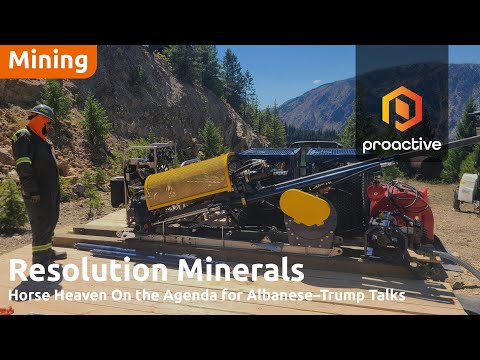
The project sits beside one of America’s largest gold-antimony operations and could slot into the emerging framework of U.S.–Australia collaboration on critical-mineral self-sufficiency.
Lindsay said the company viewed the diplomatic engagement as a tangible sign that governments on both sides of the Pacific are serious about rebuilding strategic stockpiles.
“While we are not a party to what is on the agenda for the upcoming meeting between Prime Minister Albanese and the Trump Government, it is logical to assume that one item on the agenda will be how Australian companies can assist the US in meeting its supply deficits,” he said.
He added that higher-level cooperation could directly influence Resolution’s near-term goals.
“We definitely see this as a positive development, and any elevation in cooperation between the US and Australia at senior government levels will be beneficial to Resolution Minerals as we actively develop a business model that envisions near-term production from our Horse Heaven Project,” Lindsay said. “To achieve this, support from the US government from a funding and permitting perspective will be critical.”
Nova adds Alaska’s Estelle Project to the mix
Nova Minerals has been similarly engaged, requested by Ambassador Rudd to provide an update on its Estelle Gold and Critical Minerals Project in Alaska’s Tintina Gold Belt, including the key minerals identified, planned expansion activities and the company’s engagement with US government agencies.
The briefing follows a site visit in August by Australia’s Consul-General, Tanya Bennett, who recognised Estelle as a “leading example” of US–Australia collaboration in critical resources.
The project recently secured a US$43.4 million award from the US Department of War, supporting Nova’s plan to deliver military-grade antimony products by 2026–27 through a proposed refinery at Port MacKenzie. CEO Christopher Gerteisen said the invitation “is a testament to the strategic importance of the Estelle Project” and reinforces Nova’s role in advancing “a secure, domestic supply chain for antimony and supporting US defence and industrial needs”.
With more than 20 gold and antimony prospects across a 35-kilometre corridor, Estelle is emerging as one of the largest undeveloped gold systems in the region, and its dual exposure to gold and strategic metals aligns neatly with US defence priorities.
Read more: Nova Minerals tapped to brief US talks on critical minerals as Estelle targets 2026/27 antimony
A wider pattern of engagement
The requested briefings are part of a broader wave of diplomatic and industry activity over the past month. In late September, several Australian firms, including International Graphite Ltd (ASX:IG6), joined government-backed delegations to Washington to explore US funding and equity partnerships in the critical minerals sector.
Read more: International Graphite joins US critical minerals delegation, advances global project pipeline
The growing momentum comes as the United States moves from rhetoric to investment. Recent reports suggest Washington is considering direct equity stakes and grant programs to fast-track allied projects, while Canberra has floated its own A$1.2 billion strategic minerals reserve to underpin cooperation.
The inclusion of smaller-cap ASX explorers in such high-level dialogues suggests governments are looking beyond the majors for shovel-ready opportunities in antimony, tungsten, rare earths and graphite — all areas where Australian companies have active US projects.
Strategic metals at the centre of diplomacy
The timing is politically charged: with China tightening exports of key inputs, the US is moving to secure supplies from trusted allies. Antimony, tungsten and rare earths — materials vital for munitions, semiconductors and clean-energy systems — have become strategic priorities.
For companies like Resolution and Nova, this evolving diplomacy offers both visibility and the prospect of government-level support that could accelerate their paths to production.
Whether these briefings translate into funding or formal agreements remains to be seen, but the direction of travel is clear: Australia’s critical-minerals sector is moving from exporter to strategic partner — and Washington is listening.