
Race Oncology Ltd (ASX:RAC, OTC:RAONF) has uncovered a fresh chapter in its lead cancer program, identifying a novel mechanism of action for its (E,E)-bisantrene candidate. New data shows the compound binds to G4-DNA and RNA structures — genetic “switches” that regulate cancer-driving genes like MYC — setting it apart from doxorubicin-like chemotherapies that remain the backbone of treatment in many cancers.
Read more: Race Oncology uncovers primary anticancer mechanism of (E,E)-bisantrene
Standard anthracyclines such as doxorubicin intercalate into DNA and generate free radicals to kill rapidly dividing cells. They are effective, but long-term use is constrained by cardiotoxicity, resistance and cumulative dosing limits. Race’s discovery suggests its (E,E) isomer, referred to as RCDS1, works differently, targeting the machinery that drives malignancy and potentially offering efficacy without the same toxic baggage.
This distinction could prove commercially significant. In September, Race filed three composition-of-matter patent applications covering the chemical identity, manufacturing methods and formulations of (E,E)-bisantrene. The new mechanism finding reinforces those filings, tying scientific rationale to intellectual property protection.
Read more: Race Oncology submits patent applications for (E,E)-bisantrene
The news in focus
According to Race, binding to G4-DNA and RNA reduces activity of cancer-driving genes such as MYC, while also inhibiting topoisomerase 2 and telomerase. These pathways are implicated in cell proliferation, tumour progression and resistance to standard chemotherapy. By hitting multiple targets at once, RCDS1 could blunt cancer’s ability to adapt — a potential differentiator in an oncology market where resistance often undercuts long-term treatment success.
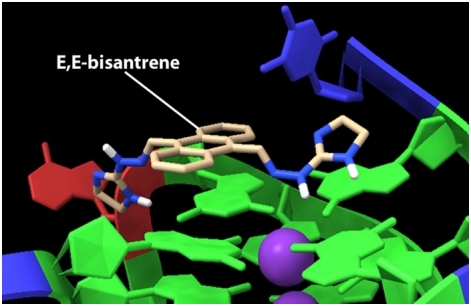
Model of RCDS1 (E,E-bisantrene) binding to the G4 DNA structure found within the promotor region of MYC.
Importantly, this discovery offers Race a clearer narrative around how RCDS1 could be positioned in the clinic. Where anthracyclines are limited by toxicity or relapse, a G4-targeting drug might offer physicians an alternative that is mechanistically distinct yet familiar enough to fit into existing treatment regimens.
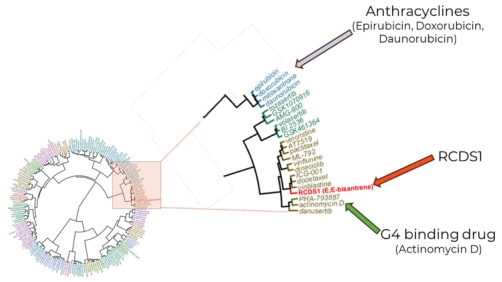
Cluster analysis of the anticancer responses of 195 drugs across 102 cancer cell lines showing that RCDS1 (E,E-bisantrene) is similar in mechanism of action to the G4-DNA binding drug actinomycin D.
Race’s share price has surged alongside these developments. The stock has gained 30% in the past week, 192% over the past month and more than 250% across the past six months. From a 52-week low near $0.93, shares were trading above $4 on Friday afternoon.
The rally underscores strong investor confidence in the company’s scientific and IP position, with upcoming clinical execution now set to determine how far this momentum can carry.
Why composition of matter matters
Patent law can be arcane, but the commercial difference is stark. Method-of-use patents can prevent rivals from copying how a drug is prescribed, but competitors can sometimes work around them. Composition patents, by contrast, stop others from producing the molecule itself.
For small-cap companies, this distinction often determines deal-making potential; big pharma rarely pays top dollar for assets with flimsy or short-dated IP. Strong composition-of-matter rights open doors to longer exclusivity, higher royalty rates and greater negotiating leverage.
For Race, the implications are twofold. First, it gains stronger credibility in partnering discussions — a must for a company of its size. Second, investors may begin to assign higher value to the asset, recognising that any eventual acquirer would be buying not just data but an enforceable monopoly.
Why this matters beyond Race
For Australia’s biotech sector, the story has resonance. Investors often complain that local names are heavy on capital raisings and light on defendable science. Race’s move to anchor its program in both a novel mechanism and robust IP suggests that deep molecular innovation is possible on the ASX — and that local companies can play in the same league as their global peers when it comes to commercial-grade drug development.
It’s also a reminder that while trial milestones and financing news dominate headlines, it is the scientific underpinnings that ultimately drive value. By securing its molecule at the core and tying it to new biology, Race has given itself a fighting chance to translate discovery into shareholder returns.