
Race Oncology Ltd (ASX:RAC, OTC:RAONF) has identified the primary anticancer mechanism of action for its lead drug candidate, (E,E)-bisantrene (RCDS1), marking what it describes as a major breakthrough in understanding the drug’s clinical and commercial potential.
New studies by Race and collaborators show that RCDS1’s activity comes from binding to and stabilising DNA and RNA structures known as G-quadruplexes (G4s), rather than acting like traditional anthracycline chemotherapies such as doxorubicin.
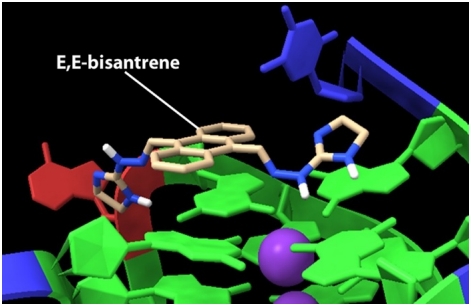
Model of RCDS1 (E,E-bisantrene) binding to the G4 DNA structure found within the promotor region of MYC.
G4 structures play a critical role in regulating the expression of genes that drive cancer growth. By stabilising these structures, RCDS1 can inhibit a master regulator of cancer, the MYC oncogene, while also blocking key enzymes such as topoisomerase II and telomerase, and indirectly increasing RNA methylation levels (m6A).
Race says this new understanding fundamentally changes how the drug may be deployed in future clinical settings.
Read more: Race Oncology submits patent applications for (E,E)-bisantrene
Clinical and commercial significance
The company believes the discovery will help streamline clinical trial design, identify cancer types most likely to respond to treatment, and enable development of predictive biomarker tests. These insights could also improve prospects for regulatory approval and large pharmaceutical partnerships, both of which often depend on a clear mechanism of action to reduce clinical and scientific risk.
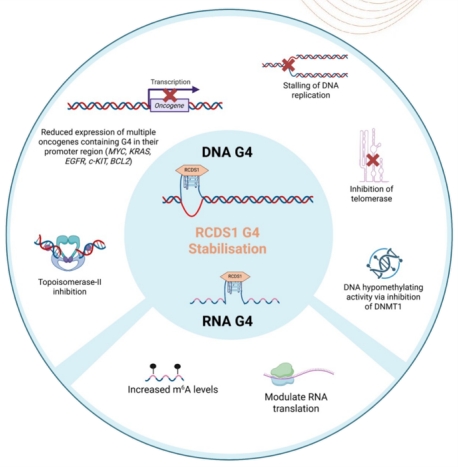
Binding of RCDS1 to G4-DNA and RNA structures causes multiple downstream anticancer effects
Race CEO and managing director Dr Daniel Tillett said the discovery of (E,E)-bisantrene’s anticancer mechanism “fundamentally changes our thinking on how to best use this drug in the clinic”.
“Bisantrene continues to surprise, and we look forward to building on this mechanism of action discovery in our future clinical and commercial plans,” Tillett said.
Rewriting assumptions about bisantrene
Bisantrene, first studied in the 1980s, had long been assumed to act like other DNA-targeting chemotherapy drugs. However, its minimal cardiotoxicity and atypical behaviour compared with anthracyclines suggested a different underlying mechanism.
Using modern molecular techniques, Race compared RCDS1 across a broad cancer cell panel, finding it clustered with G4-binding drugs such as actinomycin D rather than with anthracyclines. This prompted a deeper investigation that confirmed RCDS1’s G4-binding activity.
Importantly, the company’s studies showed RCDS1 rapidly downregulates MYC — a gene overexpressed in more than 70% of human cancers and historically considered “undruggable.”
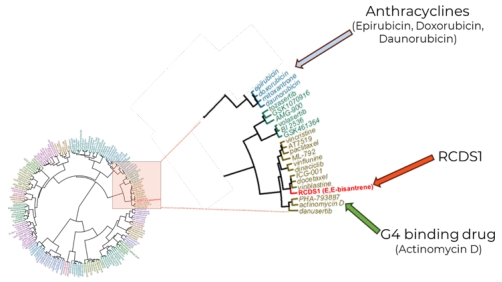
Cluster analysis of the anticancer responses of 195 drugs across 102 cancer cell lines showing that RCDS1 (E,Ebisantrene) is similar in mechanism of action to the G4-DNA binding drug actinomycin D.
Next steps
Race plans to advance additional preclinical studies to further define RCDS1’s G4-binding effects and identify the most responsive cancer indications and drug combinations. The company will also seek to determine the most valuable market opportunities and outline clinical trial strategies to support development of its proprietary RC220 formulation.
Management will present the findings in more detail at a shareholder webinar on October 8 and expects to publish results in peer-reviewed journals and at international conferences. Participants can register here.
Race is also preparing further data on RCDS1’s cardioprotective properties, which will be presented at the European Society of Medical Oncology conference later this month.