
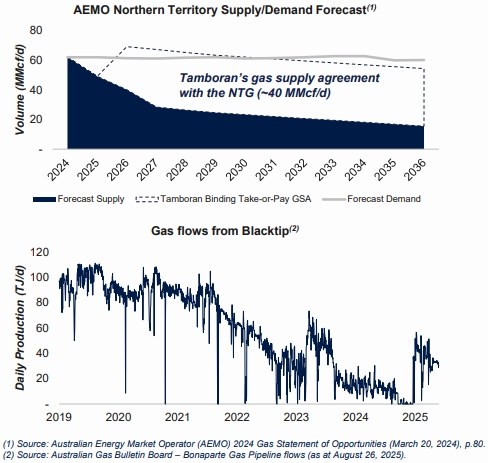
Australia is heading into an energy bind. Regulators from the Australian Energy Market Operator (AEMO) to the Australian Competition & Consumer Commission (ACCC) have warned that, as early as 2028, the East Coast could face significant gas shortfalls unless new supply is developed. The Blacktip gas field, the Northern Territory’s long-time domestic supplier, is in terminal decline. Coal retirements and the surge in renewable generation are tightening the need for flexible gas-fired power. And liquefied natural gas (LNG) export contracts out of Queensland remain locked up well into the 2030s, leaving little space to redirect supplies.
In this context, attention has turned north to the Beetaloo Basin, a vast shale formation in the Northern Territory that remains one of the world’s largest undeveloped gas resources.
For years, exploration in the Beetaloo was tentative, constrained by limited shale expertise and modest investment. Now, Tamboran Resources Corporation (ASX:TBN, NYSE:TBN, OTC:TBNRL) is applying modern US drilling methods and drawing on a leadership team experienced in unlocking shale plays, aiming to make the basin Australia’s next major gas province — and potentially the solution to the coming supply crunch.
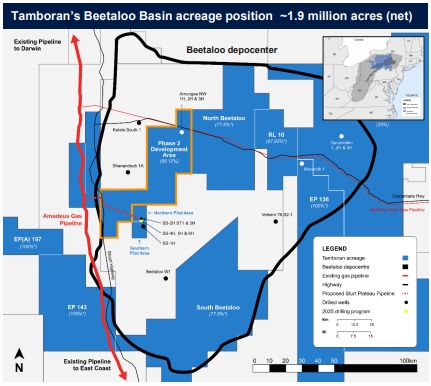
Key operator of ~1.9 million net prospective acres in Australia’s Beetaloo Basin
Why the Beetaloo matters
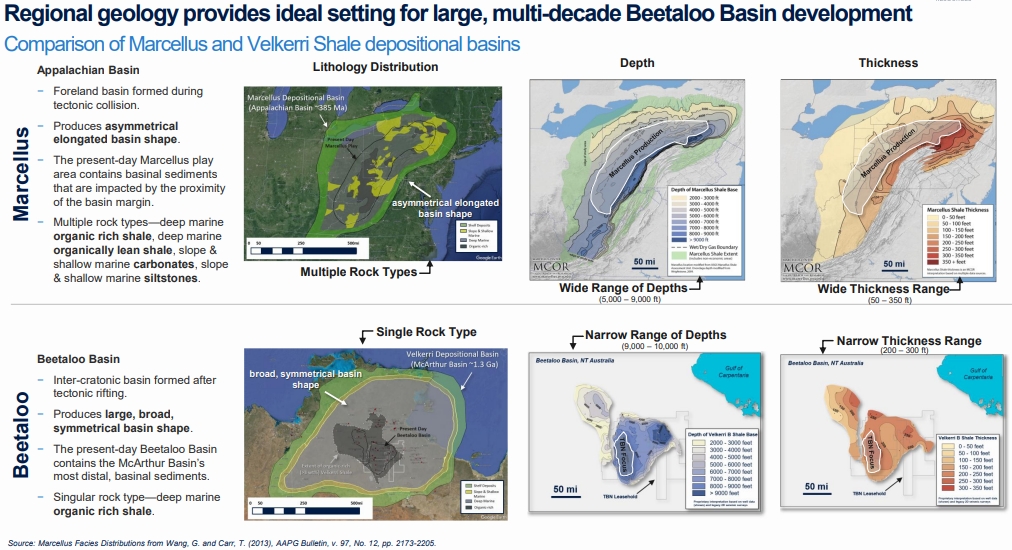
The Beetaloo lies some 300 miles southeast of Darwin, under remote pastoral land but with a surprising advantage: access to existing highway, rail and pipeline infrastructure, plus water allocations sufficient to support large-scale drilling. Geologically, comparisons with the Marcellus Shale — the formation that underpinned the US gas boom — show Beetaloo’s Velkerri B shale delivering similar flow rates and potentially stronger decline profiles, meaning longer-lasting wells.
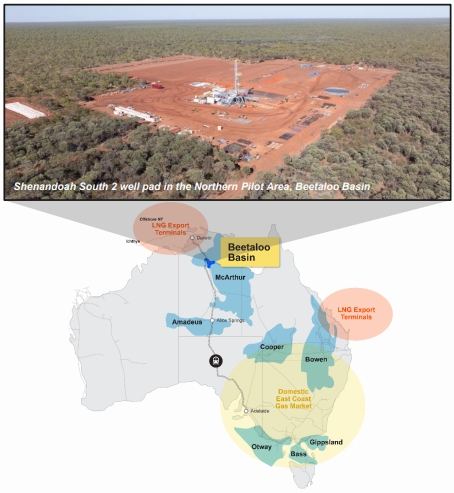
For domestic energy planners, the basin’s strategic location is critical. Gas produced here can flow into three markets: the Northern Territory, the East Coast grid via the Amadeus pipeline, and LNG export hubs at Darwin. That flexibility makes the Beetaloo more than a regional play — it could underpin national energy security while also tapping high-growth Asian LNG demand.
Tamboran’s strategy: Phased build-out
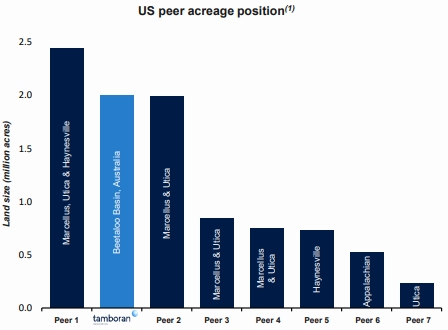
Tamboran controls around 1.9 million acres of Beetaloo acreage, a landholding comparable in scale to some of the largest US shale operators.
Its plan is staged:
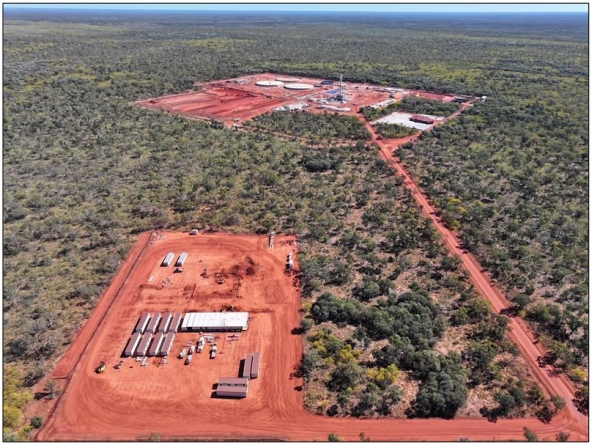
- Phase 1 is the Shenandoah South Pilot Project, designed to deliver an initial 40 terajoules per day from mid-2026, all of it already contracted to the Northern Territory Government through 2041. This early production will replace declining Blacktip volumes, keeping the NT’s lights on while generating royalties for Native Title holders under recently introduced legislation.
- Phase 2 focuses on the East Coast shortfall. Tamboran is advancing farm-out discussions on a 400,000-acre development area, aiming to sanction a larger project by 2028-30 — right when regulators forecast the biggest gap in supply hitting. Non-binding expressions of interest from six major gas retailers already cover as much as 875 terajoules per day (TJ/d).
- Phase 3 looks further ahead, with a proposed LNG export terminal at Middle Arm in Darwin. Tamboran has secured a 170-hectare site, completed pre-FEED work with Bechtel, and signed preliminary offtake MOUs with BP and Shell for 4.4 million tonnes per annum of LNG.
Read more: Tamboran secures NT Government approval for gas sales from Shenandoah South Pilot Project
This sequencing is central to Tamboran’s pitch: near-term domestic supply to prove performance, then scale to meet East Coast and export demand.
The US connection
One of Tamboran’s key differentiators is its import of US unconventional expertise. The Beetaloo has been drilled before, but often with older rigs and without the tailored stimulation approaches honed in US basins.
Tamboran has partnered with Helmerich & Payne to bring in FlexRig super-spec rigs, and with Liberty Energy to supply modern frac fleets. These alliances aim to replicate the efficiency gains achieved in US shale basins such as the Marcellus, reducing well costs and speeding drilling times.
Tamboran recently recorded a Beetaloo-best 90-day average flow (IP90) of 6.7 million cubic feet per day at its SS-2H well — a result in line with Marcellus peers.
Read more: Tamboran Resources sets Beetaloo Basin IP90 record
The company is also targeting a 40% reduction in drilling costs, down to around US$7.2 million per well, through batch drilling, local sand sourcing, and operational optimisation.
Economics and markets
Keeping costs under control is essential in the Australian gas market, where pricing can be as much a challenge as an opportunity. On the East Coast, the ACCC reported average contract prices of around US$8.00 per gigajoule in late 2024 — more than triple Henry Hub levels in the US. That premium reflects transport distances, lack of new investment, and a tight market.
For producers like Tamboran, the spread means significant margin potential if costs can be contained. For consumers and policymakers, it highlights the urgency of bringing on new supply before prices rise further. A dedicated Beetaloo-to-East Coast pipeline, proposed by APA Group at a cost of US$3 billion–4 billion, is now under study, with a final investment decision targeted for 2027.
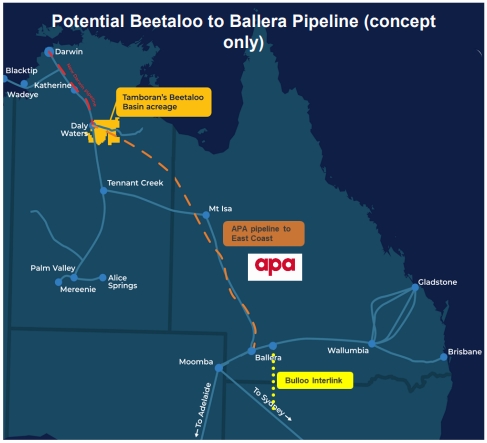
Tamboran’s pilot volumes will flow via a shorter spur into the existing Amadeus pipeline, but scaling up will require this new eastward link. The company has already contracted foundational capacity on the APA-operated Sturt Plateau Pipeline, due for completion in mid-2026, to move gas into the NT market.
Community and political dynamics
Community support remains a critical factor for any large energy development. Tamboran has pointed to record spending with Indigenous businesses in FY25 and a royalty framework that will expand once production begins. Agreements with Native Title holders already permit the sale of appraisal gas from exploration permits, creating an early precedent for revenue sharing.
Read more: Tamboran secures Native Title Holder approval for gas sales under Beneficial Use of Gas legislation
The company has also supported a range of local initiatives, including sport and youth programs, as part of its broader engagement efforts in the NT.
The Northern Territory Government has also cast the Beetaloo as a priority project, viewing it as both an energy security measure and a source of future revenue.
Northern Territory gas market dynamics
At the federal level, up to US$1 billion in infrastructure contributions has been flagged for the proposed LNG hub at Darwin. Such political and community settings can determine whether projects advance on schedule.
The bigger picture
For Australia, the Beetaloo story is about whether domestic gas can provide a bridge as the power system shifts away from coal and towards renewables. Gas remains controversial in the context of climate targets, but AEMO’s modelling suggests it will continue to play a role in firming renewable generation through the 2030s.
Tamboran aims to bring its first pilot gas to market by mid-2026, coinciding with the decline of existing NT supply. Construction of the Sturt Plateau Compression Facility is more than halfway complete, with the associated pipeline due to break ground later this year. Multiple pilot wells are scheduled for stimulation through 2025–26.
Phase 1 – Proposed Shenandoah South Pilot Project
Drawing on its large acreage position and leadership team’s US shale experience, Tamboran is looking to adapt proven methods to the Northern Territory. If successful, its projects could underpin the Beetaloo’s emergence as a critical source of new supply and help close Australia’s looming gas shortfall.