
Janus Electric Holdings Ltd (ASX:JNS) is hitting the ground running after its recent ASX debut, unveiling an ambitious roadmap to electrify Australia’s heavy road transport fleet with swappable battery technology, scalable infrastructure and a growing list of blue-chip customers.
The company raised $8.8 million at $0.20 per share ahead of its May 21 listing, closing 10% higher on debut. Backed by strong support from institutional and professional investors, Janus plans to ramp up delivery of 142 contracted truck conversions while scaling its battery and energy-as-a-service network — a model that enables zero-emissions transport with lower up-front capital and maximum operational uptime.
The company’s stated aim is to “be a disruptive force, improving the economics and productivity of the heavy road transport industry by retrofitting existing diesel trucks and innovating through smart technology to create long-term value for the industry and our shareholders.”
With key contracts in hand, a growing station network and a leadership team focused on execution, Janus is now moving from pilot phase to commercial rollout — targeting Australia’s busiest freight corridors and the 80,000-truck segment most suited to its retrofit and battery-swap model. Janus is targeting a 1% market share of that market, or about 80 trucks, representing $140 million in potential conversion fees alone, while pursuing offshore partnerships that could expose it to hundreds of thousands more convertible prime movers.
Battery swapping drives performance and uptime
At the heart of Janus’s offering is a modular, swappable battery system designed to overcome one of the biggest hurdles in commercial electric vehicle (EV) adoption: charging downtime.
The Janus Charge & Change Station (JCCS) network allows electric prime movers to swap depleted batteries for fresh ones in under five minutes — eliminating range anxiety and maximising fleet utilisation. New electric vehicles from original equipment manufacturers (OEMs), in contrast, can take three hours to charge.
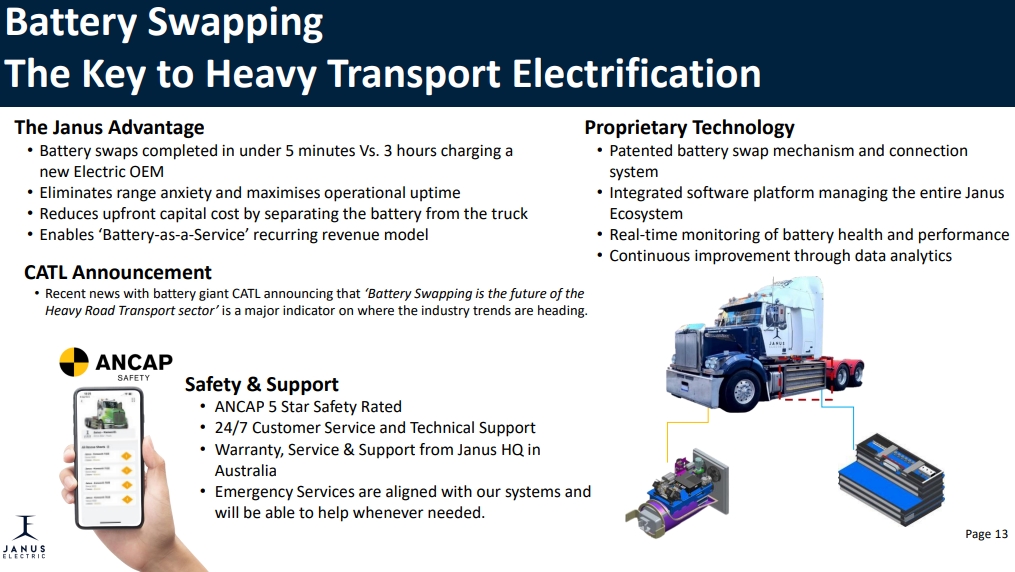
With each truck delivering up to 63% less carbon dioxide (CO₂) emissions and avoiding millions of litres in diesel use over its lifetime, the company’s clean transport credentials are gaining traction with major fleet operators.
Cement Australia already has six Janus-converted prime movers operating across New South Wales and Victoria, with more orders in the pipeline. Qube Holdings Ltd, one of Australia’s largest logistics groups, is also among Janus’s confirmed customers — and is working with the company to deliver what may become the world’s largest electric road train, with a 240-tonne haulage capacity.
Janus currently operates seven JCCS sites and is focused on building a dense network of battery swap infrastructure along Australia’s busiest freight corridors, particularly between Melbourne, Sydney and Brisbane.
New battery supply deal accelerates scale-up
To support its growing vehicle and infrastructure rollout, Janus has signed a commercial supply agreement with North American battery innovator Electrovaya Inc.
Read more: Janus Electric partners with Electrovaya on next-gen battery supply for heavy transport
Announced on July 7, 2025, the deal secures next-generation battery systems that will underpin Janus’s expansion and help integrate advanced safety and performance features into its swappable battery platform.
The agreement gives Janus access to Electrovaya’s proprietary Infinity Battery systems, which are expected to enhance energy density, reduce lifecycle costs and support Janus’s push toward scalable, recurring revenue.
Dual-revenue model anchored in conversions and subscriptions
Janus’s business model generates revenue through two main channels: upfront truck conversions and recurring fees under its battery and energy-as-a-service framework.
Each diesel-to-electric conversion costs around $175,000 and delivers an estimated 15% gross margin. However, recurring revenues — including battery hire, authentication, energy usage, and platform access fees — generate margins closer to 50% and are expected to grow in prominence as Janus scales.
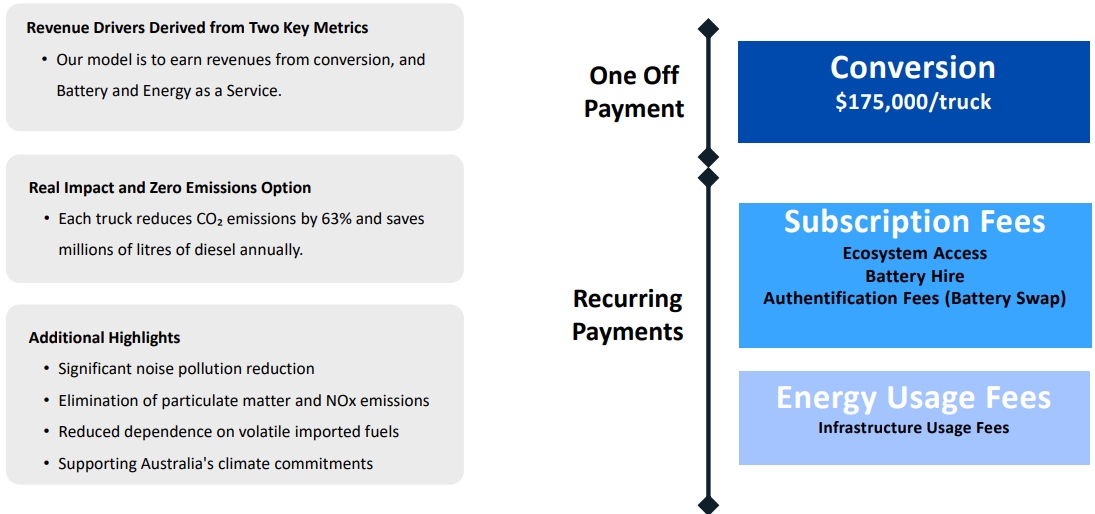
The model is deliberately asset-light from the customer’s perspective: Janus owns and manages the battery fleet, while clients pay subscription fees for access to the network and ecosystem.
For fleet operators, benefits include:
- Lower operating costs and reduced exposure to fuel price shocks
- Minimal disruption through diesel truck retrofits
- Zero-emissions transport option without high upfront capex
- Seamless grid integration and reduced noise pollution
- Enhanced driver wellbeing and safety
Path to profitability underpinned by a massive addressable market
With 124,300 registered prime-mover trucks in Australia — and roughly 80,000 suited to Janus’s technology — the company is aiming for a 1% market share, equating to 800 trucks and about $140 million in potential one-off conversion revenue, not including subscription fees.
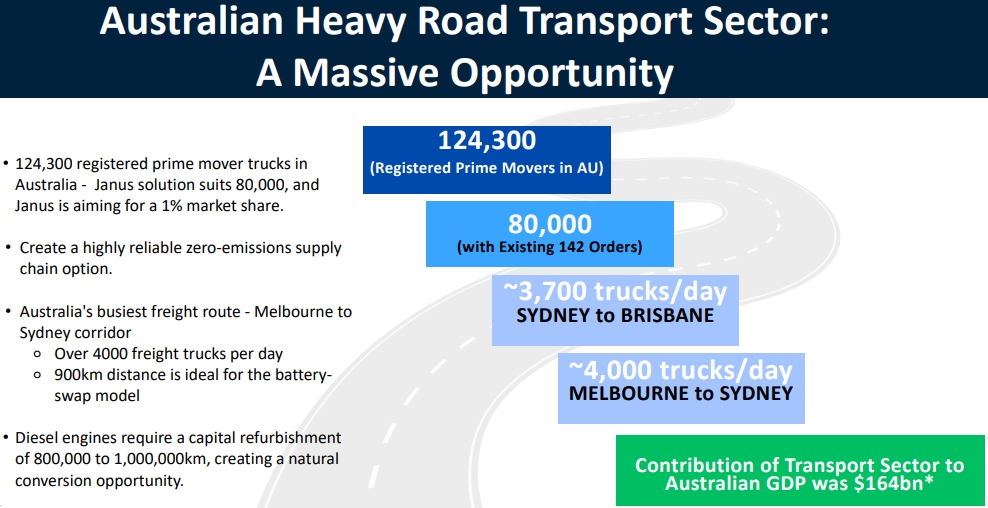
The company’s early focus is on closed-loop haulage routes of 200–350 kilometres — such as point-to-point mining or intermodal freight — where predictable distances and high utilisation rates maximise battery efficiency and infrastructure return.
Janus has already converted 23 trucks and expects to reach 24 imminently. Importantly, it has secured 142 conversion orders and is negotiating additional deals with tier-one clients. New manufacturing facilities on the NSW Central Coast will enable automation and volume scale-up, while dealership partnerships will help broaden national uptake.
Innovation built in Australia, designed for global use
Founded in 2019 in Berkeley Vale on the NSW Central Coast, Janus Electric emerged from real-world haulage challenges faced by co-founder and chief operating officer Lex Forsyth, who brings decades of personal heritage and professional expertise from his family's 50-year legacy in the trucking industry.
Unlike traditional EV makers, Janus focuses on electrifying the existing heavy truck fleet. Its swappable battery model avoids the long charging times and high upfront costs that typically hold back large-scale electric truck adoption.
The company holds patents on its battery connection systems and swap mechanisms, while its software platform manages battery health, swap logistics, authentication, and real-time analytics.
With increasing demand for sovereign energy solutions and cleaner supply chains, Janus’s Australian manufacturing credentials are an added strength — particularly for government partnerships and major industrial clients.
Expanding internationally through licensing and partnerships
While Australia is Janus’s primary market for now, global interest is growing. The company has received early-stage enquiries from potential partners in the United States, New Zealand, South Africa and Southeast Asia.
Each market presents a different opportunity:
- In California, drayage trucks servicing the LA and Long Beach ports are already under regulatory pressure to decarbonise, with more than 26,000 trucks in operation and a $50 million state-backed ‘green bank’ initiative supporting clean fleet transitions.
- In New Zealand, a similar regulatory landscape and 84% renewable electricity mix align well with Janus’s model.
- Indonesia and South Africa both offer opportunities in mining logistics, where grid reliability is limited and diesel dependence is high.
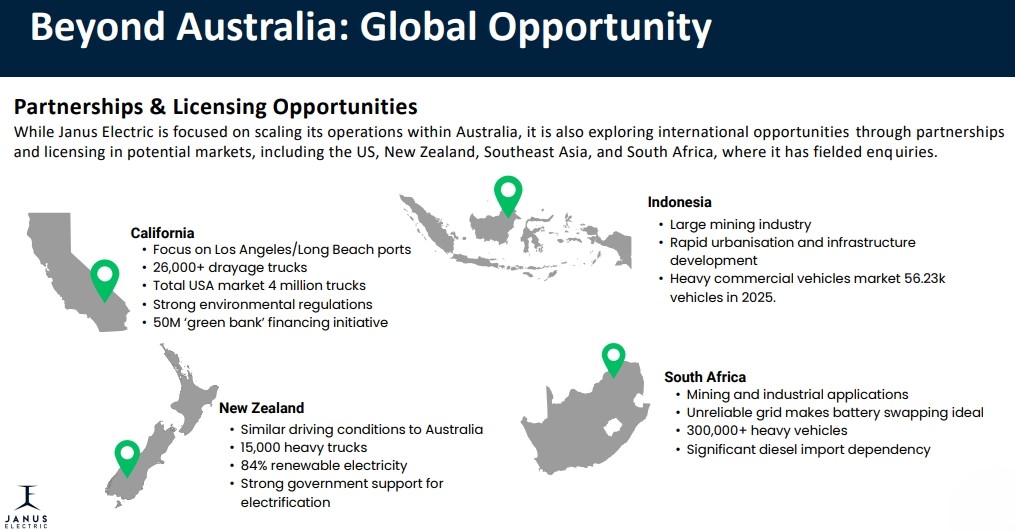
By pursuing a licensing and partnership strategy offshore, Janus will look to extend its technology’s global footprint without taking on capital-intensive international expansion.
Leadership team and ESG vision drive momentum
Janus’s post-listing board and executive reshuffle brings together talent across finance, renewables, and transport.
CEO Ian Campbell brings commercialisation and growth expertise from the renewable energy and infrastructure sectors, while chief financial controller Greg Watson and board chair Dennis Lin add capital markets and governance experience.
Forsyth continues to anchor the company’s industry credibility, while non-executive director Kristy Carr brings operational and strategy oversight from the health and consumer sectors.
The company’s environmental, social and governance (ESG) profile is core to its value proposition. Every truck converted saves thousands of litres of diesel, reduces carbon and nitrogen oxide (NOx) emissions, and supports Australia’s net zero goals. The Janus ecosystem also helps reduce noise pollution, enhances driver wellbeing, and lowers particulate exposure for workers and communities alike.
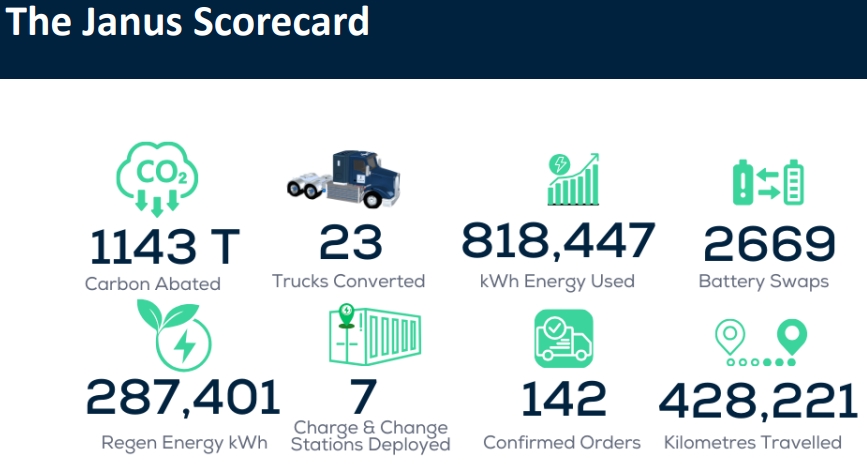
With its patented technology, scalable business model and growing pipeline of contracted conversions, Janus is carving out a clear role in Australia’s transition to cleaner freight transport — with its solutions already being deployed on roads today.