
- FTSE 100 up 10 points at 8283
- Phoenix Group leads fallers as SunLife sale shelved
- Playtech climbs as profits expected to beat forecasts
- Pound rises to almost $1.32 as Fed cut bets shift
4.03pm: Slight caution reigns
London's blue chips are heading for a small gain at the start of the week, despite the pound strengthening against the dollar.
The FTSE 100 is up just over 0.1% and the FTSE 250 not quite that.
Marks and Spencer PLC is top of the FTSE 100 leaderboard, while among the mid-caps bid action has boosted TI Fluid Systems PLC (LSE:TIFS) and Playtech PLC (LSE:PTEC).
Overall, caution is the word of the day.
It's the one that Chris Beauchamp, chief market analyst at IG, uses to describe the attitude across most equity markets, with gains "limited at best", with the exception being the Dow Jones, which has notched up a new all-time high.
"A cautious pruning of risk has been in evidence for most of the day, with the mood soured by reports of poor sales for Apple’s new product.”
He notes that the surge in expectations around a 50bps rate cut last week and into this week has, in part be due to "a recognition that the Fed’s window to ease policy is limited by the election.
"Recession fears have spiked dramatically, and investors have an unnerving feeling that the Fed is firmly behind the curve.
"A 50bps move might help to stop that perception from spreading further, though Powell will have to perform a delicate balancing act to avoid giving the impression that they are more concerned about the near-term outlook."
3.43pm: Pound up as Fed expected to make 50bps cut
The pound is up strongly versus the dollar today, up 0.6% to 1.3198 as traders and investors ramp up expectations for a larger-than-usual rate cut from the US Federal Reserve's policy committee.
(Sterling's not far off the two-year high above $1.326 seen in late August.)
Bets on the size of this week's FOMC cut have been shifting around a lot in recent weeks, and that continued today.
The probability of a half-a-percentage (50 basis points) cut has moved to 61%, according to futures markets, up from around 30% a week ago.
Expectations for a 0.25bps cut have shifted to 39%, down from 70% last Monday.
These moves follow the US inflation numbers and jobs data last week.
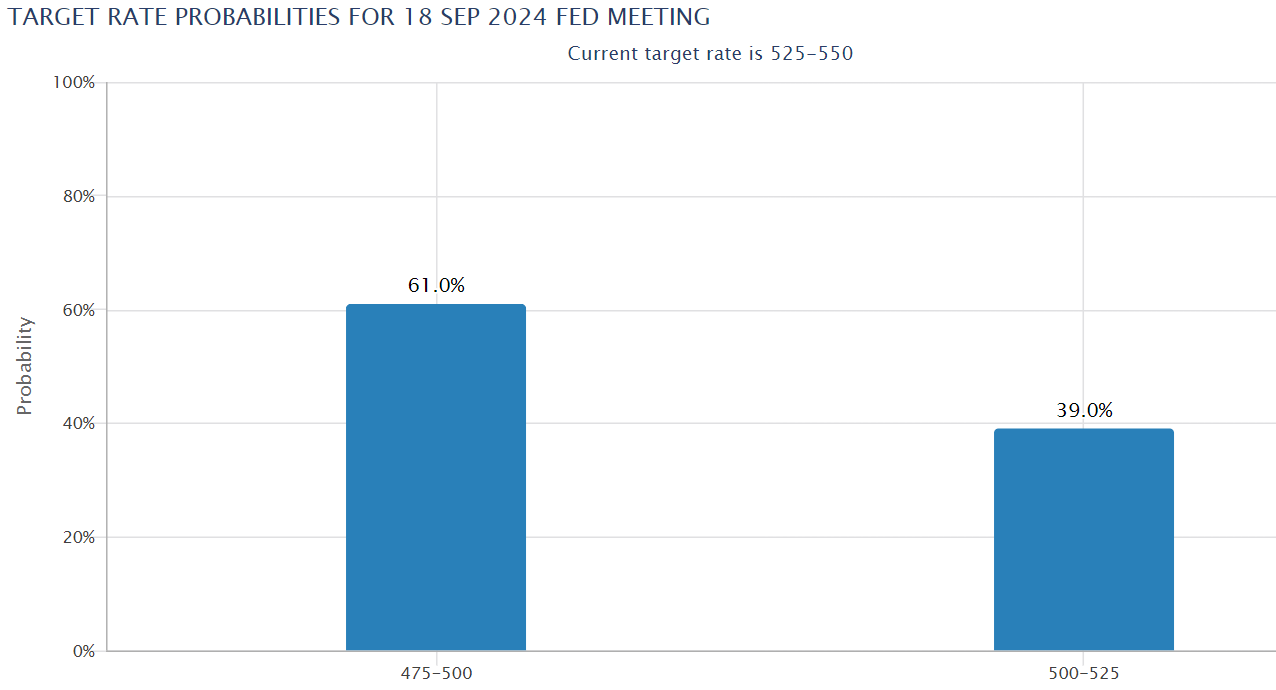
Analysis by Deutsche Bank, including insights from AI, suggests recent hints given in the media towards a 0.50% cut are weaker than those in the lead-up to June 2022's famous 0.75% hike.
Rates analyst Matt Raskin says the surprise component of the Fed’s rate move is the largest in over 15 years, and he believes there will either be further press-led communications that steer the market back to 25bps today or that ultimately the Fed will deliver 50bps on Wednesday.
So there could be some moves in markets later.
3.10pm: FTSE pushing higher as mining losses ease
It's been a day where the FTSE 100 has not wanted to wander too far and if you wait 10 minutes it will have moved the other side of the line.
But now the London index has not only crept back into positive territory but also risen to around its highest so far today, still just over 0.1% though.
Trading has been "on cautious note" so far this week, says City Index analyst Fiona Cincotta, pointing to the weak Chinese data over the weekend and ahead of a slew of central Bank rate decisions this week.
Miners have been underperforming following the weak data, but the losses have eased, which has allowed the index some more leeway.
Separately, a few housebuilders are rising, which Cincotta says is on the back of the Rightmove data showing house prices increased 0.8% in September after falling 1.5% in August.
2.49pm: Wall Street starts mixed
US stocks have had a mixed start, as expected, with the tech-heavy Nasdaq drooping the heaviest.
The S&P 500 is down 0.2% in opening trades, while the Nasdaq Composite index has dropped 0.95%.
Apple Inc (NASDAQ:AAPL, ETR:APC) is having a gravitational pull, down 3.2% after a prominent analyst said sales of the iPhone 16 family were down an estimated 12.7% in the first weekend compared to the iPhone 15 last year.
On the up, however, is the Dow Jones, rising 0.5% as Apple is one of only four fallers.
Others in the red on the Nasdaq include Micron, ARM Holdings, Nvidia and Broadcom as semiconductor firms see another swing in sentiment.
This has seen a dip in sympathy in London, where the FTSE 100 and 250 both immediately dropped, the former is seven points into the red and the latter 33.
2.28pm: BP cashing out
BP PLC (LSE:BP.) has sold a 20% stake in its trans-Adriatic pipeline business to private equity group Apollo and put its US onshore wind energy business up for sale.
BP said the sale of the stake to Apollo would "unlock near-term value and capital for efficient reallocation".
The FTSE 100 oil giant also has agreed a separate collaboration with Apollo to "explore greater strategic cooperation, including energy transition opportunities".
Could this mean buying its US wind business? BP has 10 US operating and connected wind farms across seven states, with a total combined capacity of 1.3 gigawatts.
1.50pm:London startup pushed by backers to list in NYC
UK fintech Thought Machine is reportedly eyeing a $2.7 billion IPO in London or New York.
According to weekend reports, chief executive and founder Paul Taylor is keen on floating in London but says investors want him to list in New York where software firms generally get higher ratings.
An IPO is not likely before 2027, either way, though the startup is “definitely going to IPO” Taylor told CityAM.
He told the paper that the UK capital is the company's home and "all other things being equal, we’d be very keen to list in London".
1.14pm: Hybrid car sales to continue until 2035
The UK Government has confirmed weekend reports that it will allow the sale of hybrid cars until 2035, despite a Labour manifesto pledge to end the sale of petrol and diesel cars from 2030.
In a statement published in The Guardian, the government said this aligns with the manifesto pledge as “the original phase-out date included the provision for some hybrid vehicle sales between 2030 and 35”.
“We know it is important to provide certainty and stability for drivers and will set out further details in due course,” the Department for Transport added.
Labour leader Keir Starmer pledged to restore the 2030 internal combustion engine (ICE) phase-out target after the former Tory administration pushed it back to 2035.
The government rebuffed claims from The Telegraph that this represents a climb down from the 2030 manifesto pledge.
“This is untrue as we have always been committed to restoring the original 2030 phase-out date for the sale of new cars with pure internal combustion engines,” said the DfT.
12.44pm: Wall Steet stocks mixed
US stock futures are mixed, with the S&P 500 flat, the Nasdaq 100 expected to head lower and Dow Jones higher when trading begins later.
Dow Jones futures are up 0.18%, while Nasdaq futures are down 0.3%.
For the big three, Apple futures are down over 2%, Nvidia futures are down 1.3% and those for Microsoft are down 0.2%.
12.02pm: Midday markets
At midday, the FTSE 100 is just below flat, down 4 points.
Gains for several retailers are being offset by declines for Phoenix Group and some China-related stocks, including Prudential, HSBC and miners.
Meanwhile, the FTSE 250 has broken above the flatline, up 6 points.
This is on the back of bids news about TI Fluid, which is up over 13% has received offers from a Canadian rival.
And Playtech is up almost 12% after a double-update earlier, plus a Sky News story that it might be close to a third update.
11.37am: Playtech 'close' to selling consumer arm to Flutter
Paddy Power and Betfair owner Flutter Entertainment PLC (LSE:FLTR) is close to splashing out £2 billion to buy the consumer business of FTSE 250-listed Playtech PLC (LSE:PTEC), which put out a trading uppate .
This is an article from Sky News that Flutter is "closing in" on a deal, with an agreement that could be signed today or later in the week.
The purchase price in the story is not far off Playtech's £2.3 billion market cap.
11.18am: UK jobs and manufacturing data
Existing job postings last month were down 2.4% compared to the month before, and new job postings fell 3.2%, according to new data from REC.
This, suggests the Recruitment and Employment Confederation, market is "still weakening, but only marginally".
Most UK regions experienced small declines in the number of active job postings as compared to the previous month. But job postings increased in Scotland (9.9%) and Northern Ireland (8.0%) where the summer break ended mid-month. It is likely that the holiday effect slowed the market in England and Wales during the month.
REC Chief Executive Neil Carberry says: "There is no doubt that the jobs market remains slow by comparison to previous years, with summer holidays also affecting the pace of hiring. But there is little evidence of a sharp slowdown now."
He says firms are "waiting for a clear signal on growth plans and the timing of potential additional cost challenges" from the new government.
Elsewhere we hear the latest outlook report from the manufacturing industry body, Make UK, which similarly suggests UK manufacturers "have yet to see an immediate boost" from the change of government.
The report from Make UK and BDO found firms are forecasting a period of greater political stability will bring a boost to overall economic prospects.
Almost six out of 10 companies in the sector expect better growth over the next 12 months as a result.
The report also finds that manufacturing output balance turned negative this quarter for the first time in four years, at -2%, down from +9%.
But output is expected to jump by a third in the next quarter.
Export orders are also currently exceeding domestic ones, though this is also forecast to change in the fourth quarter.
10.52am: Suadi gold buying
More on gold, with the Saudi Arabian Monetary Authority seen now to have been covertly buying up gold.
Data suggests it bought roughly 160 tonnes of gold in Switzerland since early 2022.
Aanalyst Jan Nieuwenhuijs said this on the moneymetals.com site: "It seems that the Saudi central bank has secretly bought 160 tonnes of gold in Switzerland since the beginning of 2022, contributing to the current rise in gold. Although the Saudis played a key role in the birth of the global dollar standard in the early 1970s, they could this time become the pivot of its dissolution.”
He said comparing the World Gold Council estimates of central bank purchases to the levels that central banks report to the IMF, "we can conclude that ‘undeclared’ purchases have soared since 2022".
"People familiar with the situation have told me that this is largely due to the Chinese central bank and, to a lesser extent, the Saudi central bank."
10.31am: Commodities comments
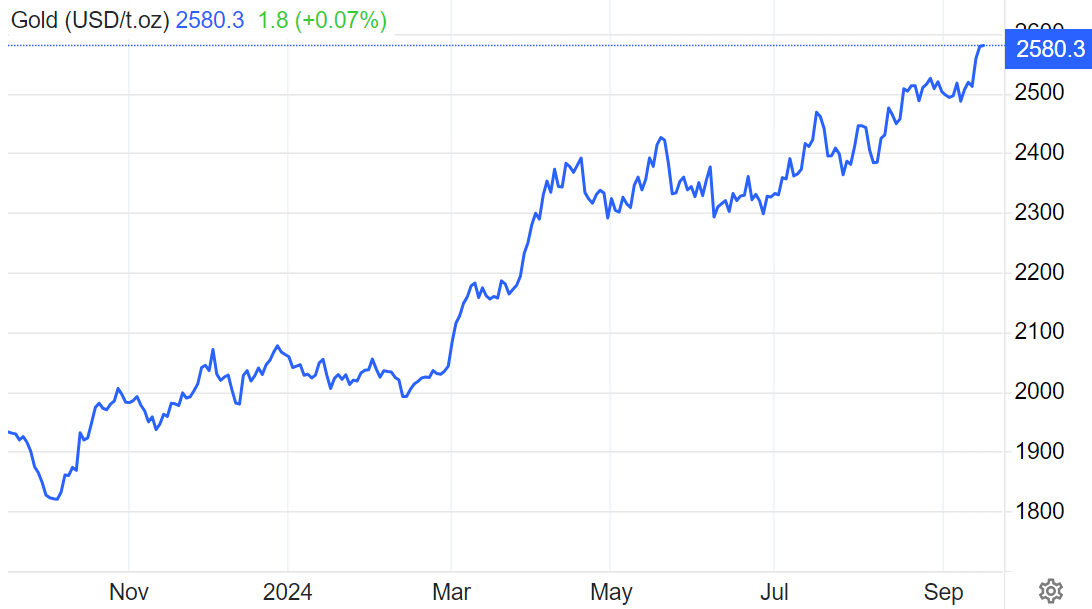
Gold prices reached the new all-time high overnight in Asia and have continued higher.
This follows a week that saw prices once again accelerate as the dollar and yields softened and traders entertained the prospect for a 50-basis point cut, say analysts.
Silver and platinum were even bigger winners, rising 10%, which is put down to additional support from a recovering industrial metal sector.
But this week, gold prices are "in for a reality check", says Naeem Aslam at Zaye Capital Markets, noting that traders are expecting a dovish hand from the Fed.
If the Fed cuts the rate by 25 basis points rather than 50bps, "it might be a case of 'close, but no cigar' for gold bulls," Aslam says.
"However, if the Fed cuts the rate by 50 basis points, then we could see some more interest among gold traders, and this means that we may see more upside moves for gold prices."
As for coffee, Saxo’s head of commodity strategy Ole Hansen says: "Just like cocoa, orange juice and recently also sugar, coffee prices have been supported by persistent weather supply disruptions in the key production regions."
Weather in Vietnam for robusta coffee beans and increasingly in Brazil for arabica, he says, leading to production outlook being lowered after heat and lack of rain.
"The worst drought in decades does not bode well for next season’s potential adding further tightness to a market underpinning prices amid worries that higher farmgate prices will not be enough to raise production as weather remains the main problem.
"The cost of your cuppa will likely rise further, although its worth remembering that only a fraction of the final cost is contributed the actual cost of the beans."
10.11am: Coffee and cigarettes gold
Two commodities of interest this morning: coffee and gold.
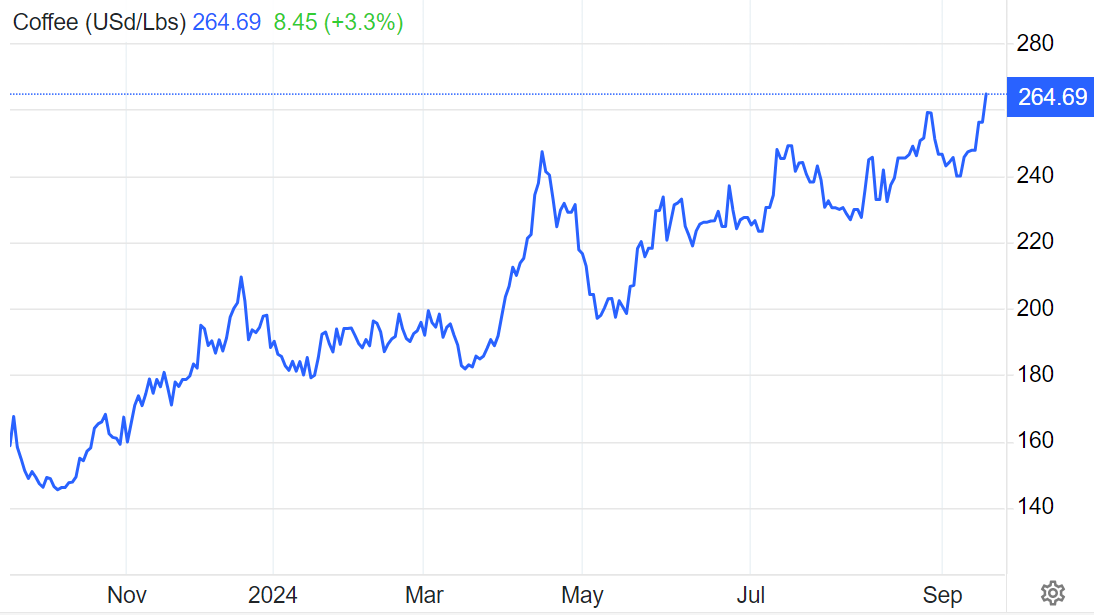
I've had a nice mug of one of those this morning and could do with another, but the price of arabica beans has risen to a 13-year high.
Futures contracts for premium arabica beans are up 2pc to $2.64 per pound today, the highest price since 2011, up from below $2.45 a week ago and $2 in April.
This is on the back of drought conditions that have limited production.
Gold, meanwhile, has topped the records set last month, breaching above the $2,585 level per ounce as markets prepare for the US Federal Reserve to begin easing monetary policy for the first time in more than four years.
9.44am: Setting the scene for markets
"Holidays in China, Japan and South Korea, and the trifecta of Fed, BoE and BoJ meetings Wednesday through Friday along with a light calendar of data and events will make for a quiet start to a potentially major week for sentiment in financial markets," says Marc Ostwald, chief economist and global strategist at ADM Investor Services.
He also points to "slightly worse than expected" weekend China data and the overnight Rightmove data to digest, with little more than Eurozone and Italian trade balance, and the US NY Fed Empire manufacturing survey ahead.
"China's activity data were a little worse than expected, while the property sector data were particularly depressing given that they should be seeing some improvement dur to base effects, which in turn underlines the obvious lack of traction from the various measures to support the property market," says Ostwald.
Looking to later in the week, he says the US FOMC meeting will be the "focal point", with markets still not 100% settled on whether it will be a quarter or half-point cut.
"The decision is very finely balanced, and will hinge on the FOMC balancing concerns that labour market loosening is getting too much momentum, and on the other hand sending a rather negative signal on the economic outlook."
The BoE MPC meeting on Thursday follows inflation data the day before, with CPI expected to be unchanged in headline terms at 2.2%, but more important he reckons will be core and services CPI readings, both seen rising.
"Expectations for no change from the BoE are unanimous, and unsurprising given the anticipated rebound in core inflation measures. It will be interesting to see if there is any reference to prospective fiscal policy tightening, which would in principle imply the need for easier monetary policy."
The Bank of Japan also meets on Friday, and will "very likely" keep rates unchanged at 0.25%, with a leadership election following next week.
9.20am: Housing market loosening up a little more
House prices rose 0.8% in the past month to an average of £370,759, according to Rightmove data released overnight.
The months of September usually is positive for house prices, but the researchers note that year’s increase is double the long-term average amidst a rise in activity levels in the market.
Numbers of new sellers are up 14% on a year ago, and the number of agreed sales is up 27%, compared to what was a subdued market last year as homeowners reacted to interest rates no longer being near zero.
However, Rightmove did note some lingering caution, with an average of 60 days for a seller to find a buyer, three days longer than a year ago.
With a key few Bank of England meetings in coming months and next month’s Budget, analyst at AJ Bell said it "could make some prospective buyers think twice about wanting to move house in the near-term".
"Many individuals might be waiting for mortgage rates to come down a lot further, and/or to get clarity over any changes in the Budget that affect their money before committing to a house purchase or sale."
9.07am: Retailers on the rise
Retailers are leading the Footsie this morning, with the leaderboard topped by Marks and Spencer Group PLC (LSE:MKS), with J Sainsbury PLC (LSE:SBRY), Associated British Foods PLC (LSE:ABF), Tesco PLC (LSE:TSCO) and B&M European Value Retail SA (LSE:BME) not far behind.
For M&S this week brings an update for Ocado Retail, its 50-50 joint venture with Ocado Group PLC (LSE:OCDO). That's on Thursday.
Also helping the index into positive territory are rises for the largest company, AstraZeneca, plus several others in the top 20, including Unilever, Diageo, Compass and Haleon, all of which have a consumer angle that could also tap into the same market sentiment as the retailers.
Whatever it is that's driven that is not entirely clear to me yet. (Update: Broker upgrades are behind both M&S and Sainsbury rises, with read across to Tesco and B&M.)
8.56am: London climbs into the green
London's blue-chip benchmark is now in green, up a mighty three points, while the rest of Europe is mostly in the red.
Germany's DAX is down 0.3%, with Siemens Energy, Infineon Technologies and MTU Aero Engines leading the fallers.
France's CAC 40 has dropped 0.1%, with Capgemini and STMicroelectronics down the most; but Spain's IBEX 35 is up 0.21%, led by clean energy company Acciona, and Italy's FTSE MIB is flat.
The cross-continent STOXX 600 is down 0.1%, with the big faller being Worldline, down another 5% to continue plummeting from Friday as the French payments group's CEO departs on the back of its third profit warning in a year.
8.43am: FTSE 100 flat, mid-caps almost
The FTSE 100 is back to flat now, while the FTSE 250 is down eight points at 20,887.
Topping the mid-cap leaderboard is TI Fluid Systems PLC (LSE:TIFS), up 13% to 164p after it rejected two takeover bids by Canada's ABC Technologies.
The suitor, owned by private equity group Apollo, says it remains interested.
Elsewhere on the mid-cap index, Playtech PLC (LSE:PTEC) is up 7.3% after stating underlying earnings (EBITDA) are now expected to be "slightly ahead" of current City forecasts, "mainly driven by a strong performance within the B2B division".
Close Brothers Group PLC (LSE:CBG) is down 1.8% after the merchant bank said its chief executive, Adrian Sainsbury, has been forced to take a temporary medical leave of absence.
Finance director Mike Morgan will take on the main responsibilities, supported by chairman Mike Biggs and members of the senior management team.
Full-year results will proceed as planned this Thursday, the group said.
8.28am: Phoenix, city
More on the update from pensions giant Phoenix Group Holdings PLC (LSE:PHNX), where the shares are down 3.6% so far this morning.
The FTSE 100-listed closed book consolidator has cancelled its planned disposal life insurance subsidiary SunLife just four months after announcing the sale in June, citing “the current uncertainty in the protection market”.
Phoenix, which received interest from potential suitors but no material offers, said it instead “will focus on enhancing the value it generates within the group”.
Otherwise, the company reported better-than-expected cash remittances and a solvency ratio of 168%, which is below the consensus forecast of 173%.
Operating profit came in at £360 million, up 15% and ahead of the consensus forecast of £348 million.
8.08am: FTSE opens in the red
The FTSE 100 has started lower, down almost 14 points or 0.2% to just below 8,260.
Biggest faller is Phoenix Group Holdings PLC (LSE:PHNX), the life and pensions operator, down 2.6%.
It is followed by aerospace parts maker Melrose Industries PLC (LSE:MRO, OTC:MLSPF), off 1.8%, with Rolls-Royce Group PLC and easyJet PLC also lower.
The big miners are also in the red, which is always a major drag on the London index.
7.38am: TI Fluid's response
After receiving two bids from Canadian sector peer, TI Fluid Systems PLC (LSE:TIFS), has put out its own statement this morning.
The Oxford-based company, which manufactures parts for petrol-powered, hybrid and electric vehicles, noted that the second proposal represented a premium of 20.7% to the closing share price on Friday, "before press speculation about a potential offer for the company".
It said it rejected both offers, adding that its board "considered the proposal in detail with its advisers and unanimously concluded that it significantly undervalued TI Fluid systems and its prospects", with directors confident in the company's strategy and prospects.
7.24am: TI Fluid received takeover offers
UK car parts supplier TI Fluid Systems PLC (LSE:TIFS) has been approached with a takeover offer by private equity-backed sector peer ABC Technologies.
ABC, which is based in Canada and owned by Apollo, put out a statement to say that it made an initial proposal in August at 165p per share, which was rejected, followed by another at 176p a share at the start of this month.
Shares in FTSE 250-listed company TI Fluid stood at around 131p at the time, but crept higher on Friday.
ABC says its offer is a 41% premium to the average share price over the month leading up to its first offer, though it's on a par with the TI price in February of this year and below the price from early in 2022.
"Although the Possible Offer was also rejected by the Board of TI Fluid Systems, ABC Technologies remains interested in a possible transaction and is therefore considering its position," ABC said.
7.19am: FTSE 100 to keeps powder dry on big week for markets
The FTSE 100 is set to see slightly more sellers than buyers on Monday, ahead of a big week with interest rate decisions from the Bank of England and US Federal Reserve.
Futures markets pointed to a decline of 8-10 points for London's blue-chip index at the start of the week, having gained just over 91 points or 1.1% last week.
Wall Street had what was its best week of the year last week, with the S&P 500 rising more than 4% and the tech-fueled Nasdaq nearly 6% as Nvidia rose more than 13%.
"The overall driver of the rally was growing speculation that the Federal Reserve will cut interest rates by 50 basis points rather than 25bps when they meet this Wednesday," says market analyst Katheleen Brooks at XTB.
The probability of a half-a-percentage point rate cut has risen to 59%, according to the CME’s Fedwatch tool, up from 30% a week ago.
The Fed decision is on Wednesday, with the BoE's monetary policy committee (MPC) sharing their rate call the day after.
Overnight we had property market data from Rightmove, showing an 0.8% increase in average house prices in early September.