
- FTSE 100 down 85 points at 8,272
- European markets in the green
- Gold price hits new record high
3.57pm: Shares down on both sides of the Atlantic
US stocks have joined London's blue-chip benchmark in the red.
The FTSE 100 is down 85 points or just over 1% lower at 8,272, with 18 of the index's top 20 largest companies in the red and only 13 of the entire index in green.
Across the pond, the Nasdaq has dropped 0.3%, the S&P 500 has fallen 0.2%, the Dow Jones is down 0.1% and the small cap Russell 2000 is down 0.9%.
''The near two-week-long stock index rally on both side of the Atlantic is taking a breather," says Axel Rudolph, senior technical analyst at IG, ahead of the July FOMC minutes tomorrow and Jackson's Hole speeches later in the week.
"A widely anticipated 25 basis point rate cut by the Swedish Riksbank to 3.5% and Canadian inflation falling to an over 3-year low were not enough to keep US and European equity indices afloat with the FTSE 100 giving back around a percentage point on Tuesday," he added.
2.47pm: US markets mixed
The main US stock market indices have not moved much in opening minutes.
Both S&P 500 and Nasdaq Composite have added a small handful of points, five and 11 respectively, while the Dow Jones dropped almost 100 in the first few minutes but now is down less than 0.1%.
Tesla is up 2.2% after the EU tariff news a short while ago.
Palo Alto Networks is the top riser in the Nasdaq 100 after its earnings last night beat expectations.
Holding the Dow back, Intel is down 2.8% and Boeing 2% lower.
Yesterday, Boeing was told by the US Federal Aviation Administration that inspections of 787 Dreamliners would be needed following the sudden midair dive of a LATAM Airlines flight earlier this year.
Back in London, the FTSE is down 76 points or 0.9%.
2.28pm: FTSE falls further
The FTSE 100 continues to test new depths as the session moves on, and it has been joined by most European markets in negative territory.
With the US stock market opening imminent the London index is down 1%.
BT is down 8% now, having lost over £1 billion in value today.
Segro is down 2.5% after being downgraded by UBS, which removed its 'buy' rating on "evidence of softening occupier fundamentals".
2.20pm: EU proposes cutting Tesla tariff
The European Union has cut its planned tariffs on Tesla vehicles imported from China, which had been set at 20.8% last month.
But the EU's executive body has proposed slashing the tariff to a new rate of 9%.
This comes in addition to an existing 10% import levy on battery electric vehicles, bringing Tesla’s rate up to 19%.
It said Tesla had requested an “individual examination” to determine what the tariff should be, based on the specific subsidies the company received from the Chinese.
Other Chinese manufacturers will face tariffs as high as 36.3%.
Tesla shares are up 0.9% in pre-market trading.
The Chinese Chamber of Commerce to the EU said it wanted to express its "strong dissatisfaction and firm opposition to the EC’s protectionist approach" and that the EC’s "unfair use of trade tools to hinder free trade in electric vehicles, along with this protectionist approach, will ultimately weaken the resilience of the European electric vehicle industry" and "will exacerbate trade tensions between China and the EU".
Rahul Bhushan, managing director of the European arm of Cathie Wood's ARK Invest, says the potential reduction in tariffs is "a significant win for Tesla and the broader European electric vehicle market".
2.04pm: Insolvency numbers
The number of UK company insolvencies last month was down 7% on the month before but still 16% higher than a year earlier.
Led by more construction and hotel firms going to the wall, some 2,191 businesses in England and Wales were unable to pay their debts in July, according to official data.
There were 320 compulsory liquidation numbers, where companies are closed down via court orders, which was the highest monthly total since before the pandemic.
Borrowing costs have been higher in the past couple of years, while demand has not fully recovered from the cost of living crisis.
More than one in six insolvencies in the past 12 months have been construction companies, numbering 4,303 over the period.
Rebecca Dacre, a partner at accountant Forvis Mazars, said the Insolvency Service data was "a strong reminder that many businesses are still a long way off from recovery".
"Despite initial signs of improvement in the economy, some sectors are still experiencing severe difficulty as interest rates remain high."
She said unless there is a stronger economic recovery, "it is likely we will see more companies pushed towards insolvency".
1.33pm: Paramount twist
The Paramount Global takeover saga has taken a fresh twist with Edgar Bronfman Jr., the media industry veteran who previously headed Warner Music, tabling a $4.3 billion offer for a controlling stake in the business.
A formal offer has been made that could derail a deal the Hollywood company agreed six weeks ago with Skydance Media, which included $2.4 billion for National Amusements, the holding company that holds significant voting rights for Paramount.
As well as matching the $2.4 billion offer for National Amusements, Bronfman has offered to inject $1.5 billion into Paramount, plus pay Skydance $400 million to terminate its July deal.
12.50pm: US flat start expected still
US stocks are set for a tepid start, according to futures markets.
S&P 500 futures and Nasdaq 100 futures are up around 0.05%, while Dow Jones futures are just below flat.
Meanwhile, London's benchmark continues to wallow in the red, down 0.7%.
12.31pm: What stocks to sell?
So much cash is being taken out of UK equity funds that fund managers are forced to focus on what stocks they need to sell rather than what to buy at the moment, says Deutsche Bank.
Based on proprietary analysis by the Deutsche Bank team, heavy net outflows are estimated to have continued in July rather than the improved June level.
"Funds are very much on the back foot," said McCann in a note to clients this morning, with managers "typically more concerned with ... deciding what stocks to sell / how to keep the portfolio in balance, rather than more proactively thinking about what to buy."
12.10pm: FTSE down 0.7% at midday
At just past midday, the FTSE 100 is down almost 60 points or 0.7% lower than where it started today.
BT Group is still bottom of the fallers, down almost 7% now, after Sky, a major wholesale customer on its Openreach broadband network, signed up to move over to rival CityFibre. Elsewhere in the telecoms sector, Vodafone is down 2%.
Retailers are also among the fallers, led by Burberry Group PLC (LSE:BRBY), which often moves on China news (see comments below), with Ocado, Frasers, M&S, JD Sports and B&M among the others not far behind.
Oil majors Shell and BP are off their worst but still down 1.7% and 1.8% as oil prices softened overnight but Brent crude futures jumped back up to $78 in recent minutes.
US futures are flat at the moment, with S&P 500 futures up 0.03% and Nasdaq futures down 0.02%.
11.46am: Dollar at lowest since December
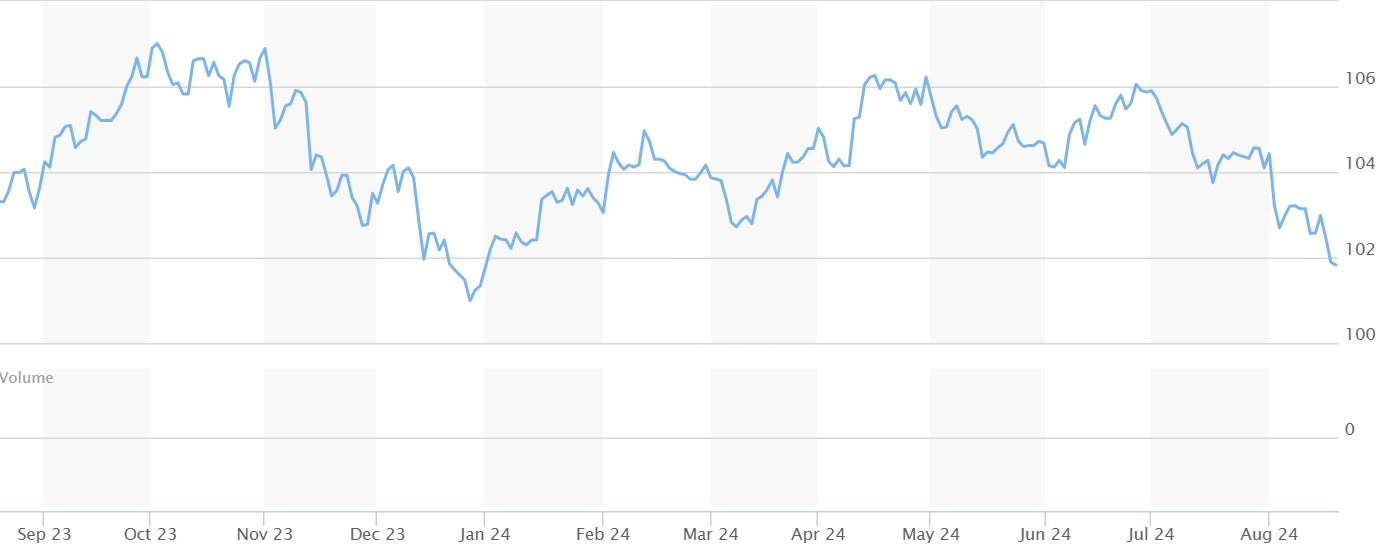
The US dollar is at its weakest this year, based on the dollar index (DXY), which has fallen below the 'flash crash' lows earlier this month and below 102 for the first time since late December.
Since April and late June, when it hovered around two-year highs just above 106, there has been a fairly consistent slope downwards.
"The signs are subtle, but bearish dollar momentum is starting to build," said ING currency specialist Chris Turner yesterday, as the DXY index dropped through the lows seen in early August.
Events this week such as the July Fed minutes, payroll revisions and Federal Reserve speakers at Jackson's Hole could add to the dollar's losses, Turner said.
There is "no flash crash underway" at the moment but rather the dollar's decline "looks to be part of an orderly adjustment cycle as the Fed prepares to cut rates", he said.
"While some may be arguing that the dollar does not need to sell off much further, since a Fed easing cycle to 3.00/3.25% is already priced, we would suggest caution in that the Fed cycle has not even started yet and any softer US data could mean Fed rates start to get priced at accommodative and not just neutral."
11.24am: Small cap M&A, one on and one off
Some M&A news among London's commodity stocks this morning: AIM-listed i3 Energy PLC (AIM:I3E, TSX:ITE, OTC:ITEEF) confirmed it has received and recommended a firm offer from Canada's Gran Tierra Energy.
In total, the offer price is the equivalent of 13.92p, valuing i3 at roughly £174 million, a premium of around 49% to the end of last week.
Majid Shafiq, i3’s chief executive, said: "We believe that the acquisition presents an exceptional opportunity for i3 Energy's shareholders. The acquisition represents the culmination of a thorough process to realise the maximum value available for shareholders and offers significant upside."
Elsewhere, Renalytix PLC tanked after the artificial intelligence-enabled diagnostics company said it has ended the formal sale process announced back in March, when it had received an unsolicited approach from a "large and well-capitalised publicly listed strategic diagnostics company".
Today, the company said its board "has determined that based on outreach, dialogue and discussions to date, it does not believe there is a realistic prospect of an offer".
It added that it is in "advanced discussions with key stakeholders", who have indicated support for management's refreshed business plan, which includes more focused expenditure and investment, cutting operating costs, and finding a "suitable capital structure and funding".
Following financings completed earlier in 2024, the company says it has a cash runway "extending into Q4 2024" based on a cash position of $4.7 million at the end of June.
10.55am: Footsie lurching lower again
The FTSE 100 has resumed its downward route, now 0.66% lower than where it finished yesterday at just over 8,300.
Oil prices fell below $77 earlier and are oscillating quite a bit this morning.
Market analyst Danni Hewson at AJ Bell says: "Hopes of a ceasefire in Gaza and continuing concerns about Chinese demand combined to drive oil prices to their lowest levels since the beginning of August and that put index heavyweights BP and Shell under pressure.
“While oil did dip below $76 around the beginning of August it has consistently traded above $80 per barrel for much of this year. If oil prices remain at these levels it could help reduce inflationary pressures and give central banks more room to make interest rate cuts."
10.36am: Gold hits new high
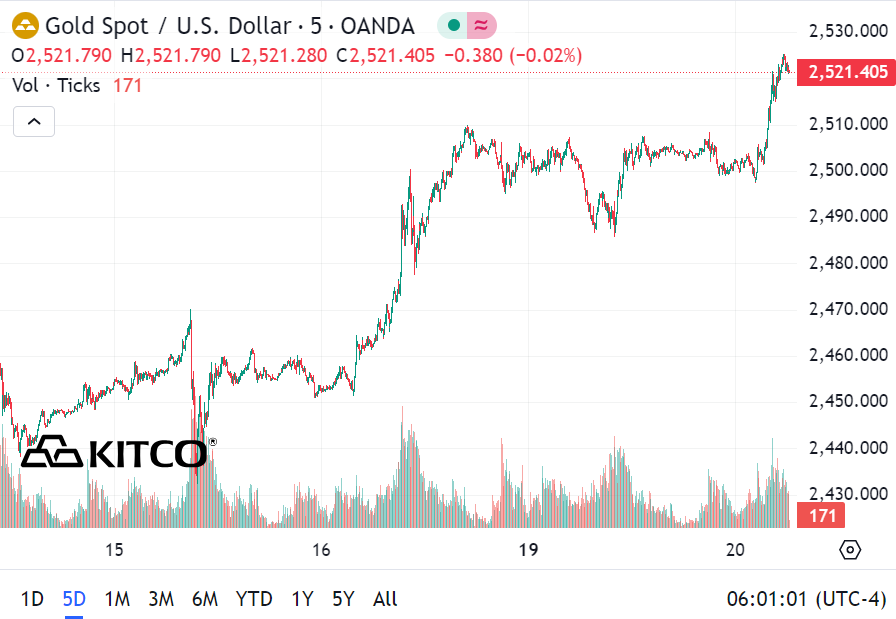
The price of gold is continuing to rise this morning, hitting a new record high that means a standard bar of gold is worth $1 million.
Spot gold rose above $2,525 this morning, surpassing the previous all-time high from last Friday.
The hike in prices follows the People's Bank of China issuing new import quotas, said analyst John Meyer at SP Angel.
"Chinese exporters and traders have been seen rushing to buy yuan and probably gold in anticipation of further US dollar weakness," he says.
He says the yellow metal has also been buoyed by Chinese buying after the PBoC cracked down on local government bond buying and troubles in the Chinese property market led to a switch in investor interest to gold as a "preferred instrument for individual savings in China".
Elsewhere, euro-zone inflation edged higher in July, to 2.6% from 2.5% in June, in line with the first estimate.
Core CPI inflation was stable at 2.9%, also in line with the first estimate and the consensus forecast from economists.
10.06am: FTSE off its worst?
The FTSE 100 is moving up off what could be the morning's low point, where it had lost over 50 points to almost reach 8,300, but is now down 39 points at 8,318.
European markets are mostly in the green, but earlier gains have been pared, with Spain's Ibex having dived into the red and the Euro Stoxx 600 now flat.
In London, BT shares are now dow more than 6%, with Vodafone down 2% elsewhere in the sector.
Shell and BP are also a big drag on the Footsie, down either side of 2%.
Top risers on the UK benchmark this morning are airlines, with easyJet PLC (LSE:EZJ) up 1.3% and BA owner IAG (LSE:IAG) up 1.2%.
Market analyst Richard Hunter at Interactive Investor says the airlines have "attracted some attention despite the ongoing conflicts which have tended to disrupt travel in parts during the crucial summer season".
The FTSE 100 is having a "tepid" time this morning amid an "absence of any obvious catalysts... with the main indices struggling for direction after a buoyant few trading sessions," Hunter says.
The London benchmark is now up 7.8% so far this year and just over 1% away from the record high recorded earlier in the year, while the FTSE 250 is up by 7.5% as "the more recent strength in sterling also having some effect on repatriated earnings, particularly for the premier index".
With US markets having largely erased the losses from early August, when recessionary fears sent stocks into a brief tailspin, he says "the latest sense of calm follows some economic data which ticked the boxes both of cooling inflation and a resilient consumer, bringing thoughts of a soft landing back into view".
He adds: "More volatility remains a distinct possibility given lighter trading volumes and therefore less ability to absorb shocks, although this is a week which is relatively free of major corporate or economic releases."
With Asian markets mixed, Hunter notes that while Japan’s Nikkei index rose but China saw an underwhelming reaction to the news that benchmark lending rates would be left unchanged.
"The news represents the latest impasse between investors and the authorities, with the former group still calling for more aggressive stimulus to improve the economic outlook, especially within the real estate and consumer sectors.
"However, Chinese officials tend famously to take a much longer term view on the general direction of economic prospects, which in turn can often exasperate investors looking for a quicker fix."
9.47am: Pound is up
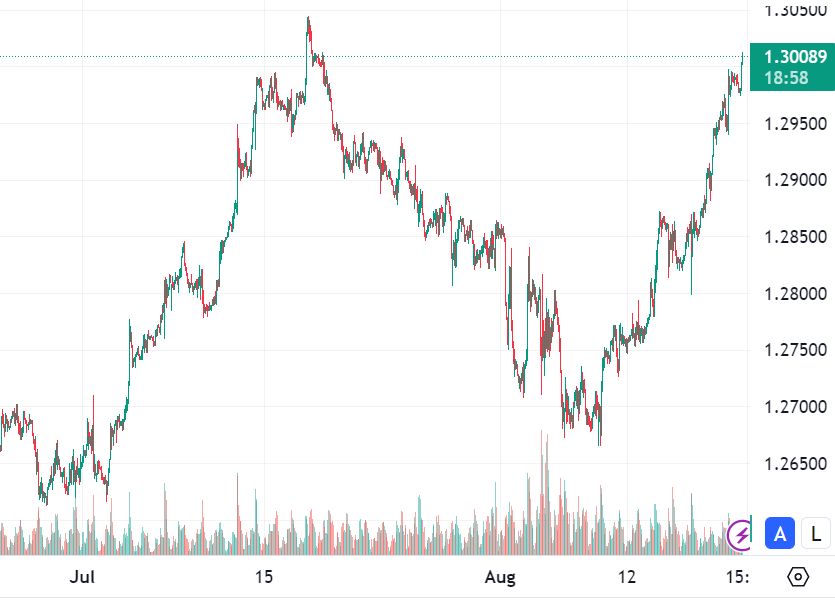
The pound has climbed to a month's high against the dollar, up 0.15% to 1.3006.
It was last above $1.30 on 17 July. And before that, it was July 2023 and April 2022.
This is due to shifting rate cut expectations between the Bank of England and US Federal Reserve.
In comments from Deutsche Bank earlier it was noted that easing US recession fears have been accompanied by markets dialling back the likelihood of a 50bp rate cut at the Fed’s next meeting, but this might be shifting again this morning.
Over the past five days pound is up 1.2% versus the USD.
9.25am: Sky and CityFibre confirm deal
CityFibre and Sky have now confirmed their "long-term partnership", where Sky will offer broadband to people on CityFibre’s nationwide full fibre network.
The broadcaster and telecoms company will offer its high-speed broadband on CityFibre’s full-fibre network from next year, the pair said in a statement.
9.06am: BT falls as Sky does deal with rival
OK, so the reason that shares in BT Group PLC (LSE:BT.A) are down almost 5% is that Sky is reported by the Telegraph to be "poised" to agree a deal to move to a rival broadband network.
The broadcaster and telecoms services provider currently uses BT's Openreach network for its 5.7 million customers, but will reportedly move to the rival CityFibre network next year.
CityFibre is Britain’s largest independent full-fibre broadband network or 'alt net', with 3.2 million ready-for-service (RFS) homes at the start of the year as it attempts to establish itself as a competitor to BT Openreach.
8.47am: Sweden cuts interest rates
A European central bank has cut interest rates and says two or three more could be coming this year.
Sweden's Riksbank cut its policy rate to 3.5% from 3.75%, as expected.
Policymakers in Stockholm said the policy rate "can be cut two or three more times this year".
At the same time, the spot gold price hit a record high of $2,509.69 per ounce/
8.43am: Wood Group results mixed says analyst
OK, let's look at some of the other company results and news out this morning.
We have interim results from John Wood Group PLC (LSE:WG.), where its shares started lower and are now in positive territory, though down 35% on a month ago after its recent potential takeover was called off.
The results are broadly in line, analysts say, with revenue, adjusted EBITDA and the order book than guidance, but profit before tax of US$34.8 million was below forecasts and a near-$1 billion statutory loss after a $815 million goodwill writedown was taken and a US$140 million exceptional charge related to the exit from LSTK & EPC work.
Despite this, guidance remains unchanged: high single-digit growth in adjusted EBITDA for 2024 before disposals, 2H weighting, and net debt at December 2024 similar to December 2023 after disposals.
Panmure Liberum analyst Ashley Kelty says: "The end of the takeover interest from Sidara – due to market conditions, rather than any underlying issues with WG – removes a distraction from mgmt. and should allow the business to refocus on the longer-term strategy and on winning new business.
"Disposals streamline the business further although some losses were crystalised on legacy contracts. The rise in margins is an encouraging step forward, but rise in net debt is a concern despite claims of savings being realised under strategy implementation.
"The overall recovery is taking longer than mgmt. expected – having to deal with multiple takeover approaches has obviously knocked business off track – but investors will hope that the company can now focus on delivery."
8.21am: London in the red, Europe in the green
Losses for the FTSE 100 have been extended to 24 points now, a fall of 0.3%, with eight out of the index's largest 10 stocks in the red, led by Shell and BP, both down 1.6%.
Looking across to European markets, investors seem more bullish there.
The DAX, CAC 40 and IBEX 35 are all up 0.3%, while the FTSE MIB in Milan has risen 0.4% and the wider Euro Stoxx 600 is up 0.11% as UK stocks drag.
Denmark's Zealand Pharma and Jyske Bank are the Stoxx 600's top risers, up 3.5% and 2.1% respectively.
8.08am: FTSE opens lower as oilers fall
The FTSE 100 sank into the red in the first minutes of trading, with falls for oil giants BP and Shell two of the main reasons.
But it's just a 10 point decline to 8,343 so far, and if you were following yesterday's market movements, the index started on the back foot then before mounting a good recovery in the afternoon.
Shell PLC (LSE:SHEL, NYSE:SHEL), the second largest company in the Footsie, is down 0.8% and BP PLC (LSE:BP.) is down 1.3%.
This is after oil prices fell back sharply overnight, with Brent crude futures easing to $77 a barrel, though starting to pare some of those losses this morning.
BT Group PLC (LSE:BT.A) is the biggest faller, down 4.8%, with the reason not apparent to me yet.
7.58am: Futures show optimism with edge of caution
Stock futures in Europe and the US are mostly continuing to trade higher, "but with a bit of caution", says market analyst Naeem Aslam at Zaye Capital Markets.
The Jackson Hole symposium organised by the US Federal Reserve later this week is "the main thing for traders and investors", he says, as Fed chairman Jerome Powell will deliver a speech on Friday.
"The speech's content will provide many answers for traders and investors looking for a much deeper rate cut for the US economy, as some believe that the Fed is now behind the curve given the latest inflation print and overall economic data in the country."
Aslam adds: "while most investors anticipate optimistic and dovish comments from the Fed on Friday, it's important to remember that the Fed's role is to balance market expectations with reality.
"Therefore, there is always a possibility that market participants may not receive a significant amount of positive news on Friday, which could lead to a decline in the US equity markets rather than a rise."
7.48am: 'Like the early August slump never happened'
Yesterday saw markets continue to recover from their recent turbulence, says Deutsche Bank strategist Henry Allen, pointing to the S&P 500 posting an eighth consecutive advance for the first time since November.
"To be honest, if you look at markets right now, in some asset classes it’s almost like the original slump never happened, as the S&P 500 is now just over 1% beneath its all-time high from July, having recovered by nearly +8% over this 8-session run."
He says if the US benchmark pulls off a ninth consecutive advance today, it would be the first time since 2004 - "these aren’t the sort of moves we see every day, and it feels a long way from the fears of two weeks ago".
Also the equal-weighted version of the S&P also hit an all-time high yesterday, which shows the breadth of the recovery, says Allen, whilst the VIX index of volatility was down to a one-month low of 14.65pts by the close.
"Those gains came as investors’ concerns about a US recession continued to ease over the last 24 hours, moving further away from the sudden wave of fears after the US jobs report on August 2," he says, noting that subsequent data like the weekly jobless claims have also been stronger.
However, "many of the factors that led to the selloff in the first place haven’t gone away," he cautions, though markets have dialled back the likelihood of a 50-basis-point rate cut at the Federal Reserve’s next meeting, with futures pricing in nearer a 25bps cut.
7.36am: GSK lung cancer drug gets fast-tracked
Some news from GSK PLC (LSE:GSK, NYSE:GSK), which says has received approval for a fast-track US regulatory process for a potential new cancer drug being developed with a Chinese partner.
'Breakthrough therapy designation' has been given by the US Food and Drug Administration (FDA) for the antibody-drug conjugate to treat relapsed or refractory extensive-stage small-cell lung cancer, an aggressive form of lung cancer.
It is being developed by Chinese biopharmaceutical company Hansoh Pharma for the treatment of lung cancer, sarcoma, head and neck cancers and other solid tumours.
GSK, which acquired exclusive worldwide rights for the drug, from Hansoh earlier this year, said it plans to begin global Phase I trials in the second half of this year.
7.14am: FTSE 100 expected to start lower
The FTSE 100 is predicted to start lower on Tuesday, giving up some of the gains from the day before despite a positive session in New York overnight.
Futures for London's blue-chip benchmark are pointing to a 25-point decline, coming after the index added 45.4 points to finish at 8,356.9 yesterday.
Last night, US stocks finished higher, with big tech powering the gains, lifting the Nasdaq 1.4%, the S&P 500 almost 1% higher and the Dow Jones ending up 0.6%. The Russell 2000 small and mid cap index also gained 0.3%.
News that semiconductor giant AMD is swooping to buy hyperscale solutions provider ZT Systems for $4.9 billion to bolster its AI capabilities, provided a boost.
Other European futures are mixed this morning, with those for Germany's DAX up around 20 points and those for France's CAC-40 flat.
Oil prices are lower though, with Brent crude down 0.8% to $77.01 a barrel, which is likely to weigh on the FTSE.
The retreat began yesterday after US Secretary of State Anthony Blinken said that Israeli PM Netanyahu had accepted a ceasefire proposal, and called on Hamas to agree to the deal. Blinken said the deal was "a bridging agreement".
European inflation data and a Swedish central bank decision are among the macro events traders are watching out for today.