
- FTSE 100 climbs 19 points to 8,173
- Results out from AstraZeneca, Unilever, BAT, Lloyds
- ...and BT, Vodafone, Centrica, Airtel, Rentokil, Mitchells & Butler and more
4.12pm: FTSE moves higher as big guns fire up
With a few minutes of Thursday's London session to go, the FTSE 100 has moved to a gain of 19 points, up 0.2%.
Looking at the top 15 largest companies on the index, the majority are in green now.
Unilever and British American Tobacco are top of the leaderboard, up 6.2% and 5.3%, while other reporters from today like Vodaone and Lloyds have climbed out of the red, now both up over 1.5%.
The FTSE 250 is still sitting in the red, down 0.35% at 20,876.
"Most indices are still lower this afternoon, though another 1% rise for the Russell 2000 on Wall Street shows that last week’s rotation is still going on beneath the surface," says Chris Beauchamp, chief market analyst at IG.
The US tech Magnificent 7 and the US dollar Japanese yen are "both viewed as the main culprits of the recent selloff".
He says the Chinese rate cuts and other measures earlier "have not been well-received, a salutary lesson for those hoping for Fed easing in the near future. For now, concerns about China’s economy appear relatively contained, but investors remain on edge", he says.
3.43pm: More mortgage cuts
More mortgage rate cuts, today from Barclays and TSB, adding to a growing flow from the sector in recent weeks.
Barclays announced cuts of up to 0.1 percentage points to a range of its residential purchase and remortgage deals, effective from tomorrow, with some product transfer deals for existing customers too.
TSB, which announced some cuts last week, alongside Halifax and NatWest, today flagged cuts to most of their fixed rate mortgage deals.
"Rate reductions are seriously picking up pace with multiple lenders adjusting their offerings on a daily basis," says Hannah Bashford, director at Model Financial Solutions.
She reckons it’s "only a matter of time" before more products are announced under 4%, as Nationwide announced earlier this week, which "has the potential to supercharge demand during the rest of 2024".
Andrew Montlake, managing director at Coreco, says: "Lenders seem to be pricing in the fact that a base rate cut is coming very soon."
3.36pm: US keeps rotatin'
Good news for FTSE 100 investors and things are calming down in New York too.
The FTSE 100 index is up 0.15% now, the only major European index in green.
Meanwhile, across the Atlantic, the S&P 500 is back to flat, and the Nasdaq has cut its losses to 0.45%.
The Dow Jones is up 0.4% and the Russell 2000 has gained 1.3%, which indicates the rotation trade is still going, with most of the Big Tech names in the red.
3.24pm: Sainsbury's 'free shopping' glitch
I wonder if Sainsbury's next results will mention the glitch that seems to have allowed shoppers to walk out with their groceries almost for free.
Photos and videos of people exploiting the glitch showed customers buying expensive items for pennies.
A spokesperson for Sainsbury's said: "We have seen an increase in fraudulent coupons in our stores and we have processes in place to detect and block them."
3.18pm: Thoughts on US economic data
The US durable good orders numbers earlier were "looks terrible, but can be ignored", says economist Oliver Allen at Pantheon Macroeconomics.
This is because it is "entirely due to the worst most for the volatile aircraft orders component since June 2020", with net orders of civilian aircraft down $8.8 billion last month, compared to a $108 billion increase in May, which almost certainly reflects a huge number of cancellations for Boeing aircraft.
"Headline aside, the 0.5% increase in orders ex-transportation is encouraging, the biggest gain in six months and far stronger than the recent flat trend," he says.
And while the headline orders numbers receive more attention, Allen says the most import series in this report is nondefense capital goods shipments ex-aircraft, which are a direct input into equipment investment in the national accounts.
Core capital goods shipments edged up by just 0.1% in June, "which suggests essentially no change in real terms" from a May level that was the lowest since late 2020.
As for the US GDP number, James Knightley at ING, says while growth beat expectations it "fails to dent the market's faith in rate cuts".
He adds: "The economy is facing more challenges in the second half of the year and with the Fed sounding more relaxed on the path ahead for inflation, we expect a growing focus on activity to deliver rate cuts from September."
The solid set of US activity numbers today is not having a major impact on market expectations for rate cuts, he notes, as these "are increasingly being seen as a done deal".
Looking at the US GDP detail, consumer spending rose 2.3% versus 1.5% in the first quarter, which is still well down on the 3% rate averaged through the second half of 2023.
"Consumer spending is set to slow further in the second half of the year," he adds, with weak real disposable income growth, reduced support from pandemic-era savings, rising loan delinquencies as the cost of credit biting harder and harder, while the investment climate "will also be more challenging with firms looking more cautious at the outlook" due to weakening hiring and capex intentions, while slowing home sales points to more weakness in residential construction.
2.45pm: US stocks start mixed
Well, US stocks have not given up the ghost yet, with some fight still in the bulls yet, bolstered maybe by the GDP data earlier.
The S&P 500 has started flat, while the Dow Jones is up 0.27%, though the Nasdaq Composite is down 0.26%.
The rotation into mid- and small-cap Russell 2000 resumed with a 0.5% rise in early deals.
Nvidia is down 2.3% and Broadcom down 1%, with other semiconductor names in the red also, while there are modest gains for Apple, Alphabet and Amazon.
Meanwhile, the FTSE 100 has climbed into positive territory, up 3.5 points.
The FTSE 250 index is still down 140 points or 0.7% at 20,810.
1.56pm: FTSE cuts losses
The FTSE 100's losses have been trimmed sizeably, now back to less than a 0.3% deficit for the day.
London's benchmark is the least-worst among the big European markets today, with the DAX down 0.98% in Frankfurt, the CAC 40 sinking 1.85% in Paris and worst of all being Milan's FTSE MIB, diving 2.29% due to big drags from STMicroelectronics and Stellantis.
The Europe-wide Euro Stoxx 600 is down 1.21%.
Helping things for the UK index are 6.6% gains for Unilever and 4.5% for British American Tobacco, both in the top 10 by market cap, while Lloyds has shifted from the red earlier to positive territory now.
The Footsie's largest trio of AstraZeneca, Shell and HSBC are down 3%, 1% and 0.7%, however, while Lloyds banking peers Barclays, NatWest and Stan Chart are all down 1%.
Market analyst David Morrison at Trade Nation says: "There’s a lot of red on the screens with European equities and stock indices down sharply."
He notes that mid-caps, small caps and cryptos aren’t offering a safe berth, with bonds seeing the main flows.
"Earlier this century, a move like this was often referred to as a ‘flight to quality’. But now, given the terrifyingly-high US national debt and surging deficit, that phrase can only be used ironically," Morrison says.
"Investors will be hoping that this week’s moves are taking some heat out of an overbought equity market. But they may have to wait until next week’s tech earnings to find out if it’s safe to buy."
1.21pm: US GDP zooms higher
US economic growth was faster than expected in the second quarter, the latest update from the Bureau of Economic Analysis shows.
The advance estimate of second quarter US gross domestic product (GDP) showed the economy grew 2.8% compared to a year earlier, much faster than the 2% economists has forecast on average.
It was also faster first quarter GDP, which was revised down to 1.4%.
Meanwhile, US durable goods orders plunged 6.6% in June, well below the consensus forecast of a small 0.3% gain.
Orders excluding transportation rose by 0.5%, a bit above the consensus, 0.2%, while nondefense capital goods orders ex-aircraft jumped 1.0%, also above the consensus, 0.2%.
1.05pm: US futures in the red
Futures markets are eyeing an extension of the US tech sell-off when trading starts in just over an hour.
Nasdaq 100 futures are down 0.35%, while those for the S&P 500 are 0.24% lower and Dow Jones futures are down less than 0.1%. Russell 2000 futures are flat.
Tesla and Nvidia shares are down over 1% premarket, while Apple, Microsoft, Alphabet and Meta Platforms are all down around 0.5%.
12.19pm: Chart of the day from DB
Another interesting 'chart of the day' from Deutsche Bank's macro strategy team has dropped into the inbox, looking at the rotation in stock sectors.
The analysts noted that in the 1999-2000 tech bubble, fom the peak until the end of 2000, there was a "ginormous rotation" into defensive sectors like consumer staples, utilities and healthcare, up 35 percentage points to 45% in the nine months after the bubble burst, while tech fell over 50%.
Today’s chart shows the rotation from the current tech sell-off, which started on July 11 (the blue bars show the 10 top-level S&P 500 sectors and the red bars show four broader indices).
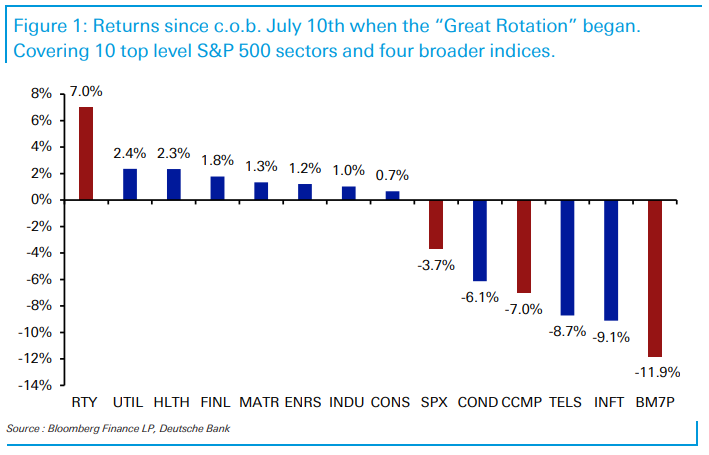
Since then, the S&P 500 has dropped 3.7%, even though seven out of ten sectors are higher over this period, the DB team point out, led by utilities and healthcare again.
Amid yesterday's big tech sell-off, which was the first 2% fall for the S&P 500 in over a year, utilities rose 1.2% and healthcare 0.8% among four sectors that rose.
Small and mid-caps are also part of this rotation, with the Russell 2000 falling 2.1% yesterday, but still up over 7% since the opening bell on July 11.
"So the conclusion is that if tech continues to correct, we should see decent up moves in other sectors, especially as the size of tech dwarfs other sectors. So even a small rotation out of tech could mean a big rotation into other sectors."
11.52am: Univeral Music, Stellantis and Nissan all crash
Looking overseas, the biggest faller in Europe is Universal Music Group, where shares have breakdanced 27% lower after the record label colossus reported slower growth than expected in subscriptions as streaming revenues were hit by the TikTok standoff between January and May.
The Amsterdam-based group, which represents acts including Taylor Swift, Adele and warring rappers Drake and Kendrick Lamar, reported revenues up 8.7% to €2.9 billion, though recorded music subscription revenue of 6.5% was lower than analysts had forecast, as streaming revenue fell 4.2%.
In the car industry, profits at giant manufacturers Stellantis NV (NYSE:STLA, EPA:STLA) and Nissan both plummeted, coming two days after the disappointing Tesla results.
Shares Nissan fell 7% in Tokyo and Stellantis 9% on the Euronext.
Stellantis, maker of Peugeot, Fiat and Jeep vehicles, reported a 48% fall in profit, which was much worse than expected.
In the car industry, profits at giant manufacturers Stellantis and Nissan both plummeted, coming days after the disappointing Tesla results.
Shares Nissan fell 7% in Tokyo and Stellantis 9% on the Euronext.
Stellantis, maker of Peugeot, Fiat and Jeep vehicles, reported a 48% fall in profit, which was much worse than expected.
At Nissan, operating profits crashed from Yen 128.6 billion to just Yen 1.0 billion in its fiscal first quarter, leading the Japanese giant to cut its full-year outlook, even though it expects an improvement in the second half from launches of new models.
Stellantis’s finance chief Natalie Knight said: “What has been happening on the industry side and competitiveness has been faster and more difficult than we expected this year, and the transition has been bumpier."
11.15am: UK car production drops
UK car sales were out earlier but got missed amid the deluge of company results.
Production of new petrol, diesel and electric cars all fell in the first half of the year, with total UK car production down 7.6%, according to the Society of Motor Manufacturers and Traders (SMMT).
Just over 416,000 vehicles rolled out of factories in the six months to the end of June, down 34,094 on the same period in 2023.
June saw a 26.6% decline due to various model changes as carmakers bring out more electric vehicles, as reflected in the reports from car companies this week.
"The UK auto industry is moving at pace to build the next generation of electric vehicles – a transition that can be a growth engine for the entire British economy," says Mike Hawes, SMMT chief executive.
But the SMMT called on the government to halve VAT on new battery electric cars for three years, estimating it will increase sales by 250,000 units, to exempt EVs from the 'expensive vehicle' supplement excise duty that applies to cars costing more than £40,000.
It also wants to equalise VAT on vehicle charging, with a 5% paid by consumers at home versus the 20% levied at on-street charging points.
10.52am: China rate cut fails to move needle
Earlier, China's central bank surprised markets for a second time this week with another monetary stimulus for its struggling economy, while Beijing administrators also announced new subsidies for trading in vehicles, with larger payments for EVs.
Another interest rate cut was made by the People’s Bank of China, though it does not seem to be helping market sentiment.
The one-year loan rate was cut by 20 basis points after the PBOC cut the short-term rate earlier this week.
Julian Evans-Pritchard at Capital Economics says the PBOC’s decision to cut interest rates is "unusual for two reasons": being double the size of its usual adjustments and that normally adjustments to rates are done on the 15 of each month.
"So the PBOC made a conscious decision not to wait until the middle of August to carry out the latest cut," he says, suggesting "something looks to have changed" in policymakers' thinking since Monday.
"Our best guess is that they had intended to wait and do a 10bp cut next month but that the underwhelming market response to the Third Plenum and Monday’s rate cuts pushed them to act with greater urgency."
11am: Analysts on Lloyds
The half-year results from Lloyds included second-quarter underlying PBT of £1.74 billion, which was 6% ahead of consensus forecasts, even though costs were 2% higher than expected.
Analysts at UBS note that this was driven by 86% lower impairments, more than offsetting an 8% pre-provision profit miss.
The dividend was "broadly in line" with consensus and full-year guidance was largely retained, except for lower impairments, with net interest margin guidance remaining for "at least 290 basis points", whereas consensus is at 2.95%.
At Peel Hunt, analyst Robert Sage says: "The share price has been strong so far in 2024, and there could be modest disappointment that guidance has not been raised," they said, especially for net interest margin despite interest rates being higher for longer.
He notes that the shares are trading towards the top end of the sector at circa 1.2 times tangible net asset value.
At Shore Capital, Gary Greenwood was of a similar mind, saying, "we think the market may be disappointed by the lack of a NIM beat and upgrade given higher for longer interest rates, while noting that TNAV per share disappointed due to an upward shift in long-term interest rates impacting negatively on the cash flow hedge reserve.
"Following a strong run, the shares are now trading close to our 62p fair value.
"Consensus earnings may nudge up a touch, but the market may be disappointed that there isn’t a bigger upgrade given the recent strong run in the shares."
10.35am: HSBC and other banks given slapped wrists by CMA
Lloyds Banking Group PLC (LSE:LLOY) and HSBC Holdings PLC (LSE:HSBA) are among four banks to have been sent letters by the Competition and Markets Authority after failing to share correct information via the 'open banking' scheme and on their websites.
Lloyds failed to publish the location of hundreds of ATMs through open banking APIs, while HSBC's list of wrongdoings was longer.
HSBC published incorrect information about how many branches it operated and incorrect charges for its overdrafts and ATM machines, with the lender having listed 167 HSBC closed branches as still being open, while the lender also failed to keep some of its annual rates for business loans and overdrafts accurate and up to date on its website.
"Providers cannot charge customers more in un-arranged overdraft charges than the [maximum monthly charge] in any given month," the CMA said, with over 300 HSBC devices displaying the charge as £35 instead of the actual value of £20.
10.13am: Existential crisis for stock markets, UK bonds in demand
Stock markets are "going through an existential crisis", says market analyst Kathleen Brooks at XTB.
"What if the big AI trade does not pay off? Are earnings faltering in Europe? How long will Chinese demand remain weak? What are the risk factors associated with the US election now that Joe Biden has pulled out of the race? And when will the German manufacturing sector come out of its malaise?"
Indeed, there are many uncertainties for traders, with earnings across multiple sectors on both sides of the Atlantic showing threatening the stock market rally we've seen so far this year.
Brooks says there's a growing list of big companies that have missed earnings estimates: LVMH, Kerring, Total Energie, ST Micro, BE Semiconductor, Google and Tesla included.
Looking at the FTSE's top dog, AstraZeneca, results were a case of "when good just isn’t good enough", she says, with stronger earnigs than expected and full-year guidance raised on the back of strong demand for its cancer drugs that meant revenues were also stronger than forecast for Q2.
"This is usually exactly the kind of earnings report that the market likes: a strong beat on estimates with better-than-expected forward guidance, they also raised their dividend.
"However, in the current environment, earnings beats are not enough to boost the share price, and Astra Zeneca is falling this morning."
The flight to safety is seeing investors buying up US Treasury yields, with the 2-year US Treasury yield at its lowest level since February.
Bond yields across Europe are falling as investors "rush to the ‘safety’ of government debt", says Brooks.
"Interestingly, in Europe, investors are favouring UK bonds over other European bonds, which is a sign that the Labour government’s message of fiscal credibility and fiscal prudence is resonating with investors."
10am: More weak data from Germany
More bad economic news out of Germany, with the IFO business climate index in Germany falling to 87.0 in July, from 88.6 in June, below the consensus, 88.6 and lower than all forecasts.
The headline number was dragged down by declines in both the expectations and current assessment indices.
Carsten Brzeski at ING says: "It's all being driven by a worsening of the current assessment component and an even worse plunge in expectations. A weaker global economic outlook, policy uncertainty in both France and Germany as well as the potential implications of the US presidential elections for Europe seem to be weighing on business sentiment."
He adds that there is still hope: "Still, despite a weak start to the second half of the year, don't rule out potential positive surprises. In fact, extremely weak May data could have been exaggerated due to many public holidays and long weekends. Plus, it only needs a small improvement in industrial order books to get industrial production growing again, admittedly from low levels. The highest increase in real wages in more than a decade should also eventually loosen even German consumers' traditionally very tight wallets."
Claus Vistesen at Pantheon Macroeconomics says: "As in France, these numbers cast doubt on our forecasts for relatively resilient growth in the second half of the year, though in the case of Germany, we always looked for relatively slow growth overall."
9.47am: Anglo American out of the red
Shares in Anglo American PLC (LSE:AAL) have climbed out of the red and are now in marginally positive territory.
Some investors may have initially been reeling from the mining giant taking a US$1.6 billion write-down of the Woodsmith fertiliser development in Yorkshire.
The miner had already said it would slow down the development of the polyhalite mine pending a final investment decision as part of a restructuring of its businesses after a failed bid from BHP.
Half year revenues dropped 8% and underlying profits by 23%, with CEO Duncan Wanblad saying "our focus on operational performance is delivering results", pointing to strong margins in copper and iron ore businesses.
9.31am: BAT hits out
Another FTSE top 10 name with shares in positive territory after results this morning is British American Tobacco PLC (LSE:BATS), which has criticised US authorities for a lack of enforcement against "illicit" single-use vapour products.
The comments came in BAT’s half-year trading update, which shows that smokeless products now comprise 17.9% of the company’s total revenues, up from 16.5% in the first half of 2023.
Single-use vapes, primarily cheaply imported from China, have become a hot-button issue in the industry, with the US FDA not having approved brands such as Elf Bar and Esco Bar which remain widely available at retail outlets.
BAT's interims were broadly in line with expectations, with adjusted EPS of 169p versus consensus forecasts of 166p.
9.10am: Big guns misfiring?
The FTSE 100 is heading lower as investors seem to be unimpressed by results from some of the index's big guns, now down over 1% to 8,070.
Shares in the Footsie's largest company, AstraZeneca PLC (LSE:AZN), are down 2.9% despite raising its guidance for revenue and earnings this year after first-half sales jumped by 18%.
CEO Pascal Soriot said: "Building on our strong growth in the first half of the year and continued underlying demand for our medicines we are upgrading our FY 2024 guidance for both total revenue and core EPS."
There's also results out from the index's fourth-largest company, Unilever PLC (LSE:ULVR), where its shares have rallied 6% this morning to their highest since 2020.
Investors shrugged off missed quarterly guidance and turned their attention to the prospect of greater profitability later in the year.
Elsewhere, BT Group PLC is down 3.3% after reporting a record pace in rolling out fibre broadband in the last quarter, but with revenues failing to keep pace as its broadband customer base declined by 0.3%.
BT's revenue fell 2% and profits by 3%, with CEO Allison Kirkby calling it a "solid start to the year".
8.43am: Revolut gets UK banking licence
UK-based fintech Revolut has finally ended its long wait for a UK banking licence from the Prudential Regulation Authority (PRA).
The company said it will now enter the 'mobilisation' stage, having received authorisation with restrictions from the PRA, which is designed for new banks to fully build out their banking operations.
Revolut has for several years offered its nine million UK customers an e-money app with many of the same services as a bank, but customer's deposits had to be held in a third-party licenced bank.
Group chief executive and co-founder Nikolay Storonsky said: "We are incredibly proud to reach this important milestone in the journey of the company and we will ensure we deliver on making Revolut the bank of choice for UK customers."
8.28am: Rentokil disappoints
The FTSE 100 fell below 8,080 a few minutes ago, the first time it's been that low since late April, exactly three months ago.
It's trimmed those losses a little now, down 52 points or around 0.6%.
Rentokil Initial PLC (LSE:RTO) is one of the big fallers after its interim results showed progress in North America, a key area of investor concern after it caused last year's profit warning, but management trimmed profit guidance due to extra investment.
"We are encouraged by the positive quarterly momentum in our US pest control business in H1 and anticipate further improvement through H2," CEO Andy Ransom said.
He said organic revenue in North America would be within the lower end of the guided 2-4% range for the full year, with a $15 million revision expected to be made to full-year operating profit to reflect the additional growth investment in the second half.
Analysts at Peel Hunt said: "Questions remain about Rentokil’s continued underperformance against leading competitor Rollins (which delivered 7.7% organic growth in 2Q)."
8.22am: Centrica bottom of the Footsie
Biggest faller of London's blueCentrica PLC (LSE:CNA) profits tumbled in its latest as gas prices normalised and the bumper profits it made from the energy cap washed through.
Striping those exceptional gains out, profits still halved to £1 billion (from £2.1 billion), but the British Gas owner upped its interim dividend by 13% to 1.5p and extended its share buyback by £200 million cash balances rose to £3.2 billion.
Underlying profits at British Gas dropped 84% even though customer numbers stayed flat at around 7.48 million.
8.12am: FTSE plunges
The FTSE 100 has plunged lower at the open, falling 73 points or 0.9% to 8,080.87, the lowest since April.
Biggest fallers are British gas owner Centria PLC and pest controller Rentokil Initial PLC (LSE:RTO) after their results, with precious metals miners Endeavour Mining PLC and Fresnillo PLC also among the fallers.
Lloyds Banking Group PLC (LSE:LLOY) fell 2.2% despite a solid set of results, with other banks in the red by a similar amount.
Others with results out, Vodafone Group PLC (LSE:VOD) and BT Group PLC, were down 1.9% and 3.7% respectively.
7.44am: Tech sell off in context
Some context on the big tech sell-off overnight, from Henry Allen at Deutsche Bank, where the Magnificent Seven tech giants were technically in correction territory after falling over 10% from a record just two weeks earlier.
"It’s worth noting that markets have been on a historic run higher since last October, so we need to put this decline into some context," Allen says.
"Indeed, the S&P 500 is up for 28 of the last 38 weeks, which is something that hasn’t been exceeded since 1989.
"But given we’ve had that relentless run of gains, in many respects that leaves markets more vulnerable right now, as historically it’s unusual to see such a prolonged run of gains maintained for much longer."
On top of that, investor allocations to equities were already elevated by historic standards, he says, and markets are about to enter the toughest part of the year on a seasonal basis, as the summer holiday period often sees markets struggle.
"Then add in unusually high political uncertainty, and you’ve got several near-term challenges that make for a pretty tough backdrop."
He says the Tesla and Alphabet earnings weren't helped by a fresh batch of underwhelming macro data in Europe and the US.
"With the deteriorating backdrop, that led to growing anticipation that the Fed would deliver a rate cut at their meeting-after-next in September," Allen says, with investors dialling up their expectations for cuts this year, which led to a steepening of the bond yield curve, which has occurred shortly before a recession in the past.
7.38am: Lloyds just beats forecasts
There may be some assistance for the FTSE from Lloyds Banking Group PLC (LSE:LLOY) shares, as the UK's biggest lender has reported first-half profits just ahead of forecasts.
It also hiked its interim dividend 15% and kept full-year guidance unchanged as statutory profit before tax fell 14% to £3.32 billion, which was slightly ahead of the £3.21 billion average analyst forecast.
Net income declined 9% to £8.39 billion and operating costs rose 7%, partly offset by a £560 million lower impairment charge.
7.16am: Third day in red for FTSE 100 expected
The FTSE 100 is heading for a third day of losses on Thursday, after US markets had their worst day since 2022 and ahead of a very busy day of results in London.
Futures markets are predicting a 33-point decline for the UK equity benchmark, extending the 13-point fall from yesterday that left the index at 8,153.69.
Overnight, a huge tech sell-off sparked by underwhelming earnings from Alphabet and Tesla led to the S&P 500 dropping over 2% for the first time in over a year and it's worst day since December 2022, and even worse for the Nasdaq Composite, which plunged 3.6% in its worst day since October 2022.
Tesla's shares decreased by more than 12%, and Alphabet's by over 5%, contributing to widespread tech sector losses, including Nvidia, Broadcom, and Arm, with the 'Magnificent 7' stocks in technical correction territory after falling over 10% from a high just two weeks ago.
A concern was spending on AI and other tech, with Google’s capex spending expected to reach or exceed $24 billion, bringing total spending this year to almost $50 billion - or around 84% more than the past five-year average.
The company CEO thinks that underinvesting is a bigger risk than overinvesting.
"But that narrative is no longer welcome among investors," says Ipek Ozkardeskaya, senior analyst at Swissquote Bank, who noted that the prospect of pause in AI spending led to Nvidia falling almost 7%, with AMD and other semiconductor companies to drop too.
The harsh market reaction "hints that we are coming to a point in the AI rally where investors are increasingly impatient to see their massive spending turn into profits, while the big spenders continue to say that they should spend more before seeing the benefits", she added.
"Also, from a broader perspective, the fact that the Federal Reserve (Fed) cut expectations are rising is not positive for the Big Tech stocks as these behemoths were seen as a safe place to hide when the rates were high, and could see their advance wane due to a sector rotation."