
- FTSE 100 drops 9 points to 8,158
- easyJet profits jump 16%, summer bookings solid
- Reckitt Benckiser to sell Air Wick, Cillit Bang and Calgon brands
4.16pm: Investors give tech stocks a bruising
As we near the end of the London session, the FTSE 100 has wiped out its day's losses several times but things are not sticking, with the index still down 0.1%.
Informa is now the top blue-chip riser, with the events group having overturned its earlier deficit as investors come round to liking the look of its £1.2 billion agreed takeover of rival Ascential.
Gains in easyJet have been trimmed to just 3.4% and Reckitt Benckiser to 2.9%, around half what they were after their respective trading updates this morning.
Housebuilders are prominent on the leaderboard, including Vistry, Barratt, Persimmon and Berkeley, which is likely to be on the back of reports in this morning's newspapers that the new government is set to loosen 'nutrient neutrality' rules that the industry has blamed for stalling building rates.
On the downside, tech-tilted investment funds such as Scottish Mortgage Investment Trust PLC (LSE:SMT) on the Footsie, and Allianz Technology Trust PLC (LSE:ATT) and Polar Capital Technology Trust PLC (LSE:PCT) on the FTSE 250 are all in the red due to today's US tech sell-off.
Across the pond, the Nasdaq has plunged 2.6%, the S&P 500 is down 1.7% and the Dow Jones has fallen 0.96%.
"The big problem with seven stocks dominating market sentiment is that if they hit a wall someone’s going to get hurt," says market analyst Danni Hewson at AJ Bell.
She says investors have been "royally spooked" by Tesla and Alphabet earnings, and while the latter's weren't awful, "the fact they’re still ploughing billions into AI has caused some to begin questioning when enough will be enough, or at least when the expenditure will deliver the kind of results we’ve all been salivating over". (See Jim Reid chart below.)
Hewson adds that Tesla boss Musk’s "attempts to get investors to look anywhere but at the bottom line has also backfired", with his insistence that the company isn’t just a carmaker will not cut the mustard until robots or Robo-taxis start to make money.
"Add in ongoing concerns about Chinese demand for luxury goods, geopolitical uncertainty and our old friend rate cut expectations and there’s little wonder investors are feeling a little bruised," she concludes.
3.44pm: AI costs on the ramp
An interesting 'chart of the day' from Jim Reid at Deutsche Bank and his macro strategy team, showing rising AI costs, which he says is after they "re-emerged as one of the main themes yesterday from the second-quarter results at Alphabet and Tesla".
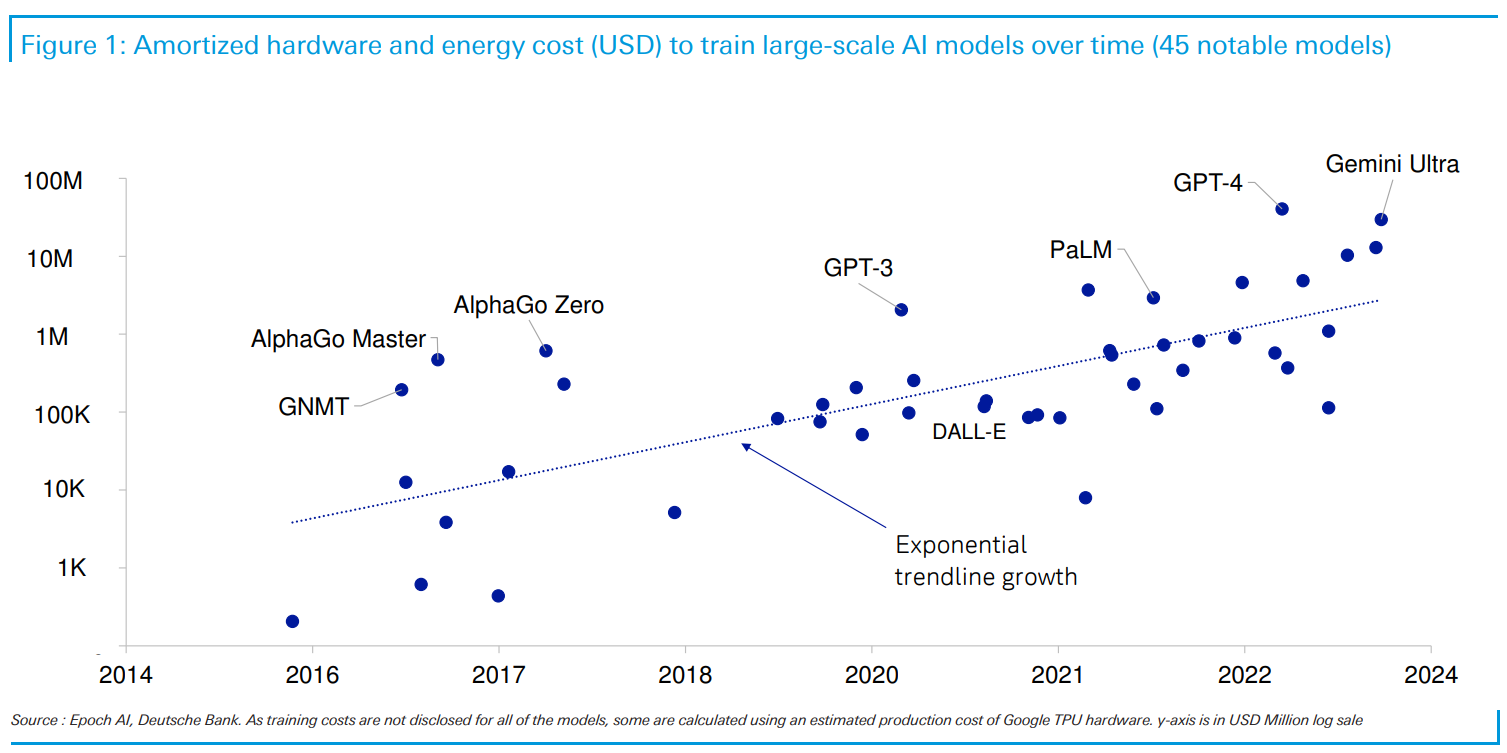
Alphabet invested $13.2 billion in supporting AI and computing power, against $12.2 billion expected, while Tesla spent $0.6 billion on AI infrastructure as operating expenses jumped to $2.97 billion, a 39% increase from a year ago.
Reid notes the eagerness to invest in AI being highlighted by Google CEO Sundar Pichai, who when asked about AI capex during the earnings call said: "When you go through a curve like this, the risk of underinvesting is dramatically greater than the risk of overinvesting for us here, even in scenarios where if it turns out that we are overinvesting."
With more Big Tech results coming next week, the DB team say a key question is how much are companies willing to spend to outpace one another in the AI race.
OpenAI has suggested it’s only now close to reaching the second of the five tiers on its 'roadmap' of measuring generative AI progress, with its eventual goal to eventually create artificial general intelligence smarter than humans.
"That screams for a lot more spending," says Reid.
"So while the promise of AI returns, alongside productivity gains, holds great allure, remember that the more sophisticated AI development becomes, the more the costs are increasing in the near term."
3.35pm: Banks have to grin and bear new cash rules
Banks and building societies were told earlier by the City watchdog that they must make sure local communities have adequate access to cash machines, as part of new regulations, which will have left a few banking bosses grinding their teeth.
The Financial Conduct Authority said that from the middle of September, high street lenders must assess whether local areas lack essential services such as branches and ATMs and take action to address any significant gaps.
"Three million people continue to rely on cash, even as digital payments become more popular. And many small businesses still need somewhere to safely deposit their takings each day," the FCA said. While
Cash is "not profitable for the banks – so naturally they want to phase it out", says lawyer Jonathan Fisher at Red Lion Court Chambers,
"But It’s clear, though, that society is not ready for this to happen. For many people, including the most vulnerable members of society, access to cash provides a lifeline.
"So it’s great to see the FCA making this move, and being sensitive towards consumers at the edge of financial exclusion – rather than just focusing on itself and macro deals in the city of London."
3.18pm: US tech rout
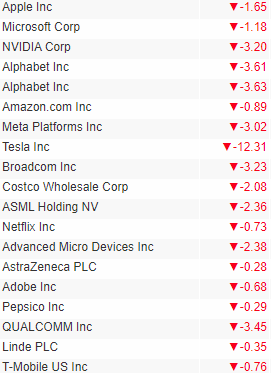
The tech rout is deepening and volatility is rising in New York, with the Nasdaq Composite now down 2%.
Tesla is down 12.4% and Alphabet, Nvidia, Meta Platforms, Broadcom and Qualcom from the index are all down more than 3%.
How's this for a picture of the tech-packed exchange's top 20:
In London, there does not seem to be much fear, with this likely being seen as knocking the froth off a market that has risen 25% over the past 12 months.
Market analyst David Morrison at Trade Nation says earnings disappointment has't just been confined to tech, with Visa also down on a small revenue miss.
"Putting this all together, it’s undoubtedly a poor start to Q2 earnings... The question is how this will affect sentiment going forward?
"Will today’s sell-off prove to be an isolated, knee-jerk reaction which quickly dissipates? Or could it poison the well as the Q2 earnings season picks up?"
Today also has earnings come from IBM, AT&T, Chipotle, Ford and Newmont Mining.
Next week is a bumper one, with Mag 7 members Microsoft, Meta, Apple and Amazon all due to report.
2.51pm: Tech sell-off whacks Wall Street
US stocks have taken a tumble at the open, with the Nasdaq tech stocks the main driver.
The Nasdaq Composite index is down 1.75%, with the S&P 500 falling 1.1% and the Dow Jones down 0.5%. The Russell 2000 small and mid-cap index is also down 0.5%.
Volatility is elevated, with the VIX index up 7.1%.
Tesla Inc (NASDAQ:TSLA) is one of the big fallers, down 9.6%, as it reported disappointing numbers after yesterday's close.
Alphabet Inc (NASDAQ:GOOG) is down 4.5% as while its headline numbers beat the Street, the overall tone did not seem to impress.
The top 15 stocks on the Nasdaq are all in the red, with Nvidia down 3.8% and back below $3 trillion valuation, while Apple and Microsoft are both down 1.6%.
2.18pm: Water companies drop
Water compaby shares have all dropped into the red after news that sector peer Thames Water has had its debt rating downgraded by Moody's.
As the news emerged Pennon Group PLC dropped from positive territory down to a 0.85% decline, with Severn Trent PLC down 0.4% and United Utilities Group PLC (LSE:UU.) down 0.2%.
None of the three are in anywhere near as much debt as Thames, though, with its debt amounting to around 80% of the value of the business.
1.50pm: Amazon rainforest ETF
An ETF for investors who want to support the sustainability of the Amazon rainforest is reportedly set to launch soon.
The exchange-traded fund is being developed by the Washington-based Inter-American Development Bank in cooperation with Brazil's public banks, BNDES, Banco do Brasil and Caixa Economica Federal, Reuters is reporting, ahead of an announcement tomorrow.
A benchmark index for the 'Amazonia Brasil' ETF to track has not yet been created, but the fund aims to launch before the COP30 Belem climate conference in Brazil next year.
1.42pm: Thames Water up the creek
Credit agency Moody’s has double-downgraded Thames Water's credit rating to 'junk' status, raising the prospect of the company breaching the terms of its operating licence.
With a £16.5 billion debt mountain to service, the move piles further pressure for the utility company, which was one of the four water firms cited by the UK environment agency for being responsible for over 90% of serious pollution incidents in the past year,
Moody’s lowered its rating two notches to Ba2, which is below investment grade, due to the water company’s “weakening liquidity position” and the potential for debt covenants to be breached.
This follows a second rating agency S&P warning earlier this month that it was mulling a downgrade too.
1.25pm: Footsie almost flat
London's blue-chip index turned positive a few minutes ago, with oil and mining giants helping drive the U-turn, along with the boost to sentiment from Informa's takeover of Ascential and easyJet's optimistic trading update.
In the top 20, Shell and BP are up 0.8% and 1%, Rio Tinto and Glencore are up 1.3% and 0.9%.
Top of the leaderboard, easyJet is up 5.3%, while Informa has gained 3.9%.
The Footsie is down around 3 points now, while the FTSE 250 is still just under 30 points or 0.1% in arrears, as Ascential's 26% gain (53% over the past two days) and Aston Martin's 9.4% are top of the list.
12.32pm: 'Surveillance pricing' probe
The US Federal Trade Commission has started a probe into the possible misuse of personal data to set prices for different customers.
Mastercard, JPMorgan Chase, IT services provider Accenture, consulting firm McKinsey and software providers Pros, Revionics, Bloomreach, and Task Software all have been asked for information by the FTC.
In particular, the FTC said it wants to assess how AI and consumer data might be utilised to target specific customers, though it added none of the companies asked to participate have been accused of wrongdoing.
11.53am: European stocks in the red
The FTSE 100 is now down just under 14 points or 0.17%, while the FTSE 250 is down 0.27%.
It's doing the best of the European benchmarks, with Germany's DAX falling 0.65%, France's CAC 40 sinking 1%, Italy's FTSE MIB down 0.4% and Spain's IBEX flat.
The continent-spanning Euro Stoxx 600 is down 0.42%, with big fallers including Deutsche Bank, Ocado, Christian Dior and Hugo Boss.
US stock futures are also in the red.
The Nasdaq 100 is poised to lead the losses, with futures down 1.05%, while S&P 500 futures are down 0.7%, down 0.4% for the Dow Jones and 0.5% for the Russell 2000.
11.41am: Grocery trends show increase in promotion spending
Whilst the Spanish outclassed England's 'galacticos' in the Euros, Gareth Southgate's boys provided an "assist" for the British supermarkets and public houses, says analyst Clive Black at Shore Capital.
This is based on grocery sales data from NIQ, showing growth of 3.6% in June, compared to growth of 1.1% in last month's report. Volumes were up by 1.5%.
Branded promotions were also notably ahead year-on-year, with overall level of promotional spending maintained at 25%, but 38% of branded fast moving consumer goods (FMCG) sales were on promotion, compared with 33% a year ago.
"We are encouraged by this momentum ahead of a Q3 when comparatives ease," says Black, noting that Ocado gained market share in a slightly stronger online channel with Marks & Spencer going well too, Sainsbury and Tesco also remaining winners in UK grocery, "auguring well for earnings momentum" as Aldi, Asda and Co-op saw falling value sales.
The analysts noted further evidence of the beginnings of a reversal of one of the key features of the pandemic and subsequent inflationary period was around a 5% shift out of brands into private label, "which in a circa £200 billion retail value market is important".
With UK food inflation easing, Black and his team have been anticipating that brand owners would start investing a little in promotions to seek to recoup some of that lost share, a process that he says was evident in the recent trading update from Premier Foods.
11.11am: Small cap movers
Looking at some small and mid-cap movers, Shield Therapeutics PLC is a standout, up 47% on the back of strong second-quarter sales of its iron deficiency product ACCURUFeR.
The update, which was accompanied by the news of CEO Greg Madison's departure, revealed net sales of ACCURUFeR jumped 69% quarter on quarter at $6.9 million and were up 259% year on year.
Anders Lundstrom, a non-executive director, has been appointed interim CEO, bringing extensive international experience from AstraZeneca, Biogen and Orexo.
Braveheart Investment Group PLCis up 37% after announcing that 86% owned subsidiary Kirkstall has appointed Beijing Kilby Biotechnology (BKB) as exclusive China distributor for its 3D cell culture and organ-on-chip related products products.
These products are "currently in high demand in the Chinese market", BKB said.
AIM-listed Nexteq is down 34% after warning on profits as the industrial technology provider says business has "continued to see persistent softer customer demand" in line with with wider industry destocking it flagged in March.
Tortilla Mexican Grill PLC (AIM:MEX) is down 25% after also serving up a spicy profit update, warning that changes to boost profits are taking longer than expected to show a benefit.
Revenues at the Tex-Mex food chain dropped 5.9% like-for-like to £31.5 million in the half year to June 2024, with a switch to a dual-delivery platform was blamed.
10.42am: TikTok fined for slowness
TikTok has been fined by UK regulator Ofcom for failing to provide accurate information about its parental controls.
The watchdog fined TikTok £1.9 million for "failing to accurately respond" to its request for information about the take-up of its parental controls feature.
Firms are required by law to respond to all information requests from Ofcom in an timely way, and the regulator said the Chinese owned video platform was asked for info to "assess its effectiveness in protecting teenage users" and to help inform parents to make decisions about which platforms they and their children use.
TikTok ultimately provided accurate, "albeit partial", data to the request in late March 2024, more than seven months after the original deadline.
10.15am: Cash and the King
Despite the rise in digital banking, there has been an unexpected jump in the number of people who mainly use cash for their daily spending.
UK Finance found that while the volume of contactless and mobile payments increased last year and the number of cash payments resumed a downward trajectory, but there was a 66% increase in the number of people who prefer to use cash for their everyday spending.
Numbers of people who mainly use cash have been consistently declining for several years to 900,000 in 2022, but jumped to 1.5 million last year.
Outside of listed companies and economic data there's also been record profits for the King Charles as the Crown Estate, which more than doubled to a record £1.1 billion, primarily driven by the benefit of an increasing number of offshore wind deals.
Profits increased by £658.1 million in the 23/24 financial year, up from a £442.6 million rise in the previous twelve months, largely attributed to an uptick in fees charged to offshore wind developers.
With urgent calls for more wind power earlier this week, the King could be in line for a bumper few years - why not hand a big chunk of it back to the public purse, Charlie?
10.09am: BoE should be reassured by PMI
The UK flash PMI may help to reassure the Bank of England that it can cut interest rates, says economist Ashley Webb at Capital Economics, but likely not til September.
Some of the recent rebound in economic activity "may have been due to catch-up growth following the weakness of activity last year", he says, with GDP growth "easing towards a more normal rate".
The small rise in the composite PMI is consistent with GDP growth slowing to around 0.2% quarter-on-quarter at the start of Q3 after what is looking like a solid rise of around 0.6% or 0.7% in Q2, Webb says.
The manufacturing output balance points to actual manufacturing output growth picking up from what was a negative period in May to around around 0.6% growth in July, while services PMI is consistent with actual non-retail services output growth easing from 1.0% in May to 0.4%.
"Given the lingering concerns around the persistence of services inflation, the fall in the services prices balance will give the Bank of England some reassurance that services inflation will continue to ease in the coming months," Webb says.
With the BoE focusing on services inflation, he notes the decline in the PMI services output prices balance to its lowest level since February 2021, is consistent with services inflation easing from 5.7% in June to around 4.0%.
"Admittedly, the recent rise in shipping costs meant that the manufacturing input prices balance rose from 56.3 to an 18-month high of 57.9. But overall today’s data release may help to reassure the Bank that it can cut interest rates from 5.25% to 5.00% in September."
9.57am: ECB rate cut in September 'remains likely'
The earlier eurozone PMI survey, where activity was particularly weak in manufacturing and fell sharply in Germany, "offers little further clarity on the ECB’s move in September" says Franziska Palmas at Capital Economics.
Indicators of price pressures were mixed, with the euro-zone input price index rose significantly, while output price pressures in services, which the ECB has been paying particular attention to, also edged down but the prices charged index remained above its long run average.
"Overall, the survey offers little further clarity on the ECB’s move in September, with the combination of a weakening economy and still high price pressures offering some support for both the hawks and the doves on the ECB’s Governing Council.
"On balance though, we still think a cut in September is more likely," she says.
9.46am: UK PMI shows optimism improved since election
"The flash PMI survey data for July signal an encouraging start to the second half of the year, with output, order books and employment all growing at faster rates amid rebounding business confidence, while price pressures moderated," says Chris Williamson, chief business economist at S&P Global.
As the first post-election business survey, collected between 11 and 22 July, the PMI data "paints a welcoming picture for the new government", he adds, as manufacturing and services companies expressed improved optimism about the future, reporting a improved surge in demand and taking on more staff.
With prices rising at their lowest rate for three and a half years, he suggests this may add to confidence of a summer rate cut from the Bank of England.
"However, policymakers will likely take a cautious approach to loosening policy amid signs of inflationary pressures pivoting away from services towards manufacturing, where Red Sea shipping delays and higher freight prices are adding to costs again.
"The renewed hiring trend could also add to pay pressures, sustaining some stickiness of inflation in the coming months," Williamson says.
9.39am: UK economy improving, flash PMI shows
The UK flash purchasing managers' index (PMI) composite index inched up to 52.7 for July from 52.3 in June, says S&P Global, above the average forecast of 52.6.
UK manufacturing again outdid services, with the flash UK manufacturing output index rising to a 29-month high of 54.4 from June's 53.3, higher than forecast.
The service PMI activity index rose to 52.4 from 52.1, less than expected.
This preliminary PMI survey indicates the ninth monthly expansion in economic putout in a row, with the full July report due at the start of next month.
Inflation slowed to its lowest in three and a half years, based on average prices charged, but S&P Global said the pace "remained steep due to elevated costs", as manufacturing firms faced the strongest rise in costs in one-and-a-half years due to freight challenges linked to the Red Sea attacks.
Earlier, the euro-zone composite PMI dropped for the second consecutive month, to 50.1 in July from 50.9 in June, was weaker than the consensus forecast of 51.1.
Both the manufacturing output PMI and the services PMI fell, with activity particularly weak in manufacturing.
The composite PMI fell sharply in Germany, returning to contractionary sub-50 levels, below France and the rest of the euro area.
9.22am: Investory generally underwhelmed
With results season getting into its stride on both sides of the Atlantic, "so far, investors are underwhelmed by what they have seen", sums up Steve Clayton, head of equity funds at Hargreaves Lansdown.
He says investors gave the thumbs-down to figures from Alphabet, Tesla and Visa, while the pound eased back to $1.289 "in the face of a dollar that is making gains against all major currencies presently as investors reassess the US political outlook".
London's oil supermajors are little changed as the Middle East situation seems not any closer to change, meaning Brent oil futures are holding steady around $81.44, having slipped back from $87 at the start of the month.
"If last night’s news was any guide, 2024 could be the year when markets start to talk about the So-So Seven" instead of the Magnificant Seven, says Clayton, "because what we saw from Tesla and Alphabet was just not enough to keep momentum in their stocks.
"AI has been such a driver of expectations and has led to an extraordinary surge in revenues for Nvidia as the hyperscalers like Google, Amazon and Microsoft’s cloud units race to build capacity.
"But at some point, that scale has to start delivering returns on capital and, so far, the jury is out."
As for Tesla, Clayton says it is "simply struggling to turn rising output into earnings".
8.50am: easyJet mostly impresses
The results from easyJet results were generally "well ahead" of forecasts, but fourth-quarter guidance "looks to be a little softer than previously guided", says analyst Alexander Paterson at Peel Hunt.
But he noted that Holidays guidance has been raised again.
Overall, he says he does not expect to change his full-year forecasts by much, "but some stale consensus numbers that are high are likely to fall back a bit and drag consensus down."
Richard Hunter, market analyst at Interactive Investor, says planned capacity growth and expansion of flight options "seems to have left the company in a commanding position in its space over the peak period".
"Indeed, there seems to be an increasing body of evidence to suggest that the family holiday remains almost sacrosanct and outside of normal budgetary restraints, which has played into the hands of easyJet and its keenly priced offerings of flights and holiday packages.
"Its network of destinations are usually convenient and difficult for some of its competitors to mirror, while the group has also managed to keep a relative lid on its prices," he adds.
Despite the 7% jump today, the share price has not reflected this turnaround, with the shares down around a third over the last three years and two thirds from the pre-pandemic February 2020.
A dip of 13% in the week before this update left easyJet at threat of relegation yet again from the FTSE 100 at the next reshuffle in September, Hunter noted, but the strong share price reaction "adds to investors remaining defiantly confident that sunnier times are returning and that the group is on a strong flight path".
8.26am: Ascential soars and Aston Martin roars
London stocks are mixed this morning, but the Footsie is down 31 points now, cutting some of its initial losses for a 0.4% deficit.
The mid-cap FTSE 250 is just nine points below the waterline, helped by a 26% jump for Ascential after it agreed to a takeover by larger rival Informa.
Aston Martin Lagonda Global Holdings PLC (LSE:AML) is up 11% too, despite reporting lower sales and larger losses.
The second-quarter performance reflects its "core portfolio transition in line with guidance and strong Specials volumes", it said, reiterating full year guidance for positive free cash flow the second half of the year, along with medium-term targets.
8.15am: Shaky start for FTSE
The FTSE 100 has got off to a shaky start again, falling 45 points to 8,122 in initial trades, but has come off those worst levels already.
Burberry Group PLC (LSE:BRBY), knocked by the LVMH update overnight, is the big faller, down 1.9%.
Tech investor Scottish Mortgage Investment Trust PLC (LSE:SMT) is down 1.4% after the Tesla and Alphabet earnings.
At the top of the risers is easyJet PLC (LSE:EZJ), up 8% on the back of third-quarter results, where profits rose 16% and summer bookings impressed after Ryanair's warning this week.
Next is Reckitt Benckiser Group PLC (LSE:RKT, ETR:3RB), which has announced a sweeping reorganisation of its business that will see it dispose of ‘non-core’ brands.
The FMCG conglomerate plans to get rid of Air Wick, Mortein, Calgon, Cillit Bang and other non-core products from its home care range.
This was alongside first-half results from RB that showed net revenues fell 3.7% and operating profit margins tightened by 20 basis points.
7.59am: FTSE 100 company to buy FTSE 250 company
Exhibitions and events group Informa PLC (LSE:INF) has had a £1.2 billion cash offer accepted by Ascential PLC (LSE:ASCL), which owns events such as the Cannes Lions and Money20/20.
The FTSE 100-listed Informa pitched its bid at 568p per share after a number of other approaches in recent months.
Ascential shares were trading at 369p yesterday afternoon until rumours escaped and the shares shot up, leading the company to put out a statement at 4.47pm saying it has received a conditional proposal from Informa and was "minded to recommend" it.
This morning, Informa said the two boards have reached agreement on the terms of a recommended offer.
7.49am: European stocks also heading down - despite strong bank numbers
Looking across to the continent, stocks are also heading lower, with Euro Stoxx 50 futures down 0.85%, DAX futures down 0.8% and CAC 40 futures down 1.1%.
There's been a plethora of big European results too, including luxury market titan Louis Vuitton Moet Hennessy (LVMH) overnight, which reported a 14% fall in Asia sales, which held back overall organic revenue growth to 1%, with operating profits down 6%.
Chairman and chief executive Bernard Arnault, said the owner of Dior and Tiffany showed its "remarkable resilience... in a climate of economic and geopolitical uncertainty" and the group "approaches the second half of the year with confidence".
Elsewhere, Deutsche Bank, Spanish bank Santander and France's BNP Paribas also reported.
The German lender posted its first loss in four years due to a large provision for a scuppered takeover, though underlying earnings also came in short of expectations, despite dealmaking and other advisory revenues doubling in the second quarter.
Santander posted a 20% profit increase to a record €3.2 billion, thanks to higher interest rates, though UK profits fell due to strong mortgage market competition.
At BHP, trading profits growth rocketed 58% higher on the back of French political volatility and the recent ECB rate cut.
Declines elsewhere meant overall net profit for the second quarter only increased 1.6%, though this was the bank's biggest-ever second quarter and beat consensus forecasts.
7.34am: easyJet 'on track for record summer'
Third-quarter results from easyJet PLC (LSE:EZJ) may reassure investors after the warning from rival Ryanair earlier in the week, with the orange-branded budget airline's profits rising 16% to £236 million.
Revenue was up 11% to £2.6 billion as passenger numbers were up 8% and ancillary revenue grew 11%. Passenger revenue per seat was down 1%, however.
Looking forward, bookings for the final quarter of its financial year saw 69% of summer capacity sold, from 68% a year ago, with 7% more capacity on sale than last summer, with total revenue per passenger yield "broadly flat" year on year.
Johan Lundgren said easyJet is "on track to deliver another record-breaking summer, taking us a step closer to our medium term targets".
7.14am: FTSE 100 set to extend losses
The FTSE 100 is poised to extend losses for another day on Wednesday after the first big tech earnings overnight were uninspiring and ahead of PMI data later this morning.
Futures for the London equity benchmark are pointing to a 19-point decline at the open, adding to the 31.4 points lost yesterday when the index closed at 8,167.4.
Overnight, the big three Wall Street indices all retreated, while the rotation into the small and mid-cap Russell 2000 continued, as it rose over 1%.
The S&P 500 and Dow Jones both dipped around 0.2%, while the Nasdaq Composite was just below flat.
Google parent Alphabet Inc (NASDAQ:GOOG) and Tesla Inc (NASDAQ:TSLA) both reported earnings after the closing bell, with Alphabet's shares down 2% in afterhours trading despite it beating expectations for both revenue and earnings per share.
Tesla skidded almost 8% lower as the electric vehicle maker’s second-quarter profits fell short of expectations and it pushed back Robotaxi expectations.