
- FTSE 100 rises 14 points to 8205
- UK CPI inflation falls to 2%, but core inflation remains elevated
- Berkeley falls despite profit beating expectations
- Spectris warns on profits, weighs on industrial sector
4.10pm: Stress for Europe but quiet session for FTSE
Barrelling towards the end of the day, the FTSE 100 is holding its head above water, but the FTSE 250 has taken a dip, down 56 points or 0.3%.
London's blue-chip benchmark is the only major one in Europe in the green, with stocks on the continent given the willies by debt concerns, as the EC issued a warning about excessive levels of national debt in seven countries, including France and Italy.
France's CAC 40 index is down 0.7%, Italy's FTSE MIB only 0.2% lower, while Germany's DAX is down 0.25% and Spain's IBEX just below flat.
"The first two days of the week saw the wave of selling in European markets halted, but warnings about fiscal stress in the eurozone have caused traders to hit the sell button once more," says IG market analyst Chris Beauchamp.
"Eurozone governments of all types face a host of challenges, but are unlikely to find popularity if they go down the fiscal austerity route. France’s current troubles could be a template for what’s to come, putting further pressure on European markets."
As for the FTSE 100 he said it was a "quiet session" with the US on a mid-week holiday but "enlivened" by the return of UK inflation to 2%.
"As is so often the case, the headline figure doesn’t tell the full story, and higher services inflation has dampened hopes of an August cut by the BoE. Nonetheless, the FTSE 100 managed to eke out a small gain in thin trading, taking its cue from the stronger Asian session overnight."
3.45pm: Musk's xAI building supercomputer with help from Dell and SMC
US stock markets are closed but do you know what isn't closed? Elon Musk, that's what.
So far, the boss of Tesla Inc (NASDAQ:TSLA) and the second-richest man in the world (or he may be the richest again I haven't checked for a while), has Tweeted various items of news, much of which is comments about political matters and his interview at the Cannes Lions festival with WPP boss Mark Read.
On his X social media platform, he confirmed that Dell Inc. (NASDAQ:DELL) and Super Micro Computer Inc (NASDAQ:SMCI) are helping build a supercomputer for his AI startup xAI.
Musk said Dell is assembling half of the racks that are going into the supercomputer, and that the other half is being built by SMC.
Earlier Michael Dell said the computer company is "building a Dell AI factory" with Nvidia chips to power xAI's Grok chatbot.
He also shared a first look at the supercomputer that will be powered by 100,000 of Nvidia's H100 graphics processing units (GPUs).
3.22pm: You ain't getting Zilch
Zilch, the fintech firm backed by eBay, has threatened that it won't list in London unless the UK government fails to boost the market and drive greater investment for tech firms.
The London-based payments company secured £100 million in debt financing from Deutsche Bank today, in what it said was a "precursor" for an IPO.
But boss Philip Belamant claimed the company was holding off on listing in London until it saw evidence of government policies aimed at creating "liquidity and excitement around IPOs".
3.10pm: EU 'budget discipline holiday in Europe is over'
The start of 'excessive deficit procedures' for France, Italy and five other EU countries "does not only illustrate the return of fiscal discipline but could also once again test political cohesion in the monetary union", say economists at ING.
"The budget discipline holiday in Europe is over," says Carsten Brzeski, ING's global head of macro.
"While apparently the European Commission didn’t want to influence the European elections, it will now very likely affect the French national election campaign".
Noting that while in the US, deficits continue to run between 6 and 7% of GDP, the European Commission is "tightening the screws" on European countries, and if countries do not comply with the agreed path of correction, they could end up paying half-yearly fines amounting to 0.05% of GDP until they are compliant – "although this famously has not happened so far".
The decisions on EDPs will be formalised in mid-July and the next relevant date is 20 September, says Brzeski, when countries will have to hand in their proposals for corrective paths to adjust their budgets.
"Today’s announcement will not only have fiscal implications but will also test political cohesion in the monetary union, and will eventually be of relevance for the European Central Bank."
2.34pm: Digesting the FTSE's day so far
Some thoughts on what markets are up to, with the FTSE in positive territory and European markets mixed.
"It appears that the initial fall in early trading may have been as investors digested this morning’s inflation read," says Chris Peters, trading floor manager at Accendo Markets.
"As services inflation remains higher than was hoped, a rate cut may not be as forthcoming as first hoped.
"However, the drop in inflation to the targeted level of 2% and the easing in core inflation to 3.5% could provide both companies and consumers with something to cheer.
"This latest delivery on a macro front may also provide some optimism ahead of tomorrow’s BoE interest rate decision, although a hold is widely expected, the rate cut roadmap could become clearer."
While some headlines suggested that the easing back of CPI would be a boost for the Conservatives in the election race, Fawad Razaqzada, market analyst at City Index, says it is "unlikely to improve Prime Minister Rishi Sunak’s rating before the upcoming UK election, although markets have not shown too much concern about the potential end of a Conservative government".
"Concerns about the looming French elections have had a far greater impact on risk appetite across Europe.
"Still, the lack of any further deterioration in risk appetite suggests investors are looking past the elections."
The recovery in oil prices is providing an extra boost to the FTSE above its European peers, he says, with shares in BP and Shell both on the rise.
Looking to tomorrow's BoE decision, Razaqzada points out that nearly all of the 65 economists polled by Reuters anticipate a rate cut in August, with most expecting at least one more reduction this year.
"If the BoE clearly hints at an August cut tomorrow, it may immediately impact the pound negatively and the FTSE positively. However, the risk remains that the BoE might appear more cautious."
2.10pm: Debt procedures for France and Italy, plus warning from ECB
The EU Commission this afternoon recommended that seven countries, including France and Italy, start a so-called "excessive deficit procedure" (EDP), criticising the nations for overspending.
The Commission confirmed today it will recommend France, Belgium, Italy, Hungary, Malta, Poland, Slovakia take corrective action after they were found to breach the deficit and debt ceilings set under the bloc’s fiscal rules.
The EDP is the first step in a long process before any member state can be hemmed in and moved to take corrective action.
Based on Eurostat data, France’s general government deficit increased from 4.8% of GDP in 2022 to 5.5% in 2023, the Commission said in its assessment.
Also today, the European Central Bank also warned that most euro-zone countries need to start reducing debt immediately due to the "significant fiscal burdens" from ageing populations, climate change and extra defence spending. (The UK is in a similar boat but is obviously not mentioned.)
"These developments will be challenging enough in isolation, and countries will face all of them simultaneously," it said in an article.
"Consequently, action needs to be taken today – especially in high-debt countries high-debt countries facing."
Officials at the central bank estimated eurozone countries would have to reduce their budget deficits by a total of five percentage points of GDP by in 2070, requiring total savings or extra revenue across the bloc of €720 billion at current output levels.
The European Commission reprimanded France and six other countries for breaching EU fiscal rules, increasing investor anxiety about the sustainability of public finances.
1.58pm: Starling battling to bring down debtor numbers
Under pressure from regulators, Starling Bank has stepped up enforcement actions against lenders that borrowed money guaranteed by the government during the Covid crisis.
The digital bank is actively pursuing several debtors that have never or barely traded as it grapples with increasing loan defaults and a regulatory investigation into its crime controls, according to a report in the FT.
The neo bank reported a rise in loan defaults in its last financial year and an ongoing investigation by the Financial Conduct Authority (FCA) into its anti-money laundering and financial crime systems, similar to a probe into rival Monzo.
Starling disclosed in its annual report that the FCA had launched the investigation in November and warned that the probe could have a material impact on the company.
1.25pm: UK pay deals on the up
Some news that is not good for the prospects of a Bank of England rate cut: new salaries offered by British employers stepped higher in the quarter to May, stoking fears that one of the top drivers of inflation may be taking a while to ease.
Median basic pay settlements in the three months to May lifted 4.6% year-on-year compared to the 4.5% jump recorded in April, data provider Brightmine found.
Pay growth is an important area of focus for the BoE as it mulls when to start lowering interest rates, with policymakers on the MPC understood to be looking for signs that wage growth is rising by around 3% to 4% before they vote to cut rates.
1.20pm: Ferrari (NYSE:RACE) and Clarks, rarely seen together
Here's a few other interesting stories around today.
Ferrari (NYSE:RACE) has announced that its first electric vehicle will set back buyers at least €0.5 million, with the Italian sport car maker planning to open a site specially to develop the new model.
A new production plant is expected to help boost its manufacturing of the EV, hybrids and ICEs by as much as a0 third.
Shoe retailer Clarks has warned it will axe more than 150 office staff after it swung to a loss last year.
Blaming “discount-hungry customers” for the downturn in performance, the group said it will now cut jobs at its headquarters in Somerset, UK and Massachusetts in the US.
And finally, an election-related one, with Jim Ratcliffe, the billionaire owner of Ineos and co-owner of Manchester United Plc, has publicly backed Labour and said he thinks Kier Starmer will "do a very sensible job" if made PM.
The petrochemicals mogul said he “had enough” of Sunak’s policies and the string of failed prime ministers.
1.16pm: France remains in the red, euro near lows
France and Germany's stock markets are the only ones in Europe in the red, while the euro remains close to recent lows on concerns about France - where Goldman Sachs has warned proposals by the far-right National Rally could send national debt to dangerous levels.
The wide spread in 10-year bond yields between France and Germany is highlighted by Luca Santos, currency analyst at ACY Securities, as it has caught the attention of European Central Bank officials,
Large rises in recent days have taken the spread to nearly 80 basis points, a significant jump from around 48 basis points before French President Macron announced a snap election, and now the highest since February 2017.
Further increases could push it to levels reminiscent of the eurozone debt crisis in 2011-2012, says Santos,
ECB president Christine Lagarde and chief economist Philip Lane reassured that the ECB is closely monitoring financial market conditions but hinted that no immediate actions would be taken, downplaying the need for support measures for the French bond market, suggesting that the recent changes are more about market adjustments than any disorderly behaviour.
"Lane also indicated that any decision on rate cuts by the ECB might be postponed until September, depending on upcoming data regarding services inflation," notes Santos. "He conveyed a cautious outlook, expecting cost pressures to remain low in 2025 and showing a willingness to tolerate short-term inflation changes."
Assurances from NP leader Marine Le Pen at the start of the week somewhat calmed market fears, leading to a more measured widening of the spread.
"However, the broader political uncertainty remains, hinting at potential further weakening of the euro as the French elections draw nearer," Santos says.
A few things to know about @EU_Commission decision today re an Excessive Deficit Procedure for France (& 6 others). All the Commission is doing today is saying France is breaching the 3% ceiling. It is not being put in an EDP - it is the 1st formal step towards opening an EDP 1/
— Mujtaba Rahman (@Mij_Europe) June 19, 2024
12.52pm: Alpha better
Shares in Alpha Financial Markets Consulting PLC (AIM:AFM) have jumped 23% to 481p after it confirmed that the board are willing to back a takeover bid from Bridgepoint.
The proposed bid, which was made in early May, was priced at 505p in cash per share, the fund management consultancy says in an RNS statement.
Last month, another of the possible bidders, private equity group Cinven, dropped out of bidding, saying it no longer intended to make an offer.
12.17pm: CMA probe, banker bonus cap lifted
US markets are closed, but here, have some fresh news about some US companies.
First, the UK competition regulator has just launched a probe into Hewlett Packard Enterprise’s planned $14 billion takeover of Juniper Networks.
In a statement put out a short while ago, the Competition and Markets Authority said it will decide by 14 whether to refer the deal to a deeper 'phase 2' investigation.
It invited comments from interested parties to be made by July 3.
Elsewhere, JPMorgan Chase & Co (NYSE:JPM) is reported to be removing the EU bonus cap for its UK staff, according to Sky News's Mark Kleinman.
This comes just weeks after Goldman Sachs did the same, allowing senior bankers and traders to get bonuses of up to ten times their salary from this year onwards.
12.05pm: US markets closed for holidays today
Worth noting that the New York Stock Exchange and the Nasdaq will be closed today for the Juneteenth holiday.
This day commemorates the ending of slavery in the US.
The US bond market will also be closed on June 19, according to the Securities Industry and Financial Markets Association.
All markets will reopen on Thursday.
Meanwhile, both FTSE indices continue to rise, the FTSE 100 up 11 points to back above the 8200 mark for the first time since last Thursday, and its mid-cap sibling has gained 48.
In Europe, Germany's DAX is down 0.24%, France's CAC is down 0.61%, while the Italian and Spanish benchmarks are both just below flat.
The Euro Stoxx 50 and Euro Stoxx 600 are down 0.42% and 0.08% respectively.
11.46am: GE delisting from LSE
General Electric's GE Aerospace said today that it is delisting its shares from London, as well as from Euronext Paris and SIX Swiss Exchange.
It says this is "part of a simplification project across multiple jurisdictions and following a comprehensive review of the trading volume, cost and administrative requirements related to the LSE listing".
GEC seems to have been listed in London since 2003, from what I can tell.
11.32am: Back in the black/green
The FTSE 100 is back in positive territory, glory be.
London's leading index is up 4.3 points at just under 8196, while the FTSE 250 is up 30 points at 20,440.
Half the Footsie's top 10 are still in the red though, led by AstraZeneca and RELX, down 1.2% and 0.8% respectively.
11.20am: FCA delays probe into politically exposed persons
A review by the Financial Conduct Authority of the treatment by financial services firms of politically exposed persons (PEPs) has been delayed until after the election.
The watchdog launched a review of the treatment of domestic PEPs last year in the wake of the Nigel Farage/Coutts bank issue.
It was due to publish the findings from the review towards the end of this month.
"However, we do not think it is appropriate to publish the review during the pre-election period," the FCA said in a statement this morning, saying it will publish the findings in July once Parliament has returned.
10.55am: FTSE almost back to flat
The FTSE 250 has broken into positive territory, up four points, and the FTSE 100 has cut its losses, with the index almost back to flat for the day.
Most big blue-chips have picked up as the morning has worn on. Vodafone, Anglo American and Beazley are behind box-maker Smurfit Kappa on the leaderboard, followed by airlines IAG and easyJet and two more packaging companies, DS Smith and Mondi.
The FTSE is now the best performer among the major European benchmarks, with the DAX down 0.33% and CAC 40 down 0.57%.
This is despite the pound being up 0.2% against the US dollar at 1.2729 and the same versus the euro at 0.8434.
10.32am: Nvidia valued at more than all the whole LSE
Here's an incredible factoid about NVIDIA Corp (NASDAQ:NVDA) returning to the world's most valuable company status, which it did last night.
After another 3.5% surge, the chipmaker's market valuation swelled to $3.34 trillion - which is more than not just the FTSE 100 but more than the value of the whole of the London or Paris stock exchanges.
Earlier this week, London regained the crown of Europe’s most valuable for the first time in nearly two years, with the total value of companies listed on the LSE hit $3.18 trillion in US dollar terms.
London overtook the $3.13tn total value of companies listed in Paris after the French market slumped over election uncertainty, having lost the crown in November 2022 in the wake of Prime Minister Liz Truss’s disastrous mini-Budget.
10.19am: Housing market stability
The rebound in UK house prices in the last two official reading is "bringing some much-needed stability to the property market", says Iain McKenzie, CEO of The Guild of Property Professionals.
"This period of calm is an opportunity for both buyers and sellers alike. Sellers can benefit from continued strong buyer demand, while a more balanced market may offer better value for buyers, particularly those looking to own their first home."
He noted that while mortgage approvals dipped slightly in April, the overall number of transactions remains higher year-on-year, suggesting a market with "continued momentum".
Sarah Coles, head of personal finance at Hargreaves Lansdown, says the rise in prices in April is a reflection of the fact that "when many of these sales were agreed in January, mortgage rates were falling and buyers were flocking back to the market".
She notes that most political parties included first-time buyers in their manifestos, with both Labour and the Conservatives hoping to encourage the building of more properties – with Labour pledging 1.5 million more homes and the Conservatives 1.6 million, Labour focusing on building more affordable housing and reforming planning, the Conservatives suggesting cutting stamp duty on homes up to £425k for FTBs, with both parties pledging a permanent mortgage guarantee scheme.
9.44am: UK house prices rise again
Average UK house prices grew for the second consecutive month, following eight months of falls, according to official data.
1.1% in the year to April 2024 to £281,000, up from 0.9% in the year to March 2024, with last month's figures revised down from 1.8% in the provisional estimate a month ago.
These are the official numbers from the Office for National Statistics, using Land Registry data.
UK private rents increased by an average of 8.7%, down from 8.9% in last month's figure.
Average rents increased to £1,301 (8.6%) in England, £736 (8.5%) in Wales, and £957 (9.3%) in Scotland, with the highest average rent in Kensington and Chelsea (£3,397) and lowest in Dumfries and Galloway (£480).
9.05am: European stocks mostly in the red as France in spotlight
The 0.2% fall for the FTSE 100 is not the only major European equity benchmark in the red this morning.
Germany's DAX is down 0.15%, France's CAC 40 is 0.24% lower and Spain's IBEX is just below flat. Italy's FTSE MIB is the only one in positive territory, up 0.28%.
The wider Euro Stoxx 600 is flat.
Traders are likely to be focusing on France, says market analyst Kathleen Brooks at XTB, as the EU Commission makes its verdict about the "punishments" that should be imposed on EU member states that are on the ‘Excessive Deficit Procedure List’.
"France, with its 5.5% budget deficit and debt at 111% of GDP, is likely to be admonished by the EU Commission and may face fines for breaching the bloc’s budget deficit rules, with just over one week to go before the first round of voting in the French Parliamentary election," she says.
This comes with the right-wing National Rally party, headed by Marine Le Pen, leading election polls, and with measures touted that could boost the budget deficit, with the campaign also built on greater freedom from Europe.
"Thus, today’s verdict from the EU Commission, could see jitters creep into the French bond market, and we will be watching the French – German bond yield spread closely to see if this rises on the back of the focus on European debt levels.
"The spread between French and German 10-year yields is 78 basis points, a breach of 80 basis points could trigger another sell off in French stocks," says Brooks.
8.55am: Mid-caps outperforming blue chips
After almost an hour of trading, London's blue-chip index is down 0.3% but the mid-caps have pared their early losses.
The FTSE 250 index is down just seven points at just under 20,403.
Helping the mid-cap index is a 7.5% rise for Games Workshop after its upbeat trading update, which showed profit growth accelerated in the second half of its financial year.
CMC Markets is up almost 7% too, extending gains from yesterday to over 11%. This could be on the back of the online broker's new strategic partnership with Revolut, which will enable Revolut customers to access CMC's trading 'universe' directly through the neo-banking app.
Spectris is the biggest faller, down 8.4% after an unscheduled trading update revealed that implementation issues at Malvern Panalytical have negatively impacted sales and profit by around £10 million and £15 million in the first half.
"Although we expect a recovery in 2H, there is a risk that this may not materialise," says broker Peel Hunt.
"In addition, a slowdown in EV has led to weaker Chinese demand for MP, which we estimate will further reduce 1H profits. Consequently, we anticipate that the annual profit will meet or slightly fall short of the consensus."
Helios Towers is also down 8.4% after major investors Newlight and RIT Capital Partners (LSE:RCP) sold £43 million of shares.
8.47am: Trainer IPO comes undone
Golden Goose, the pre-scuffed trainers brand beloved by Taylor Swift and J-Lo, has pulled its planned IPO.
The Venice-based company and its British owners, private equity firm Permira, made the decision after the snap election in France sparked turmoil for European stocks.
In a statement last night Golden Goose said "the significant deterioration in market conditions following European Parliament elections this month and the calling of a general election in France have impacted European markets performance and, in particular, the luxury sector".
8.25am: Why the downbeat sentiment?
The Footsie continues to slip lower.
While UK inflation finally hitting target comes as a relief for many individuals and companies, given this descent was widely expected "it’s not moved the dial much for London-listed stocks", says Susannah Streeter, head of money and markets at Hargreaves Lansdown.
"The FTSE 100 has opened lower as investors digest the inflation reading which shows prices in the services sector remain hot, indicating a rate cut may not come until the Autumn.
"Fed policymakers are also staying cautious about the prospects for interest rate cuts. Concerns about an increase in geopolitical tensions in the Middle East and between Russian and Ukraine also seem to have added to a more downbeat sentiment."
Streeter points to warnings from Israel that an all-out war against Hezbollah is possible, which has led to increased concerns over possible oil supply disruption in the region.
Brent Crude started the day at around six-week higher above $85 a barrel, but has dropped 0.3%.
Oil traders also have a keen eye on what’s happening in Eastern Europe, Streeter adds, with a Ukrainian drone strike sparking a fire at an oil terminal in the Russian port of Azov.
"However, a lid is being kept on prices to some extent, by industry data showing a lower-than-expected drawdown on US crude stocks last week."
8.11am: FTSE falls at open
The FTSE 100 has fallen 19 points or 0.2% lower to 8172 in early trades, after the mixed inflation reading earlier.
Headline CPI inflation fell to the 2.0% Bank of England target but core inflation and services inflation in May still too high for policymakers to be comfortable cutting interest rates, economists said.
Bottom of the list of blue-chip fallers is AstraZeneca PLC (LSE:AZN), down 1.8%. Yesterday it revealed that a breast cancer drug combination failed in late-stage trials.
Another faller is Berkeley Group Holdings PLC (LSE:BKG), though its final results showed higher profits than expected.
Smurfit Kappa is top of the leaderboard after its takeover by WestRock Co (NYSE:WRK) was approved by the US packaging group's shareholders yesterday evening.
7.55am: Games Workshop profits keep battling higher, FTSE not so much
Spread-betters have lowered their are now expecting the FTSE 100 to fall at the open, around 17 points.
Looking around at other company news, Warhammer tabletop games maker Games Workshop Group PLC (LSE:GAW) has given a year end-update, saying revenue grew 10% and profit before tax should be up 17% or more.
The maker of miniature figurines for tabletop battle games said core revenues came at above £490 million for the 53 weeks to 2 June, we up from £445 million last time, while profit is estimated to be "not less than £200 million", compared to £171 million the year before.
Included in the profit estimate is the allowance for £18 million of staff profit share.
7.46am: Inflation *not* expected to change Bank of England decision tomorrow
The fall in CPI inflation from 2.3% in April to 2.0% in May "probably won’t be enough" to persuade the Bank of England's MPC to cut interest rates tomorrow, says Ruth Gregory at Capital Economics.
And with services inflation nudging down only slightly, Gregory says her forecast that the MPC will cut rates for the first time in August is "looking a little shakier".
"With core inflation (3.5%) and services inflation (5.7%) in May still above that in the euro-zone (2.9% and 4.1% respectively), we doubt the Bank will be ready to follow in the ECB’s footsteps and cut interest rates tomorrow. For now, we are sticking with our forecast that the Bank will first cut interest rates from 5.25% in August, although that relies on better news on services CPI inflation and wage growth in the coming months," she says.
Paula Bejarano Carbo, economist at NIESR, says that while it is positive news that annual CPI falling to the Bank of England’s 2% cent target for the first time since July 2021", the bad news is that "we expect to see inflation rebound somewhat from June onwards".
"Given that today’s data indicate that core inflation remains elevated, this rebound might be sharper than projected. As a result, we expect the MPC to exert caution at its upcoming meeting and hold interest rates, despite today’s encouraging fall in the headline rate," she added.
Jonathan Bone, lead mortgage adviser at Better.co.uk, said: "It’s taken 35 long months for inflation to finally reach the 2% mark.
"This milestone should be cause for celebration for the 1.5 million homeowners who are set to remortgage this year. Typically, reaching this target would provide the Bank of England the confidence needed to cut interest rates, making mortgage borrowing more affordable. However, given the fact we’re in the middle of an election, Andrew Bailey will be hesitant to pull the trigger."
He advises that people needing to remortgage this year can consult with a mortgage broker up to six months before their current deal ends.
"Mortgage offers generally remain valid for three to six months, giving you the flexibility to secure a better rate when interest rates likely drop later this year."
7.31am: Another Vodafone sale
There's about 100 comments about inflation in my inbox but some company news first: Vodafone Group PLC (LSE:VOD) has sold down its stake in Indian mobile towers group Indus Towers Ltd.
The FTSE 100 telecoms group sold 484.7 million shares, almost exactly an 18% stake via a placing that raised it the equivalent of €1.7 billion gross proceeds.
Vodafone, which retains a 3.1% stake in Indus, says it will use the cash to repay its outstanding debt of €1.8 billion secured against Vodafone's Indian assets.
7.28am: Good news on inflation
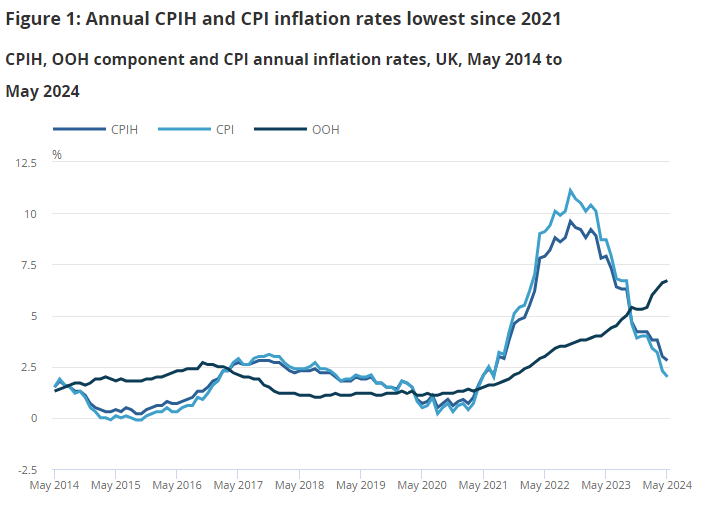
More on those UK inflation numbers, where the headline CPI rate returned to the BoE's 2.0% target for the first time since July 2021.
Core CPI, which excluded more volatile prices like food, fuel, alcohol and tobacco, was up 3.5%, softening from the 3.9% in the previous month.
A small possible blot on the copybook is that services CPI, which is closely followed by the BoE's monetary policy committee as a signifier for the persistence of inflation, eased less than expected in May to 5.7% from 5.9% a month earlier, when it had been forecast to drop to 5.5%.
CPI including owner occupiers’ housing costs (CPIH) rose by 2.8%, down from 3.0% in the 12 months to April, or 0.3% on a monthly basis.
The largest downward contribution to the monthly change in both CPI and CPIH annual rates came from food, with prices falling this year but rising a year ago.
The largest upward contribution came from motor fuels, with prices rising slightly this year but falling a year ago.
7.14am: FTSE 100 set for hesitant start
The FTSE 100 is set for a meek start on Wednesday after a mixed UK inflation reading and despite some fresh record highs overnight on Wall Street.
London's blue-chip index has been called down one point on spread-betting platforms, after finishing up just over 49 points at 8,191.29 yesterday.
US stock indices all finished in the green, mostly helped by Nvidia overtaking Microsoft to be the world's most valuable company at a $3.33 trillion market cap, though the rest of the top five mega-caps all fell.
Asian stocks are mixed this morning.
Back home, the big news is from the Office for National Statistics, which posted its prices day data, showing the consumer price index was up 2.0% year-on-year in May, finally returning to match the Bank of England's target.
The headline CPI rate eased from 2.3% the month before, as expected, as CPI rose 0.3% on a monthly basis, which was lower than the 0.4% consensus forecast from economists.
More details in a sec.