
- FTSE 100 falls 36 points to 8230
- Shell and BP dragged down by lower oil prices
- UK retail sales rose 0.7% in May, says BRC
4.09pm: Day ahead
The Bank of Canada will announce its next monetary policy decision tomorrow, with a rate cut widely expected.
In company results, UK retailers WH Smith and B&M European Value have results scheduled, while US games retail chain and meme stock Gamestop Corp also publishes earnings.
There are also some big economic data due, including UK, European and US services PMIs.
4.03pm: Global sell off
Large and mid-cap shares in London were heading lower in the last half hour before the close on Tuesday, as Wall Street turned red and there was a sharp sell-offs in India on the back of early election counts.
The FTSE 100 has crumpled almost 36 points, or 0.43%, while the FTSE 250 is down 182 points or 0.92%.
Across the Atlantic, the S&P 500 and Nasdaq are down 0.3%, while the Dow Jones is flat.
Over the Channel, European indices are all under water, with the largest falls being Germany's DAX, down 0.74% after more disappointing jobs data, while the FTSE MIB in Italy and IBEX 35 in Spain are both down more than 0.8%.
The biggest fall was in India, where major stock market indices were down more than 5%, a day after Mexico's stock market fell almost 11% on election results.
Best performers were the Hang Seng in Hong Kong and China's Shanghai Composite, up 0.2% and 0.4% respectively.
3.47pm: Indian sell-off
Today saw the highest ever single-day foreign institutional investors' outflows from Indian markets, according to provisional data from India's National Stock Exchange (NSE).
Foreign institutional investors sold a net 124.36 billion rupees worth of Indian shares today.
Domestic institutional investors sold net 33.19 billion rupees.
This came as early counts from the national election showed PM Narendra Modi's BJP had less than half of parliament.
It was leading in 238 seats in the 543-member lower house, or about 295 if also including its coalition partners, well below the 400 seats that Modi was confidently aiming for before the election.
3.24pm: Shein could taint London
The UK risks becoming "the market of last resort" if it accepts Shein's IPO in London despite the allegations about its questionable business practices.
Peter Hugh Smith, chief executive of CCLA — the UK’s largest charity investment manager — told Financial News that approving an IPO for Shein would not be good for the London market.
“There might be some float fees and make investment bankers a little bit richer. But will it help the UK or with growth? Quite the opposite,” he said.
He said the CCLA would recommend against Shein listed in London and that the issue was "about valuation versus values".
3.15pm: US job openings sink
US job openings sank to below a three-year low, providing more weight to the idea that the economy is cooling.
Job postings fell to 8.1 million in April, the lowest since February 2021, from 8.4 million in March, Labor Department data showed.
New openings are higher than before the pandemic, but down from the Covid peaks in 2022.
Numbers of people quitting jobs rose to 3.5 million from a three-year low of 3.4 million.
3pm: Wall Street starts down but losses quickly trimmed
US stock markets started in a sea of red, but the Dow Jones has just climbed above the waterline and the S&P 500 is just below it.
The Dow is up 50 points or 0.13%, while the S&P 500 is down less than four points or 0.1%.
With Microsoft, Apple, Alphabet and Amazon in the red, the Nasdaq Composite is down 0.17%.
2.37pm: Precious metals hit by wider commodity selloff
Precious metals miner Fresnillo PLC (LSE:FRES) is the biggest faller in the FTSE 100 today, down 7%, with gold miner Hochshild Mining also down 3% on the FTSE 250.
Shares in other miners, including Anglo America (down 4%), Antofagasta (3.5%) and Rio Tinto (1.6%) have lost some sheen today too.
Selling pressure have hit key commodity prices such as crude oil and copper in recent days due to consistently weak manufacturing data from around the world, says market analyst Fawad Razaqzada at City Index.
While demand concerns are hitting these crucial commodities, the bruised sentiment is also knocking gold and silver prices, which have added to their modest losses the week before.
"This morning’s losses coincided with the dollar index bouncing off the 104.00 support level ahead of a busy week for macro data and central bank action," says Razaqzada, but he sees support for silver.
Without significant new bullish catalysts, metals traders have been content to take profits after a strong year in the sector, he adds, but "the overall outlook remains positive".
"After some consolidation, I expect the bull trend to continue, especially as silver tests liquidity just below the technically significant $30 level," he says, based on his reading of silver charts, with silver dipping below $30 an ounce early this morning before being carried back towards this "key psychological and technical level".
"It's crucial to watch silver's behaviour here. A daily close above $30 will please the bulls and sustain the bullish trend seen this year, while a close below $30 could trigger some further short-term weakness before the rally potentially resumes."
2.12pm: Who's next to IPO in London?
Raspberry Pi, the technology group, is set to float in London next week, and after a difficult few years where London IPOs have all but dried up, investors are keen to get their teeth into some new meat.
Expected and potential new arrivals range from Shein, where reports are growing louder, to Monzo and Revolut, where CEOs have given some hints in recent weeks...read more.
Also there's news that California-based medical technology tiddler Advanced Oxygen Therapy Inc (AOTI) is planning to list on the AIM market in two weeks.
The company says it has developed a therapy to reduce hospitalisations and amputations caused by non-healing wounds, particularly diabetic foot ulcers.
With Peel Hunt broker and nominated adviser, AOTI is seeking to raise US$25 million according to some reports and £40 million according to others.
1.50pm: FTSE paring losses
The FTSE 100 is off its worst levels of the day, down just under 24 points, or a 0.29% drop, having been down 61 points or 0.74% mid-morning.
Shell and BP are both still big weights around the index's neck, along with miners Glencore (down 2.7%) and Rio Tinto (1.8%) in the top 10.
Rolls-Royce (LSE:RR.) is also down 1.4% despite reports that the engine maker might be set for a boost from a major Airbus A330 jet aircraft order from China.
Some of the Footsie's largest stocks are firmly higher, with Unilever up 1.7%. GSK rebounding 1.6% from yesterday's big drop, while RELX and the LSEG are also up over 1%.
The biggest riser on the blue-chips are the National Grid nil paids, up over 11% to 222.4p, up over 56% since last week (when some said the market's reaction was too harsh).
Citi has today also weighed in with an upgrade to ‘buy’ and lifted the utility firm’s price target to more than a 9% premium to its current market value, while analysts at Jefferies issued a slightly more cautious note...(You can also read our guide on what investors can do about the rights issue.)
Other risers include GKN Aerospace owner Melrose, water company Severn Trent and retailers M&S and Next.
12.55pm: 2021 throwback - a busy year for (bad) IPOs
Here's a piece from my colleague Leo Grieco looking at the performance of the 'class of 21', the last year that London saw a torrent of IPOs.
Most London Stock Exchange IPOs in 2021 have lost market value in the three years since listing, he finds, with a total of around £30 billion in market value destroyed since the shares were listed publicly.
Over 100 companies listed on the LSE during what was a record year for IPOs in the City, with Deliveroo, Wise and Dr Martens as some of the biggest names to go public.
The performances of Made.com, Revolution Beauty, Parsley Box and In The Style Group are so bad they don't seem to even make it into the Morningstar data.
12.45pm: US futures point to slump at the open
Wall Street stocks are facing a wide slide when trading begins later, with tech mega-cap stocks in the red in premarket trading.
Dow Jones futures are down 0.41%, those for the S&P 500 are off 0.44% and for the Nasdaq they are 0.36% lower. GameStop is little changed premarket.
The latest macroeconomic data has pointed to the US economy slowing more than expected.
This has led to markets pricing in almost a 62% chance of the Federal Reserve cutting rates in September, up from 53% before the ISM manufacturing data yesterday, according to the CME’s FedWatch tool.
Weaker economic data and a story of a slowing economy in need of a rate cut, often leads to stocks rallying on the cut idea, but not this time, says Kenny Polcari, chief market strategist at Slatestone Wealth.
"Lower rates, good for stocks? Not this time…why, because this is when ‘bad news IS bad news’ versus those times when ‘bad news IS good news’ for stocks – which has been the story for such a long time," he says, noting that bonds once again rallied on this news.
US economic data today includes JOLTS job openings, Redbook retail numbers, factory orders and the API crude oil inventories.
"The focus is now squarely the labor market, Friday’s NFP report," says Polcari.
The June FOMC meeting begins next Tuesday, which means as of today we are in the 'black out' period where policymakers are prohibited from talking to the media.
"But that does not mean that the Non-Members have to keep quiet….so look for anything from Neely Kashkari – since he seems to be the mouthpiece for when the others can’t speak," says Polcari. "You can also watch for comments/stories from Nicky T (WSJ) or anyone from Goldman as they are ‘sources of leaks’ by the Fed, when they want to float a balloon (or an idea) to see how the markets react."
12.10pm: Investment tax changes expected post-election
With the polls pointing to an imminent change in government, Gary Smith, financial planning partner at wealth management firm Evelyn Partners, says this could bring significant changes to pensions and wealth planning, though campaign rhetoric offers few decisive answers.
"One elephant in the room is the prospect that a new government might look to the taxation of pensions, or other wealth assets, to escape the fiscal restraints the main parties have imposed on themselves," he says.
The IFS and the IMF have warned that both parties’ public finance projections indicate a significant funding gap, unless unscheduled spending cuts are enforced, while polls have revealed that more than half of voters expect taxes to go up after the election if Labour or the Tories win.
With both parties having pledged not to raise any of the three biggest levies – income tax, national insurance and VAT – that account for the lion’s share of Treasury revenues, and Labour vowing not to raise the headline rate of corporation tax, Smith says: "A new government might look at the tax treatment of pensions or certain IHT reliefs to bridge a funding gap that seems bound to open up".
As Labour previously objected to Jeremy Hunt’s pension taxation reforms as "a tax gift to the wealthy", this could point to one potential change, while Smith says another way to limit the Treasury spend on pension tax benefits would be to reduce or do away with the 25% pension commencement lump sum, or to limit tax relief on pension contributions.
As either measure would be controversial and difficult, suspicions that a new government might look to cap or reduce tax relief in some way are leading some savers to stash cash into their pensions now, he says.
11.54am: Election betting
William Hill, owned by Evoke PLC (LSE:EVOK), the renamed 888 Holdings, says recent betting indicates Tory cabinet members Jeremy Hunt and Grant Shapps will lose their seats in next month’s general election.
The bookmaker says betting is in line with recent polls.
Chancellor Hunt is priced at even-money to retain his seat, while defence secretary Shapps is at 4/1 odds to keep his seat, well behind the Labour candidate in the betting to win Welwyn Hatfield at 1/7 on.
Contrary to recent poll predictions, the bookie says Penny Mordaunt is 8/11 favourite to cling onto her constituency, with Labour even-money to win Portsmouth North.
William Hill spokesperson, Lee Phelps, said: “Recent polls point to the Tories being routed by Labour across the UK when the public go to the polls next month, with predictions that Rishi Sunak’s party could lose upwards of 200 seats, and some big names are expected to lose their constituencies in the process.”
11.35am: Hedge funds wary of shorting UK mid caps
Interesting story on the FT, which reports that hedge funds are "increasingly wary" of making short bets against UK share after having their fingers burnt by takeover bids.
The story cites hedgies Millennium Management, GLG and Gladstone Capital as among those caught out by recent bids for Hargreaves Lansdown, Darktrace and Keywords Studios all soared after attracting offers.
"Shorting any UK mid-cap is insane, literally insane," one hedge fund source told the paper, as valuations are "so low in the vast majority of cases that a $2bn UK company is peanuts for any mid-sized American company".
Another story from the pink un is that three former executives of FTSE 100-listed aerospace manufacturing company Melrose Industries have enjoyed a massive £180 million payday after the crystallisation of the firm’s 2020 employee share plan.
Current chief executive Peter Dilnot received just over £1 million on his portion of the pot, while the lion’s share of the bonus pot went to ex-chief executive Simon Peckham, former vice chair Christopher Miller and former finance director Geoffrey Martin.
However, whether or not Melrose actually extracted any real value or benefit from its 2018 hostile takeover of GKN remains questionable, or at least moot.
Meanwhile, the mid-cap FTSE 250 index is down over 200 points today or almost 1% at 20,699.
Big bro FTSE 100 is down 0.55% meanwhile, which is far from the worst of European indices, with the DAX, FTSE MIB and IBEX down 1.1%, 1.3% and 1.5% respectively.
The wider Euro Stoxx 600 is down 0.7%.
11.15am: UK election polling update
Labour would win a historic landslide at the general election, according to a YouGov poll published overnight, which shows the party is expected to win a 194-seat majority.
The 422 seats for Labour would exceed their landslide victory in 1997 under Tony Blair and be the highest number of seats of any party at any election in a hundred years of Westminster history.
It suggested the Conservatives would fall back to just 140 seats, down from 365 at the 2019 election.
The poll was commissioned by Sky News as the first of three polling projections, known as multi-level regression and post-stratification (MRP) models that uses polling data.
Earlier, Jim Reid at Deutsche Bank noted that with the general election now exactly a month away, the significant news overnight was Nigel Farage announcing that he would become leader of the right-wing Reform UK party.
"Farage was previously the leader of UKIP for many years, and played a significant role in the Brexit campaign of 2016. He previously said that he wouldn’t stand for Parliament at this election, but reversed course yesterday and said he’d be standing in the Essex seat of Clacton, which was the only seat won by UKIP in the 2015 general election.
"This could pose a big problem for the governing Conservatives, since if they lose votes to Reform in key seats, it would mean that the opposition Labour Party are able to win many more seats."
10.57am: Global stock market upside seen
UBS has raised its year-end forecast for one of the most tracked and invested global stock market indexes, implying 6% upside potential from current levels.
The MSCI All Country World index prediction was lifted to 830 from 800 on Tuesday by the equity strategists at the Swiss bank, citing reasons sich as an improvement in equity risk appetite and the market "reacting positively to weaker data".
There is also optimism that artificial intelligence can push up productivity growth and that equities are "still modestly cheap".
While an unusual occurrence, there is scope for a "defensive-led bull market", the strategist say.
10.35am: ChatGPT down
ChatGPT, the OpenAI chatbot and sometimes productivity tool, is not working.
When I asked it, there was no reply, which suggests reports from Downdetector are correct.
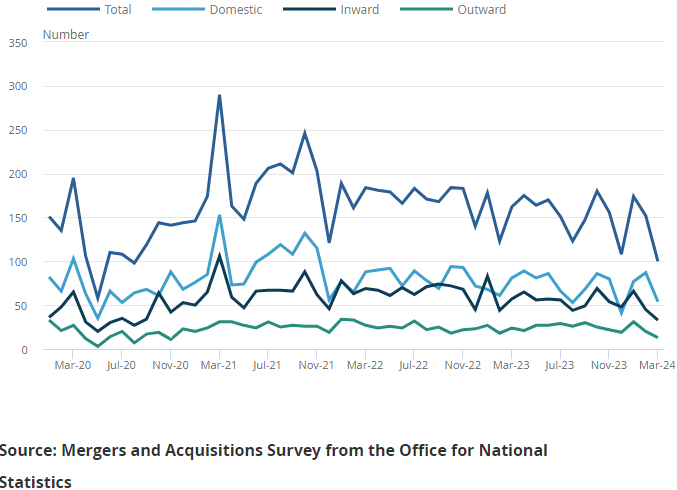
10.14am: M&A numbers down but value up
The Office for National Statistics has shared some data on numbers of domestic and cross-border mergers and acquisitions (M&A).
There were 426 that involved a change in majority share ownership, down 18 on the final quarter of last year, though the total value was up to £4.4 billion from £3.5 billion.
In January there were 174 deals, falling to 152 in February and declining further to 100 in March.
Domestic M&A, where UK companies buy other UK companies, were valued at £3 billion, flat on the preceding quarter, with inward M&A falling to £6.1 billion from £10.1 billion in the end of last year.
9.57am: Rate cut chances not helping equity markets
"Rate cuts are in the mail," says market analyst Neil Wilson at Finalto, who says the recent US economic readings provide "a sense that the case for rate cuts is building again".
He notes that 10yr Treasury yields tumbled about on soft manufacturing readings and GDP estimates from the US, "which will bolster the case for the Fed to cut in the autumn and use this month’s meeting to signal confidence in their outlook."
On oil, his sense is that "rising supply will meet with softening demand and market is close to contango which is usually not bullish".
Goldman Sachs sees downside risks for its $75-90 range for Brent.
"Also, we heard that Israel is prepared to go with phase 1 of a truce plan, which could suck out some of the geopolitical premium – something we noticed with gold ticking down on the news yesterday, though we also saw Treasury yields track lower at the same time," Wilson adds.
On elections, as well as India’s Nifty 50 plunging 5% from record highs, he notes that Mexico's stock market ETF, the EWW, yesterday had election-related jitters, crashing nearly 11% as the Mexican stock market had its worst day since 2008. The Mexican peso also lost 4.5% against the US dollar in its biggest one-day drop for a long time.
9.40am: Why are markets down?
Some thoughts on what's happening with markets this morning.
"The main driver is oil falling which has continued to sell off post the OPEC+ meeting that took place on Sunday. Add in political uncertainty of the UK elections next month and uncertainty about the timing of interest rate cuts this is causing traders to pause and take stock," says Sam Springett, trading floor manager at Accendo Markets.
Victoria Scholar, head of investment at Interactive Investor says: "European equities are on shaky ground with the DAX, FTSE 100, CAC, and FTSE MIB nursing losses ahead of the ECB’s rate decision as well as key US jobs data this week."
She also notes that sterling hit the highest in more than two months against the US dollar yesterday, but is down 0.2% to $1.2779 this morning.
"The pound is now the only G10 currency which is in positive territory year-to-date. Sterling is also near 21-month highs against the euro as the ECB prepares to cut rates by 25 basis points this week while investors will likely have to wait longer for the Bank of England to follow suit," Scholar says.
The negative start is due, says AJ Bell investment director Russ Mould, to signs of US economic weakness and mixed trading in Asia.
"News of slowing activity in US factories is a double-edged sword as it could provide the Federal Reserve with more room for manoeuvre on interest rates. Job openings data later today could reveal if a softening economy is being reflected in looser labour market conditions," he says, with this Friday’s coming non-farm payrolls release a big focus as investors await the latest decision from the Federal Reserve next week.
Looking to Asia, he says today's sharp falls in Indian stocks are reversal of gains made yesterday is due to "the fear will be that if he has to rely on alliances with smaller parties, any market-friendly policies will be diluted".
9.24am: Oil prices should be supported - UBS
UBS reckons oil prices "should stay supported" despite OPEC's plan to restore output.
Price are subdued at the start of this week, down around 9% since the end of last week to under $73 per barrel of Brent.
This is due to bearish market interpretations of the weekend OPEC+ agreement on production cut policy, says UBS, after the cartel stated it would extend group cuts to December 2025, but paired this with a small production quota increase for the UAE next year and a clearer timeline on how it could begin unwinding 2.2 million barrels per day in voluntary cuts beginning October 2024.
"While some oil market participants are focusing on the risk of excess supply in late 2024, we are more constructive on both the supply and price outlook for several reasons," says the Swiss bank.
These reasons are that the voluntary curb taper "appears conditional on market conditions", that OPEC+ returning oil to market "will impact other producer plans, too" and that "oil demand is holding up well", with global oil inventories expected to fall in the coming weeks as demand seasonally rises over the summer.
9.13am: BP credit rating downgraded
BP's shares are also being hit this morning as S&P Global last night revised down the oil giant's credit outlook.
Citing a slower-than-expected debt reduction, the rating agency downgraded the energy company's credit outlook to 'stable' from 'positive' while affirming its 'A-' long-term and 'A-2' short-term issuer credit ratings.
"BP's updated cash allocation strategy is less likely to result in meaningful further absolute debt reduction," S&P said in a statement.
9.07am: StanChart slides on whistleblower allegations
Shares in Standard Chartered PLC (LSE:STAN) are down 2.3% this morning, with the bank having been accused of facilitating billions of dollars worth of transactions linked to US-designation terrorist organisations including Hezbollah, Hamas and al-Qaeda.
In newly filed court documents, a whistleblower, Julian Knight, accused US authorities of either overlooking or concealing evidence of the illegal transactions allegedly conducted in the mid-2000s.
While StanChat agreed to forfeit $227 million in 2012 to the Justice Department for conducting transactions with sanctioned entities in Iran, Sudan, Libya, and Burma, and in 2019 paid over $1 billion in fines after admitting to illegally processing transactions in violation of Iranian sanctions, Knight claims the bank conducted significantly more transfers than it has admitted.
8.58am: Shell hydrogen collab, AIM deals, GameStop manipulation?
Some other company stories this morning, Shell PLC (LSE:SHEL, NYSE:SHEL) is to step up its development work in green hydrogen with a new solid oxide electrolyser (SOEC) module for large-scale industrial applications such as synthetic fuels, ammonia and green steel.
The oil and gas giant will work on the new design with existing partner Ceres Power Holdings PLC (LSE:CWR, OTC:CPWHF), where shares are up 3.5%.
The two have been collaborating since 2022 on a 1MW SOEC system at Shell's R&D facility in Bangalore, India.
Elsewhere, two AIM-listed deals.
Enterprise software designer Checkit has announced its plans to buy service management software platform specialist Crimson Tide (AIM:TIDE) for £12 million.
And MISSION Group (LSE:TMG) has confirmed it received another unsolicited conditional proposal regarding a possible offer from fellow marketing group Brave Bison last week, which it is evaluating.
And after another jump in GameStop shares yesterday, an online brokerage owned by Morgan Stanley (NYSE:MS) is reported to be considering banning famous meme stock trader Keith Gill, better known as Roaring Kitty, due to concerns about potential stock manipulation.
GameStop rocketed 75% higher when markets opened on Monday after Gill, who rose to fame in the 2021 meme stock frenzy, posted a supersized trade worth around $116 million, leading other traders to follow suit, before the shares fell back later.
Morgan Stanley (NYSE:MS)’s E*Trade platform took umbrage at this potential act of market manipulation.
8.45am: Consumer card spending tightened
Consumer credit card spending last month grew at the slowest rate in over three years, according to data from Barclays, with households deciding to limit spending on non-essential items, especially take-away food.
Barclaycard data showed card spending growth of 1.0% year-on-year in May, the smallest rise since February 2021, as spending on non-essential items was the lowest since early 2021 too.
Spending on takeaways and fast food declined 0.2%, the first fall since the pandemic, and eating out at restaurants seeing a decline of 15.7%, worse than the 13% fall in April.
8.29am: European markets in the red
Shares in London are down this morning and it's not just oil prices, as most European stock markets are also in the red.
The FTSE 100 is down almost 0.5% at 8224, while the mid-caps of the FTSE 250 are down 104 points too, also around 0.5% at 20,796.
Ocado is bottom of the Footsie list this morning, a familiar position in recent weeks, down 4%, just ahead of BP's 2.8% fall and Shell's 2% drop.
BAT is down 1.75% after its half-year update this morning revealed a drop in sales and profits.
"Trading is 'in line' with management’s expectations, but those expectations were not particularly stretching as the company resets (“invests”), again, this year," says analyst Rae Maile at Panmure Gordon.
He notes that 'quality growth' is the mantra at BAT but "the issue is the lack of 'quantity'."
Risers are led by Carnival PLC (LSE:CCL), where broker Peel Hunt has upgraded to a 'buy' rating, saying the cruise operator is "well placed" as "limited capacity growth is creating pricing tension".
Chemring Group (LSE:CHG) is down 2% as the defence contractor increased revenues in the first half but operating profit fell 24% due to "operational challenges" at its Tennessee Countermeasures business.
Looking around Europe, Germany's DAX is down 0.5%, while in Paris the CAC 40 is 0.6% lower and in Milan the FTSE MIB has dropped 0.8%. Spain's IBEX is least bad with a dip of 0.4%.
8.07am: FTSE falls at the open as commodities drag
The FTSE 100 has kicked off in the red, as expected, down almost 26 points or 0.3% at 8,236.90.
Shell PLC (LSE:SHEL, NYSE:SHEL) and BP PLC (LSE:BP.) are both among the fallers, down 1.65% and 2%, as investors adjust for the further fall in oil prices.
Brent crude prices are down 0.9% to $77.63 a barrel this morning and US West Texas Intermediate is down 1.2% at $73.32.
Miners are also dragging on the index, with Anglo American PLC (LSE:AAL), Rio Tinto PLC and Glencore PLC (LSE:GLEN) down between 1.5% and 1.2%.
7.56am: UK retail sales recover, but less than hoped
UK retail sales saw a more modest rebound in May than was expected in the latest data from the British Retail Consortium.
Total UK retail sales value increased 0.7% year-on-year, which was above the three-month average of 0.3% but below the 12-month average of 2%.
The BRC-KPMG retail sales monitor improved in May from the decline of 4.0% in April, but was not as strong as the consensus forecast of 1.2%.
"The awful weather and an uptick in mortgage interest rates have slowed consumer spending growth this spring, but the situation is now improving," says Rob Wood at Pantheon Macroeconomics.
Averaging March, April and May provides a simple way of adjusting the BRC retail sales data for Easter distortions and gives 0.1% year-over-year values growth, down from the 1.2% year-over-year average in January and February.
His estimate of an ‘Easter adjusted’ BRC retail sales measure suggests sales rose 1.3% year-over-year in March, fell 1.3% in April and then returned to 0.7% growth in May.
"This shows sales remain disappointing as the weather kept shoppers away, but retail spending is at least recovering from April’s catastrophe."
7.42am: Indian stock losses increase
The sell-off on Indian stock exchanges is getting spicier, with over 7% losses on the Sensex and the broader Nifty indices.
A short while ago, the Nifty Infrastructure index was down almost 11%.
Early indications from vote counts in what is the world's biggest election, suggest PM Narendra Modi's coalition alliance is leading in nearly 300 seats, though the opposition alliance is performing better than expected, with gains in more than 200 seats.
A party or alliance needs to win 272 seats in the lower house of parliament to form the government, and Modi had been hoping to win a 400-seat majority.
????????NIFTY AND SENSEX FELL BY OVER 7%. NIFTY SMALL CAP INDEX FELL BY 10%, THE MOST SINCE MARCH 2020.$USDINR > 83.5#India #stockmarket https://t.co/33ZPnQ7uPR
— CN Wire (@Sino_Market) June 4, 2024
7.29am: BAT profits dented by 'ilicit vapour' competition
British American Tobacco PLC (LSE:BATS) said first-half revenue and profit are expected to be down by 'low single digit' percentages due to macroeconomic pressures in the US market and growing competition from "illicit vapour" products.
However, the cigarette maker insisted that it remains on track to hit its previous targets for this year, helped by market share gains in its tobacco business and a recovery from its vaping and other new categories.
In a half-year trading update, BAT said it expects an acceleration in performance in the second half of the year, driven by the phasing of launches of new categories and the benefits of US marketing action.
Chief executive Tadeu Marroco said: "Our year-to-date performance is in line with our expectations, and we are on track to deliver our guidance of low-single digit revenue and adjusted profit from operations growth on an organic, constant currency basis in 2024."
7.15am: FTSE 100 slated to open lower
The FTSE 100 is slated to kick off in the red on Tuesday, assuming the negative position from the end of trading yesterday, as oil prices are likely to weigh.
On spread-betting platforms, the London equity benchmark was down 25 points points in advance of the open, having lost almost 13 points to close at 8,262.75 the day before.
US stocks ended in mixed fashion overnight, with the Dow Jones finishing 0.30% lower, but Nasdaq Composite rising 0.56% and the S&P 500 in the middle with a gain of 0.11%.
Asian markets are mostly down this morning, notably India's Sensex down 4.5% and Nifty 50 down 4.6% after early final vote counts pointed to Prime Minister Narendra Modi’s BJP winning the country's election by a smaller margin than expected.
Oil prices have continued to sell off this morning, with Brent crude down 0.92% to $77.64 per barrel, close to four-month lows, which is likely to hit the London index's heavyweights.
Macroeconomic data due today includes the BRC sales monitor, Barclaycard credit card spending, US factory orders and auto sales.
Company results are expected from BAT, Ferguson, Chemring, LondonMetric and Gooch & Housego.