
The gap between mortgage and savings rates continues to grow as the lenders hike the former after the UK entered 5% base interest territory last month.
Though lenders have been quick to raise mortgage rates in line with the Bank of England’s 50 basis point hike in June, corresponding offers of higher interest on savings accounts have dragged.
Average easy-saver account rates currently sit 4.02 percentage points lower than the UK’s typical two-year fixed rate mortgage, according to Moneyfacts, at just 2.45% compared to 6.47%.
Average five-year fixes passed the 6% mark on Tuesday meanwhile, approaching levels seen in the wake of September's famed mini-budget.
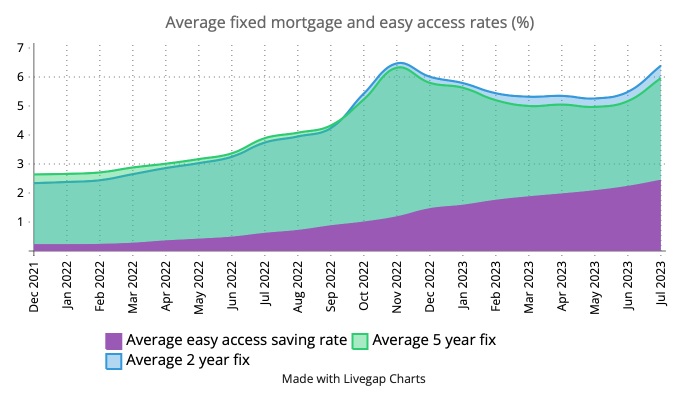
Data set from Moneyfacts
Pressure has built on lenders to pass on higher savings rates to consumers as they are with mortgages.
Lloyds Banking Group PLC, HSBC Holdings PLC, NatWest Group PLC and Barclays PLC have been summoned to explain the lag in lifting savings rates to the Financial Conduct Authority (FCA) on Thursday.
“We do think there is more value that can be provided to consumers, we are not happy with some of the lower savings rates we see,” an FCA source told the Financial Times on Tuesday.
This follows calls from chancellor Jeremy Hunt for banks to pass savings rates on just weeks ago, though the government has since ruled out aiding households with bills over concerns the move could fuel inflation.
Analysts say the delay comes as banks look to make up margins lost when interest rates were far lower during the pandemic, which saw mortgage offerings become far more competitive.
“They’re busy filling their boots,” Hargreaves Lansdown analyst Sarah Coles commented, explaining that maintaining a large gap between savings and mortgage rates means banks make more money.
“The rise in rates has given them an opportunity to make up for lost time,” she added.
She also noted that this week's HL Savings & Resilience Barometer showed that 26% of mortgage holders could be at risk of arrears over the next 12 months.
Some economists have suggested the rate increases are currently benefiting savers more than they’re costing mortgage payers, though.
An analysis by Bloomberg found that UK households are roughly £10bn a year better off as a result of the Bank of England's latest hikes, as consumers see more immediate benefits from higher rates in their savings accounts while increases in mortgage costs take time to feed through to those on fixed deals.
— Ben Chu (@BenChu_) July 4, 2023