
- FTSE 100 closes 6 points higher
- Wall Street volatile after above-forecast CPI data
- Deutsche Bank double-upgrades easyJet
4.45pm: FTSE holds on
At the close, the FTSE 100 was in positive territory, though only just. The UK's blue-chip index ended the day at 7,934 points for an ever-so-slight 0.1% gain on opening levels.
A strong UK jobs report and slowing US disinflation brought plenty of volatility today, with central bank hawks likely to feel emboldened, wrote Joshua Mahony, senior market analyst at online trading platform IG.
“Today has been a largely mixed affair for markets on either side of the pond, with US risk-off momentum failing to inhibit European investors optimism," Mahoney noted.
"On a day that was always going to be heavily driven by economic data, the UK has managed to emerge with a positive jobs outlook but concerns over the need to tighten interest rates further. Higher employment, lower claims, and a quickening pace of growth in earnings (minus bonuses) signals to the Bank of England that there is a need and ability to go further in their bid to combat inflation."
3.55pm: Brexit bill immense
The UK has suffered a loss of business investment since the 2016 Brexit referendum worth £29bn, or £1,000 a household, according to a study by a senior Bank of England official, the Guardian reported.
Jonathan Haskel, an external member of the Bank’s nine-strong monetary policy committee that sets UK interest rates, said private sector investment “stopped in its tracks” in the years following the decision to quit the EU.
He said that in the aftermath of the vote the UK immediately began to fall behind the trend of the previous six years and “suffered much more” when compared with other major industrialised economies, opening up a productivity gap that has left permanent scars.
The study by Haskel and his team is likely to fuel concerns that the Brexit vote and the strategy adopted by the former prime minister Boris Johnson to leave the EU single market and customs union has done irreparable harm to the UK economy, the newspaper report said.
3.30pm: Crude measures
Oil prices have fallen after the US government confirmed it will release more crude supplies from its Strategic Petroleum Reserve (SPR).
The US Department of Energy (DoE) said it would sell 26 million barrels of oil from the SPR, which is already at its lowest level since 1983.
The DoE had considered cancelling the sale after President Joe Biden's administration last year sold a record 180 million barrels from the reserve. But that would have required Congress to act to change the mandate.
Supply concerns also eased after the Energy Information Administration (EIA) said it expected record March production from the seven biggest US shale basins.
Brent crude futures dropped by around 1%, to $85.70 a barrel and US WTI futures were down 1.2%, at $79.17, though both had more than halved earlier losses.
2.55pm: Early US falls pared back
Wall Street made mixed progress having started the day in the red after January's US consumer price index (CPI) reading came in slightly higher than expected, reigniting fears that the Federal Reserve will continue its hawkish stance in regard to its monetary policy in the coming months.
At open, the Dow Jones Industrial Average (DJIA) had shed 212 points or 0.6% at 34,033 points, the S&P 500 was down 30 points or 0.7% at 4,107 points, and the Nasdaq Composite had shed 108 points or 0.9% at 11,784 points.
But after 25 minutes of trading, the DJIA loss was cut to 0.1%, the S&P 500 was almost flat, and the Nasdaq Composite ticked up 0.1%. This helped the FTSE 100 index to rally again, adding 20 points, or 0.3% at 7,967.
BRI Wealth Management portfolio manager Tom Hopkins said today’s US inflation reading was proving that inflation is stubborn and it’s an important indicator as to how many more 25 basis point rate hikes might be in the pipeline as the Fed looks to push inflation back to its 2% target.
“I expect the Fed to further tighten monetary policy as they are still far from achieving price stability,” he said, noting that, after an unexpectedly strong jobs report for last month, this could stoke the Fed to be more aggressive in its tightening monetary policy to cool the economy more effectively.
“The enduring strength of the US labour market combined with a gradual easing of inflation has raised hopes that the American economy might avoid a recession, but Fed officials have always cautioned that such an outcome is far from guaranteed. I suspect the hawkish rhetoric to continue from the Federal reserve," he added.
2.25pm: Shell shines in Google searches
Shell is Europe's most Googled UK stock, topping search results in 12 European countries with over an estimated 460,000 monthly global searches for the oil giant's stock, according to a recent study by CMC Markets.
The UK financial services provider analysed Google search data for over 250 top UK stocks in every European country and found that FTSE 100-listed Shell, software developer Endava, and drugs giant AstraZeneca were the top searches in just over half of all countries included.
However, fellow FTSE 100-listed oil giant BP had the largest combined search volumes, driven by the UK, where it was the most Googled stock.
The analysis revealed that Shell and BP were most searched in almost two-fifths of Europe, making UK oil and gas sector stocks the most searched by far.
2.10pm: CPI doesn't change US rate outlook
In an initial reaction to the January US CPI data, Tom Kremer, senior macro strategist at Quintet Private Bank - the parent of Brown Shipley - commented: "US inflation continues to be on a downward trend, but, as recent revisions and today’s CPI print have made clear, the decline may not happen quite as fast and smoothly as markets had come to anticipate in recent months.
"Having said that, shelter inflation in particular will become a supporting factor later in the year once the observed declines in rents feed through to the official inflation measure, while base effects should also turn favourable as last year’s large increases in spring and summer fall out of the calculations."
He added: "While today’s data was somewhat disappointing for those hoping for a rapid normalisation in inflation pressures, we don’t think it fundamentally changes the outlook for the Federal Reserve. We look for the Fed funds rate to peak just above 5% in spring, followed by long pause as policymakers wait for evidence that underlying price pressures – particularly in core services – are moderating more sustainably alongside a rebalancing in the labour market."
1.55pm: US inflation digested
The FTSE 100 index came further off highs as US stock futures turned flat after the highly anticipated US consumer price index (CPI) reading for January came in slightly higher than expected at 0.5% month-over-month and 6.4% year-over-year. The market had been expecting increases of 0.5% and 6.2%, respectively.
The core index, which excludes the food and energy components, rose 0.4% month-over-month, on par with the Street’s expectation. Core inflation came in up 5.6% over the 12 months to January, ahead of the expected 5.4%.
Around 35 minutes ahead of the New York open, futures for the Dow Jones Industrial Average were up 0.1%, those for the S&P 500 also added 0.1%, but the Nasdaq-100 contracts were little changed in pre-market trading.
1.30pm: A few of today’s fallers and risers in London
UP Global Sourcing Holdings PLC (LSE:UPGS) dipped 8% after the home wear brands portfolio company released its 2023 interim trading update. Unaudited group revenues increased by 2% to £87.6mln in the first half, while net-debt-to-EBITDA leverage improved from 1.3 times to 1.0 times.
Kanabo Group PLC (LSE:KNB) shares added 8.5% as investors weighed up the promise that its cannabis inhaler will gain European CE approval in the third quarter of 2023. In a business update, Kanabo said its submission has been undertaken in conjunction with its manufacturing partner, and the group hopes to be in a position to provide an update “in the coming months”.
Altitude Group PLC (AIM:ALT) added 23% having forecast 2023 trading to be materially ahead of market expectations. The technology and information services company suggested revenues and adjusted pre-tax earnings would be ahead of consensus estimates, of £16.5mln and £1.5mln respectively.
1.00pm: US futures higher ahead of CPI figures
Wall Street is expected to open higher ahead of a consumer inflation report that is likely to provide a steer for the Federal Reserve's interest rate policy going forward.
Futures for the Dow Jones Industrial Average (DJIA) rose 0.1% in Tuesday pre-market trading, while those for the broader S&P 500 index added 0.3%, and contracts for the Nasdaq-100 gained 0.4%.
January’s Consumer Price Index (CPI), scheduled for release at 8:30am Eastern Time, is expected to show core inflation decelerating to 5.4% from 5.7% in December, with headline inflation slowing to 6.2% from 6.5% a month earlier.
On a monthly basis, core inflation is seen stable at 0.4%, while headline inflation is seen ticking higher from 0.1% to 0.5%.
Ahead of today’s release, the DJIA closed 1.1% up on Monday at 34,256, the Nasdaq Composite added 1.5% to 11,892 and the S&P 500 jumped 1.1% to 4,137.
"A sufficiently soft, or ideally a softer-than-expected CPI read today should give an additional boost to the equity bulls and push the S&P500 to fresh highs in the actual positive trend,” commented Ipek Ozkardeskaya, senior analyst at Swissquote Bank. “A stronger inflation read, on the other hand, could easily bring the Fed hawks back to the marketplace and send the S&P500 tumbling.”
Following a "seismic" shift in market sentiment on the back of the surprisingly strong US labour reports for January, TickMill Group market analyst James Harte said today's inflation reading couldn’t have more meaning attached to it.
"With the NFP coming in almost 300% above forecasts alongside the unemployment rate dropping to its lowest levels since 1969, traders are grappling with the prospect of a resurgence in Fed hawkishness," Harte said. "The key takeaway from the report is that the US economy is holding up better than expected and therefore the Fed has more headroom to continue with rate hikes for longer or at higher levels."
Meanwhile, as earnings season progresses, Coca-Cola, AirBnB, and Marriott are among the companies reporting fourth-quarter results today.
Back in London, the FTSE 100 has drifted further back from the new intra-day all-time high, now at 7,971.66, up 24.06 points, or 0.3%.
12.45pm: Air India plane order to generate 450 jobs
Air India’s 250-plane order with Airbus will create 450 manufacturing jobs in Britain.
The order is part of what is set to be the largest aircraft purchase in commercial aviation history, according to a report on Bloomberg.
Rolls-Royce Holdings PLC (LSE:RR.) stands to be a beneficiary as the deal also includes 40 wide-body A350 aircraft powered by Rolls-Royce engines, which are assembled and tested in Derby in central England.
Prime Minister Rishi Sunak welcomed the mega deal, saying it would create jobs and boost exports from Britain, where the French plane-maker designs and makes aircraft wings.
The 450 jobs will bring more than £100mln of investment to Wales, where Airbus manufactures the wings, the British department for business and trade said.
12.35pm: All eyes on US inflation
Not long until the US CPI figures which are usually a major market-moving event. Ahead of those here's a helpful guide from JP Morgan as to where the market may head depending on the print.
The all important US ???????? CPI data is to be released Tuesday. Consensus for full year to Jan ‘23 is 6.2% vs 6.5% for year to Dec ‘22. For what it’s worth, here is the @jpmorgan CPI playbook???????????????????? pic.twitter.com/vmz3w8X7Zg
— Alex Sundich (@AlexSundich) February 14, 2023
A sharp drop in inflation would clearly be welcomed by the markets, as it could encourage US central bankers to slow their interest rate increases.
Meanwhile, the FTSE 100 remains stubbornly below 8,000. Here's Simon English, financial editor of the Evening Standard summing up the feelings of news editors everywhere. Footsie currently at 7,977.03, up 29.43 points, or 0.37%.
The FTSE 100 is up 30 at 7977.
News editors everywhere are going, come on, just another 23, then we can run that 8000 headline thing...
— SimonEnglish (@SimonEngStand) February 14, 2023
12.20pm: Wage inflation adds to Bank's rate puzzle
Ahead of tomorrow’s UK inflation figures, policymakers were reminded that wage pressures remain strong suggesting a wage-prices spiral is still a threat.
Average earnings, excluding bonuses grew by 6.7% in October to December, data from the Office for National Statistics (ONS) shows, meaning with inflation still in double digits most workers’ are suffering a real terms pay cut.
But the number remains historically strong and could make uncomfortable reading for the Bank of England rate-setters as they try to tame soaring inflation.
Workers in the private sector saw a boost of 7.3% to their pay, while the strike-engulfed public sector saw a more muted increase of 4.2%.
The ONS said: “For regular pay, this is the strongest growth rate seen outside of the coronavirus (COVID-19) pandemic period.”
But there may be hope on the horizon. Simon French at Panmure Gordon expects that “real pay declines should give way to real pay growth by H2 as headline inflation falls away fast from July.”
However, this gain could be offset by higher interest rates although the City is split as to how high borrowing costs will go.
Capital Economics thinks the Bank of England will be increasingly concerned about the persistence of domestic inflationary pressures as private sector wage growth exceeded its forecast. It expects the Bank to raise rates to a peak of 4.5% over the coming months.
But Samuel Tombs at Pantheon Macroeconomics continues to think that the MPC will be able to keep Bank Rate at 4% over the coming months.
“It still is far too high for the MPC to tolerate long-term, but it should slow further, as labour market slack builds, job-to-job flows decline, and CPI inflation and inflation expectations continue to fall,” he explained.
Martin Beck, chief economic advisor to the EY ITEM Club, suggested: “The latest numbers mean the odds of the MPC going for one further rise in Bank Rate in March, before pausing, have likely increased,” and ING Economics agreed.
ING noted that there's little sign that UK wage growth has reached a peak, and the jobs market looks reasonably healthy. “A 25bp rate hike at the March meeting seems likely,” they said.
Economists may be hoping tomorrow’s inflation figures add further clarity to the situation.
11.35am: Mortgage availability improves, rates fall
The number of mortgage products on the market has surpassed 4,000 for the first time since August last year, according to the latest data from Moneyfacts.
There are now a total of 4,341 options for mortgage borrowers, up from 3,643 in January. At the end of last year, lenders began taking their rates off the market amid the interest rate chaos caused by the September mini-Budget.
Boost in number of mortgage products available, Moneyfacts sayshttps://t.co/7svHyM3DR1
— Mortgage Finance Gazette (@MFG_Magazine) February 13, 2023
In good news for first-time buyers, the number of low-deposit deals has increased from a month ago. There are now 539 deals for those with 10% deposits and 149 deals on 5% deposits.
This is a jump from last month when there were 435 products for 10% deposits and 132 products for 5% deposits.
In addition, the average rates on two-year and five-year fixed deals have fallen for the third consecutive month with the average rate on a two-year fixed deal now 5.36% with the five-year average at 5.08%, down from 5.79% and 5.63% at the start of the year.
Meanwhile, the FTSE is ticking along nicely at 7,983.88, up 36.28 points, or 0.46%.
11.05am: Concerns about recession fall sharply - fund manager survey
Concerns among investors of a global recession have fallen sharply according to a survey of European fund managers.
Bank of America’s Global Fund Manager survey showed a net 24% of those fund managers polled think the global economy will go into a recession over the next twelve months, down from 51% last month and a peak of 77% in November.
Whereas 61% of investors still think European growth will slow in response to tightening credit conditions (down from 70% last month) a growing share of 33% expects growth to be resilient thanks to savings and order backlogs.
In the US, 33% sees resilient growth in the near term (up from 25%).
Nearly two-thirds of investors (63%) see the fading energy crisis as the key driver of the rally in European equities, followed by China reopening (16%).
But over half (53%) see downside for European equities over the coming months with more central bank tightening in response to resilient inflation seen as the most likely cause of a correction (47%) followed by earnings downgrades (35%).
Investors remain bullish over the medium term with 55% seeing upside for European equities over the coming 12 months.
Banks has become the most popular overweight sector, overtaking insurance, while capital goods saw the biggest improvement in investor positioning over the past month, switching from underweight to overweight.
Mining, on the other hand, saw deep cuts and is now the largest consensus underweight in Europe, followed by construction.
The FTSE 100 seems to have settled for now, at 7,985.07, up 37.47 points, or 0.47%.
10.35am: Insolvencies rise 7% year-on-year in January
There were 1,671 company insolvencies across England and Wales in January, new figures from the Insolvency Service show, an increase of 7% year-on-year.
The figures were 11% more than in January 2020, just before the pandemic hit but lower than December 2022 when 1,964 firms collapsed.
There were 189 compulsory liquidations in January 2023, which is 52% more than in January 2022.
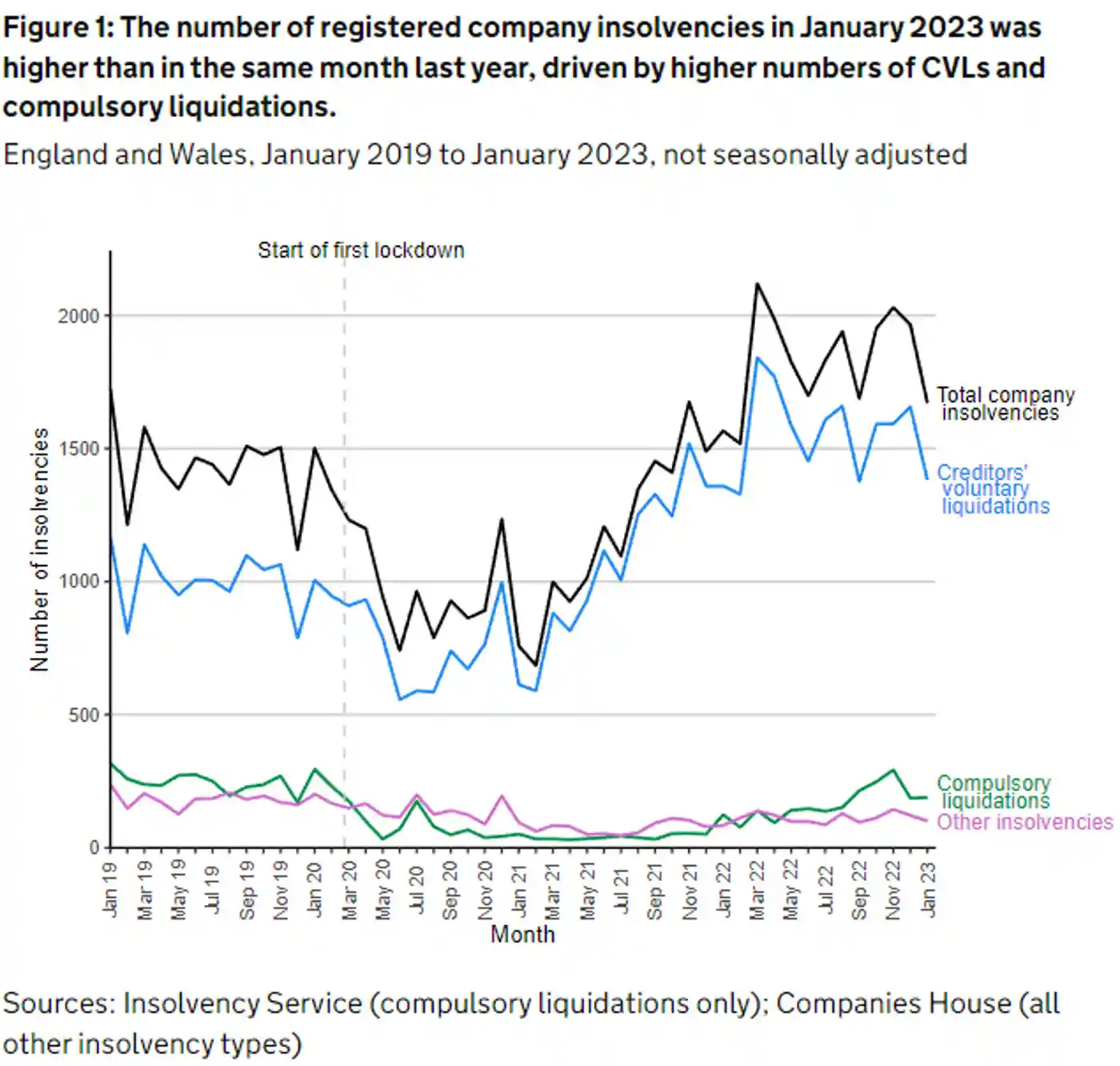
There were also 1,382 creditors’ voluntary liquidations, in which a company that can’t pay its debts decides to put itself into liquidation.
Ed Macnamara, head of restructuring at PwC’s Restructuring and Forensics practice, warned of a ‘domino effect’ as companies struggle to pay their bills: “While the number of company insolvencies in January is down on the month before, any respite is likely to be short-lived.
“The data, which shows a 7% rise on the year before, serves as a reminder that we are still in the midst of a difficult trading environment with rising interest rates and high inflation which, when combined, generally results in more company failures.”
Nothing bankrupt about the FTSE 100 which is now at 7,986.68, up 39.08 points, or 0.49%.
10.05am: Amigo leaps after dodging £73mln fine
Amigo Holdings PLC (LSE:AMGO) shares leapt over 41% higher after it dodged a fine of almost £73mln from the UK financial watchdog and instead was only "publicly censured".
The Financial Conduct Authority (FCA) said that the guarantor lender's failure to have proper systems in place to assess the circumstances of its customers and their guarantors before it approved loans between 1 November 2018 and 31 March 2020 led to a "high risk of consumer harm, both to borrowers and guarantors".
Here's the full story.
9.45am: Drax firms as JP Morgan ups target, sees 44% upside
Drax Group (LSE:DRX) PLC sits top of the FTSE 250 risers lifted by positive comments from JPMorgan.
The investment bank has raised its price target to 900p from 850p, giving 44% upside potential from the current share price.
JPM analysts noted that shares in the generator are down 10% in the year-to-date on a lower commodity outlook which it considers “an overreaction, in a context where the market did not price in the value of higher power prices to begin with.”
The bank's analysts expect strong guidance on EBITDA for 2023 and see further catalysts in the second quarter of 2023 with the publication of UK Biomass Strategy and a potential update from the company on US Bioenergy with Carbon Capture and Storage.
Drax remains a top pick for JPMorgan which has an ‘overweight’ rating. It is also on the bank’s 'Positive Catalyst Watch' list heading into results later this month.
Shares in Drax were up 3% at 645.50p in London on Tuesday.
The FTSE 100 also continued to power ahead, currently at 7,983.46, up 35.86 points, or 0.45%.
9.30am: Glimmers of hope at TUI but challenges remain
Shares in TUI AG (LSE:TUI) are enjoying a good day, up 3.7%, as the travel industry continues to recover post-Covid.
Richard Hunter, head of markets at interactive investor, commented: “TUI has not yet reached its preferred destination of profitability, but the damage wrought by the pandemic is being slowly undone.”
“As such, the general direction of travel as evidenced by last year’s results remains promising. Significant momentum within its Markets & Airlines business has resulted in some record booking days for the UK and Germany, with both the Winter 2022/23 and Summer 2023 seasons continuing towards capacity,” he noted.
“There are glimmers of light at the end of the tunnel for TUI, but the pandemic damage was severe and will need much more repair,” Hunter said, adding “another mountain to climb will be to convince investors that the recovery is becoming entrenched and sustainable.”
Analysts at Barclays Capital noted that bookings have gathered momentum which was encouraging.
“If the trajectory of the bookings recovery continues into the summer (c30% booked today), along with continued price strength, we see scope for mitigated cost inflation and would expect co-consensus EBIT forecasts to nudge up today from c.€980mln,” the bank's analysts said.
Barclays Capital has an ‘underweight’ rating on TUI given the impending rights issue (broadly guided at c.€1.5bn at the financial year 2022 results).
Meanwhile, on another record-breaking day, the FTSE 100 is at 7,979.00, up 31.40 points, or 0.40%. The lead index earlier establised a new intra-day high of 7,996.35.
9.05am: FTSE in touching distance of 8,000 level
The Footsie established new record highs in early exchanges on Tuesday as investors continued to bet that falling inflation will stop central banks raising interest rates as high as had been feared.
At 9.00am, London's blue-chip index was at 7,993.23, up 45.63 points, or 0.57%, in touching distance of the 8,000 mark.
Neil Wilson chief market analyst at markets.com said: “The FTSE 100 pushed up to a fresh record high, nudging closer to the magic 8,000 level, as risk remained bid following a positive start to the week ahead of today’s all-important US inflation data.”
Strong growth in wages in the UK prompted some concerns that inflation may not fall as quickly as some hope with Wilson noting it all “goes to back up the thesis that inflation will remain persistent because of structural problems in the labour market. Of course, pay growth is still shy of inflation at 10.5%. Inflation is not coming down fast enough.”
Martin Beck, chief economic advisor to the EY ITEM Club, suggested: “The latest numbers mean the odds of the MPC going for one further rise in Bank Rate in March, before pausing, have likely increased.
“Granted, the jobs market is a lagging indicator, so could turn down more significantly in coming months. However, continued recruitment difficulties suggest employers may hold onto labour rather than cutting headcounts, and while recent Bank of England survey evidence suggests pay growth may have peaked, the MPC may want more reassurance from the hard data before it changes tack on policy.”
In London, Coca-Cola HBC was in demand, rising 2.9% after the soft-drink bottling company reported a strong year of organic growth. Despite a challenging backdrop, the firm reported record revenue in 2022 of €9.20bn, growth of 28% from €7.17bn the previous year.
However, Coca-Cola HBC posted pre-tax profit of €623.6mln, down from €734.9mln mainly due to impairment charges relating to its operations in Russia.
Doing even better were telcos BT Group PLC (LSE:BT.A) and Vodafone Group PLC (LSE:VOD) which took the gold and silver medals in the FTSE 100 risers list, up 3.2% and 3.1% respectively.
News that Liberty Global (NASDAQ:LBTYA) has taken a 4.9% stake in Vodafone prompted investors to take a closer look at valuations in a sector where M&A activity is widely expected.
WPP PLC (LSE:WPP) rose 1% as Deutsche Bank raised its price target to 1,235p from 1,100p and reiterated a ‘buy’ rating.
8.45am: easyJet flies on Deutsche Bank upgrade
Shares in budget airline operator flew higher in early exchanges, up 3.1% to 484.77p, after a ‘double’ upgrade from Deutsche Bank.
Analyst Jaime Rowbotham has upgraded the FTSE 250-listed airline to ‘buy’ from ‘sell’ and raised the price target to 580p from 410p.
He highlighted the improved outlook for UK macro as being behind the move.
“One of the key pillars of our cautious stance on easyJet when we wrote our 2023 outlook report back in mid-December was concern about the health of the UK consumer.
“However, the UK economic outlook has ‘improved dramatically’ according to our colleague Sanjay Raja in his note ‘What a difference three months can make ’," Rowbotham said.
Given Raja estimated easyJet generated around 40% of pre-Covid profits from the UK, the analyst saw this as a positive for the stock.
Meanwhile, the FTSE 100 has settled just off its new highs at 7,976.02, up 28.42 points, or 0.36%.
8.10am: FTSE 100 hits new high
The FTSE 100 posted a new intra-day high at the open on Tuesday, making a fresh assault on the 8,000 mark, following gains in the US and Asia.
At 8.15am, London's blue-chip index was at 7,982.43, up 34.83, or 0.44%, just off its high for the day of 7,983.63.
The market shrugged off data from the Office for National Statistics which showed regular pay has grown at the fastest rate in more than 20 years, but is still failing to keep up with rising prices.
Pay, excluding bonuses, increased at an annual pace of 6.7% between October and December 2022, the strongest growth seen outside of the Covid pandemic. However, when adjusted for inflation, regular pay fell by 2.5%.
ING Economics noted that there is little sign that UK wage growth has reached a peak, and the jobs market looks reasonably healthy. “A 25bp rate hike at the March meeting seems likely,” they said, suggesting that the strong wage growth “will be a concern for the Bank of England’s hawks.”
“But with the BoE putting greater emphasis on the lagged impact of past tightening, and with inflation likely to show signs of improvement by spring, we suspect a March rate hike will be the last," they added.
In corporate news, Vodafone Group PLC (LSE:VOD) was in focus after yesterday’s news that Liberty Global (NASDAQ:LBTYA) has bought a 4.9% stake in the telco.
Deutsche Bank analysts noted that Liberty has followed Xavier Niel and others in buying a chunk of the FTSE 100 listed firm. “You wait for one and three show up all at once,” they quipped.
“The rapid stake build and the use of 'non-recourse financing' suggests a derivative-based collar structure previously used by LBTYA to acquire a stake in ITV and how reportedly (Bloomberg) Altice UK recently acquired an interest in BT,” the analysts suggested.
Deutsche has a ‘buy’ rating on Vodafone with a 195p price target. Shares rose 1.5% to 95.38p.
TUI AG (LSE:TUI) rose 2% after reporting narrowed losses as the travel industry continued to recover post-Covid.
The Hanover, Germany-based travel firm reported a pre-tax loss of €272.6mln compared to €404.5mln a year ago. Revenue jumped 58% to €3.75bn from €2.37bn, outpacing a 48% increase in cost of sales to €3.66bn from €2.47bn.
TUI said the improvement reflected "strength of demand and a return to a restriction-free travel environment achieving levels above pre-pandemic levels."
The FTSE 250-listed group reiterated its expectations for financial year 2023 that underlying earnings before interest and tax will increase "significantly", helped by "an encouraging booking momentum."
BAE Systems added 0.2% after comments from the Indian prime minister, who said India wants to raise its annual defence exports to $5bn by 2024-25 from $1.5bn.
Meanwhile positive comments by Barclays Capital supported British American Tobacco PLC (LSE:BATS). Shares in BAT rose 0.8% as Barclays reiterated an ‘overweight’ rating and £40 price target.
Another early riser was easyJet PLC which flew 2.9% to 483.90p as Deutsche Bank double-upgraded to ‘buy’ from ‘sell.’ The bank raised its price target to 580p from 410p.
7.40am: Losses narrow at TUI
TUI AG (LSE:TUI) on Tuesday said its loss in the first quarter that ended December 31 2023 narrowed amid increased revenues as demand for travel recovered helped by easing Covid restrictions.
The Hanover, Germany-based travel firm reported a pre-tax loss of €272.6mln compared to €404.5mln a year ago. Revenue jumped 58% to €3.75bn from €2.37bn, outpacing a 48% increase in cost of sales to €3.66bn from €2.47bn.
TUI said the improvement reflected "strength of demand and a return to a restriction-free travel environment achieving levels above pre-pandemic levels."
The FTSE 250-listed group reiterated its expectations for financial year 2023 that underlying earnings before interest and tax will increase "significantly", helped by "an encouraging booking momentum."
The company noted that the start of the new year has demonstrated "record" booking days online in the UK and Germany. It said: "Volumes overall in the last four weeks are now above pre-pandemic levels at +5% for Winter 2022/23 and +10% for Summer 2023, with higher prices, underlining the popularity of our product offering and a testament to the importance of travel for our customers."
TUI declared no dividend, unchanged from a year prior.
7.20am: Liberty Global swoops for 4.92% in Vodafone PLC
Liberty Global has taken a 4.92% stake in FTSE 100-listed telecommunications company Vodafone Group PLC (LSE:VOD), believing it to be undervalued.
Liberty Global chief Executive Mike Fries said the company believes Vodafone's share price "does not reflect the underlying long-term value of their operating businesses".
Liberty Global bought 1.33bn shares in Vodafone and will fund the investment through a non-recourse financing. It said it required equity funding of £225mln.
At current market prices, the stake purchased by Liberty Global is worth £1.22bn.
Liberty, in partnership with Telefonica SA, owns Virgin Media O2, a rival operator to Vodafone in the UK. It also has investments in companies such as broadcaster ITV PLC (LSE:ITV) and the Formula E racing series.
It becomes the latest high-profile shareholder to be attracted to Vodafone, following share purchases by French billionaire Xavier Niel and United Arab Emirates telecoms operator, e&.
Liberty said it was not considering an offer for Vodafone.
7.10am: Unemployment unchanged at 3.7%
The UK unemployment rate for October to December 2022 increased by 0.1 percentage points in the quarter to 3.7% compared to the quarter to September according to the Office for National Statistics. It was unchanged from November.
In the latest three-month period, the number of people unemployed for up to six months increased, driven by people aged 16 to 24 years.
The employment rate was estimated at 75.6% in October to December 2022, 0.2 percentage points higher than the previous three-month period driven by part-time workers.
Headline indicators for the UK labour market for October to December 2022 show that:
▪️ employment was 75.6%
▪️ unemployment was 3.7%
▪️ economic inactivity was 21.4%
— Office for National Statistics (ONS) (@ONS) February 14, 2023
The number of payrolled employees for January 2023 showed another monthly increase, up 102,000 on the revised December 2022 figures, to 30.0mln.
In the period from November 2022 to January 2023, the estimated number of vacancies fell by 76,000 on the quarter to 1,134,000, the seventh consecutive quarterly fall since May to July 2022.
Growth in average total pay (including bonuses) was 5.9% and growth in regular pay (excluding bonuses) was 6.7% among employees in October to December 2022; for regular pay this is the strongest growth rate seen outside of the coronavirus (COVID-19) pandemic period.
7.00am: FTSE 100 set to edge higher
The FTSE 100 index is expected to post a new intra-day high when it opens on Tuesday although enthusiasm may be limited ahead of some key economic data.
The early focus will be on UK unemployment numbers and average earnings figures with attention switching across the pond later with a US CPI print due at 1.30pm UK time.
Spread betting companies are calling the lead index up around 8 points at 7,954 which would beat the recently posted record high of 7,949.57 as London’s lead index continues to threaten to top the 8,000 mark.
In the US, the Dow Jones Industrals Average closed Monday up 377 points, or 1.1%, at 34,256, the Nasdaq Composite added 174 points, or 1.5%, to 11,892 and the S&P 500 jumped 47 points, or 1.1%, to 4,137.
Michael Hewson chief market analyst at CMC Markets UK said: “Today’s (CPI) numbers for January could well go some way to reinforcing the more hawkish commentary we’ve seen from various Fed officials since the January rate meeting as well as upend US stock markets even further.
“It should also be noted that the recent ISM services report reinforced the resilience from the US jobs report as well resilience in prices paid which came in at 67.8. Wage growth is also looking strong particularly in hospitality and leisure.
“This stickiness in prices is likely to be reflected in a similar uptick in inflationary pressure with headline CPI expected to rise 0.4% on a monthly basis, and by 6.2% year on year.”
Back in London and in corporate news trading updates are expected from TUI AG (LSE:TUI) PLC, Carrs Group PLC and Coca-Cola HBC AG.