
- FTSE 100 closes down 14 points
- US markets down as manufacturing contracts
- Next confirms purchase of Joules for £41mln
4.45pm: FTSE 100 closes lower
FTSE 100 closed in the red after being positive earlier as the stronger pound put a dampener on big cap gains.
Britain's index of leading shares closed down around 14 points, or 0.19%, at 7,558.
FTSE 250, on the other hand, gained around 246 points, or 1.28%, at 19,409.
"A resurgent pound served to limit any FTSE 100 upside today, with early European optimism fading into the close," said Joshua Mahony, senior market analyst at online trading firm IG.
"Yesterday’s comments from Powell over the willingness to slow the pace of tightening has helped boost risk assets, to the detriment of the dollar. However, it seems the rebound for US stocks has been relatively short-term in nature, with the Dow leading the losses today."
Elsewhere, UK housebuilders took a hit as the latest Nationwide figures showed the biggest monthly decline in house prices since mid-2020.
3.40pm: US manufacturing contracts in November
Stocks markets in Europe are wobbling slightly as they head towards the close.
Not helping is US manufacturing firms signalled a renewed deterioration in operating conditions in November, according to the latest PMI data from S&P Global.
The seasonally adjusted number was 47.7 in November, down from 50.4 in October but broadly in line with the earlier released 'flash' estimate of 47.6.
The downturn was the sharpest since May 2020 and driven by declines in output and new orders.
???????? The US #PMI posting of 47.7 in November (Oct: 50.4) signalled the first decline in the manufacturing sector's health since June 2020 amid weakening demand conditions. Read more: https://t.co/hOxW0WYlZm pic.twitter.com/paRs4dlTHt
— S&P Global PMI™ (@SPGlobalPMI) December 1, 2022
Demand conditions weakened in domestic and external markets, as new export orders fell further.
Employment growth slowed as pressure on capacity dwindled and backlogs of work contracted strongly.
On a more positive note, supply chains improved for the first time since October 2019, with price pressures softening as a result of reduced demand for inputs from firms.
Input costs rose at the slowest rate for two years.
Separately, The Institute for Supply Management's gauge of factory activity slid to 49 in November from 50.2 in the prior month and below market expectations of 49.8.
November US ISM manufacturing index 49.0 vs 49.8 expectedhttps://t.co/IduxVRglVt
— ForexLive (@ForexLive) December 1, 2022
A score above 50 indicates manufacturing growth, while below 50 shows a contraction.
Back in London, the FTSE 100 has dropped into the red and the FTSE 250 has retreated from its intraday high.
There are still some big riser among the smallcaps, including Invinity Energy Systems PLC, an AIM-listed manufacturer of utility-grade energy storage.
It has skyrocketed today following the signing of a reseller agreement with a Taiwan-based industrial group, Everdura, which has agreed to buy 15 MWh of vanadium flow batteries (VFBs) from the Jersey-domiciled outfit.
3.05pm: Exane BNP downgrade hurts Pearson
Pearson PLC (LSE:PSON) topped the FTSE 100 fallers today hurt by a downgrade by Exane BNP Paribas.
Shares fell 5.7% as the broker lowered its rating to neutral from outperform and cut the price target to 1,000p.
"We concede that it will take the group much longer to see the benefits of the hoped-for cyclical and structural turnaround” analysts wrote.
“We also believe that capital allocation issues are likely to further put pressure on the shares in the near term. We do not see significant upside in the share in the short term."
At the same time, Exane reiterated its buy rating on RELX, formerly known as Reed Elsevier.
“It said capital allocation policies are supportive for RELX but a negative for Pearson.”
2.43pm: US markets make a mixed start
US stocks opened mixed after yesterday afternoon’s gains with investor sentiment bolstered by Fed chair Jerome Powell’s less hawkish stance and a cooling core personal consumption expenditure (PCE).
The Fed’s preferred gauge of inflation, the annual core PCE price index, declined to 5% from 5.2% in October, on par with the consensus analyst expectation.
Personal spending and personal income rose by 0.8% and 0.7% respectively month-over-month.
Forex.com market analyst Fiona Cincotta said today’s data was enough to keep the market happy that inflation was moving in the right direction.
“However, it is a small decline, highlighting that this is likely to be a long journey,” she said.
Meanwhile, initial jobless claims for the week ended November 26 fell to 225,000, down from 241,000 in the week prior and below the expected 235,000.
“Overall, the data is upbeat, showing that the economy is still holding up while inflation is cooling,” Cincotta noted. “If it continues like this, then a soft landing for the US economy could be likely.”
Just after the market opened, the Dow Jones Industrial Average had shed 32 points or 0.1% at 34,558 points, while the S&P 500 had added 10 points or 0.3% at 4,091 points and the Nasdaq Composite was up 30 points or 0.3% at 11,450 points.
2.32pm: Next confirms it has bought Joules, 19 shops to close
Next PLC (LSE:NXT) has confirmed that it has bought the majority of the assets of Joules in partnership with Tom Joule for £34mln cash.
In addition, Next has acquired the current Joules Head Office for £7mln.
It intends to continue to operate a significant number of stores (around 100 of the current 124 Joules' stores) but 19 stores will be closed by the administrator today.
Next will own 74% of the equity in the new company with the remaining 26% owned by Tom Joule.
Joules will retain its management autonomy and creative independence and the company will have its own board and continue to be based in Market Harborough.
Jonathon Brown was appointed CEO of Joules in 2022 and will remain in that role.
Joules' websites and online operations, both in the UK and overseas, will be operated by Next through Next's Total Platform.
Simon Wolfson, Next chief executive said: "We are excited to see what can be achieved through the combination of Joules' exceptional product, marketing and brand building skills with Next's Total Platform infrastructure."
1.40pm: US PCE broadly in line with expectations
The closely watched PCE inflation data has come in broadly in line with market forecasts with core deflator up 5% year-on-year (estimate 5%) with the monthly increase of 0.2%, a touch below the 0.3% forecast.
US PCE Deflator (M/M) Oct: 0.3% (est 0.4%; prev 0.3%)
- US PCE Deflator (Y/Y) Oct: 6.0% (est 6.0%; prev 6.2%)
- US PCE Core Deflator (M/M) Oct: 0.2% (est 0.3%; prev 0.5%)
- US PCE Core Deflator (Y/Y) Oct: 5.0% (est 5.0%; prev 5.1%)
— LiveSquawk (@LiveSquawk) December 1, 2022
Personal spending rose 0.8% in October, in line, while personal income rose a higher-than-forecast 0.7% (estimate 0.4%).
US Personal Income Oct: 0.7% (est 0.4%; prev 0.4%)
- US Personal Spending Oct: 0.8% (est 0.8%; prev 0.6%)
- US Real Personal Spending Oct: 0.5% (est 0.5%; prev 0.3%)
— LiveSquawk (@LiveSquawk) December 1, 2022
Weekly jobless claims of 225,000 were slightly weaker than market forecasts of 235,000.
US Initial Jobless Claims Nov 26: 225K (est 235K; prev 240K)
- US Continuing Claims Nov 26: 1608K (est 1570K; prev 1551K)
— LiveSquawk (@LiveSquawk) December 1, 2022
1.00pm: Ford to invest further £125mln in UK EV car production
Ford plans to invest an extra £125mln in electric vehicle parts production at its Halewood plant in a move that will make it a key part of the company’s European zero-emissions ambitions.
The factory on Merseyside will produce 420,000 electric drive units a year from 2024 under the plan, an increase from the 250,000 initially planned, Ford announced on Thursday.
The additional investment means Ford will spend £380mln on upgrading Halewood and the van design centre in Dunton, Essex, for electric vehicles (EVs).
12.30pm: Next trumps Foschini to snap up Joules - Sky
Next PLC (LSE:NXT) has won the battle to buy Joules, the fashion retailer, which recently went into administration, according to Mark Kleinman of Sky News.
Revealed: Next has managed to secure a deal to snap up the fashion retailer Joules out of administration, trumping rival bidder Foschini Group at the last minute of a fraught auction process.
— Mark Kleinman (@MarkKleinmanSky) December 1, 2022
Next has teamed up with Tom Joule, the founder of the business, to secure the retail brand, winning a battle against rival bidders, South Africa’s Foschini Group which owns Phase Eight.
Joules, which started life as a clothing stall at a country show in Leicestershire in the 1980s, posted multiple profit warnings this year amid supply chain difficulties and waning consumer appetite due to the cost-of-living crisis.
Mike Ashley's Frasers and M&S also showed interest in the company.
12.00pm: US expected to open slighlty lower after stellar gains yesterday
US stocks are expected to open slightly lower on Thursday, giving back some of the gains seen after Federal Reserve chairman Jerome Powell signaled that the pace of interest rate hikes in the US will ease although borrowing costs will stay higher for longer.
Futures for the Dow Jones Industrial Average were down 0.1% in pre-market trading, while those for the S&P 500 were 0.2% lower, and contracts for the Nasdaq-100 shed 0.2%.
"While it could be argued that Jerome Powell's comments on Wednesday were relatively balanced - slower tightening now but rates high for longer - the last year has proven that anticipating the path of inflation even a short period ahead is incredibly difficult,” noted Craig Irlam, senior market analyst at Oanda.com.
“Knowing what the Fed intends to do next is far more valuable than what it thinks it may do 6-12 months down the line,” he added.
The Federal Reserve has delivered four 75 basis point interest rate hikes in as many meetings this year as it tries to curb runaway inflation levels.
Investors are counting on rate setters to scale back on hikes amid the early signs that inflation may be starting to ease.
Anything that is perceived to reduce to possibility of an interest rate recession is going to be a positive for equity markets, said Irlam.
“The Fed has every opportunity to tighten more in the months ahead if the data doesn't play ball. What's far more difficult is undoing the damage caused by moving too fast now with little to no visibility on how impactful past tightening has been,” he added.
The strength of the labor market is also a key factor underpinning the wider US economy. To that end, the US non-farm payroll numbers, due out on Friday, will be important. Consensus points to an increase of around 200,000 in November after a 261,000 gain the previous month.
The data calendar today includes the Federal Reserve’s preferred measure of inflation, the PCE price index. Any sign that inflationary pressures are easing in this gauge will likely boost stocks.
Elsewhere, markets have also been cautiously optimistic over recent developments in China, welcoming hints that China’s government could ease its Covid curbs in response to citizen protests.
11.40am: Sterling hits 16-week high
The pound has hit a 16-week high against the US dollar following the comments by Federal Reserve chair, Jerome Powell, that smaller rate increases might be on the way.
Sterling has gained 0.63% to US$1.216 following Powell's speech in the US yesterday which investors took as a signal that the next FOMC meeting would see a 50bps rate rise rather than the 75bps increases seen in recent months.
Much will depend on a further batch of key economic data with PCE inflation numbers due today and non-farm payrolls figures tomorrow.
.jpeg)
11.05am: British Gas to pay customers to reduce energy usage
British Gas will become the latest energy company to pay its customers to reduce the amount of electricity that they use during peak hours in order to help take pressure off the grid.
Britain's largest energy supplier said that it hoped 100,000 customers would sign up as it launches the demand flexibility service for the households that it supplies.
The supplier becomes the latest - and the largest - to sign up to the scheme - which is run by National Grid.
However, its ambitions for participation are lower than Octopus Energy, which has so far signed up more than 400,000 customers to its version of the scheme.
10.30am: Recession already underway in UK manufacturing
Gabriella Dickens, senior UK economist at Pantheon Macroeconomics said “November’s PMI data suggest that a recession already is underway in the manufacturing sector.”
“While the headline reading edged up in November from October’s 29-month low, it remained well below the 50.0 mark and its average since January 2020, 53.9” she noted.
“The forward-looking sub-indices, meanwhile, point to further gloom. The new orders index, for instance, remained well below 50.0, despite edging up to 41.9, from 39.9, as both domestic and external demand remained weak” she pointed out.
Dickens failed to see an improved picture in 2023 either. “The outlook for next year is just as grim. Demand for industrial goods likely will be hit again early next year as real incomes are squeezed by the watering down of government support for energy bills and higher unemployment, as businesses are forced to consolidate costs.”
“Indeed, there now are concrete signs that manufacturers already are adjusting their hiring plans; the unemployment balance dropped to a 23-month low of 47.7 in November, from 48.3 in October, well below its average over the past two years 54.5.”
James Brougham, senior economist at Make UK, which represents manufacturers said: ““There is clearly a long winter ahead as those businesses that haven’t moved into a battle footing yet soon will, with investment continuing to decline as businesses repurpose planned capex towards business continuity and contingency spend.”
Maddie Walker, Industry X lead for Accenture (NYSE:ACN) in the UK, said: “With inflationary pressures, tight labour market conditions and the ongoing cost of living crisis continuing to bite, manufacturers are understandably pessimistic about the future which has hurt output."
"UK manufacturers may be tempted to rein in their R&D investment strategies to cut costs in the short-term, but it's important they maintain a long-term plan for growth."
"Sustaining growth with transformative technologies will be critical to protecting factories from further disruption, which will help the sector to turn around the sluggish production that has defined much of this year.”
10.03am: Brexit added £5.8bn to UK food bills
Brexit added £210 to household food bills across the 24 months to the end of 2021, new research suggests.
Analysts from the Centre for Economic Performance (CEP) at the London School of Economics said extra checks and requirements on goods crossing the border increased food prices by 6% overall, burning a £5.8bn hole in consumers' pockets.
The rising costs have likely hit poorer people harder, as those on low incomes tend to spend a greater share of their pay packets on food, the CEP found.
9.40am: UK manufacturing contracts in November and outlook darkens
November saw the UK manufacturing sector contract further, as companies reported lower output, weaker new work intakes and reduced employment, according to the latest S&P Global/CIPS UK Manufacturing Purchasing Managers’ Index.
The intermediate goods sector fared especially poorly, while downturns also continued at consumer and investment goods producers.
???????? UK manufacturers saw further contractions in output, new orders and employment in November, while business sentiment towards future activity slipped to its lowest since April 2020. On the plus side, the #PMI edged up to 46.5 from 46.2 in Oct. Read more: https://t.co/n6M7Qcb8EK pic.twitter.com/XWdtTReNpL
— S&P Global PMI™ (@SPGlobalPMI) December 1, 2022
The PMI edged up to 46.5 in November, from 46.2 in October but remained below the neutral 50.0 mark for the fourth month running and posted one of its lowest levels during the past 14 years.
Commenting on the latest survey results, Rob Dobson, director at S&P Global Market Intelligence, said: “November saw a further contraction of the UK manufacturing sector, as weak demand, declining export sales, high energy prices and component shortages all hit industry hard.”
“The outlook for the sector also darkened, as confidence among manufacturers fell to its lowest level since April 2020.”
9.30am: Eurozone manufacturing PMI falls
Over in Europe and activity by eurozone manufacturers fell again last month as the downturn in the sector continued, according to the latest survey of purchasing managers by S&P Global.
The Eurozone Manufacturing PMI was 47.1 in November, up from October’s 46.4, but still below the 50-point mark showing stagnation.
Eurozone Manufacturing #PMI at 47.1 in Nov (Oct: 46.4) to mark the second-worst performance among #manufacturing firms since spring 2020. Weaker demand helped to soften inflationary pressures further and reduce strain on suppliers. Read more: https://t.co/CGq2HXZZ7G pic.twitter.com/1T8w9kSGa4
— S&P Global PMI™ (@SPGlobalPMI) December 1, 2022
Factories were hit by a drop in new orders again, with clients spooked by economic uncertainty and high selling prices.
This prompted factories to cut back on their purchases on raw materials and components.
8.55am: FTSE 100 loses some of its early shine
FTSE 100 has lost some of its early sparkle, now up just 6 points.
Richard Hunter, head of markets at interactive investor, commented “Unusually dovish comments from the Federal Reserve Chair Jerome Powell were seized upon by investors, sending markets sharply higher on hopes that the pace of aggressive rate hikes has peaked.”
The comments were taken by investors as signalling a 50bps rate rise at the next FOMC meeting rather than the recent 75bps increases.
Back in London and shares in chocolate retailer Hotel Chocolat rose 1% despite posting a loss of around £9.4mln in the year to June after taking a hit from its Japanese business, where Covid restrictions continued.
The business swung from a pre-tax profit of £3.7mln last year and the loss came despite a big jump in revenue, from £165mln to £226mln.
Victoria Scholar, head of investment, interactive investor said: “In order to face the macroeconomic challenges particularly of rising costs, Hotel Chocolat has been streamlining the business geographically and giving its attention to higher-end, expensive products in the hope that its luxury range will prove to be more resilient during the looming recessionary environment.”
“Although December is likely to provide a seasonal boost to sales around Christmas, the start of 2023 could prove to be very challenging.”
On the way down though were shares in Tribal Group PLC (AIM:TRB) which slumped 33% as it announced further delays to the implementation and delivery of the NTU contract resulting in substantially increased ongoing costs and lower recognisable revenue in fiscal year 2022 than originally anticipated.
“Consequently, the NTU contract is now expected to generate a loss of c£12mln over the life of the contract” the group said.
Tribal said it now a negative impact on EBITDA for 2022 of around £9mln. The NTU contract combined with extra cost and wage inflation is expected to reduce anticipated EBITDA performance in the year ending 31 December 2023 by c£4mln.
8.15am: FTSE 100 makes a bright start
FTSE 100 made a steady start to proceedings boosted by gains in the US and Asia following Jerome Powell’s comments that smaller rate rises may lie in store across the pond.
At 8.15am the FTSE 100 was up 15 points at 7,588 while the FTSE 250 advanced 225 points to 19,388.
More downbeat news on house prices with the Nationwide reporting prices fall 1.4% in November, the biggest fall since June 2020.
Sarah Coles, senior personal finance analyst, Hargreaves Lansdown said: “The carnage wrought by the mini-budget may have tipped the property market over the edge.”
“The delay in sales being completed means this is just a first glimpse of the horrors that may lie ahead, and it’s looking like the next few months could be something of a nightmare.”
“Kwasi Kwarteng’s ill-fated budget, caused a horrible spike in mortgage rates, which spooked the market, and buyers deserted in droves. Zoopla figures have shown that demand plummeted 44% in the following months.”
On a quiet day for corporate news Capita PLC (LSE:CPI) rose 2.5% after completing the sale of Pay360 to Access PaySuite for around c.£156mln.
The proceeds will be used to further reduce net debt and provide additional liquidity.
The latest FTSE 100 quarterly reshuffle has also been confirmed with abrdn, Beazley and Weir Group joining the FTSE 100 on December 19, replacing Dechra Pharmaceuticals, Harbour Energy and Intermediate Capital Group (LSE:ICP).
Elsewhere, Italian oil major Eni is in early stage talks to buy Sam Laidlaw’s Neptune Energy for up to $6bn according to Reuters.
The private equity-backed British oil firm had been planning an IPO although this had been delayed.
7.45am: Black Friday boosts November's retail footfall - Springboard/BRC
Latest data from retail consultancy Springboard and the British Retail Consortium showed that retail footfall sparked in November, boosted by Black Friday, although it remains well below pre-pandemic levels.
Footfall rose 4.3% year-on-year in the four weeks to 26 November.
However, stripping out Black Friday, the increase was closer to 2.5% meaning overall growth has also now slowed for four consecutive months, from July's 15.6% jump.
On high streets, footfall increased 5.6% - down from October's 7.8% jump – while it rose 5% in shopping centres and by 0.7% in retail parks.
Compared to the same month in 2019, however, overall footfall was down 11.1%, following a 9.8% year-on-three-year slide in September.
7.33am: Sterling and euro surge against the greenback, as US economic data darkens
Sterling made strong gains against the US dollar this morning.
Weak economic data emerging from the US caused GBP/USD to surge a chunky percentage point to 1.207 in yesterday’s trading session, and another 0.3% to 1.210 in this morning’s Asia window.
The Chicago Purchasing Managers’ Index (PMI), a measure of manufacturing output, had the lowest reading since May 2020, while US mortgage applications fell 0.8% after a 2.2% advance in the previous period.
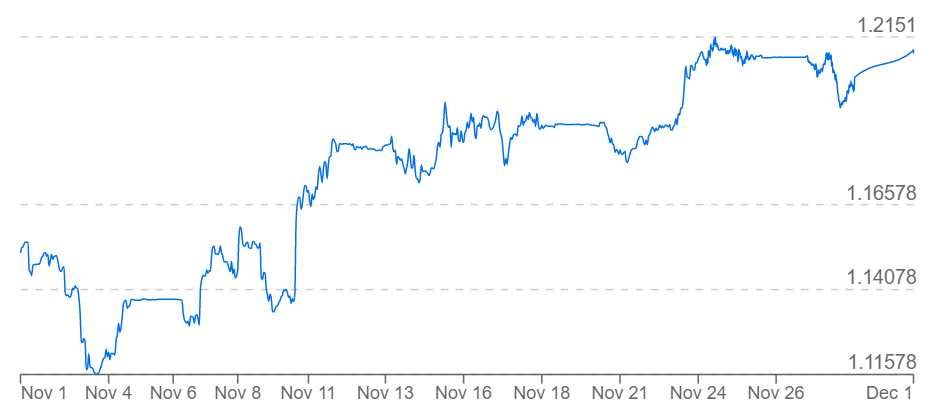
Sterling made strong gains against the US dollar in November – Source: xe.com
Employment data also failed to impress, while the goods trade balance widened its deficit more than expected.
As such, Federal Reserve chair signalled a slower pace of interest rate hikes in the months to come.
"It makes sense to moderate the pace of our rate increases as we approach the level of restraint that will be sufficient to bring inflation down,” said Powell, though he did note that the terminal rate could be "somewhat higher" than the 4.6% indicated by in the September projections.
EUR/GBP closed the Wednesday session at .863, around 12 basis points below the intraday high, though the euro has the slight upper hand this morning having added a few pips.
Yesterday’s EU headline inflation data came in at a flat 10% against a 10.3% forecast, though that figure is still unacceptable high given the 2% target, so excessive rate hikes are likely to stay on the agenda in the coming months.
Combined with Powell’s dovish overtures, EUR/USD jumped a full percentage point to 1.042 yesterday, and continued to rally another 0.33% to 1.045 in today’s Asia window.
7.22am: House prices tumble 1.4% in November
UK house prices tumbled 1.4% in November compared with October, the biggest monthly drop since June 2020, mortgage lender Nationwide said today as the fall out from the mini-budget continued.
The fall was much larger than market expectations for a fall of 0.3% and left annual house price growth at 4.4% in November down from 7.2% in October, Nationwide said.
Annual house price growth slowed sharply in November to 4.4% versus 7.2% in October. #housing House prices fell 1.4% month on month. Average house price now stands at £263,788. #houseprices Full report & commentary from our chief economist: https://t.co/PE9wRoeD8r
— NBS External Affairs (@NationwidePress) December 1, 2022
Robert Gardner, Nationwide's chief economist, said: “While financial market conditions have stabilised, interest rates for new mortgages remain elevated and the market has lost a significant degree of momentum.”
“Housing affordability for potential buyers and home movers has become much more stretched at a time when household finances are already under pressure from high inflation.”
“The market looks set to remain subdued in the coming quarters. Inflation is set to remain high for some time and Bank Rate is likely to rise further as the Bank of England seeks to ensure demand in the economy slows to relieve domestic price pressures.”
“The outlook is uncertain, and much will depend on how the broader economy performs, but a relatively soft landing is still possible.”
7.00am: FTSE set to follow US higher after Powell's comments
FTSE 100 set to make a bright start to the day, building on yesterday’s gains, after US markets soared following comments by Federal Reserve Chair Jerome Powell who confirmed that the central bank will slow the pace of its aggressive rate-hiking campaign.
Spread betting companies are calling the lead index up by around 30 points.
In the US, the Dow Jones Industrial Average leapt 738 points, or 2.2%, to 34.590, the S&P 500 surged 122 points, or 3.1%, to 4,080 and the Nasdaq Composite jumped 484 points, or 4.4%, to 11,468 following Powell’s speech at the Brookings Institution in Washington, DC.
"The time for moderating the pace of rate increases may come as soon as the December meeting" of the Federal Open Market Committee, Powell said.
But he also stressed that the smaller hike should not be taken as a sign the Fed will let up on its inflation fight anytime soon.
Ipek Ozkardeskaya, senior analyst at Swissquote Bank suggested investors “did not listen well to what Jerome Powell said yesterday.”
She said: “In summary, Powell warned investors that the terminal Fed rate will be higher, and it will stay there longer.”
In Asia, stocks were trading higher. The Japanese Nikkei 225 index was up 0.9%. The S&P/ASX 200 in Sydney was up 1.0%. In China, the Shanghai Composite was up 0.4%, while the Hang Seng index in Hong Kong was up 1.5%.
Back in London and the manufacturing PMI is expected to come in at 46.2, still firmly in contraction territory while results are due from retail investment platform AJ Bell and online auction operator Auction Technology Group.