
Dundas Minerals Ltd (ASX:DUN) is putting the last pieces in place ahead of a down-hole electromagnetic (DHEM) survey at its Central nickel-copper-gold target in WA’s Albany-Fraser Orogen.
The explorer plans to hit the ground running in early December when it will mobilise the Vortex Geophysics crew to assess up to four drill holes for conductive anomalies.
Those findings will help the team plan drill hole six, which is designed to test low resistivity audiomagnetotellurics (AMT) anomaly at the polymetallic prospect.
Any conductors that Vortex uncovers could indicate massive sulphides, providing further exploration fodder as Dundas heads into the new year.
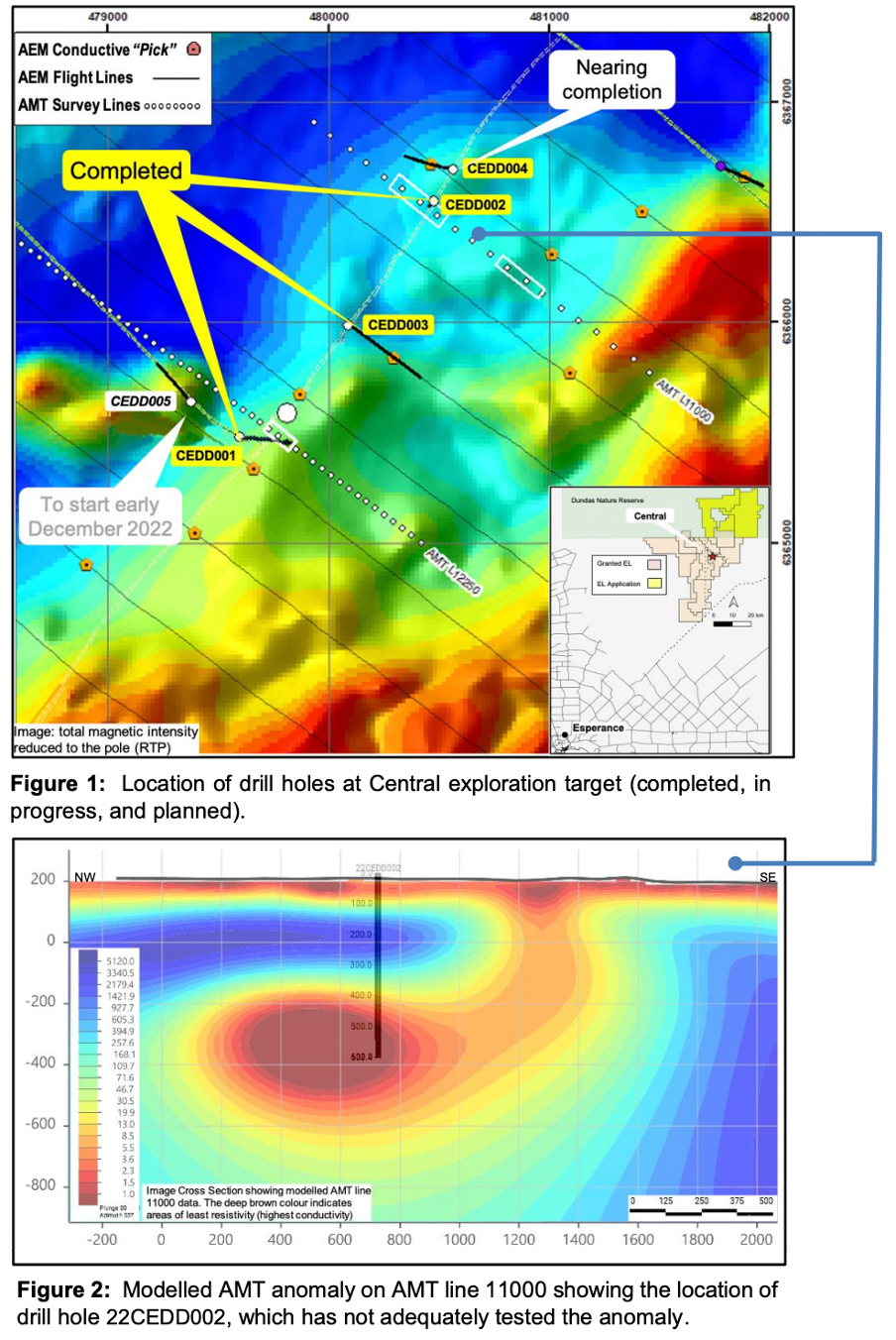
The DHEM data and subsequent modelling will be used with other geophysics data to design future drilling near holes 22CEDD002 and 22CEDD004, as well as hole 22CEDD003 if warranted.
Meanwhile, the sixth hole is slated for drilling in January next year — an expedition co-funded by the WA Government’s Exploration Incentive Scheme (EIS).
A second co-funded drill hole at Central has also been awarded up to $110,000 in EIS funding. This hole may also be drilled in early 2023, depending on the results from hole six.
Exploring Central
Dundas started drilling at Central back in September, determined to follow up on its fieldwork findings.
The polymetallic target was initially identified as prospective for mafic-ultramafic associated nickel-cobalt-copper mineralisation thanks to a project-wide gravity survey in October last year.
A detailed gravity survey — conducted over 250-metre-spaced lines — was subsequently conducted across the northeast prospect area over late January and early February.
This survey identified the Central target as having correlated gravity, magnetic and SkyTEM (electro-magnetic) geophysical anomalies, and worthy of more detailed exploration.
In March 2022, an audiomagnetotellurics survey was completed at the Central target.
Two survey lines were completed, and both returned areas of extremely low resistivity (equivalent to high conductivity), where values were less than one ohm-metre.
Fast forward to today, and Dundas is out to prove those results through the drill bit.