
Natural Resources
Comment
29 November 2022
On 17 November we published a comprehensive review of the nickel market and our view on how the supply and demand dynamics are likely to unfold over the coming years.
Nickel prices rose sharply in the first half of November, up 30%, to reach a $29,600/t high. They have fallen back slightly since but remain above $25,000/t. Even after the now infamous short squeeze and LME debacle in early 2022, nickel obviously remains volatile. Perhaps not surprising, being as it is a key ingredient required to achieve climate goals.
As many commentators have pointed out, people - both consumers and those involved in M&A - are probably going to have to pay more to secure it, evidenced not least by BHP upping its bid for OZ Minerals.
LME 3-month Nickel price US$/t
Last week also saw Indonesia putting forward a proposal to the Canadian government for an OPEC style “Coordination and integration policy” to maximise opportunities for those nickel producing countries.
In reality of course this was always likely to be a bit of a non-starter, aside from it being antithetical to open market economies like Canada’s, given the private nature of Canadian companies, Chinese influence in the Indonesian nickel market and the recent Canadian decisions to limit Chinese influence in their own domestic mining industry. Not surprisingly the Canadians, politely (of course) declined to explore the proposal.
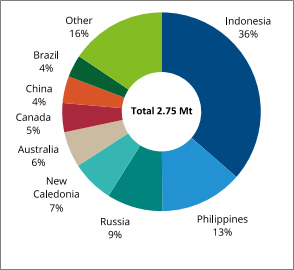
One wonders why the Indonesians even bothered as effectively they are already there. Indonesia is already producing ~40% of global nickel, roughly the same percentage as OPEC+’s output of crude.
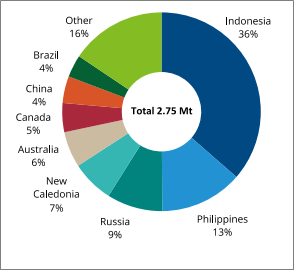
Nickel Mine Production 2021– Source USGS
The picture looks starker when considering Indonesia’s dominance of the potential new nickel project capacity to come on stream in the coming years.
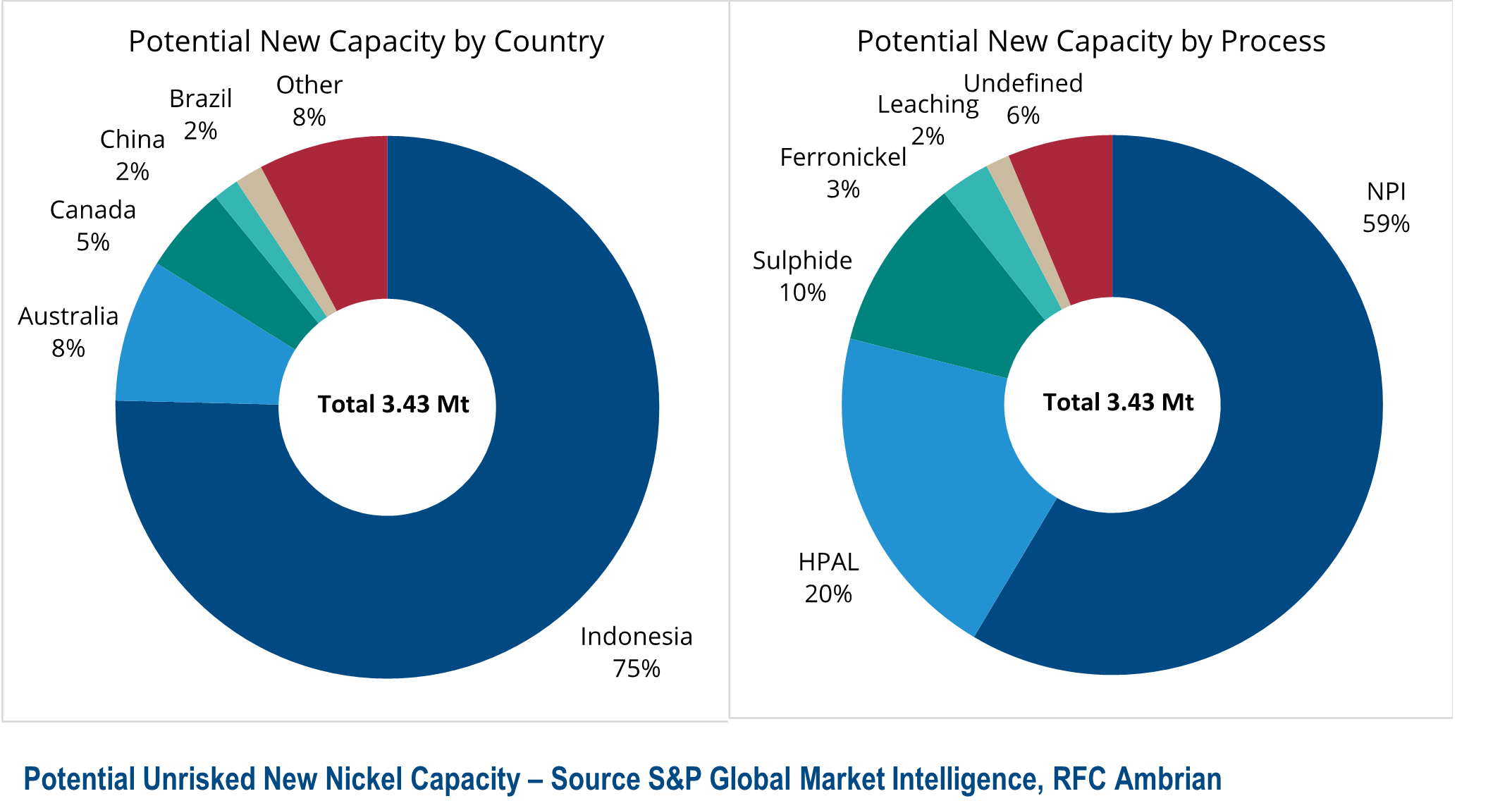
Of course, the nickel market is complicated by the bifurcation into Class I nickel, largely from sulphide orebodies of which there are relatively few, and Class II, from laterites of which there are many. The big demand change for nickel is coming from battery demand, which relies on the purity of Class I metal.
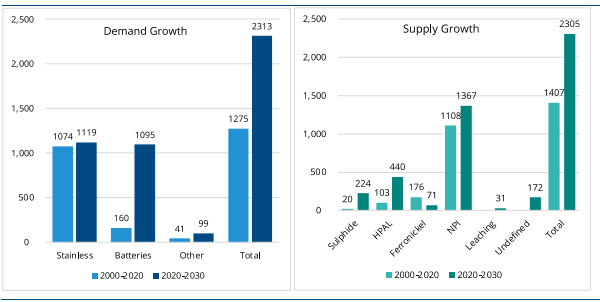
Nickel Supply and Demand Growth (2010-2020 and 2020-2030) – Source S&P Global Market Intelligence, RFC Ambrian.
As David Bird pointed out in our report, ESG issues are likely to impact Western demand for material from specific projects. That perhaps puts a premium on sulphide projects that can supply “clean” metal. Nevertheless, the future supply-demand balance will largely hinge on Indonesia’s (and Chinese companies by default) ability to convert NPI into Class I product to supply the energy transition.
Whether you thought you knew everything about the state of play in the nickel market or if you are a novice it’s worth a read. David Bird will be following up this report with a second in the new year focussing on nickel market M&A and nickel project developments.
Meanwhile…
We’ve been working with battery metals developer, ASX-listed Rafaella Resources (Rafaella Resources Ltd (ASX:RFR)). Rafaella are in the process of acquiring the near surface, copper-nickel-PGM Horden Lake project in Quebec Canada, originally discovered by INCO. High voltage power lines from the La Grange hydro power plant pass the front door and the Noranda smelter is down the road. Last week the company published an updated JORC compliant Mineral Resource Estimate of 27.8 Mt of 1.49% CuEq (Cu 0.73%, Ni 0.22%, gold, silver and PGMs also present).
Rafaella’s management team, represented by CEO Steven Turner, will be at the Mines & Money conference in London this week. If you are interested in future nickel sulphide projects do make time to see Steven at the conference or contact us and we can provide more detail.
Key takeaways from RFC Ambrian’s Nickel report :
Nickel demand is booming: Stainless steel demand is expected to remain the largest demand segment for nickel out to 2030 and beyond, despite the strong growth in demand for nickel from the battery sector. Battery sector demand is forecast to grow up to five-fold from 2020 levels by 2030.
The Class I and Class II nickel divide adds complexity to the picture: Bifurcation of the nickel market makes it complicated to accurately analyse longer-term supply and demand forecasts. Recent technological developments have shifted the goalposts and blurred the historical lines between preferential Class I and Class II feedstocks.
ESG issues are to the fore: Battery and EV manufacturers are increasingly striving to minimise the CO2 footprints of their products, reduce risks caused by geopolitical concentration, and ensure environmental and ethical standards are implemented and maintained. This may put some Indonesian NPI producers at a disadvantage and opens the door for nickel sulphide production in countries with lower CO2 intensities to potentially supply “greener” nickel to end users.
M&A is heating up: Recent public markets activity has primarily been driven by large, well-resourced acquirers putting their foot on future sources of nickel sulphide supply, both at the corporate and asset level.
NPI remains the key to the supply outlook: The development of new NPI capacity in Indonesia will remain key to the overall balance of the nickel market out to 2030. There is also a need for a significant proportion of the planned new HPAL and sulphide projects to come onstream to help balance the overall market. Whilst they are a smaller part of the overall equation, these HPAL and sulphide projects will also be critical in bringing on sufficient Class I nickel capacity to supply nickel matte to the battery markets. However, it is likely to be NPI and its conversion to nickel matte that will be the key swing supply factor in balancing the Class I market out to 2030.
We intend to release a follow-on report in early 2023 which will take a closer look at nickel market M&A and nickel project developments.
Charlie Cryer
Head of RFC Ambrian London
+44 (0)20 3440 6834
charlie.cryer@rfcambrian.com
Copyright © 2022 RFC Ambrian Limited, All rights reserved.