
- FTSE 100 closes firmly ahead
- HSBC sells its Canadian business for $10.1bn
- Halma falls as UBS downgrades to neutral
4.49pm: FTSE 100 closes in green
FTSE 100 closed higher on Tuesday and reached levels not seen since August this year.
The UK's top share index closed nearly 38 points higher, or 0.51%, to stand at 7,512.
"It has been a lacklustre session for most markets but the FTSE 100 has pushed on to its highest level since late August, said Chris Beauchamp at online trading platform IG.
"While the market as a whole has been sceptical today about a positive development from the China protests, the same cannot be said of the FTSE 100," he said.
"Solid gains from Asia-focused names HSBC and Standard Chartered show that at least some investors think the government in China will respond by loosening Covid restrictions, while the lower dollar has boosted commodity prices and thus given the raw materials and energy sector a boost."
3.45pm: BoE's Andrew Bailey defends QE policy
Over at the House of Lords and the Bank of England govenor Andrew Bailey is appearing in front of his predecessor Lord Mervyn King and other Lords on the economic affairs committee.
Bailey was asked if the Bank understood the impact of quantitative easing.
The governor said the Bank had learned “its effects are more state contingent than we first thought they would be” adding it “works best in periods of extreme crisis.”
He said the Bank had also learned “it has the effect of lowering long term rates” which eases the burden for households.
Asked about the inflationary impact of quantitative easing, Bailey said he is not prepared to engage in hindsight answers as the Bank makes policy based on information known at the time.
Lord King asked if policy should have been tightened rather than eased when the economy was hit by the Covid pandemic in light of the issues being down to a weakening on the supply side rather than demand of the economy.
Usually Mr Bailey would agree, he said, but he added “there is an important difference.”
He said: “We had to look forward to what would happen once that temporary closing of the economy came to an end and what would be the state of the supply side at that point.”
“When I look back on this period, there were clearly things we couldn’t see. I would challenge anybody to say they could see Russia was going to invade Ukraine.”
“There were two other big judgments. One was around the transient nature of the supply chain shock. The other was around the supply side and what would happen once those measures were lifted.”
“It is the case that the labour market has turned out to be much more constrained on the labour side than we thought it would be.”
3.10pm: US consumer confidence falls in November
US consumer confidence fell to 100.2 in November, slightly ahead of expectations, but down from October's 102.5.
The present situation Index edged lower to 137.4 from 138.9 and the expectations index fell to 75.4 from 78.1 in the same period.
Finally, the one-year inflation rate expectations rose to 7.2% from 6.9% in October.
US CB Consumer Confidence Nov: 100.2 (est 100.0; prev 102.5)
- Present Situation: 137.4 (prev 138.9)
- Expectations: 75.4 (prev 78.1)
— LiveSquawk (@LiveSquawk) November 29, 2022
2.42pm: Footsie holds gains as US makes a cautious start
US stocks opened mixed on Tuesday as the market mood improved on optimism that China may be moving toward amending its zero-COVID policy.
Just after the market opened, the S&P 500 was flat at 3,964 points, the Dow Jones Industrial Average had slipped 18 points at 33,831 points, while the Nasdaq Composite had added 12 points or 0.1% at 11,062 points.
Forex.com market analyst Fiona Cincotta said US stocks were set for a stronger start amid rising speculation that unrest in China from COVID restrictions would force authorities to move faster to loosen curbs.
“Beijing didn’t announce any major changes to the current measures but did say that it would speed up the pace of vaccinations among senior citizens,” she said. “This could be considered a crucial step toward ending strict lockdown rules.”
Cincotta noted that, in addition to China, stocks were benefitting from optimism that the Federal Reserve could slow the pace of rate hikes from the December meeting, with Fed speakers yesterday sending mixed messages.
“NY Fed President John Williams suggested that there is still work to be done to tame inflation, but there could be a cut next year,” she said.
“James Bullard and Vice Lael Brainard also flagged the amount of work still to be done. The hawkish chatter could be a prelude to Federal Reserve chair Jerome Powell’s speech tomorrow.”
Meanwhile, back in London the FSE 100 is up 40 points.
2.25pm: BoE's Mann says rates could fall from mid-2023
Bank of England policymaker Catherine Mann has suggested the Bank could cut interest rates from the middle of next year.
Mann has said that financial market pricing suggesting cuts in interest rates were “an accurate assessment of what the prospects for Bank rate are.”
Asked on an online conference hosted by the Conference Board what the determinants would be for considering rate cuts, she said: “One of the things about market assumption was that it did contain some drift down from the peak.”
“A humped profile. I think that is an accurate assessment of what the prospects for Bank rate are.”
“That there will be a peak that will serve to temper medium-term inflation expectations, and at that point, we have the opportunity to pull back from that peak.”
“So we’re really managing in my view, it’s critical to manage inflation expectations, and in order to do that you might have to be a bit more aggressive in the near term so that you can then pull back once you have tempered those medium term inflation expectations.”
Mann also flagged that inflation is ‘increasingly embedded’ in UK firms, something which will concern the BoE.
2.00pm: Bulb sale to Octopus faces further delay
The sale of energy supplier Bulb to Octopus is facing further delays as rivals plan to challenge the UK government’s decision in court, Bloomberg reports.
A ruling to approve the deal had been expected today. But Bloomberg said lawyers for the bust supplier’s administrators say rival suppliers are pushing for a judicial review.
12.45pm: Economic sentiment improves in Europe
Better news from Europe. Economic sentiment in the single currency block registered its first increase since February on the back of a rebound in consumer confidence, the results of a closely followed survey revealed.
The euro area Economic Sentiment Index (ESI) improved from a reading of 92.7 for October to 93.7 in November (consensus: 93.5), the European Commission (EC) said, while net revisions added 0.2 points to November's ESI reading.
The EC also confirmed a preliminary reading for the consumer confidence sub-index of -23.9, which was up from the previous month's print of -27.6.
But a sub-index for industry sentiment deteriorated for a ninth consecutive month, from -0.3 to -2.0 (consensus: -1.2).
ING Economics said the overall picture continued to show a mild recession, but also more signs of slowly fading inflation pressures.
“While consumers became slightly more upbeat – but still at depressed levels – in November, industry and services still showed signs of contracting activity.”
“Signs of a changing inflation picture are slowly becoming more apparent. Energy prices have moderated somewhat, which is helping headline inflation readings for November stay on the low side” ING pointed out.
12.05pm: HSBC estimates $5.7bn pre-tax gain on $10.1bn sale of Canadian arm
HSBC Holdings PLC (LSE:HSBA) has confirmed the sale of its banking business in Canada, HSBC Canada to Royal Bank of Canada (TSX:RY) for $10.1bn with the deal expected to complete in 2023.
Shares in the FTSE 100-listed bank rose 4.3% as it estimated a pre-tax gain of $5.7bn on the deal and said its CET1 ratio would be enhanced by an additional c.130bps over and above existing capital plans.
HSBC said it would continue to target a return on average tangible equity of at least 12% from 2023, excluding the gain on this deal.
And it signalled there could be some reward for shareholders.
"The Board will proactively consider opportunities for organic growth and investment, and the appropriate amount of additional surplus capital created as a consequence of this transaction to be returned by way of a one-off dividend and/or share buybacks (in addition to any existing share buyback programme)" it said.
"The current timing of any distributions related to this transaction is assumed to be from early 2024 onwards, following completion."
Noel Quinn, CEO of HSBC Group, commented: “The deal makes strategic sense for both parties, and RBC will take the business to the next level.”
11.55am: US markets seen making steady early gains
US stocks are expected to open higher on Tuesday, regaining some ground lost after falls in the previous session, with investors continuing to eye news about anti-government protests in China.
Futures for the Dow Jones Industrial Average were up 0.1% in pre-market trading, while those for the S&P 500 were 0.2% higher, and contracts for the Nasdaq-100 gained 0.4%.
“China and its covid response are driving the headlines,” noted Neil Wilson, chief market analyst at markets.com, citing the Hang Seng’s 5% surge in Hong Kong after health officials in China moved to encourage the elderly to get vaccinated against COVID-19.
The anti-government protests in China continue to worry markets, however, especially with regard to whether the world’s most populous country will continue to pursue its stringent zero-covid policy amid the opposition from ordinary citizens.
“There is unease about supply chain implications from ongoing restrictions and rising cases, and concern about what protests against the government could mean for risk,” said Wilson, noting that there is also a sense that the direction of travel can only be towards easing restrictions sometime in the new year.
“When exactly that will be depends on many things, not least the pace of vaccinations, but it seems likely to regime will have to relent at some point,” he added.
Closer to home, the latest comments from US rate-setters came in decidedly on the hawkish side and in turn weighed on share prices on Monday.
St Louis Fed president James Bullard, seen as one of the most hawkish members of the Federal Open Market Committee went on record to say that markets were “under-pricing risk that the FOMC will have to be more aggressive rather than less aggressive in order to tame the substantial inflation in the US.”
“This chimes with my own view that inflation will be stickier and the Fed will need to keep going for longer than the market currently expects,” noted Markets.com's Wilson.
US rate-setters have delivered four consecutive interest rate increases of 75 basis points in as many meetings as they try to rein in stubbornly high inflation. More rate increases are expected even as some sections of the market hold out hope for a scaling back in interest rate hikes.
It is worth noting too that New York Fed president John Williams stressed that inflation was still too high and predicted unemployment could rise as high as 5% next year from 3.7% last month.
On the data front, the US consumer confidence index for November, due at 10.00am ET today, and the S&P Case-Schiller home sales data, due at 9.00am ET, will be closely watched.
11.25am: Mortgage lending likely to remain weak
Plenty of reaction to the news that mortgage approvals hit their lowest levels in October since June 2020.
Samuel Tombs, chief UK economist, at Pantheon Macroeconomics said “The sharp fall in house purchase mortgage approvals in October comes as no surprise, given the jump in quoted mortgage rates and the temporary withdrawal of some lenders from the market in the wake of the mini-Budget.”
He forecast that the increased squeeze on real incomes, “suggests that mortgage approvals will continue to fall further over the coming months.”
He estimated they would average just 52,000 in quarter one.
Martin Beck, chief economic advisor to the EY ITEM Club, pointed out “October's decline left approvals at the lowest level since June 2013, excluding the pandemic period.”
But “as the mortgage market has seen a degree of calm restored over the last month or so - with rates retreating from recent highs and the return of some mortgage products - the EY ITEM Club expects a recovery in activity in the short-term.”
But he warned that on top of rising mortgage rates the housing market faces plenty of other headwinds, including falling real household incomes and very stretched affordability.
“A period of weakness in mortgage lending, approvals, and property prices therefore looks baked in” he commented.
10.45am: UBS rejigs ratings and targets in capital goods sector
UBS has relaunched coverage of the UK capital goods sector and altered ratings and price targets for a number of stocks.
Analyst Rory Smith has downgraded IMI PLC (LSE:IMI), down 2.5%, to sell from neutral highlighting an unfavourable end market mix, limited margin expansion potential and high leverage. He cut the price target to 1,150p from 1,300p.
Halma PLC (LSE:HLMA), down 2.4%, was also downgraded to neutral from buy with the price target slashed to 2,470p from 3,300p. Smith said larger deals were needed to move the dial and cautioned that the UK may drag on growth in the near-term.
Bodycote PLC, down 0.5%, was cut to neutral from buy with a reduced price target of 600p from 995p although Smith forecast margins should be better protected in a downturn.
On the upside, Spirax-Sarco, up 0.75%, was put on the buy list (from neutral) and the price target increased to 13,700p from 11,110p.
UBS said the decarbonisation of industrial heat is a significant opportunity and could support growth while margin expansion supports a re-rating case.
Rotork PLC (LSE:ROR), up 2.9%, was also upgraded to buy from neutral with a revised price target of 370p from 270p.
“Rotork is among our most preferred names in UK Engineering with leverage to the energy transition and the ability to outperform peers” UBS commented.
Group and divisional management are focused on pursuing growth in attractive target markets, it noted.
UBS also has buy ratings on Melrose Industries PLC (LSE:MRO, OTC:MLSPF), up 2%, with a 190p price target and Weir Group PLC (LSE:WEIR), up 1%, where the price target was upped to 2,300p from 1,920p.
“Future-facing Weir is a long-term energy transition winner with cyclical resilience and margin upside from mix shift” UBS commented.
But Spectris PLC (LSE:SXS), down 1%, remained on the sell list, as did Renishaw PLC (LSE:RSW), down 4.7%.
UBS said Renishaw faces short-cycle and semicon headwinds and appears most at risk from supply chain de-coupling. The broker has a 3,200p price target.
10.12am: Government confirms Sizewell C will go ahead
The government has confirmed the new Sizewell C nuclear power plant in Suffolk will go ahead, backing the scheme with a £700mln stake.
Under the plan, Britain will become a 50% shareholder in the Sizewell C nuclear project under a deal with its owner EDF.
Sizewell C nuclear power plant backed by government https://t.co/WvZbFgEH5e
— BBC News (UK) (@BBCNews) November 29, 2022
This will allow them to buy out a Chinese backer, China General Nuclear (CGN).
The £700mln stake is the first state backing of a UK nuclear project in over 30 years.
Ministers said the move, first announced in Jeremy Hunt’s autumn statement, would create 10,000 highly skilled jobs, provide reliable low-carbon power to the equivalent of 6m homes for more than 50 years and would help secure UK energy security.
9.45am: Mortgage approvals hit lowest levels since June 2020
The number of mortgages approved by lenders in Britain fell in October to its lowest level since June 2020, according to Bank of England data that underscored a sharp slowdown underway in the housing market.
Lenders approved 58,977 mortgages for house purchase last month, down from 65,967 in September. A Reuters poll of economists had pointed to approvals of 60,200
UK Mortgage Approvals Oct: 59.0K (est 60.0K; prevR 66.0K)
- UK Net Lending Sec. On Dwellings Oct: £4.0B (est £5.0B; prevR £5.9B)
- UK Net Consumer Credit Oct: £0.8B (est £0.9B; prevR £0.6B)
- UK Consumer Credit (Y/Y) Oct: 7.0% (prev 7.1%)
— LiveSquawk (@LiveSquawk) November 29, 2022
9.00am: FTSE 100 extends gains
The bright start continued with the FTSE 100 now up over 60 points at 7,535.
Asian-focused stocks were strong early performers on hopes that the accelerated vaccination programme announced today in China might be the prelude to an easing of restrictions.
Prudential PLC (LSE:PRU), up 6.6%, led the risers in the blue-chip index with Standard Chartered PLC (LSE:STAN), up 3%, another prominent stock on the move upwards.
Neil Wilson at markets.com said despite the continued uncertainties surrounding supply chains, Covid cases and ongoing protests “there is also a sense that the direction of travel can only be towards easing restrictions sometime in the New Year.”
“When exactly that will be depends on many things, not least the pace of vaccinations, but it seems likely to regime will have to relent at some point.“
Shell PLC (LSE:SHEL, NYSE:SHEL) benefited from a rally in the oil price and its acquisition of Denmark’s Nature Energy, Europe’s largest biogas producer which follows BP PLC (LSE:BP.)’s similar acquisition of US biogas producer, Archaea Energy for $4.1bn last month.
Victoria Scholar, head of investment, interactive investor said: “With increased focus on the energy transition and climate change, green energies are a major growth avenue for oil and gas giants like Shell and BP particularly given the lack of long-term investment in fossil fuel projects.”
“Plus, they can also help with energy security, reducing the West’s dependence on Russia for natural gas. Biogas is an alternative to natural gas but is produced using agricultural and other waste.”
But shares in Safestyle UK PLC (AIM:SFE) slumped 21% as it said reduced sales, lower installation volumes, higher costs of order acquisition and costs of maintaining capacity levels in the short-term will adversely impact gross margins.
8.40am: Oil price jumps
Oil prices rallied strongly on news that China was ramping up its vaccination programmes aimed at quashing Covid numbers.
Brent crude was up 2.2% to $84.99 while WTI prices rose 2.1% to $78.92.
At the same time, there was also speculation that OPEC+ might agree on another production cut at its meeting on 4 December.
Metal prices were also broadly higher with copper prices up 1.6%, silver up 1.7% while the coal price soared 8.8%.
.jpeg)
8.15am: FTSE 100 makes bright start
FTSE 100 made a strong start to the day as commodity prices rallied as China reported a fall in Covid cases for the first time since 19 November and as authorities ramped up its vaccination programme especially aimed at the elderly.
By 8.15am the lead index was up 49 points at 7,523 and the FTSE 250 was up 6 points at 19,299.
The oil price and other commodity prices rallied as yesterday’s volatile session and this was reflected in the leading risers in London’s blue chip index with Rio Tinto Ltd up 3.5%, Glencore PLC (LSE:GLEN) up 1.5% and Anglo American PLC (LSE:AAL) up 2.2%.
Oil majors and index heavyweights also rose with BP PLC (LSE:BP.) up 1.9% and Shell PLC (LSE:SHEL, NYSE:SHEL) up 1.85% with the latter also boosted by news that the global energy titan is set to buy Europe’s largest renewable gas producer Nature Energy Biogas A/S in a deal worth $2bn, in a bid to accelerate the major's net-zero goal.
EasyJet PLC slipped in early trading, down 3.25%, despite in line full-year results and a sharp reduction in full-year losses.
Analysts at Peel Hunt noted “The outlook statement is slightly lower than we are assuming across capacity, load factor and unit revenue, but the group is a beneficiary of the recent US dollar weakness, which is supportive of forecasts.”
Richard Hunter, head of markets at interactive investor, commented “Freed from the holding pattern restrictions of the pandemic, easyJet is beginning to emerge from the clouds.”
7.53am: AstraZeneca snaps up Neogene in $320mln deal
AstraZeneca PLC (LSE:AZN) has agreed to buy biotechnology group Neogene for up to $320mln, as it looks to accelerate its ambition in oncology cell therapy.
Neogene is a clinical-stage company pioneering the discovery, development and manufacturing of next-generation T-cell receptor therapies (TCR-Ts) that offer a novel cell therapy approach for targeting cancer.
The purchase prices includes an initial payment of $200mln upon closing, and a further up to $120mln in both contingent milestones-based and non-contingent consideration.
7.46am: easyJet upbeat for 2023 as it reports hefty reduction in losses
easyJet PLC said bookings for next year were looking positive as it reported a hefty reduction in annual losses of £178mln from £1,136mln last time.
Total revenue increased by 296% to £5,769mln from £1,458mln last year predominantly due to the increase in capacity flown and as ancillary products continue to deliver incremental revenue.
The budget airline operator said EBITDAR was a record £674mln in quarter four, and up from £82mln last year, while the operational performance was improved compared to 2019 with fewer on day cancellations.
Looking head, easyJet forecast quarter one revenue per passenger seat (RPS) to be up more than 20% year-on-year with load factor growth of more than 10 percentage points in the period.
For the first half, capacity is forecast to be up 25% at around 38mln seats and this is expected to increase further in the second half of the year to 56mln seats. By quarter four capacity is seen at around pre-pandemic levels.
Johan Lundgren, easyJet chief executive said: “The summer saw easyJet achieve its highest ever earnings for a single quarter with headline EBITDAR of £674mln, ancillaries up by 59% on FY19 and easyJet holidays well on its way to its £100mln target.”
"easyJet does well in tough times.”
“Consumers will protect their holidays but look for value and across its primary airport network, easyJet will be the beneficiary as customers vote with their wallets.”
7.30am: Euro hawks square up to US dollar hawks, Sterling makes early morning gains
Investors are underestimating just how aggressive the Federal Reserve will be in the new year.
That’s according to Federal Open Market Committee (FOMC) member James Bullard, who yesterday stated that the base rate needs to rise as high as 5.25% in order to be "sufficiently restrictive" on inflation.
FOMC members John Williams and Thomas Barkin made similar comments on Monday, although the latter stated his preference for slowing the pace of rate hikes.
Those hawkish comments offered a boost to the US Dollar Index (DXY), which closed yesterday’s session at 106,29, a full 1.3% higher from intraday lows.
This morning’s Asia session has seen the greenback retract though, with DXY heading back to 106.1 and the GBP/USB pair gaining 30 pips to 1.198.
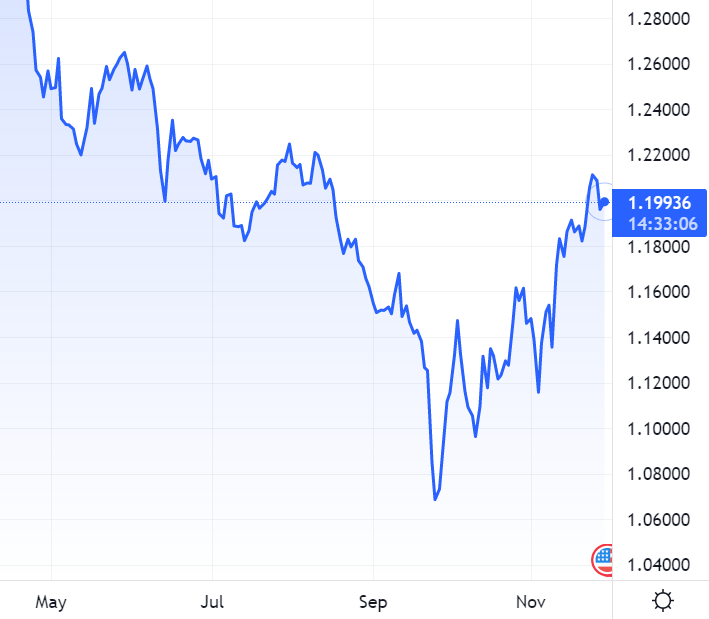
GBP/USD cuts back on hawkish Fed comments – tradingview.com
After cutting back 1.5% from yesterday’s intraday highs, the EUR/USD pair opened this morning at 1.034 and has since inched upwards to 1.035.
It should be noted that European Central Bank president Christine Lagarde also made some hawkish comments to the European Parliament yesterday, even if today’s consumer price index readings from Spain and Germany are expected to see a reduction in prices.
Today’s mortgage approvals data should shed some light on the UK’s struggling housing market.
FTSE 100 expected to open slightly higher this morning despite heavy falls in the US as the Hang Seng rebounded sharply after yesterday’s falls as China reported its first fall in Covid cases since 19 November.
Spread betting companies are calling the lead index up by around 18 points.
US markets endured a tough day with all three major indices closing sharply lower as the fall-out from the Covid protests in China unsettled sentiment.
At the close the Dow Jones Industrial Average slumped 497 points, or 1.45%, to 33.850, the S&P 500 dropped 62 points, or 1.54%, to 3,964 and the Nasdaq Composite fell 177 points, or 1.58%, to 11,050.
Back to London and investors will be eyeing further data on the strength of the housing markets with today’s mortgage approval numbers predicted to fall to 60,000, their lowest levels since June 2020.
Results are also expected from easyJet PLC, Greencore Group PLC (LSE:GNC) (Greencore Group PLC (LSE:GNC)), Marstons PLC, Redrow PLC (LSE:RDW) (Redrow PLC (LSE:RDW)) ,and Treatt PLC amongst others.