
- FTSE 100 closes down 19 points
- IAG down on travel worries
- Retailers fall after inflation data
4.49pm: FTSE finishes in red
FTSE 100 closed in the red mid-week as the shine appeared to come off the recent risk rally.
Britain's blue-chip benchmark closed down around 18 points, or 0.25%, at 7,351.
"Stocks have pushed to the downside in lacklustre trading, as the positive momentum established by last week’s CPI figure disappears," noted Chris Beauchamp, chief market analyst at IG.
"This may well only be a temporary development, and the gains of the past week or so certainly suggest that the market is in a mood to push higher into the end of the year.
"While not exactly beating the drum on a pivot, Fed speakers have not been too zealous in talking about the need for higher rates, thus helping to avoid a resumption of the downtrend in equities for now," he added.
3.45pm: Consumer stocks help push leading shares lower
Leading shares are off their worst level heading into the close, but still just about in the red following the hefty rise in UK inflation.
The FTSE 100 is down 9.95 points or 0.14% at 7359.49 after earlier falling to 7341.
Providing some support are The Sage Group PLC (LSE:SGE) and Experian (LSE:EXPN), up 6.99% and 4.07% respectively following their results.
The geopolitical tension following a missile killing two people in Poland has helped push BAE Systems PLC (LSE:BA.) up 3.68%.
But the growing cost of living crisis has left retailers lower, with Ocado Group PLC (LSE:OCDO) falling 6.49%.
Signs of a weaker housing market has seen Rightmove PLC (LSE:RMV) lose 4.56%.
And British Airways owner International Consolidated Airlines Group SA (LSE:IAG) is down 4.6% on concerns the situation in Poland could put people off travelling again.
Michael Hewson, chief market analyst at CMC Markets UK, said: "European markets have struggled today, opening lower on the back of the reports of the two Russian missiles which crash landed in Poland, and killed two people in the process. It quickly became apparent the incident wasn’t a deliberate act, and the explosion was likely caused by a Ukrainian air defence missile, that was launched in response to a Russian missile attack.
"Despite the clarification from the Polish President, as well as NATO, tensions have remained high with concerns over an escalation still very much front of mind.
"A higher-than-expected UK inflation number was also a reminder if any were needed that continued sticky inflation was likely to be a significant drag on future earnings potential, not only in the UK, but also in Europe where it is just as high, and in a lot of cases much higher."
Elsewhere Bank of England governor Andrew Bailey has told a Treasury committee any recession is a bad one but the forthcoming downturn is not expected to be deep by historic standards.
He said the Bank had commented that interest rates were not likely to rise as much as the market expected because the was "a UK risk premium built into the markets."
That premium - which involved the surge in UK borrowing costs following the chaotic mini-budget - was too high and not consistent with the Bank's view of the situation.
Bailey - who caused controversy earlier this year by saying workers should not seek large pay rises despite surging inflation - told the committee he would not take a rise if offered.
Still, his base salary last year was £495,000 so that may not be the biggest sacrifice ever made.
3.06pm: UK tenants facing rising rents
Back with the UK cost of living crisis, and it is not just mortgage holders who are feeling the pain.
Private rental prices paid by UK tenants rose at their fastest pace for six years and in England, the most since the ONS started collecting data in 2006.
NEW
ONS says rents are rising at the fastest rate since it began collecting data on them (which was 2006 for English data, 2016 for UK as a whole).
Up 3.6% over past yr in UK, 3.7% in Eng.
A reminder that it is not just those with mortgages being squeezed right now - far from it. pic.twitter.com/nLBYrR9nf2
— Ed Conway (@EdConwaySky) November 16, 2022
2.53pm: Target shares fall after profit decline
Shortly after the opening bell, the Dow was up 20 points, less than 0.1%, while the Nasdaq Composite slid 77 points, 0.7%, to 11,281 and the S&P 500 declined 10 points, 0.3%, to 3,982.
Shares of Target Corporation (NYSE:TGT) (Target Corporation (NYSE:TGT)) are dragging on S&P 500 in early trading. The retailer's stock is down about 15% after the company reported a third-quarter profit decline of roughly 50% and warned of a slower holiday season.
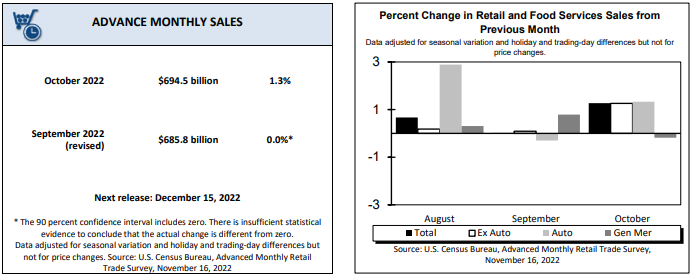
Investors also reacted to the better than expected retail sales data which showed advanced sales for October increased 1.3%. Excluding autos, the figure was also 1.3%, ahead of expectations of 0.6%.
That builds on better-than-expected producer price index data for October, which sparked a market rally on Tuesday, but those gains may be short-lived, said Adam Sarhan, CEO of 50 Park Investments.
“In the short term, the market is very extended and overdue to pull back and digest the recent rally,” Sarhan said, as reported by CNBC.
Back in the UK and the FTSE 100 has slipped further, and is now down 20.82 points or 0.28% at 7348.62.
1.47pm: US retail sales rise
US retail sales have come in stronger than expected, adding another wrinkle to the question of how much the Federal Reserve will raise interests by.
October sales rose by 1.3% compared to expectations of a 1% increase. This was the biggest increase in eight months.
US Retail Sales Advance (M/M) Oct: 1.3% (est 1.0%; prev 0.0%)
- US Retail Sales Ex Auto (M/M) Oct: 1.3% (est 0.5%; prev 0.1%)
- US Retail Sales Ex Auto And Gas Oct: 0.9% (est 0.2%; prevR 0.6%)
- US Retail Sales Control Group Oct: 0.7% (est 0.3%; prevR 0.6%)
— LiveSquawk (@LiveSquawk) November 16, 2022
12.30pm: Mid-cap index underperforms
The FTSE 100 remains marginally lower - down just 7 points - but the FTSE 250 has fallen further.
The mid-cap index is 1.8% lower at 19,101.27, with cruise company Carnival PLC (LSE:CCL) leading the decline as it unveiled a US$1bn convertible note offering.
Airlines also continued to be weak on concerns an escalation of tensions after a missile fell on Poland would deter travellers.
easyJet PLC (LSE:EZJ) is down 5.18% while Wizz Air Holdings PLC (AIM:WIZZ) has lost 5.04%.
Marks and Spencer Group PLC (LSE:MKS) has fallen 4.97% after a downbeat note from JP Morgan.
But software company Kainos Group PLC (LSE:KNOS) has climbed 6.45% to 1534p after Berenberg raised its rating from hold to buy and its price target from 1200p to 1700p.
11.50am: US investors wary after missile lands in Poland
US stocks are expected to open flat as the cheer over easing inflationary pressures is likely to be offset by rising geopolitical worries arising from missiles landing within the borders of NATO-member Poland.
Futures for the Dow Jones Industrial Average were flat in pre-market trading, while those for the S&P 500 were little changed, and contracts for the Nasdaq-100 rose 0.1%.
“US stocks extended their rally yesterday, as the unexpected easing in producer prices beefed up the optimism that the Federal Reserve would soften the monetary tightening and the better-than-expected New York Empire State Manufacturing index hinted that the US economy is holding up well,” noted Ipek Ozkardeskaya, senior analyst at Swissquote Bank.
Investors reacted positively to the latest producer price index report, a measure of wholesale inflation, which rose 0.2% in October, lower than the 0.4% rise expected. The softer data came on the heels of last week’s easing in the consumer price index for October.
Some of the cheer from the economic data is expected to continue into trading on Wednesday.
“News that ... missiles fell to Poland somehow killed a part of that falling-inflation, resilient growth optimism. But escalation of tensions have been avoided so far,” said Ozkardeskaya.
Notably, however, the escalation in hostilities led energy prices higher. “US crude gained on the geopolitical concerns after the Poland attack, and on a more-than-5-million-barrel decline in US oil inventories last week,” said Ozkardeskaya.
Taiwan Semiconductor Manufacturing is expected to stay in focus after the stock shares jumped over 10% on news that Warren Buffet’s Berkshire Hathaway took an around $5bn stake in the company.
“Investors concluded that Buffet thinks that the selloff may have hit a bottom after a nearly 60% dive since the beginning of the year, which wiped out $250 billion in value, said Ozkardeskaya.
On the economic data front, focus will be on US retail sales figures for October.
Back in the UK, the FTSE 100 has slipped back a little and is now down 3.61 points at 7365.83.
11.35am: Food and Drink Federation seeks government help to combat inflation
The Food and Drink Federation has called for government help to combat rising food price inflation, including cutting the cost of trade with the European Union.
Chief executive Karen Betts said: "Food and drink price inflation continued its worrying upward trend in October, hitting 16.4% in the ONS figures out today.
“Manufacturers continue to do what they can to contain price rises for shoppers, and we are very conscious of their impact on low income households in particular. But on average manufacturers have seen a 21% rise in their costs over the past year, with the high cost of energy particularly significant. This has meant that some costs are having to be passed onto consumers.
"Government could help ease these pressures by reducing the costs of doing business, for example through simplifying regulation, reducing the cost of trade with the EU, and helping companies to invest in growth, innovation and skills through tax incentives. To that end, we’re looking forward to seeing what measures the Chancellor will set out in his Autumn Statement tomorrow.”
With food inflation now at 16.4% ???? It is vital the Government supports #FoodAndDrink businesses in the Autumn Statement ????
Read Karen’s full statement ???? https://t.co/6l7MStxocI pic.twitter.com/i81OZ0JRi2
— Food and Drink Federation (@Foodanddrinkfed) November 16, 2022
10.55am: Long wait for inflation to hit target - UBS
UK inflation will not fall to the Bank of England's 2% target until at least the end of 2025, according to Anna Titareva at UBS Investment Bank.
She said: "Taking into account today's upside surprise, we now expect inflation to average 9.1% in 2022, 5.9% in 2023 and 2.3% in 2024 before returning to the 2% target only by end-2025. Overall, we think the risk to inflation remains skewed to the upside. While tighter fiscal policy implies some downside risks, uncertainty around energy and food prices and wage pressures imply upside risks to inflation...
"Today's inflation print has likely come as a moderate upside surprise to the BoE as well, with the MPC expecting October inflation to rise to "almost 11%". A combination of higher services inflation and another solid wage growth print is also likely to be of concern for the Committee amid its focus on inflation persistence. Overall, we continue to expect the BoE to deliver another 150bp of hikes, taking Bank Rate to 4.5% by March 2023.
"However, we reiterate that risks to the pace of rate hikes (75bp vs 50bp in December) and the level of the terminal rate appear to be skewed to the downside amid a weaker economic outlook and likely more fiscal tightening. The next key signpost will be the autumn fiscal statement tomorrow."

10.25am: UK house prices unchanged month on month in September
More downbeat UK economic news, this time on the housing market.
UK house prices were unchanged from August to September at £295,000, according to the latest figures from the Office for National Statistics.
The annual increase was 9.5%, down from 13.1% in August. But last September prices rose sharply as people rushed to take advantage of the stamp duty holiday.
Average house prices increased over the year by:
▪️ 9.6% England to £314,000
▪️ 12.9% in Wales to £224,000
▪️ 7.3% in Scotland to £192,000
▪️ 10.7% Northern Ireland to £176,000 pic.twitter.com/QSIJPkbXBu
— Office for National Statistics (ONS) (@ONS) November 16, 2022
Jonathan Hopper, chief executive officer of Garrington Property Finders, said: "Monthly house price rises evaporated entirely in September after the disastrous, short-lived mini-Budget sent interest rates soaring and shockwaves through the property market.
“Gone are the days of house values marching thousands of pounds upwards every month. The official ONS data shows the price of an average home stagnated in September, but on the front line we saw prices begin to fall in many areas.
“At 9.5%, the annual rate of price growth still looks implausibly high. But it does at least give a measure of how fast things are changing. Just two months ago it stood at 15.2%, and the coming months are set to see it fall further as the market enters a period of intense rationalisation."
10.05am: Poland missile reports send airlines lower
Following the reports of a missile hitting Poland - whether from Russia or not - have left airlines lagging.
Wizz Air Holdings PLC (AIM:WIZZ) is down 4.95%, easyJet PLC (LSE:EZJ) has fallen 4.54% and British Airways owner International Consolidated Airlines Group SA (LSE:IAG) has lost 3.59%.
Neil Wilson at Markets.com said: "Some airlines are getting offered on [the missile reports] with Wizz Air and EasyJet falling about 5% presumably on fears that it might tamp down demand for flights to Eastern Europe."
But BAE Systems PLC (LSE:BA.) is up 3.01% while BP PLC (LSE:BP.) has added 1.93% and Shell PLC (LSE:SHEL, NYSE:SHEL) 1.6%.
AJ Bell investment director Russ Mould said: "“Defence firm BAE Systems was among the top FTSE 100 risers as investors chewed over a possible escalation of the conflict. Index heavyweights BP and Shell were also higher as oil prices rose on the latest developments."
BAE has also been helped by a buy note from analysts at Deutsche Bank following its update this week. They said: "Operational performance remains strong, despite a few headwinds. We raised estimates by 2% on average and upped our price target from 970p to 1,000p, confirming our buy rating."
Overall the FTSE 100 is up 12.22 points or 0.17% at 7381.66.
The mid-cap FTSE 250 index is lower, however, down 1.28% at 19,206.35.
9.25am: Footsie remains positive
Leading shares remain in positive territory, just about, despite the worse than expected inflation figures.
The FTSE 100 is up 9.23 points or 0.13% at 7378.67.
Meanwhile the pound has slipped back, even as the Bank of England is expected to continuing raising interest rates for the foreseeable future.
It has dipped 0.08% to US$1.1873 after a strong rise on Tuesday.
Against the euro it is down 0.53% at €1.1409.
Joshua Raymond, director at online investment platform XTB.com, said: "The instant market reaction to the inflation data was some selling in the pound..
"First, we know the Bank of England is indicating that it doesn't believe it needs to raise interest rates much higher to curb inflation. As such, we need to see inflation rise even higher to change rate hike expectations and that would boost the pound.
"Secondly, UK growth expectations continue to be dampened and that also weakens demand for the British pound.
"Thirdly, many investors are stepping back and waiting for tomorrow's Autumn Statement before making further moves in the pound and so we are likely to see much more sterling volatility tomorrow."
Back with blue chip index, and The Sage Group PLC (LSE:SGE) remains the biggest riser, up 5.24% following its strong full year results.
BAE Systems PLC (LSE:BA.) has climbed 3.68% as geopolitical tensions increase after Russian missiles reportedly hit Poland.
BP PLC (LSE:BP.) has added 2.11% and Shell PLC (LSE:SHEL, NYSE:SHEL) 1.77% as crude edges higher, with Brent up 0.2% at US$93.92.
But with households facing a surge in prices which is likely to curtail their spending, retailers are among the fallers.
JD Sports Fashion PLC (LSE:JD.) is down 2.26% and B&Q owner Kingfisher PLC (LSE:KGF) has lost 2.24%.
Still with retail, and there are some US figures due later.
Michael Hewson, chief market analyst at CMC Markets UK, said: "While retail sales in the UK have been uniformly dire this year, the consumer in the US has been much more resilient despite similar price pressures, although the spikes seen in natural gas prices in the US have been nothing compared to those being seen in the UK and Europe.
"This is due to the US having in its own source of natural gas in the form of shale which has kept prices reasonably low, and not impacted on consumer demand by anywhere near as much.
"In September retail sales came in unchanged, while the previous month was revised up to 0.4%.
"Today’s October numbers are expected to come in at 1%, which appears to show that despite rising prices, consumers still have the appetite to spend money."
9.00am: Inflation data paints different picture for consumers and businesses
The inflation figures seem to tell two different stories, according to Victoria Scholar, head of investment at interactive investor.
She said: "The first is that inflationary pressures continue to take their toll on the consumer as gas, electricity and food in particular add to the cost-of-living with CPI outpacing expectations. The rising cost of essential items means poorer families are unfairly getting hit harder, with the inflation gap between high and low-income households reaching the widest since March 2009.
"However for businesses, the picture looks more rosy. Producer input prices and factory gate rises appear to be showing an encouraging trajectory, slowing month-on-month with downward contributions from metals, crude oil, and chemicals. PPI has now slowed for the third month in a row. "
8.53am: Dilemma for the Bank of England
With recession looming and inflation surging, the Bank of England is facing a tricky time.
Susannah Streeter, senior investment and markets analyst at Hargreaves Lansdown, said: "This is difficult reading for Bank of England policymakers, as inflation is clearly proving sticker than they forecast. They are now likely to vote for another rise in interest rates at the December meeting, although expectations of another super-size hike still remain lower.
"So, a rise of 0.5% is on the cards next month with more to come with rates forecast to rise to around 4.5% - 4.75% by the middle of next year. With a two-year recession looming, and unemployment already rising slightly to 3.6%, deflationary pressures are set to emerge. Lower gas and grain prices on international exchanges should also feed through as long as the Russia situation does not deteriorate. The risk is that if the Bank squeezes monetary policy too tight, the recession could be deeper."
Economist and former member of the Bank's monetary policy committe Andrew Sentance also believes rates could go much higher:
Really shocking inflation numbers today. CPI 11.1 percent. RPI 14.2pc. Factory gate prices 14.8pc. Hard to see interest rates of 3-4 percent being high enough to quell this inflation surge when even exc food and energy inflation is 6.5pc - more than 3x 2pc target!
— Andrew Sentance (@asentance) November 16, 2022
8.41am: Poor suffering most from higher inflation
Poorer households are being hit hardest by the surge in inflation, says the ONS.
This is because they spend more of their income on energy and food, the two areas where prices have risen the most.
The inflation gap between high- and low-income households is the largest since March 2009.
CPIH annual inflation was 10.5% for low-income households and 9.1% for high-income households in the year to October 2022 – a gap of 1.4 percentage points.
— Office for National Statistics (ONS) (@ONS) November 16, 2022
8.23am: Footsie edges higher as investors take inflation news in their stride
Leading shares have shrugged off the higher than expected UK inflation figures and growing geopolitical tensions after reports that Russian missiles had landed in Poland killing two people.
Contrary to expectations, the FTSE 100 is up 17.46 points or 0.24% at 7386.90.
Analysts said there were some positive signs for business in the inflation figures, with producer input prices and factory gate rises slowing month on month.
Raw material inflation eased, including crude oil and petrol prices.
The Sage Group PLC (LSE:SGE) is the biggest riser in early trading, up 3.33% following its results.
Meanwhile BAE Systems PLC (LSE:BA.) has climbed 2.3%, amid the concerns over the latest developments in Russia's war on Ukraine.
7.57am: Sterling indecisive following runaway inflation data, euro gains on dollar
UK inflation data knocked forecasts out of the part with another 2% jump in October, bringing the yearly rate to a 40-year high of 11.1%.
Energy prices were the primary culprit, so one silver lining was the core inflation rate – which excludes energy and food prices – came in slightly lower than forecast at 6.5%.
Combined with yesterday’s hot labour market data, we have a potent mix that will probably drive hawkish policy from the Bank of England, even though the BoE insisted that rate hikes will be less aggressive in the months to come.
Sterling seems unsure how to react to all of this; Cable has cut back 0.2% this morning, after reaching three-month highs of US$1.174 in yesterday’s session.
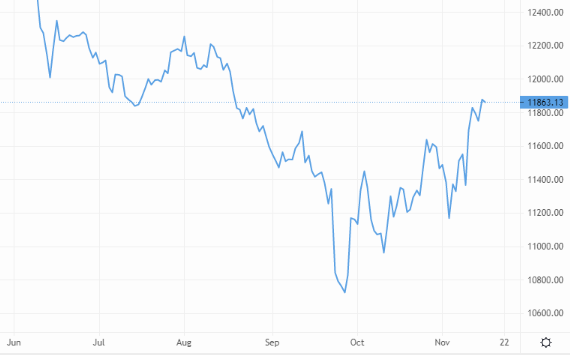
GBP/USD eyes up August highs – Source: capital.com
But that could be down to a generally weaker greenback- the US Dollar Index (DYX) is inversely at three-months lows of 105.95 as investors turn riskier equities bets
The euro added 44 bps against Sterling this morning after ceding over 70 bps yesterday, in pretty typical fashing for the ranging EUR/GBP which is changing hands at 87.57p right now.
GBP/JPY is sitting at 165.55 while GBP/CHF is at 1.119.
Eurozone employment and GDP data marked an expected deceleration in the economy, yet the euro’s recovery against the dollar seems like it’s keeping pace, even if
Now trading at US$1.038, EUR/USD is steadily approaching July highs.
7.46am: Could inflation have peaked?
The surge in inflation comes a day ahead of Jeremy Hunt's Autumn Statement, which is likely to see spending cuts and tax rises.
But Alpesh Paleja, CBI lead economist, believes there is a chance the cost of living crisis may have peaked.
He said:“Despite the higher energy price cap pushing inflation to another high, there are signs that we are reaching its peak. Global price pressures appear to be easing, and forecasts predict that inflation could fall from double digits to high single digits over the course of 2023. Next year’s outlook, however, is clouded by uncertainties: including the extent to which the labour market will loosen, and the status of domestic energy bills support beyond April 2023.
“High inflation, alongside a weaker economic outlook, will make for some tough choices for the Chancellor during tomorrow’s Autumn Statement. While we all accept that the Chancellor needs to close the fiscal black hole and reinforce macroeconomic stability, he must not forget to implement more pro-growth policies, if we’re to avoid a decade of lacklustre growth.”
Jonathan Moyes, head of investment research at the Wealth Club, said: “With US inflation showing signs of softening last week, there would have been many looking at today’s release hoping to see something similar for the UK. These hopes have been dashed.
"Today’s inflation number was a full 1% higher than just a month ago. Food and energy remain the key drivers of the UK’s inflation problem.
"A bright spot might be that fuel prices have begun to soften, with petrol a notable negative contributor to inflation over the month. The pound has also been far stronger in recent weeks, helping to lower the cost of imports.
"However, all in all, this was not an announcement for the optimists."
7.34am: Inflation hits four decade high
UK inflation has hit a 41 year high of 11.1% in October, much higher than the expected figure of 10.7% and well above the Bank of England's 2% target.
Higher energy bills pushed the annual inflation rate up from 10.1% in September, and puts more pressure on the Bank to raise interest rates further.
The Office for National Statistics said the figure would have been 13.8% without the energy price cap.
Rising food prices also contributed to the increase, with food inflation of 16.4% the highest since September 1977.
Grant Fitzner continued: (2/3)
— Office for National Statistics (ONS) (@ONS) November 16, 2022
7.00am: FTSE 100 seen lower ahead of inflation figures
FTSE 100 is expected to open lower ahead of an inflation reading for the UK and a day before the chancellor Jeremy Hunt unveils his autumn budget.
Spread betting companies are calling the lead index down by around 20 points.
Geopolitical concerns may also unsettle sentiment following the news that a stray Russian missile had crossed into Poland killing two people.
The news took some of the steam out of another strong market rally in the US which followed weaker than expected PPI numbers which boosted hopes that inflation was being tamed meaning the Fed may slow the pace of interest rate increases.
At the close the Dow Jones Industrial Average was up 56 points, or 0.17%, to 33,592, the S&P 500 rose 34 points, or 0.87%, to 3,992 and the Nasdaq Composite jumped 162 points, or 1.45%, to 11,358.
In London, investors will also have a hefty batch of corporate and economic data to digest.
UK inflation numbers will give an indication as to the challenge faced by the Bank of England while on the corporate front results are due from Sage Group PLC, British Land Company PLC (LSE:BLND), Castings PLC (LSE:CGS), CMC Markets PLC (LSE:CMCX) and Experian (LSE:EXPN) PLC.