
Riversgold Ltd (ASX:RGL) will this week start a deep ground penetrating radar (DGPR) survey at the Tambourah Lithium Project in Western Australia’s Pilbara region with the aim of identifying additional pegmatites for drill testing.
DGPR has been proven by Riversgold during a trial survey at Tambourah earlier this year to be an effective technique for targeting pegmatites and gaining a better understanding of their subsurface expression.
Outcrops identified
This initial survey focused on the Ragdoll/Lion and Bengal prospects in the northwest corner of the main tenement where a number of lithium-bearing pegmatite outcrops were identified through mapping and sampling.
The new DGPR survey will expand Tambourah fieldwork further into the ‘Goldilocks Zone’, beyond areas in which pegmatites express at surface.
“To be of significant help”
Riversgold chief executive officer Julian Ford said: “Our focus to date has been on the northwest corner of the main tenement, where outcropping pegmatites have been identified.
"This is only a small portion of a 16-kilometre corridor running through the tenement that we believe is fertile for large lithium-caesium-tantalum (LCT) systems.
"Based on its effectiveness to date, we expect DGPR to be of significant help in determining which parts of the corridor to concentrate our exploration efforts.”

The previous survey increased the number of interpreted lithium-bearing pegmatites from 12 to 40, while the total strike length of interpreted lithium-bearing pegmatites more than doubled from ~1.3 to ~2.7 kilometres.
A maiden reverse circulation (RC) drilling program launched at Tambourah in late October intersected a 13-metre pegmatite interval with spodumene at depth below the weathering.
The surface expression of this intercept was limited lepidolite-bearing pegmatite outcrops, the full size of the pegmatite was suggested by the DGPR anomaly.
Assays are awaited from this program.
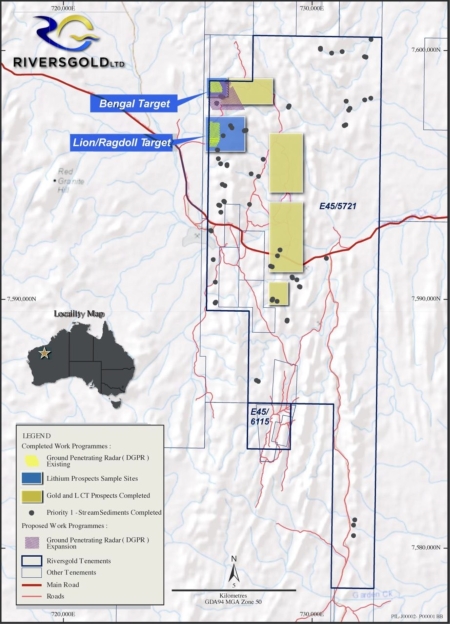
Relative location of new DGPR area.
Bengal is next target
At Bengal, previously identified subsurface potential lithium-rich pegmatites were followed up with mapping and ground truthing. For two of these targets, surface lepidolite outcrops were identified.
The extended DGPR survey at Bengal should help follow the lithium pegmatites at depth.
The new survey will cover a ~1.1 square kilometre portion of the Bengal prospect not included in the initial survey.
A second expanded survey is planned for the Ragdoll and Lion Areas in the first quarter of 2023.
The utilisation of the DGPR as a targeting technique is an important advancement for the company that will be utilised as it expands its detailed exploration footprint deeper into the interpreted greenstones in 2023.
Ultramag Geophysics will start the new survey this week with a planned seven days of data capture, with the processing of data anticipated to take approximately three weeks after data capture.
Drilling campaign
Riversgold’s expanded Tambourah drill program is set to continue through to the end of the year.
"In the meantime, the company is making plans to drill through to year-end – weather permitting,” Ford added.