
- FTSE 100 closes lower after bright start,
- UK GDP falls 0.2% in quarter three
- Pound at highest level since August
4.45pm: FTSE closes down
FTSE 100 closed in the red at the week's end as defensive stocks took a hit but generally European markets have had a positive week.
Britain's blue-chip benchmark finished Friday around 57 points down, or 0.78%, at 7,318.
"Yesterday’s excitement around US CPI has faded to an extent, but any suspicion that stocks would turn lower has been countered by the morning reports of China easing back some Covid restrictions," suggested Chris Beauchamp, chief market analyst at IG before the close.
"This has been sufficient to prevent more than modest losses on some indices, with the week ending in a far more optimistic tone. Confident for now that the Fed can walk back some of its most hawkish rhetoric, stocks look well set for additional gains into the second half of November."
3.30pm: FTX crash sparks calls for tougher regulation, Bitcoin price tumbles
The FTX collapse shows that regulators must monitor the crypto space more closely, Naeem Aslam, chief market analyst at Avatrade commented.
“The biggest destruction of wealth has happened today in the history of crypto as FTX files for bankruptcy, leaving its customers hanging high and dry.”
“This is the best time for regulators to come and start tightening up the grip, we can no longer afford to have different privileges for crypto exchanges and the whole space needs to be monitored by the regulators.”
Aslam predicts that bitcoin could continue to slide, if the fall of FTX causes a ‘domino effect’: “As for bitcoin, this is certainly another major set back and this is causing pressure on the price, and the chances are that we may see the price moving toward the 13K level.”
Shares in some crypto-focused companies are also falling following FTX’s bankrupcy filing.
Crypto bank Silvergate Capital are down 5%, while bitcoin miners such as Riot Blockchain (-4%) and Hut 8 Mining (-6.5%) are also taking a hit while the price of Bitcoin went below $17,000.
A year ago, the price of Bitcoin was 69K...#BTC #Bitcoin pic.twitter.com/RyAeUzPmgV
— Stay ???? (@Stay1104) November 11, 2022
3.10pm: FTX starts US bankruptcy proceedings
Crypto exchange FTX is to start US bankruptcy proceedings and chief executive Sam Bankman-Fried is to step down, after a liquidity crisis at the cryptocurrency group that has prompted intervention from regulators around the world.
The distressed cryptocurrency trading platform has been struggling to raise billions in funds to stave off collapse while coming under heightened regulatory scrutiny.
The company said in a statement on Friday, shared via a tweet, that FTX and its affiliated crypto trading fund Alameda Research and approximately 130 other companies have commenced voluntary Chapter 11 bankruptcy proceedings in Delaware.
Press Release pic.twitter.com/rgxq3QSBqm
— FTX (@FTX_Official) November 11, 2022
2.45pm: FTSE little changed as US gives up some of yesterday's gains
Footsie little changed by the US open as markets across the pond make a muted start to the day giving up some of the stellar gains of yesterday.
The strength in the pound against the US$ hit the dollar earners and exporters in the blue chip index seeing London underperform other European bourses.
At 2.45pm the FTSE 100 was down down 31 points but the FTSE 250 continued to soar higher, up 254 points to 19,632.
In the US stocks dipped into the red as investor optimism faded after lower-than-expected CPI data yesterday set off the biggest rally seen since early 2020.
Just after the market opened, the Dow Jones Industrial Average had shed 142 points or 0.4% at 33,574 points, the S&P 500 was down 7 points or 0.2% at 3,950 points, and the Nasdaq Composite dipped 6 points or 0.1% at 11,108 points.
Analysts at ING noted that one CPI did not make a pivot. “For once the US CPI release broke with the bad habit of surprising on the upside and the market was quick to jump on the ‘pivot’ bandwagon,” the analysts wrote in a report.
2.25pm: Pound hits highest levels since August
The pound has hit its highest level against the US dollar since August after the greenback continued to weaken following yesterday’s weaker-than-expected CPI numbers.
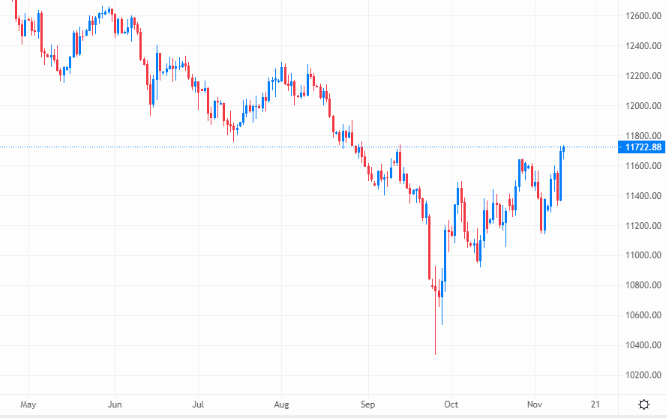
Sterling made its biggest gain since March 2020 against the US currency yesterday after the US inflation numbers suggested the Fed was winning its battle to tame inflation supporting hopes of a lower peak in US rates than expected.
The British currency has extended those gains today trading up 0.25% at US$1.174.
Quite a lot of movement after US inflation came in below expectations yday, so time for a quick
????UPDATE????
- Pound up to $1.18 vs US$. Highest since Aug.
- Markets now pricing in a 4.5% peak in @bankofengland int rates. Down from 4.75% last week.
- Equity markets pretty happy too pic.twitter.com/Hr46ee7qkn
— Ed Conway (@EdConwaySky) November 11, 2022
2.10pm: EC downgrades economic forecasts for 2023
The European Commission has upgraded its forecast for eurozone growth this year, but downgraded the forecast for 2023, citing the impact of the war in Ukraine.
The EC said in its Autumn economic forecast that the bloc will grow 3.2% this year, up from a forecast of 2.7% in July.
However, growth next year is now predicted to slow to 0.3% from a previous forecast of 1.4%.
Inflation, meanwhile, will ease to 6.1% in 2023 from 8.5% this year and to 2.6% in 2024.
"After a strong first half of the year, the EU economy has now entered a much more challenging phase," the Commission said.
"The shocks unleashed by Russia's war of aggression against Ukraine are denting global demand and reinforcing global inflationary pressures.”
The unemployment rate is expected to rise to 7.2% in 2023 from 6.8% this year, before falling back to 7.0% in 2024.
1.40pm: Legal moves to delay Octopus/Bulb deal
Octopus Energy's takeover of bust energy supplier Bulb is facing a delay of as much as three weeks after rivals asked a London court to pause the approval process, according to the Telegraph.
The Government has approved an agreement for Octopus to buy Bulb, which collapsed last year at an estimated cost of £2.2bn to the taxpayer.
Lawyers for the two companies appeared in court today to seek approval for the deal.
However, Scottish Power, Eon and British Gas have all intervened in the court hearing to ask for more time.
David Allison, a lawyer for Scottish Power, sought a three-week delay because it had been "impossible" to get to grips with key documents since the deal was announced in late October.
Lawyers for British Gas told the court there was a "serious lack in transparency" to the process.
But Bulb's administrators said the court needed to allow the deal to go through by November 17, when regulator Ofgem begins its next observation window for wholesale hedging.
12.50pm: BoE Governor says inflation battle could take up to two years
Bank of England governor Andrew Bailey said today that efforts to bring inflation under control were likely to take between 18 months and two years, adding that inflation was "way above where we (want) it to be."
"Inflation is bad for the least well-off generally and this inflation is particularly bad," Bailey said in an interview with Newcastle's The Journal newspaper and its Business Live website.
Bailey said further increases to interest rates were likely in the coming months but said he was hopeful inflation would peak over the winter.
He also praised companies for directing salary rises to the lowest-paid workers.
He said it was "sensible" that firms are "doing more to direct their pay rises."
Mr Bailey told BusinessLive: "I wouldn't direct them to do that, it's not for me to do that but when I talk to businesses, I can understand why they're doing that."
12.00pm: US markets expected to rise further
The FTSE 100 might be struggling but other European bourses are pushing ahead and the US is also set for further gains today..
US stocks are expected to rise on Friday, still enjoying the effects of the softer-than-expected inflation data for October, which propelled the S&P500 to its biggest daily gain since 2020 in Thursday’s trading.
Futures for the Dow Jones Industrial Average were 0.3% higher in pre-market trading, while those for the S&P 500 were up 0.3%, and contracts for the Nasdaq-100 rose 0.5%.
In data out yesterday, US headline inflation fell to 7.7% in October, versus 8.0% expected by analysts and from 8.2% printed a month earlier, stoking expectations that US rate-setters will scale back on further interest rate hikes, having delivered four straight 75 basis point increases so far this year.
“And more importantly, core inflation fell more than expected as well. Plus, there are hints that both headline and core figures could further cool down in the coming months, including falling housing prices, used car, and apparel prices,” noted Ipek Ozkardeskaya, senior analyst at Swissquote Bank.
As inflation is the only thing that matters to the Fed, there was a jaw-dropping repositioning in the markets after the data release, she said, noting that the S&P500 soared 5.50%, Nasdaq surged by 7.50% and the Dow Jones rallied 3.70% on Thursday.
“Equities skyrocketed, the US yields and the US dollar tanked on the expectation that the Fed may be content with a lower end rate to call victory in its fight against inflation.”
“Investors reacted to the latest US inflation data as if a miracle happened. But in reality, US inflation remains very high compared to what the Fed is willing to achieve: the 2% target,” said Ozkardeskaya, adding that the Federal Reserve is still likely to raise interest rates by 50 basis points in December and by two 25 basis points in 2023.
“So, yes, yesterday was a fantastic day, really, but the markets went clearly well ahead of themselves and we will certainly see some correction and consolidation moving forward,” she warned.
Given the outsize reaction to the inflation figures, the University of Michigan’s consumer sentiment index, due for release at 10am ET today, is likely to pass by quietly even if it weakens as expected.
11.30am: Oil prices soar 3%
Oil prices soared over 3% on Friday on hopes that a relaxation of some Covid rules in China would support the economic superpower and lead to increased demand for commodities.
Chinese authorities said that quarantine times would be reduced for inbound passengers and close contacts of Covid-infected people while close contacts of close contacts would no longer be traced.
The new guidelines of China’s National Health Commission mark the first significant easing of the Chinese ‘zero-Covid’ policy, which has weighed on economic activity and fuel demand in the world’s top oil importer this year and has depressed the oil market.
The market warmed to the news with oil prices advancing extending yesterday’s gains.
Brent Crude rose 3% to US$95.79 per barrel while US West Texas Intermediate gained 3.3%, to US$88.65 a barrel.
10.51am: GSK tumbles as UBS cuts rating to sell
Shares in GSK fell 4.77% to 1,341p as broker UBS downgraded the stock to sell and cut its price target to 1,300p from 1,820p.
The broker pointed to two factors posing risks to the earnings base longer term - blockbuster vaccine Shingrix will exhaust its catch-up patient pool in the US around '27 and HIV product dolutegravir faces patent expiry at the same time which it forecast could erode around 20% of revenues.
READ: GSK slapped with 'sell' rating over long-term risks
GSK has received a couple of set-backs already this week with the failure of a key clinical trial for a new bone marrow cancer drug and news today that the second-line applications of its cancer drug will be limited in scope following a request by the US FDA.
10.30am: Chancellor warns of tough road ahead
Commenting after the latest UK GDP figures the chancellor Jeremy Hunt warned of a “tough road ahead” as he blamed the invasion of Ukraine, and Russia’s ‘weaponisation’ of gas suppliers, for hitting growth and pushing up inflation.
Hunt said: “We are not immune from the global challenge of high inflation and slow growth largely driven by Putin’s illegal war in Ukraine and his weaponisation of gas supplies.”
“I am under no illusion that there is a tough road ahead – one which will require extremely difficult decisions to restore confidence and economic stability.”
“We are not immune from the global challenges of high inflation & slow growth largely driven by Putin’s illegal war in Ukraine and his weaponisation of gas supplies”.
Chancellor @Jeremy_Hunt responds to today’s GDP statistics from the @ONS. pic.twitter.com/me9Rt54f59
— HM Treasury (@hmtreasury) November 11, 2022
“But to achieve long-term, sustainable growth, we need to grip inflation, balance the books and get debt falling. There is no other way.”
“While the world economy faces extreme turbulence, the fundamental resilience of the British economy is cause for optimism in the long run.”

10.10am: Heathrow rules out flight caps at Christmas
Heathrow Airport has ruled out flight caps in the run-up to Christmas following a fierce backlash from airlines.
The airport said it now has a "good plan in place" for the peak festive period that will not require a limit on flights.
Heathrow removed a blanket flight cap at the end of last month but warned curbs might be needed during holiday peaks amid continued staff shortages.
That sparked an angry response from airlines, with Virgin Atlantic vowing to resist any further interruption of its services.
A spokesman for the airport said additional recruitment and a clarification of airline schedules meant capacity would now be adequate to meet demand.
Passenger numbers totalled 5.9mln in October, a rise of 93.6% on the same month last year, with traffic now at 84% of pre-pandemic 2019 levels. So far this year, 50mln passengers have passed through the airport, 279.4% more than in the January-October period last year.
9.35am: Burberry rises after strong results from Richemont
Burberry PLC outperformed the market on Friday, rising 3.4%, given a double boost with strong results from Swiss luxury brand Richemont and news that one of its biggest markets China was relaxing some of its Covid rules.
Victoria Scholar, head of Investment, interactive investor pointed out shares rose after Richemont first half adjusted EBIT and sales beat analysts’ estimates.
“Investors are enjoying a more than 20% boost to its share price this morning thanks to the recovery in Asia and strong sales and earnings in its jewellery business” she said.
“Looking ahead, the company is likely to enjoy a strong tailwind from the removal of some of China’s covid lockdown measures, particularly if Beijing continues to ease its restrictions.”
“Plus, the luxury group is relatively well placed to navigate the macroeconomic challenges by passing on additional cost pressures to customers through higher prices with a minimal downside impact on demand” Scholar felt.
9.05am: Prudential tops FTSE risers as China relaxes some Covid rules
FTSE 100 remained in good spirits and has extended its opening gains with Asian focused stocks getting a boost from news that China has relaxed some its strict Covid rules.
This gave equities a further lift after the mammoth gains in the US yesterday after the weaker-than-expected CPI numbers.
Victoria Scholar, head of investment, interactive investor said: “European markets are trading higher thanks to cooler US inflation figures and China easing some of its covid restrictions.”
Stocks to benefit included Prudential PLC (LSE:PRU) which topped the FTSE 100 risers, up 7.2%, while mining companies also advanced, Anglo American up 5.1% and Rio Tinto PLC (LSE:RIO) up 3.7%.
The Hang Seng surged overnight by more than 7.7% after China reduced its quarantine time for international travel by two days, confirming last week’s speculation that Beijing was considering easing some of its strict covid measures.
Burberry Group PLC (LSE:BRBY) was another early riser, up 3.5%, as Richemont’s strong half year update lifted other luxury stocks in its slipstream.
On the downside GSK slipped 2.2% after it said the second-line applications of its cancer drug will be limited in scope.
The front-line use of Zejula, which has been developed to treat epithelial ovarian, fallopian tube, or primary peritoneal cancers, remains unchanged.
The US Food and Drug Administration requested the alteration to the second-line deployment of the product.
8.17am: FTSE opens higher after strong showing in the US
FTSE 100 opened higher on Friday supported by strong gains in US and Asian markets, and despite the latest UK GDP data which suggested the UK economy was on course to head into recession by the end of the year.
At 8.15am the FSE 100 was up 17 points at 7,392 and the FTSE 250 advanced 119 points to 19,496.
US markets leapt following weaker than expected inflation figures which gave hope that the Fed was winning its battle in taming inflation.
The tech laden Nasdaq surged 7.35% with a number of index heavyweights posting double digit gains.
Back in London quarter three GDP fell 0.2%, with a 0.6% decline in September, hit by a fall in manufacturing but this number was better than City forecasts of a fall of 0.5%.
Samuel Tombs, chief UK economist, at Pantheon Macroeconomics said: “The UK economy has slipped to the back of the G7 pack again, beset by more intense headwinds from fiscal and monetary policy, and substantial long-term supply-side damage from Covid and Brexit.”
He noted “The UK also is the only G7 country to have not seen GDP recover fully to its pre-Covid, quarter four 2019 level.”
Looking ahead he forecast a further decline in quarter four.
“GDP in October likely will reverse some of September’s 0.6% month-to-month drop, which was partly the consequence of the lost working day for the Queen’s funeral.”
“But the very low level of demand indicators—the orders index of the composite PMI survey fell to just 46.8 in October, from 48.6 in September—and the extremely low level of consumers’ confidence suggests that GDP likely will fall again in quarter four” he said.
7.52am: GDP numbers point to UK heading into recession
Some reaction to the GDP numbers:
Tom Stevenson, investment director for Personal Investing at Fidelity International commented: “The small decline in economic activity in the July to September quarter means we are almost certainly already in recession and creates a gloomy backdrop to next week’s Autumn statement.”
“The Chancellor will be cutting spending and raising taxes at the start of a prolonged downturn and the measures he will announce will only deepen the slump.”
"The first cut of data for the third quarter show how rising energy and labour market costs, falling consumer confidence and the national mourning period have all weighed on output.”
“A further fall in the last three months of the year will meet the definition of a technical recession - two consecutive quarters of falling output - and kick off what the Bank of England has forecast will be a two-year downturn.”
“On the face of it, this is bad news for investors in the UK stock market. But the news comes as a surprise to no-one and it has already been priced into shares.”
“The UK trades on just nine times expected earnings, compared with 17 times for the US market and investors are rewarded with a dividend yield of more than 4%, twice as high as on the other side of the Atlantic.”
“The economic outlook is poor, but for investors, the turning point will come sooner. Markets don’t wait for the dawn to break; they start to rise at the first hint that better times are on their way. And this could come as early as next year.”
7.15am: Manufacturing leads GDP decline
A bit more on the GDP numbers.
The ONS said in output terms, there was a slowing on the quarter for the services, production and construction industries; the services sector slowed to flat output on the quarter driven by a fall in consumer-facing services, while the production sector fell by 1.5% in quarter three, including falls in all 13 sub-sectors of the manufacturing sector.
In expenditure terms, real household expenditure fell by 0.5% in quarter three 2022, while there were also large positive movements in international trade flows in the third quarter.
Compared with the same quarter a year ago, the implied GDP deflator rose by 5.8%, primarily reflecting higher cost pressures faced by households.
7.05am: UK GDP falls 0.2% in quarter three
UK GDP fell 0.2% between July and September according to the first quarterly estimate from the Office for National Statistics (ONS), better than City forecasts for a decline of 0.5%.
The ONS said GDP fell by 0.6% in September 2022 which was affected by the bank holiday for the state funeral of Her Majesty Queen Elizabeth II, where some businesses closed or operated differently on this day.
GDP fell 0.2% in Quarter 3 (July to September) 2022 with:
▪️ services flat (0.0% growth)
▪️ manufacturing falling 2.3%
▪️ construction growing 0.6%
— Office for National Statistics (ONS) (@ONS) November 11, 2022
ONS director of economic statistics Darren Morgan said: “With September showing a notable fall partly due to the effects of the additional bank holiday for the Queen’s funeral, overall the economy shrank slightly in the third quarter.
“The quarterly fall was driven by manufacturing, which saw widespread declines across most industries. Services were flat overall, but consumer-facing industries fared badly, with a notable fall in retail.”
The ONS said the level of quarterly GDP in quarter three is now 0.4% below its pre-coronavirus (COVID-19) level.
GDP data for August was revised to show a marginal 0.1% contraction compared with an original reading of a 0.3% fall, and GDP in July was now seen as having grown by 0.3%, up from a previous estimate of 0.1%.
7.00am: FTSE 100 seen higher
FTSE 100 is expected to open higher on Friday, extending Thursday's rally after a US inflation reading undershot market expectations sending US markets sharply higher. Asian markets also made strong gains.
Spread betting companies are calling London’s blue-chip index up by around 25 points.
The Dow Jones gained over 1,100 points and the S&P 500 over 5.5% as US markets advanced in spectacular fashion as weaker than expected inflation data sent stocks soaring higher.
The data boosted hope that the Federal Reserve may finally tone down the pace of its rate hikes.
At the close the Dow Jones Industrial Average was up 1,198 points, or 3.69%, to 33,712.21, the S&P 500 surged 207.38 points, or 5.53%, to 3,955.95 and the Nasdaq Composite roared 761 points higher, or 7.35%, to 11,114.15.
Tech stocks that have been hardest hit by the rise in inflation and surging interest rates led the gains. Shares of Amazon surged 12%, Meta leapt 10% and Tesla jumped 7%.
Back in London, al eyes are on the GDP numbers for quarter three which are expected to show the UK economy shrank during July to September.