
Valor Resources Ltd (ASX:VAL) has leveraged geological mapping and geochemical sampling at the Surprise Creek Fault area to extend the near-surface mineralised footprint at Surprise Creek Uranium Project near the Beaverlodge Uranium District in northern Saskatchewan, Canada, to nearly 400 metres of strike length.
“The follow-up program targeting the Surprise Creek Fault prospect has successfully extended the area of uranium mineralisation and given us strong impetus to drill test this target in 2023,” Valor Resources executive chair George Bauk said.
“The known deposits in this part of the Beaverlodge district produced about 57 million pounds of uranium historically, highlighting the potential of this area to yield very significant uranium deposits."
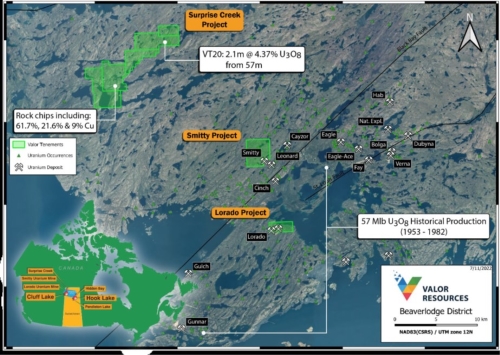
Surprise Creek Project location (Historical production figure sourced from Chi et al, 20203).
This latest round of fieldwork revealed five showings with scintillometer readings of 65,535 cps and several more with more than 10,000 cps.
Scintillometer readings are measured in counts per second (cps) using an RS-125 scintillometer. The results are not directly related to uranium grades of the measured rock sample but rather are an initial indication of the presence of radioactive material.
This supports results from an earlier rock chip sampling program, which returned several assays greater than 1% uranium and peak results of 6.13% uranium and 1.03% copper.
Copper potential in addition to uranium
“Prior to drilling, we plan to complete detailed airborne radiometrics and magnetics across the entire Surprise Creek project area to identify other potential uranium targets as well as enhance our structural understanding to assist with drill planning,” Bauk continued.
“We also plan to follow up known copper occurrences in the southern and western portions of the project, which appear to represent widespread mineralisation in an area where we have very limited geological data.”
Some 50 rock chip samples have been collected across the project so far, including 31 samples from the Surprise Creek Fault target – assays are expected in December.
Geological mapping has confirmed the mineralisation is spatially associated with the Surprise Creek Fault and has also highlighted strong geological similarities to large uranium deposits in the same region.
These indications are particularly promising as the company is targeting structurally-controlled vein-type uranium deposits at Surprise Creek, a sub-type of the basement-hosted unconformity-related uranium deposits.