
Aruma Resources Ltd (ASX:AAJ) has unearthed visible lithium-bearing lepidolite during the second phase of drilling at the Mt Deans Lithium-Rubidium Project near Norseman in the lithium corridor of southeastern Western Australia.
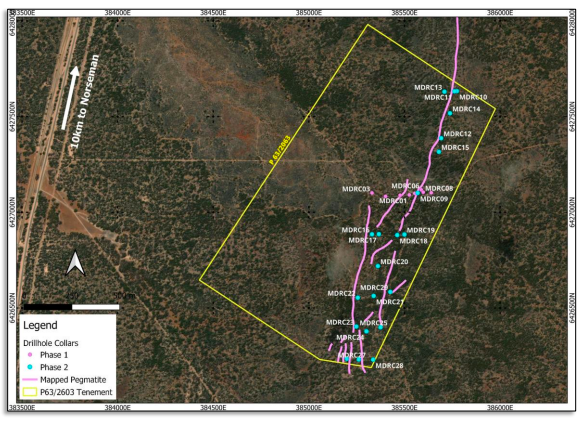
The program, comprising 15 holes for 1,560 metres of reverse circulation (RC) drilling to depths of 80-120 metres, has now been completed.
It was designed to infill and extend the lithium and high-grade rubidium mineralisation defined in Aruma’s first phase of drilling, and in a subsequent rock chip sampling program.
The latest drilling intersected several pegmatites over the entire strike length tested, with visual lithium mineralisation identified as the mineral lepidolite.
Further drilling may be carried out to define the extent of this lithium mineralisation.
Pegmatitic material, including lepidolite, has also been identified in historical drilling spoils preserved in the area. This previous drilling has been mapped and re-sampled for lithium analysis.
Assay results from the program and the re-sampling of previous drilling will be released when available.
Mt Deans RC drilling along the interpreted pegmatite.
About Mt Deans
The 100%-owned Mt Deans Project is in the Mt Deans pegmatite field, within the Eastern Goldfields Terrane of the Yilgarn Craton, about 170 kilometres south of the major regional centre of Kalgoorlie and about 10 kilometres south of the mining town of Norseman.
This project sits within the lithium corridor in southeast Western Australia, which hosts multiple significant hard-rock lithium projects. It is interpreted to sit within the same host rocks and structures as the nearby significant Mt Marion, Bald Hill and Buldania lithium projects.
Aruma completed a first phase of drilling at Mt Deans in April, comprising 1,156 metres of RC drilling in eight holes and targeted the priority Mt Deans ‘main section’. The program delivered encouraging results, including high-grade rubidium and lithium grades of up to 1.14% lithium oxide.
The company followed up this drilling with a rock chip sampling program to test for strike extensions to the interpreted pegmatite zone and to help refine targets for the second phase of drilling.
A total of 11 rock chip samples were collected along a 500-metre strike, returning up to 1.96% lithium oxide and very high-grade rubidium oxide of up to 1.42%, plus caesium values up to 1,550 parts per million.
Phase two drilling has targeted the pegmatite bodies across the 1500-metre strike length of the pegmatite swarm.