
Natural Resources
Comment
8 November 2022
Black and Green
As politicians gear up for COP27 it's increasingly clear they have some work to do to deliver on the rather grandiose pledges they have already made to limit CO2 emissions.
At COP26, 34 countries pledged to end public funding for coal, oil and gas overseas projects. As Rishi Sunak, who has just changed his mind and is now going to COP27, can tell you, credibility is hard won and easily lost.
Clearly governments have a difficult line to tread, on one hand putting in policies, incentives and regulatory frameworks that will deliver the energy transition needed to keep to decarbonisation targets and, on the other, ensuring economic health in the face of global macro headwinds.
These aren’t necessarily mutually exclusive goals over the longer term, but do provide significant challenges in the context of most democratic political cycles.
During a global energy crisis that’s fuelling global inflation and geopolitical instability - caused in part by the warmongering of one of the world’s largest fossil fuel producers, and in part by an overzealous rush to install intermittent renewable electricity supply without consideration for reliability/dispatchability and grid penetration limits - it looks like immediate priorities are trumping longer term climate change goals as cold (literally for some) reality bites.
Three reports published last week highlighted the knots governments are facing in both directions and tying themselves in.
We don’t need much…
On Friday the FT reported that Germany was in danger of reneging on its COP26 pledges as it considers funding gas exploration and development projects in West Africa to replace Russian gas. In their defence Germany’s UN Special Envoy has said they were sticking to their legally binding 2045 GHG targets and were not looking at contracts for gas for more than 15 years.
That’s a bit of an issue. Studies suggest for big fields it takes on average 5.5 years from discovery to first production and then another 17 years to reach peak output. Australia’s Gorgon field took 30 years to get from discovery to production.
Never mind the nagging moral question of quite who should take the gas once Germany has had its fill, like in many metals necessary for the energy transition, there seems to be a misunderstanding of the timelines involved for successful commodity extraction and a timing mismatch between requirement and supply.
Lack of investment in recent years has denuded natural resource development pipelines but windfall taxes on energy companies, however politically and morally tempting, are unlikely to improve the fundamental situation.
…well, maybe a little bit more.
According to a report by Bloomberg New Energy Finance (BNEF) G20 government support for fossil fuels totalled $693bn in 2021, the highest level since 2014.
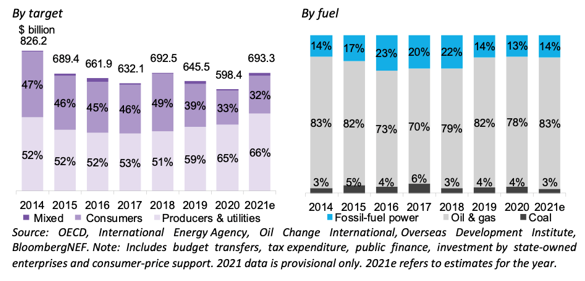
The biggest climate culprit, coal (~45% of fossil fuel related emissions), still attracted $20bn of support although its share continues to shrink as a percentage.
Perhaps unsurprisingly China accounted for the largest share of the support for coal but on a per capita basis it is near the bottom of the G20 list and has been scaling back, unlike Canada and the USA who are going the other way.
This year Germany (and others) have prolonged the life or restarted ageing coal fired power stations to cope with lack of gas coming from Russia and it’s been reported that up to 40 US coal fired plants previously due to be shut will now run for longer.
It seems unlikely that government fossil fuel support in 2022, and possibly 2023, is likely to decrease.
Do as I say not as I do.
In an excellent article last week, the FT’s David Pilling highlighted the problem from the perspective of poorer nations reliant on fossil fuel powered energy generation.
Coal accounts for 85% of South Africa’s electricity generation, which makes it the 13th biggest emitter of CO2 globally.
Some easy emission reduction wins should be possible especially given the relatively small size of its population and the natural attributes which make the potential for solar and wind some of the best globally (albeit geographically in the wrong parts of the country for the existing transmission network).
But as a country it needs financial assistance and time to achieve it, particularly given the numbers employed in the industry.
South Africa submitted a GHG emission reduction plan at COP26, which included a substantial shift away from coal power generation. The UK, EU and USA responded with $8.5bn of pledged help.
Arguments over the money have ensued (it turns out large parts are loans & guarantees rather than grants), the state power generator Eskom is still in trouble and burning poor quality coal and South Africa continues to suffer load shedding.
As South Africa rightly points out, the wealthy donors have been virtue signalling in their pronouncements whilst busily reopening their own coal mines and importing the best quality coal from South Africa at three times the price of SA domestic coal.
Charlie Cryer
Head of RFC Ambrian London
+44 (0)20 3440 6834
charlie.cryer@rfcambrian.com
Copyright © 2022 RFC Ambrian Limited, All rights reserved.
This document has been approved under section 21(1) of the FMSA 2000 by RFC Ambrian Limited ("RFC Ambrian") for communication only to eligible counterparties and professional clients as those terms are defined by the rules of Financial Conduct Authority. Its contents are not directed at retail clients as RFC Ambrian does not provide investment advisory services to retail clients.
RFC Ambrian publishes this document as non-independent research which is a marketing communication under the Conduct of Business rules. It has not been prepared in accordance with the regulatory rules relating to independent research, nor is it subject to the prohibition on dealing ahead of the dissemination of investment research. It does not constitute a personal recommendation and does not constitute an offer or a solicitation to buy or sell any security. Neither RFC Ambrian nor any of its directors, officers, employees or agents shall have any liability, howsoever arising, for any error or incompleteness of fact or opinion in it or lack of care in its preparation or publication; provided that this shall not exclude liability to the extent that this is impermissible under the law relating to financial services. All statements and opinions are made as of the date on the face of this document and are not held out as applicable thereafter. This document is intended for distribution only in those jurisdictions where RFC Ambrian is permitted to distribute its research. In particular, it is not intended for distribution in and is not directed as persons in the United States.
On the date of this document, RFC Ambrian, RFC Ambrian's holding company, persons connected with it and their respective directors may have a long or short position in any of the investments mentioned in this document. RFC Ambrian is a member of the London Stock Exchange and is regulated and authorised by the Financial Conduct Authority. RFC Ambrian is registered in England and Wales no. 4236075. Its registered office is at Octagon Point, 5 Cheapside, London EC2V 6AA.
NOTICE: The information in this e-mail message is confidential and may also be privileged. It is only intended for the above-named addressee/s. If you are not a named addressee, you must not disclose, copy or take any action in reliance on this e-mail and should delete it from your system. If you have received this e-mail in error, please contact the sender by return e-mail or by telephone +44 (0)20 3440 6800. We believe, but do not warrant that this e-mail and any attachments are virus free. You should take full responsibility for virus checking.